1792 Half Disme Value: The $2,928,000 Record Behind America's First Five-Cent Coin
Coin values · 9 min read · Updated October 23, 2026
A 1792 half disme is worth anywhere from $85,000+ in circulated grades to $2,928,000+ for the finest known example — a PCGS MS68 that shattered the auction record at Heritage Auctions on October 8, 2026. Even the most worn survivors change hands for six figures, making the half disme one of the most valuable American coins ever struck. This guide covers the record sale, the coin's remarkable history, full values by grade, and how to tell a genuine piece from a fake.
The $2.93 Million Sale: What Just Happened
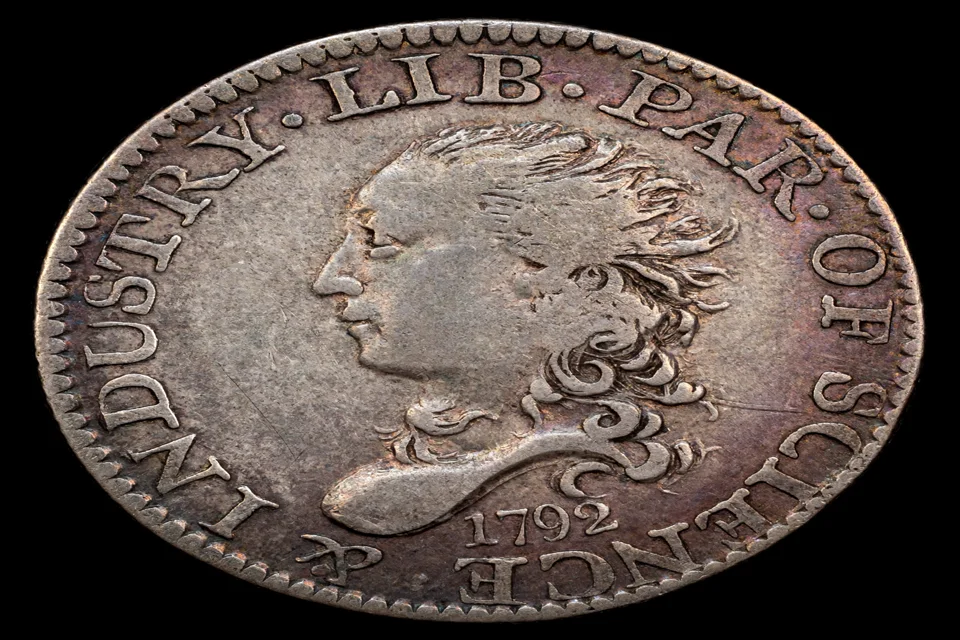
On October 8, 2026, a 1792 half disme graded MS68 by PCGS crossed the block in Heritage's GACC U.S. Coins Signature Auction and rode 66 bids all the way to $2,928,000. The coin came from the Ronald Firman Collection, and it is the only 1792 half disme ever graded MS68 by PCGS — the finest surviving example of the first federal U.S. coin struck for circulation under the authority of the Mint Act of April 2, 1792.
The result more than doubled the previous auction record for any half disme: $1.41 million, set at Heritage in 2013. Heritage's catalog highlighted the record coin's mint luster, exceptional preservation, and natural toning in shades of silver-gray, rose, amber, gold, and blue — the kind of originality that specialists prize above all else. For years, the famous Starr specimen, certified Specimen-67, had been regarded as the standard against which all half dismes were judged. The Firman coin's MS68 grade stands alone at the top of the PCGS population report.
The record-setting coin led Heritage's U.S. coins session to $10,665,743; combined with the auction house's U.S. currency sale that week, the two events generated $19,393,298.
The same sale showed how wide the half disme market runs. A circulated example graded VG10 by PCGS sold for $85,400 in the same auction — proof that even a well-worn survivor of this tiny issue commands a serious price. When a coin's floor sits near six figures and its ceiling just reset near $3 million, every collector wants to know exactly where their example falls.
What Is a 1792 Half Disme?
The half disme (pronounced "deem") was America's first five-cent coin — the direct ancestor of the half dime and, eventually, the modern nickel. Congress passed the Coinage Act on April 2, 1792, establishing the United States Mint and a decimal monetary system. Among the authorized denominations was the half disme, worth five cents in silver.
But the new Mint had a problem: its Philadelphia facility was not ready. President George Washington had appointed David Rittenhouse as the first Mint Director on April 14, 1792, and construction of the Mint building at 7th and Arch Streets did not begin until July 31. Rittenhouse, eager to begin operations, found a workaround. The earliest half dismes were struck in the cellar of Philadelphia saw-maker John Harper, using Harper's own private coin press.
On July 11, 1792, Secretary of State Thomas Jefferson visited Rittenhouse and deposited $75 in silver to be coined. Two days later, Jefferson recorded in his account book: "rec'd from the mint 1500 half dismes of the new coinage." Research suggests the Mint may have struck several hundred more later in 1792, possibly in October, with some pieces saved as souvenirs by Rittenhouse and other Mint officials. Total mintage is generally given as about 1,500 pieces, with some sources allowing up to 2,000.
Rittenhouse had laid the groundwork in a July 9 letter to Washington, seeking approval to coin half cents, cents, half dismes, and dismes from Harper's workshop while the Mint building rose. The striking itself was punishing work. The dies were failing after only a few hundred impressions — die cracks appeared early, and many coins came off the press off-center. That is why a boldly struck, well-centered half disme with clear denticles is so prized today: the press was fighting the dies from the very first day.
Washington acknowledged the effort in his November 6, 1792, address to Congress, describing a "small beginning" in half disme coinage and connecting the issue to the nation's need for small change. Although collectors long grouped the half disme with the experimental issues of 1792, PCGS recognizes it as a regular federal coinage issue — the first circulating coinage produced under the authority of the newly established federal Mint.
Was Washington's Silverware Really Melted for Half Dismes?
One of the most repeated stories in American numismatics holds that the silver for the first half dismes came from George and Martha Washington's own tableware. Adam Eckfeldt, the retired Chief Coiner and the only surviving Mint official who was actually present when the half dismes were made, later related that President Washington deposited $100 in silver bullion for the purpose of coining these pieces. Jefferson's documented $75 deposit on July 11 is the firmest paper trail. The silverware version is popular, but the accounts best support bullion — a small distinction that matters to historians and adds to the coin's legend either way.
Design and Specifications
The dies were engraved by Robert Birch, likely using letter punches supplied by Jacob Bay, a Germantown, Pennsylvania maker of printing types. Researcher Karl Moulton notes the dies were prepared by Jacob Perkins, copied in part from other 1792 dies by Birch and Joseph Wright, with John Harper as die sinker and Henry Voigt as the planchet adjuster and coiner.
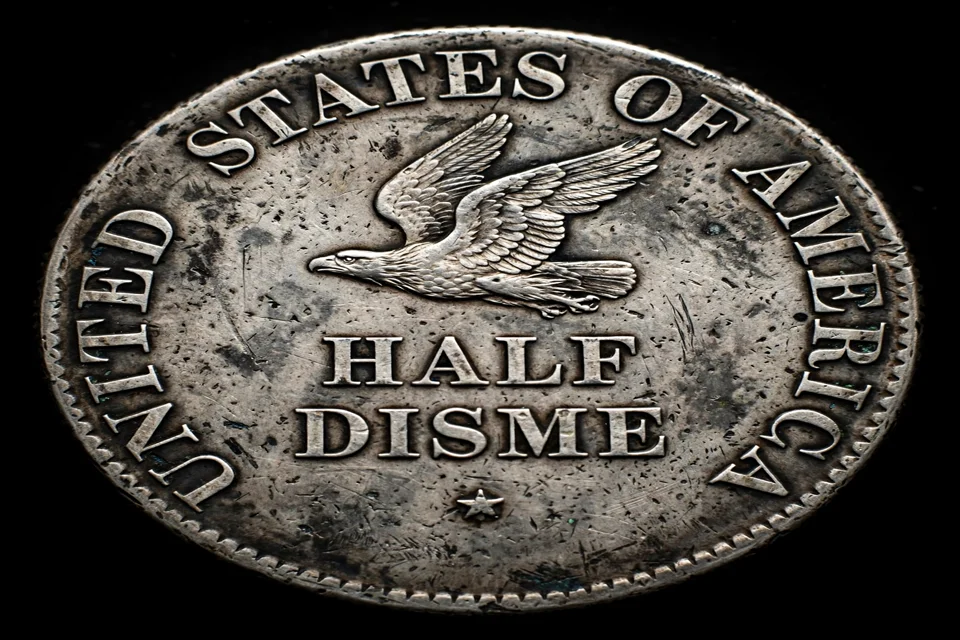
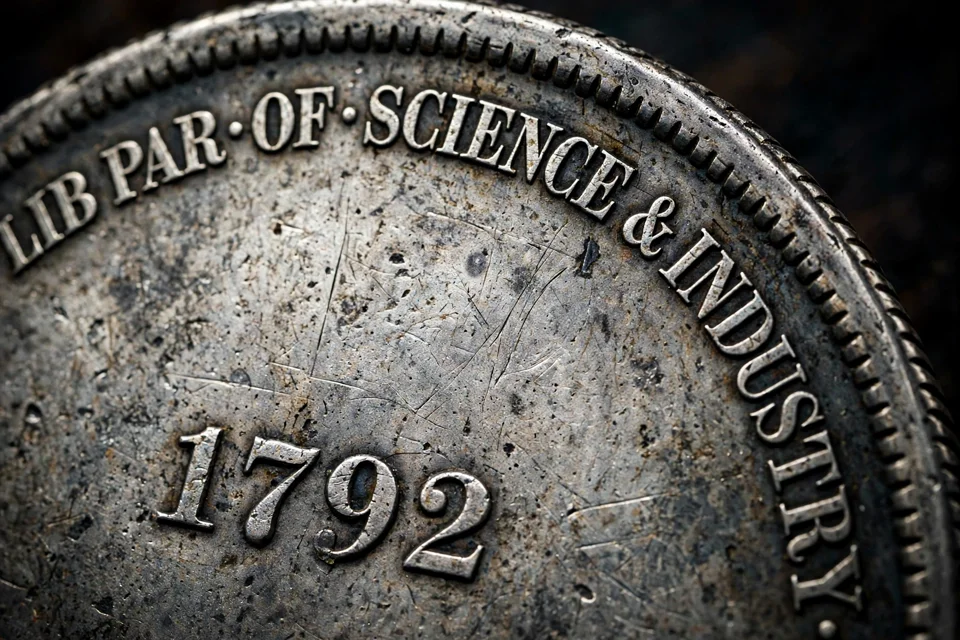
The obverse shows the head of Liberty facing left, her hair flowing behind her, with the date 1792 below the bust. The motto LIB PAR OF SCIENCE & INDUSTRY — "Liberty, parent of science and industry" — encircles the border. The reverse depicts a small eagle with outstretched wings flying left, with the denomination HALF DISME in two lines, a five-pointed star below, and the legend UNITED STATES OF AMERICA framing the eagle.
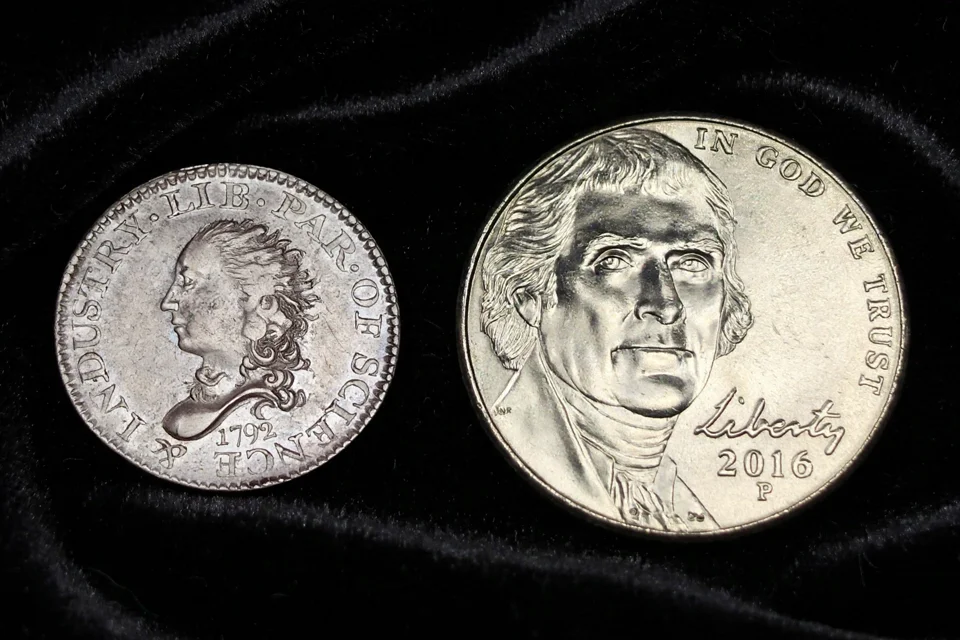
The coin is tiny: about 17.5 millimeters across and just 1.35 grams, struck in .8924 fine silver (89.24% silver, 10.76% copper) with a reeded edge. For comparison, a modern nickel is 21.2 millimeters — the half disme is noticeably smaller in the hand, which is one reason so many were lost over the centuries.
Strike quality varies. The initial striking was difficult: many examples came off-center, dies cracked after only a few hundred strikes, and adjustment marks from planchet preparation are common. Even uncirculated examples rarely show full detail on the eagle's breast or Liberty's hair curls — a sign of a genuine early strike, not wear.
1792 Half Disme Value by Grade
Only about 200 to 400 examples are believed to survive today, and roughly 20 of those are uncirculated. With demand far outstripping supply at every grade level, values start in the tens of thousands and climb steeply. The table below reflects recent market levels, anchored by the October 2026 Heritage results.
| Grade | Estimated Value |
|---|---|
| Good (G-4) | $150,000+ |
| Very Good (VG-8 to VG-10) | $85,000+ (VG10 realized $85,400, Heritage Oct 2026) |
| Very Fine (VF-20 to VF-35) | $300,000–$450,000+ |
| Extremely Fine (XF-40 to XF-45) | $500,000–$700,000+ |
| About Uncirculated (AU-50 to AU-58) | $800,000–$1,200,000+ |
| Mint State (MS-60 to MS-67) | $1,000,000–$1,500,000+ |
| Finest Known (MS68, unique) | $2,928,000 (Heritage, Oct 8, 2026) |
A leading wholesale pricing guide shows a $2.22 million retail value for an MS67, which puts the $2.928 million MS68 result in context: at the very top of the market, each grade point — and each increment of provenance — moves the price by hundreds of thousands of dollars.
A Decade of Climbing Records
The half disme's price history reads like a staircase. The $1.41 million record stood from 2013 until October 2026 — thirteen years in which the coin market's top tier kept grinding higher around it. When the Firman MS68 finally appeared, 66 bidders pushed it past $2.9 million, and Heritage's executive vice president called it a result worthy of the coin's place in the top tier of American numismatics. Records at this level are rarely broken by small margins; each new finest-known example tends to reset the ceiling by a wide gap, because there is simply no substitute for owning the best of the first.
What Makes One Half Disme Worth More Than Another?
Grade and originality. As the table shows, condition drives the price more than almost anything else. Original surfaces with natural antique-silver patina bring strong premiums; cleaned or repaired examples fall sharply.
Provenance. For coins this old, the ownership chain matters enormously. The record coin came from the Ronald Firman Collection, and Heritage highlighted its pedigree. Pieces once held in famous cabinets — Garrett, Eliasberg, Norweb — routinely sell for more than comparable examples without a documented history. Prestigious trails matter.
Strike character. Because the dies failed early and many strikes were off-center, a boldly struck, well-centered half disme with clear denticles commands attention. Adjustment marks are normal for the issue and do not carry the penalty they would on a later coin.
Certification. With six- and seven-figure sums at stake, certification by PCGS or NGC is effectively mandatory. The finest certified example — the unique MS68 — is precisely what drew 66 bids in October 2026.
How to Spot a Fake 1792 Half Disme
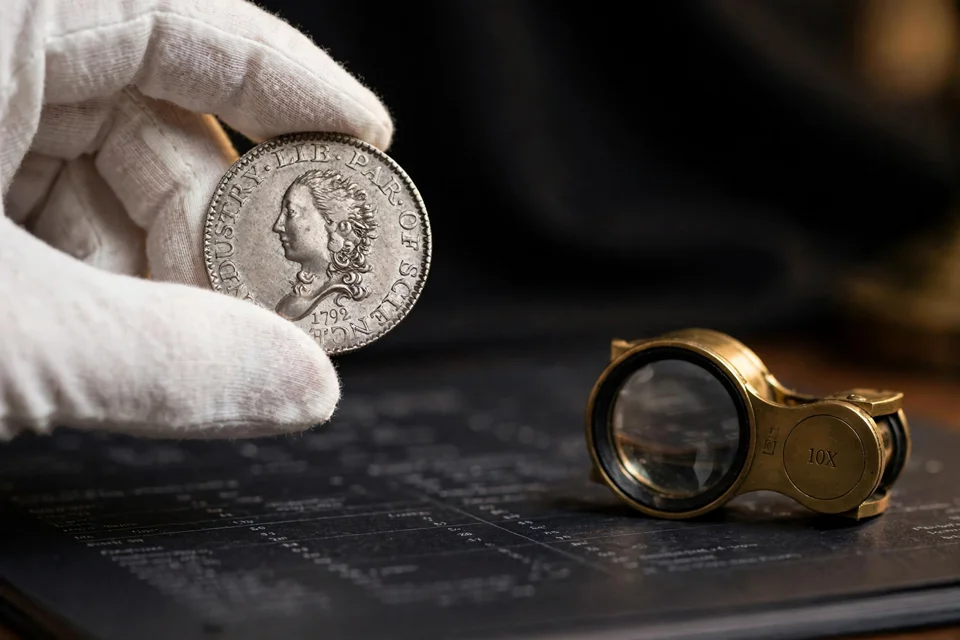
Cast counterfeits of the 1792 half disme are known, and the stakes make authentication critical. A genuine piece weighs 1.35 grams and measures about 17.5 millimeters across, with a reeded edge. The lettering should be sharp and correctly spelled — including the archaic "DISME" — with the date 1792 below Liberty's bust and the star positioned below HALF DISME on the reverse.
Any purported half disme offered without certification from a major grading service should be treated with extreme caution. Given that only a few hundred genuine examples exist, the overwhelming majority of raw "1792 half dismes" encountered online are reproductions or altered coins. If you believe you have found one, do not clean it — submit it for professional authentication.
Could You Ever Find One in Circulation?
Honestly, no. Unlike wheat pennies or silver dimes that still turn up in pocket change and coin rolls, the 1792 half disme has been a collector prize for well over a century. Survivors trade at major auctions and through top-tier rare coin dealers. The realistic path to owning one runs through Heritage, Stack's Bowers, or an established specialist dealer — with a six-figure budget as the entry ticket.
That said, the half disme's story is the perfect reason to check your change. America's first five-cent coin began a lineage that runs through the half dime to the Buffalo nickel in your pocket today, and valuable varieties still hide in ordinary coinage. For a broader look at how auction records reshape the market, see our coverage of the 2026-P Team USA Silver Eagle's $92,800+ benchmark.
The Half Disme's Legacy
The half disme gave way to the half dime, struck from 1794 onward, which carried the five-cent denomination for nearly 80 years until the nickel — cheaper to produce during the Civil War coin shortage — took over in 1866. Every five-cent coin since descends from the little silver piece struck in a saw-maker's cellar.
The October 2026 record confirms what specialists have long argued: the 1792 half disme is not a pattern or a curiosity, but the cornerstone of federal American coinage. A coin that began as Thomas Jefferson's $75 silver deposit now anchors the top tier of the rare coin market.
Curious what your own coins might be worth? Run them through the Coin Value Checker for an instant estimate, verify key dates with the Key Date Checker, or browse collector listings on the Marketplace.
Related Reading
- How Much Is a Dime Worth? From Pocket Change to $200,000+ — the half disme's direct descendant: silver dimes, key dates, and the errors worth hunting
- How Much Is a Buffalo Nickel Worth? From 50 Cents to $511,875+ — the five-cent coin that carried the lineage into the 20th century
- 2026-P Team USA Silver Eagle Value: The $92,800+ Auction Benchmark — how a modern rarity's first auction sale reset its market
Frequently Asked Questions
How much is a 1792 half disme worth?
A 1792 half disme is worth $85,000+ in circulated grades, rising to $300,000+ in Very Fine, $500,000+ in Extremely Fine, and $1,000,000+ in Mint State. The finest known example, graded PCGS MS68, set the auction record at $2,928,000 at Heritage in October 2026.
Why is it spelled "disme" instead of "dime"?
"Disme" (pronounced "deem") comes from the French word "dîme," meaning a tenth. Early American coinage used the French-derived spelling; it was later simplified to "dime." The spelling on the coin is correct for its era.
How many 1792 half dismes still exist?
About 1,500 were originally struck in July 1792, with possibly a few hundred more later that year. Roughly 200 to 400 are believed to survive today, and only about 20 are uncirculated — which is why even low-grade examples sell for $85,000+.
What is the most expensive half disme ever sold?
The most expensive half disme ever sold is the PCGS MS68 example from the Ronald Firman Collection, which realized $2,928,000 at Heritage Auctions on October 8, 2026, after 66 bids. It more than doubled the previous record of $1.41 million set in 2013.
Was George Washington's silverware really melted to make half dismes?
According to retired Chief Coiner Adam Eckfeldt, who was present at the striking, President Washington deposited $100 in silver bullion for the coinage. The popular silverware story persists, but surviving accounts best support bullion rather than tableware. Thomas Jefferson's documented $75 silver deposit on July 11, 1792, is the firmest record of the metal's source.
Are 1792 half dismes ever found in circulation?
No. The 1792 half disme has been a prized collector coin for over a century, and surviving examples trade at major auctions and through specialist dealers. You will not find one in pocket change or coin rolls — but its descendants, the half dime and the nickel, are still worth checking.