Gold Dollar Coin Value: How Much Is a Gold Dollar Worth Today?
Gold coins · 9 min read · Updated October 21, 2026
How much is a gold dollar coin worth? A common gold dollar in circulated condition starts around $450+ today, carried by gold trading above $4,200 an ounce — every genuine gold dollar holds about $200+ in gold alone. Most Type 3 examples in ordinary grades trade between $450 and $600, scarcer Type 2 coins start around $500+, and the great key dates climb into another universe entirely: a circulated 1861-D Dahlonega brings $10,000+, mint-state examples have sold for $180,000, and the legendary 1849-C Open Wreath realized $690,000 at auction. So while the gold dollar in an inherited collection is always worth at least its gold, the type, date, and mint mark on yours decide whether it is a $450 coin or a life-changing rarity.
Why America Made a Gold Dollar
Congress authorized the gold dollar on March 3, 1849, for two reasons. First, the California Gold Rush was flooding the East with yellow metal, and the government needed new denominations to turn that bullion into coinage. Second, the country needed a practical small coin for everyday purchases in an era when a single dollar represented real money — roughly a day’s wages for many workers.
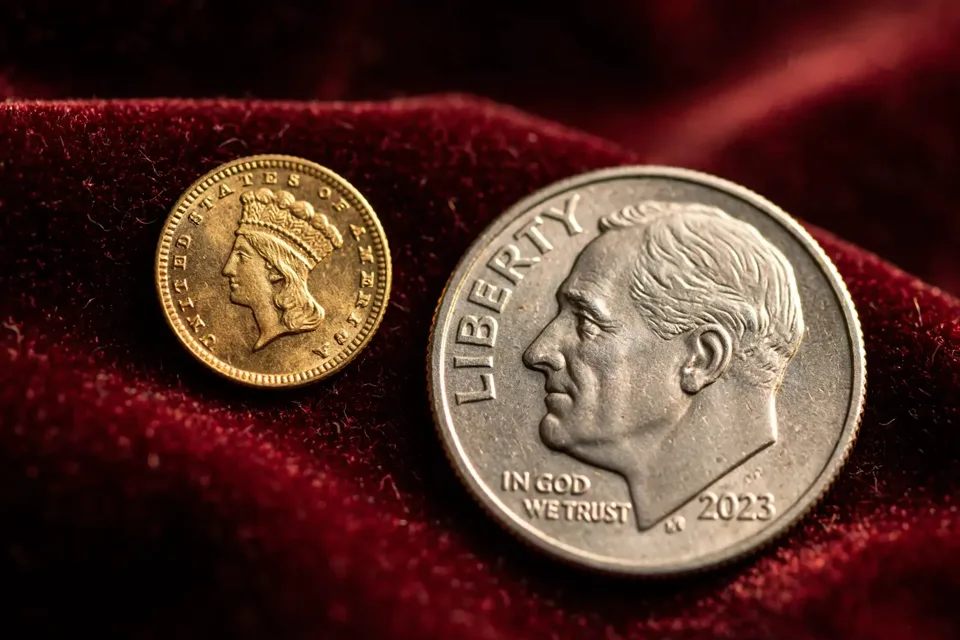
Chief Engraver James B. Longacre designed all three gold dollar types. The first coins left the Philadelphia Mint in 1849, and the denomination ran through 1889 — forty years of America’s tiniest gold coin. In its early years the gold dollar was a genuine workhorse, circulating widely. But the coin’s fatal flaw was obvious from the start: at about 13 millimeters across — smaller than a modern dime — it was hard to handle and easy to lose, and by the 1880s it survived mostly as a novelty issue.
The Three Gold Dollar Types
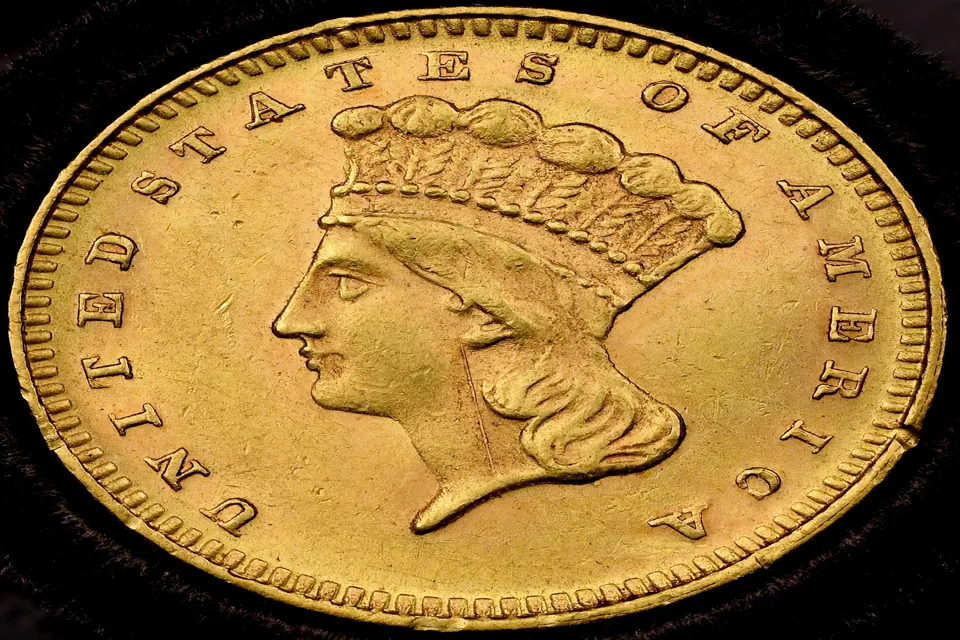
Every gold dollar belongs to one of three design types, and the type is the first thing that determines value:
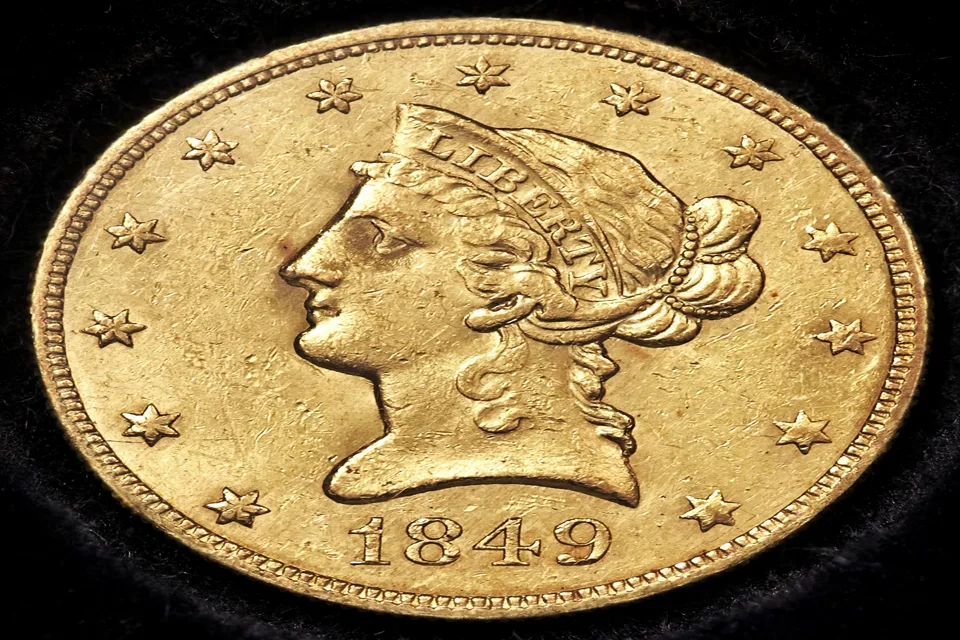
Type 1 — Liberty Head (1849–1854). The original small portrait of Liberty wearing a beaded coronet, surrounded by thirteen stars. At barely 13mm, these are the smallest regular-issue U.S. coins ever made for circulation. Common dates in worn condition are affordable; branch-mint issues carry strong premiums.
Type 2 — Indian Princess, small head (1854–1856). In 1854 the Mint widened the coin to about 15mm to make it easier to handle, and Longacre gave Liberty a feathered Native American headdress. The thin, wide planchet proved nearly impossible to strike well — most Type 2 dollars show weak detail, especially on the central date digits. With a cumulative mintage of only about two million across its short run, Type 2 is by far the scarcest of the three types, and problem-free examples are genuinely rare.
Type 3 — Indian Princess, large head (1856–1889). The refined version: a larger, better-proportioned portrait in shallower relief that struck up cleanly. This is the type most collectors encounter — it ran for over thirty years and is the most available and affordable of the three.
Gold Dollar Value by Type and Grade
All three types share identical specifications: 90% gold, 1.672 grams, containing 0.04837 troy ounces of pure gold. With gold above $4,200 an ounce, that gold content alone is worth about $200+ — the floor under every genuine gold dollar, no matter how worn.
Here is what common dates bring in today’s market:
| Type | Circulated (VF–EF) | Mint State (MS-60) | Gem (MS-65) |
|---|---|---|---|
| Type 1 (1849–1854) | $450–$550+ | $1,000+ | $3,000+ |
| Type 2 (1854–1856) | $500–$700+ | $2,500+ | $15,000+ |
| Type 3 (1856–1889) | $450–$600 | $700–$900+ | $2,000+ |
A popular collector goal is the three-type set — one example of each design. In circulated grades that set can still be assembled for around $1,000; in mint state it runs $2,000–$3,000. That affordability is a big part of the series’ appeal: it is one of the cheapest ways to own genuine 19th-century American gold.
Key Dates Worth Real Money
Beyond the common dates, a short list of gold dollars carries serious premiums:
| Date | Why it matters | Value range |
|---|---|---|
| 1849-C Open Wreath | Only 4–5 known; the great gold dollar rarity | $500,000+ finest known |
| 1861-D | Struck under Confederate authority; ~50–60 survive | $10,000+ circulated; $180,000+ mint state |
| 1853-D (Type 1) | Rare Dahlonega issue; MS66 brought $116,000+ | $5,000+ circulated |
| 1855-D (Type 2) | Scarce branch-mint Type 2 | $20,000+ in high grade |
| 1875 / 1876 | Proof-only; no business strikes exist | Five figures+ certified |
The 1849-C Open Wreath is the undisputed king. Struck at Charlotte in the series’ first year with an open wreath on the reverse, only four or five examples are known. The finest, graded MS63 Prooflike, realized $690,000 at auction in 2004 and reportedly changed hands privately for close to $1 million the following year.
The 1861-D carries the most dramatic story in American coinage. When the Confederacy seized the Dahlonega Mint in April 1861, a small final batch of gold dollars — some 1,000 to 1,500 pieces — was struck under Confederate authority before the mint closed that June. It was the last coinage ever produced at Dahlonega, and the only U.S. coin struck entirely under Confederate authority. About 50–60 survive. Even low-grade examples bring $10,000+; an AU55 sold for $88,450 at Heritage in January 2026, and mint-state pieces have reached $180,000.
The 1875 and 1876 dollars are proof-only issues — no circulation strikes were ever made. Any example should show proof characteristics (mirrored fields, razor-sharp rims) and must be certified; these are five-figure coins at minimum.
Where Is the Mint Mark on a Gold Dollar?
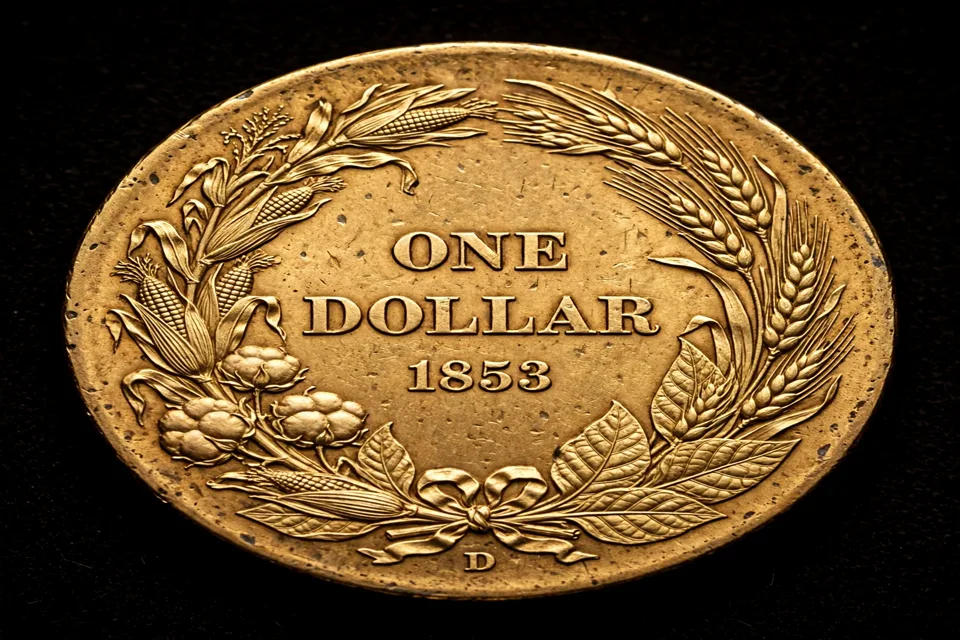
On the reverse, directly below the wreath’s bow. A C means Charlotte, D means Dahlonega, O means New Orleans, S means San Francisco — and no mark means Philadelphia. Both Southern mints closed during the Civil War, so every C- or D-mint gold dollar is genuinely scarce next to Philadelphia issues.
How to Tell If Your Gold Dollar Is Genuine
Gold dollars are among the most counterfeited small U.S. coins, and the tiny size makes fakes easier to pass. Run these checks before you celebrate:
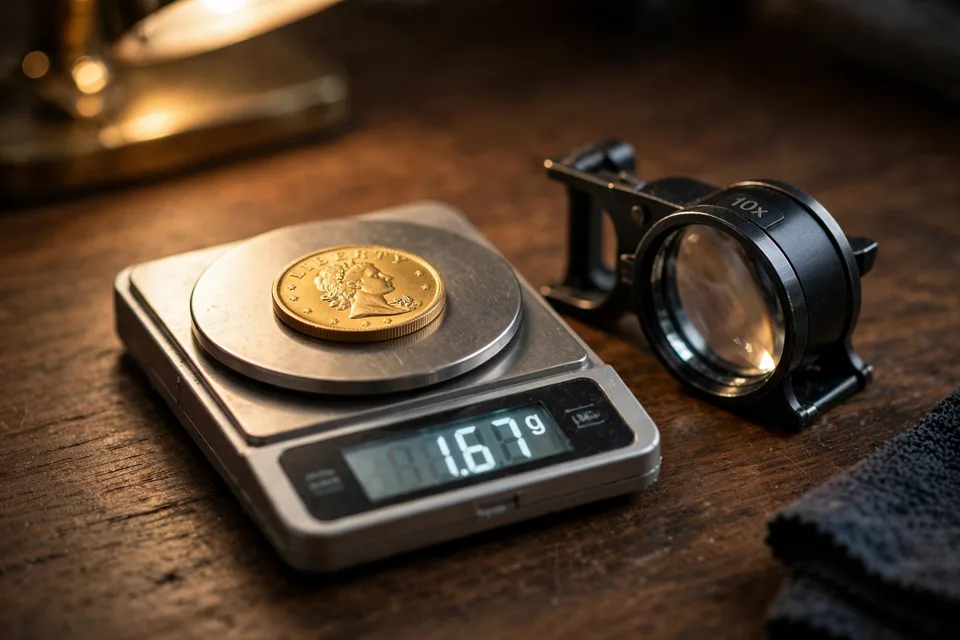
- Weigh it. A genuine gold dollar weighs 1.672 grams. Most fakes miss this number — a precision scale is the fastest authenticity screen there is.
- Measure it. Type 1 should be about 13mm across; Types 2 and 3 about 15mm.
- Check the date. The dates 1861 and 1862 are the most commonly counterfeited in the series — treat any uncertified example with extra suspicion.
- Look for jewelry damage. Type 3 dollars were popular in bracelets and earrings. Check for solder marks, removed loops, or plugged holes around the rim — ex-jewelry coins trade at a discount.
- Get valuable pieces certified. Any gold dollar that might be a key date belongs in a PCGS or NGC holder. Authentication is not optional at these values — run the Key Date Checker first to see whether your date and mint mark land on the key-date list.
Handle gold dollars by the edges, store them in 2x2 holders or capsules (never PVC flips), and never clean one — cleaning strips original surfaces and destroys the premium. Our coin handling guide covers safe storage for gold coins in detail.
Is a Gold Dollar a Good Way to Buy Gold?
For a small amount of gold in historic form, yes — with a caveat. Common circulated Type 3 dollars trade fairly close to their $200+ melt value, so you are paying a modest premium for a genuine 19th-century artifact. But the tiny size works against efficiency: the premium over melt is proportionally larger than on a $10 eagle or $20 double eagle, which is why serious gold accumulators prefer the bigger coins.
The real case for the gold dollar is numismatic: America’s smallest gold coin, a California Gold Rush artifact, and a three-type set you can finish for around $1,000 in circulated grades.
Find Out What Your Gold Dollar Is Worth
Run our free Coin Value Checker to compare your gold dollar against current market ranges for its exact type, date, and mint mark — from common Type 3 dollars to the great branch-mint rarities. If you are thinking of selling, list it on our Marketplace where collectors compete for certified gold.
Open the Coin Value Checker Browse the Marketplace
FAQ: Gold Dollar Coin Value
What is a gold dollar coin worth today?
Common gold dollars in circulated condition start around $450+, with every genuine example holding about $200+ in gold at current prices above $4,200 an ounce. Type 3 dollars trade $450–$600 worn; scarcer Type 2 coins start around $500+; key dates like the 1861-D and 1849-C Open Wreath reach $180,000–$690,000+.
How do I tell the three gold dollar types apart?
Type 1 (1849–1854) shows a small Liberty Head in a coronet on a tiny 13mm coin. Type 2 (1854–1856) has an enlarged Indian Princess head that usually looks weakly struck, especially on the date. Type 3 (1856–1889) has a refined, better-proportioned large head with clearer details. A 10x loupe makes the difference obvious.
Why are Charlotte and Dahlonega gold dollars more valuable?
Both mints operated only from 1838 to 1861 in Southern gold-producing regions and closed during the Civil War. Their modest output and tiny surviving populations make every C- or D-mint gold dollar genuinely scarce compared to Philadelphia issues — and the 1861-D’s Confederate history adds an unmatched story premium.
Are the 1875 and 1876 gold dollars real coins?
Yes, but they are proof-only — no business strikes exist for either year. Any 1875 or 1876 gold dollar should show proof characteristics like mirrored fields and sharp rims, and it should be certified before any significant transaction.
Is a gold dollar a good way to buy gold?
For a small amount of gold in historic form, yes — common Type 3 examples trade close to their $200+ melt value. But the premium over melt is proportionally larger than on bigger gold coins, so the $10 eagle or $20 double eagle is more cost-efficient for pure gold accumulation.
Are gold dollar coins made of solid gold?
They are 90% gold and 10% copper — the standard U.S. gold coin alloy of the era — weighing 1.672 grams with 0.04837 troy ounces of pure gold. Modern golden-colored dollars like the Sacagawea are manganese brass with no gold at all; only the 1849–1889 issues are real gold.