How Much Is an Indian Head Penny Worth? From $2+ Commons to $152,750+ Rarities
Pennies · 9 min read · Published October 30, 2026 · Updated October 30, 2026
Most Indian Head pennies are worth $2+ in worn condition, $15+ in Very Fine, and $75+ in Mint State, because even common dates from this beloved 1859–1909 series trade well above face value. The real money sits in the key dates: the 1877 starts around $900+ worn and has sold for $149,500, the 1909-S starts around $550 in Very Fine and has reached $97,750, and the finest 1864-L has sold for $152,750. If you have an old penny with a Native American headdress on the front, this guide shows you exactly how to identify it, grade it, and price it — date by date, mint mark by mint mark.
What Is an Indian Head Penny?
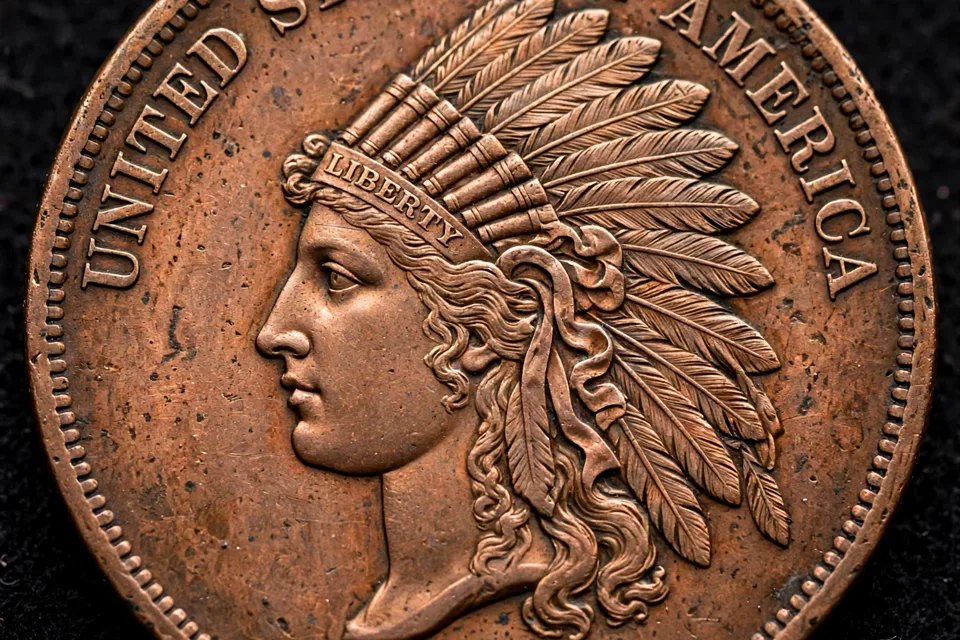
The Indian Head penny, officially the Indian Head cent, is the one-cent coin struck by the United States Mint from 1859 through 1909. Chief Engraver James B. Longacre designed it as the replacement for the short-lived Flying Eagle cent, and it became one of the longest-running and most collected series in American coinage — fifty years and fifty-four regular issues. It was replaced in 1909 by the Lincoln wheat cent.
Despite the name, the portrait is not a Native American chief. Longacre's obverse shows Liberty wearing a feathered headdress, with LIBERTY on her headband, UNITED STATES OF AMERICA around the rim, and the date below. The reverse carries an oak wreath with a shield at the top enclosing ONE CENT. The coin measures 19 millimetres across with a plain edge.
Two compositions split the series. From 1859 through mid-1864, Indian cents were struck in copper-nickel — 88% copper and 12% nickel — weighing 4.67 grams. Collectors call these pale pieces "white cents." In spring 1864 the Mint switched to bronze — 95% copper with 5% tin and zinc — weighing 3.11 grams, the alloy family the Lincoln cent inherited. A pocket scale settles it: 4.67 grams means copper-nickel, 3.11 grams means bronze.
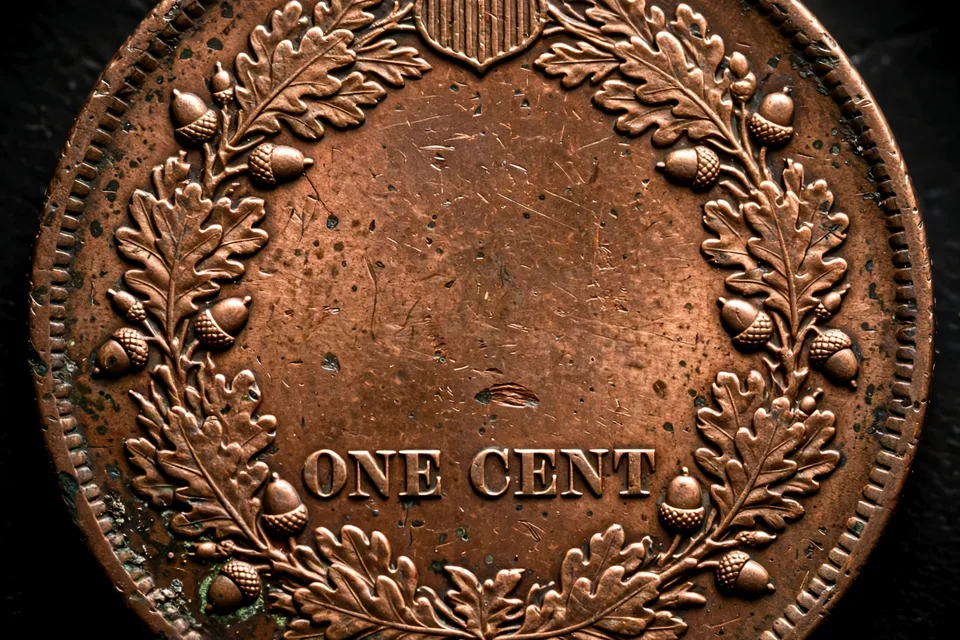
How to Identify Your Indian Head Penny
Work through the checks in order, and you will rarely misidentify an Indian cent. First, read the date on the obverse, below Liberty's portrait. Second, flip the coin over and look below the wreath on the reverse. For almost the entire series there is no mint mark at all, because Philadelphia struck every Indian cent from 1859 through 1907. Only the final two years carry a mint mark: a small S below the wreath means San Francisco, struck in 1908 and 1909 only. If you see any other letter, or a mint mark on a pre-1908 date, the coin has been altered or is not genuine.
Third, sort out the early design types. The 1859 is a one-year type with a laurel wreath and no shield; from 1860 the reverse shows the oak wreath with a shield at the top. In 1864 Longacre sharpened the portrait for the softer bronze planchets and added his initial L to the ribbon behind Liberty's neck — the 1864-L variety. Fourth, weigh the coin: the two metals overlap only in 1864, so weight plus date settles nearly every question.
Indian Head Penny Values by Grade
Condition drives Indian cent values harder than almost any other factor, because copper tones and wears visibly and original red mint lustre is genuinely rare on a coin that circulated for decades. Uncirculated Indian cents carry a colour designation: BN for Brown (under 5% original red), RB for Red-Brown (5% to 95% red), and RD for Red (95% or more red). At the same grade, a Red coin can be worth five to ten times its Brown twin.
The table below covers common dates — the high-mintage Philadelphia issues from the 1880s through 1907 that collectors trade most often.
| Grade | Typical value |
|---|---|
| Good to Very Good (G-4 to VG-8) | $2–$7 |
| Fine to Very Fine (F-12 to VF-20) | $15–$25 |
| Extremely Fine to About Uncirculated (EF-40 to AU-50) | $40–$110 |
| Mint State Brown (MS-60 to MS-63) | $75–$160 |
| Mint State Red (MS-65 RD) | $400–$900 |
Never clean an Indian Head penny. Cleaning strips the original surfaces and the natural toning that collectors pay for, and a cleaned coin is worth a fraction of an original one in the same grade. If your coin might grade Mint State Red, or if it is any key date at all, professional certification pays for itself: the holder settles authenticity, grade, and colour in one step.
The Key Dates That Change Everything
A short list of dates turns a $2 penny into a serious payday.
| Date / Variety | Mintage | Very Fine | About Uncirculated | Choice Uncirculated |
|---|---|---|---|---|
| 1877 | 852,500 | $2,100 | $4,500 | $6,250 |
| 1909-S | 309,000 | $550 | $1,100 | $1,500 |
| 1908-S | 1,115,000 | $175 | $325 | $550 |
| 1864-L bronze | Included in 1864 bronze | $250 | $425 | $575 |
| 1873 Double Liberty | Included in 1873 | $2,250 | $5,000 | $7,750 |
| 1888/7 overdate | Included in 1888 | $6,600 | $30,000 | $70,000 |
The 1877 is the king of the series. With a circulation mintage of just 852,500 — the lowest of any Philadelphia issue — it was recognised as the rarity of the set almost from the day it was struck. Even heavily worn examples start around $900+, and the finest known specimens have sold for $149,500. It is also the most counterfeited Indian cent: any 1877 that is not certified should be treated as guilty until proven genuine.
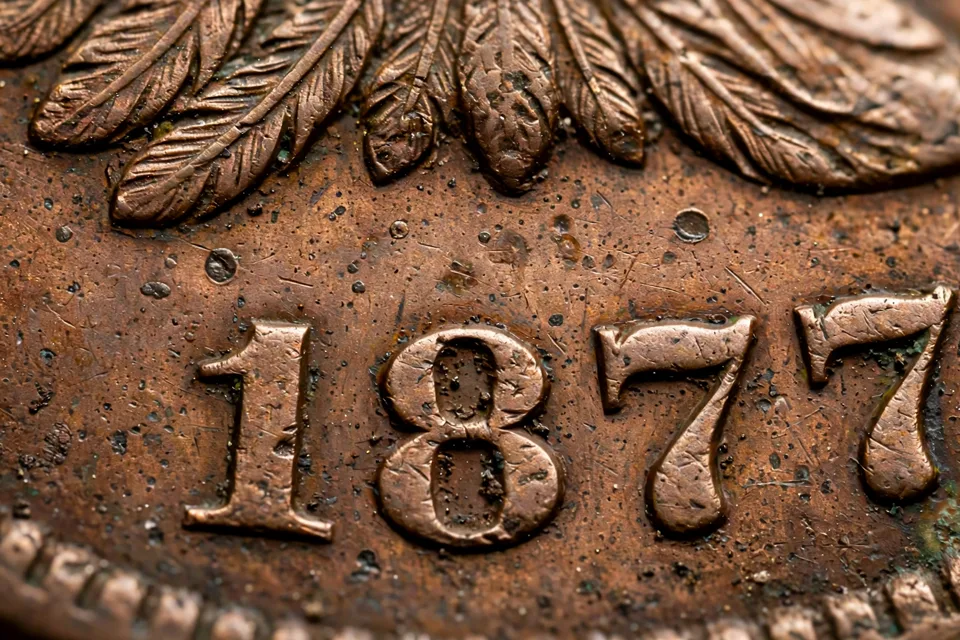
The 1872, struck in a mintage of 4,042,000, is the sleeper key of the early bronze years: circulated examples start around $100+, and the finest have reached $126,500. The 1873 Double Liberty — doubling across LIBERTY in the headband, visible under a loupe — is the variety specialists hunt first in that year, while the 1888/7 overdate, with a 7 beneath the final 8, is one of the most dramatic overdates in the cent series.
The San Francisco Pair: 1908-S and 1909-S
The final two years of the series are the only branch-mint Indian cents ever struck, and both are keys for a simple reason: tiny mintages by the standards of a series that routinely struck tens of millions. The 1908-S, the first cent ever struck at a branch mint, had a mintage of 1,115,000 and starts around $175 in Very Fine. The 1909-S, the final Indian cent of all, had a mintage of just 309,000 — the lowest mintage of the entire series — and starts around $550 in Very Fine, with the finest examples reaching $97,750.
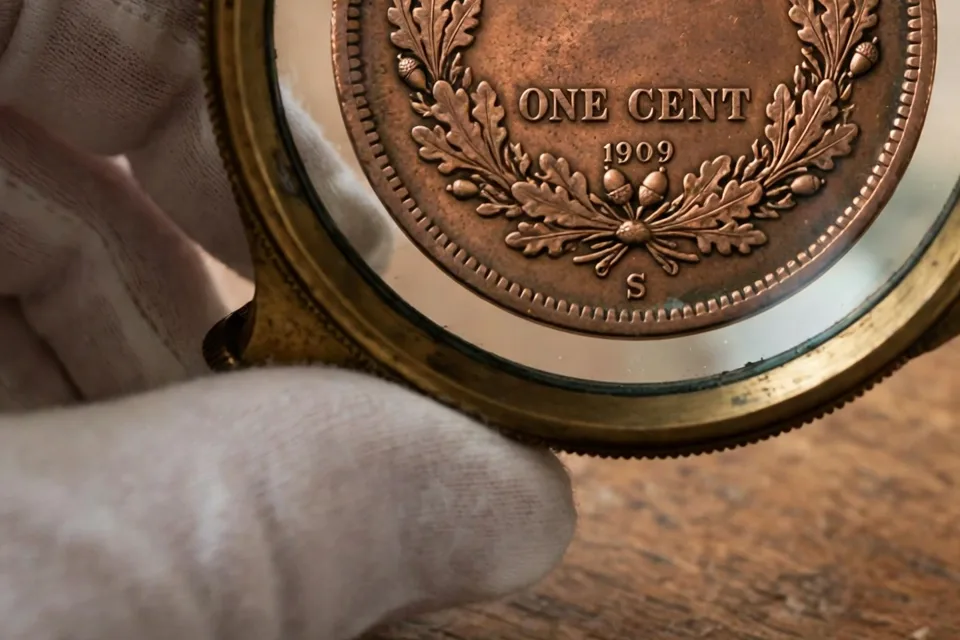
San Francisco Indian cents carry one more quirk: a streaky, wood-grain toning caused by an improper metal mix in the bronze strip. It is not damage — on a certified 1908-S or 1909-S it is a badge of origin. Because both dates are heavily counterfeited by adding an S to a Philadelphia coin, check the mint mark's style and position below the wreath, and buy certified if the price is serious money.
Proofs, Varieties, and the 1864-L
Proof Indian cents were struck every year for collectors, in small numbers that make them a field of their own. A typical proof mintage runs under 3,000 pieces — the 1902 proof numbered just 2,018 — and Red-designated proofs are genuinely scarce because most have toned to Brown. A PCGS PR67 RD 1902 proof sold for $15,600.
The 1864-L bundles three stories into one coin: the year's switch to bronze, Longacre's sharpened portrait, and the tiny L on the ribbon behind Liberty's neck. About three bronze 1864 cents without the L exist for every one with it, and the variety's finest examples have sold for $152,750 — the highest price in this guide. The 1873 Closed 3 and Open 3 varieties, the 1886 Type I and Type II styles, and the many repunched dates catalogued by Rick Snow give the series a lifetime of variety hunting beyond the key dates.
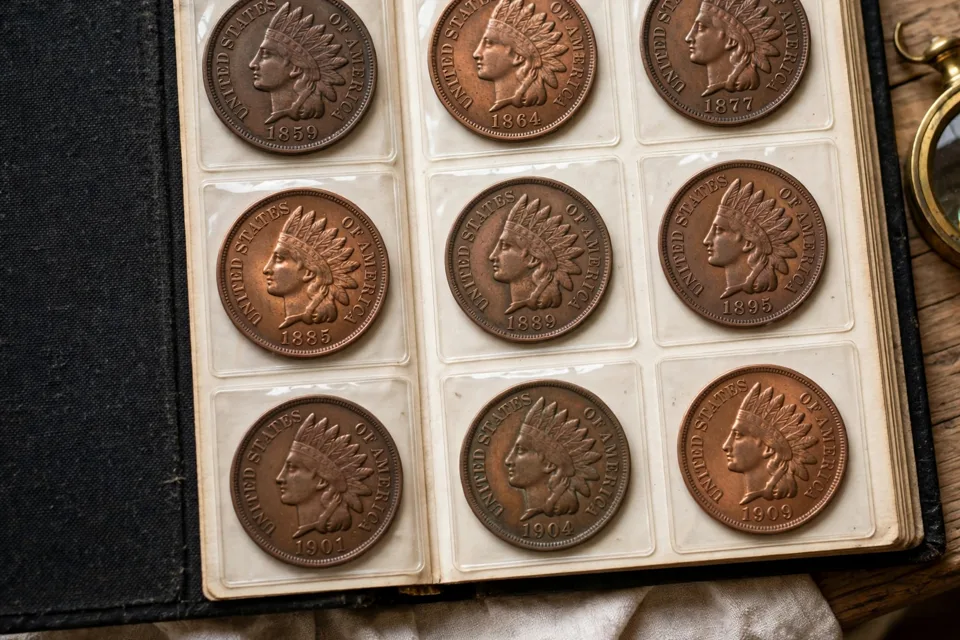
Before You Spend or Sell One
Work through the checks in order: date, mint mark below the wreath (S only, 1908–1909), weight (4.67 grams copper-nickel or 3.11 grams bronze), and the LIBERTY headband and feather tips for grade. Never clean the coin, and certify any key date, any shot at Mint State Red, and any confirmed variety.
Most Indian Head pennies are worth $2+ worn, $15+ in Very Fine, and $75+ in Mint State, driven by a century of collector demand rather than metal value — these are copper coins, not silver. Key dates run $175+ in Very Fine to $6,250+ in Choice Uncirculated, and the records run from $97,750 for the 1909-S to $149,500 for the 1877 and $152,750 for the 1864-L. Check the date and the wreath before you spend one: the difference between a $2 penny and a five-figure rarity is often a single digit or a single tiny letter.
Frequently Asked Questions
How much is an Indian Head penny worth?
Most Indian Head pennies are worth $2+ in worn condition, $15+ in Very Fine, and $75+ in Mint State. Key dates are worth far more: the 1877 starts around $900+ worn, the 1909-S around $550 in Very Fine, and the finest 1864-L has sold for $152,750. Grade, colour designation, and date determine the final figure.
What is the most valuable Indian Head penny?
The 1864-L bronze variety holds the highest verified price in this guide at $152,750, followed closely by the 1877 key date at $149,500 and the 1909-S at $97,750. Among regular issues, the 1877 is the most famous and most counterfeited key date, while the 1888/7 overdate reaches $70,000+ in Choice Uncirculated.
Where is the mint mark on an Indian Head penny?
The mint mark is on the reverse, below the oak wreath. Only the 1908-S and 1909-S carry one — a small S for San Francisco. Every Indian cent from 1859 through 1907 was struck at Philadelphia and carries no mint mark. Any other mint mark, or an S on an earlier date, signals an altered or counterfeit coin.
How do I tell a copper-nickel Indian Head penny from a bronze one?
Weigh it. Copper-nickel Indian cents from 1859 through mid-1864 weigh 4.67 grams and look pale and silvery, while bronze cents from mid-1864 through 1909 weigh 3.11 grams and show warm copper colour. Only 1864 was struck in both metals, so date plus weight settles nearly every coin.
Are Indian Head pennies made of silver?
No. Indian Head pennies contain no silver at all. The early issues are 88% copper and 12% nickel, and the later issues are 95% copper with 5% tin and zinc. Their value comes from collector demand, rarity, grade, and colour — not from precious-metal content.
What years were Indian Head pennies made?
Indian Head pennies were struck from 1859 through 1909 at Philadelphia, with San Francisco striking cents only in 1908 and 1909. They replaced the Flying Eagle cent in 1859 and were replaced by the Lincoln wheat cent in 1909, closing a fifty-year run.
An Indian Head penny costs nothing to check, and the difference between a $2 common date and a $152,750 rarity is one digit or one tiny letter below the wreath. Before you spend or sell any old penny you are unsure about, run it through The Diggin Dave's free Coin Value Checker to confirm its date, mint mark, and value range, use the Key Date Checker to test it against the key-date list, and try Grade-or-Not for a grade verdict on your best examples.
Related Reading
- How Much Is a Wheat Penny Worth? From 3 Cents to $1.7 Million+ — the Lincoln series that replaced the Indian cent in 1909, with its own key dates and the $1.7 million copper error
- 1982 Penny Value: How Much Is a 1982 Penny Worth? (The 7-Variety Copper-to-Zinc Guide) — the other great composition switch in penny history, and the $18,800 transitional error it produced
- 1955 Doubled Die Penny Value: Famous Error Worth $2,000+ — America's most famous doubled die, and how to tell real doubling from machine doubling