How Much Is a 1921 Morgan Dollar Worth? From $40+ Melt to $240,000+ Proofs
Dollar Coins · 9 min read · Published October 27, 2026
How much is a 1921 Morgan dollar worth? Most circulated 1921 Morgan dollars are worth $40+ — the silver inside alone is worth about $42 at late-October 2026 prices — while uncirculated examples start around $75+ and climb steeply: certified MS63 runs $110+ to $160+ by mint, gem MS65 runs $175+ to $875+, and the rare Chapman Proof has reached $240,000. The 1921 Morgan is the last Morgan dollar struck for circulation, the only Morgan ever struck at Denver, and America's most collected large silver coin — which is why the mint mark on the reverse is the first thing to check.
Why 1921 Is the Morgan Dollar Everyone Asks About
Designed by George T. Morgan, the Morgan dollar was struck from 1878 to 1904 and then stopped. After the First World War, the Pittman Act of 1918 ordered the Mint to replace more than 270 million silver dollars melted to support Britain's wartime currency — and the Morgan came back for one final year in 1921 at three mints: Philadelphia, Denver, and San Francisco. In the last days of December 1921, the Peace dollar replaced it.
That scale is the key to its value. Total 1921 Morgan production reached 86,730,000 coins — Philadelphia 44,690,000, Denver 20,345,000, and San Francisco 21,695,000. No 1921 Morgan is rare in worn condition, and no worn example will ever be a five-figure coin. What makes individual examples valuable is condition, mint mark, surface type, and — at the top — proof status: a drawer coin is worth its silver plus a small premium, while a never-circulated coin with full luster can be worth ten to twenty times as much.
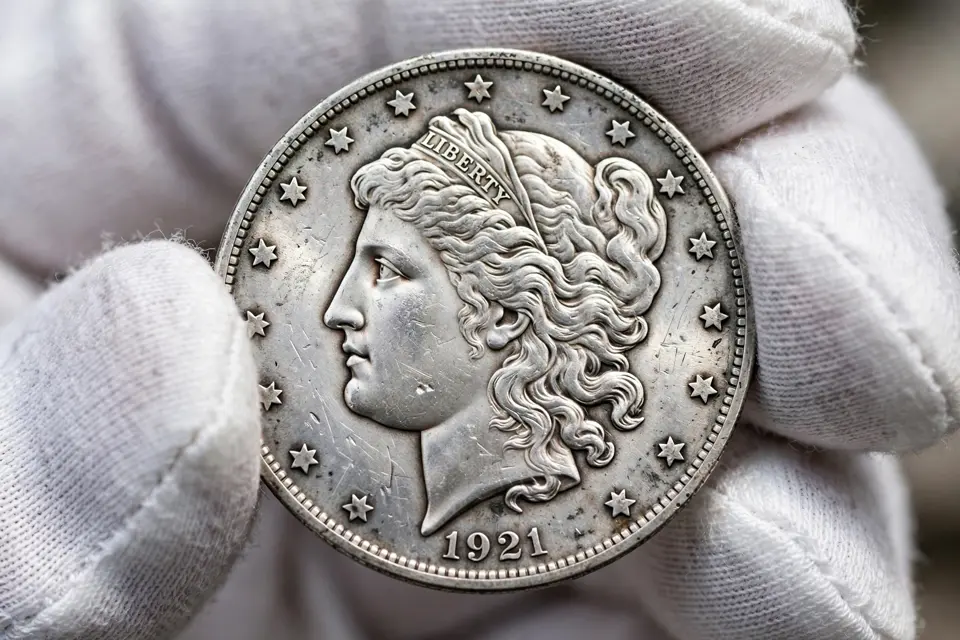
1921 Morgan Dollar Value by Mint and Grade
Grade is everything here. Circulated coins trade close to silver value; mint-state coins trade on scarcity at each grade step, and the steps get expensive fast — especially for Denver and San Francisco in gem condition. The ranges below are typical October 2026 retail ranges; they move with silver and certification.
| Mint | Good to Fine | Very Fine to AU | MS60 | MS63 | MS65 |
|---|---|---|---|---|---|
| Philadelphia (no mint mark) | $40+ | $50+ | $75+ | $110+ | $175+ |
| Denver (D) | $45+ | $55+ | $85+ | $160+ | $575+ |
| San Francisco (S) | $50+ | $60+ | $90+ | $150+ | $875+ |
Three patterns matter. Philadelphia is the common coin at every grade — largest mintage, most survivors, lowest price. Denver is the surprise: the only Morgan Denver ever struck, genuinely scarce in gem condition, which is why an MS65 Denver commands more than triple the Philadelphia price. San Francisco is scarcest in practice despite its middle mintage — millions were melted under later silver acts — and top-grade examples reach $1,600+ in MS65 and above.
The Silver Floor: What the Metal Alone Is Worth
Every 1921 Morgan dollar contains 0.7734 troy ounces of pure silver: it weighs 26.73 grams, measures 38.1 millimeters across, has a reeded edge, and is 90% silver with 10% copper. At silver near $54 per ounce, that metal is worth about $42 — the floor under every genuine example, no matter how worn, and the reason no dealer will ever pay face value for one.
That floor sets the circulated band at $40+ to $60+: melt plus a small premium. If someone offers far less than melt for a genuine example, walk away.
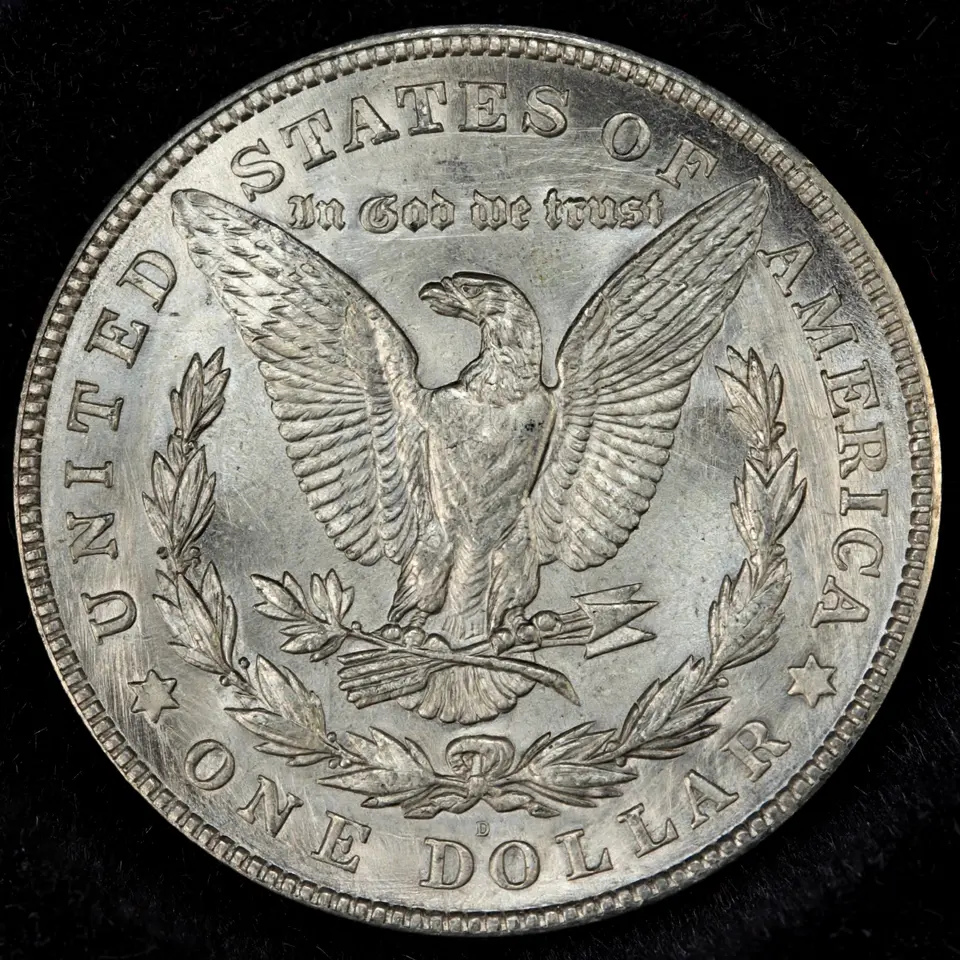
How to Tell a 1921 Morgan From a 1921 Peace Dollar
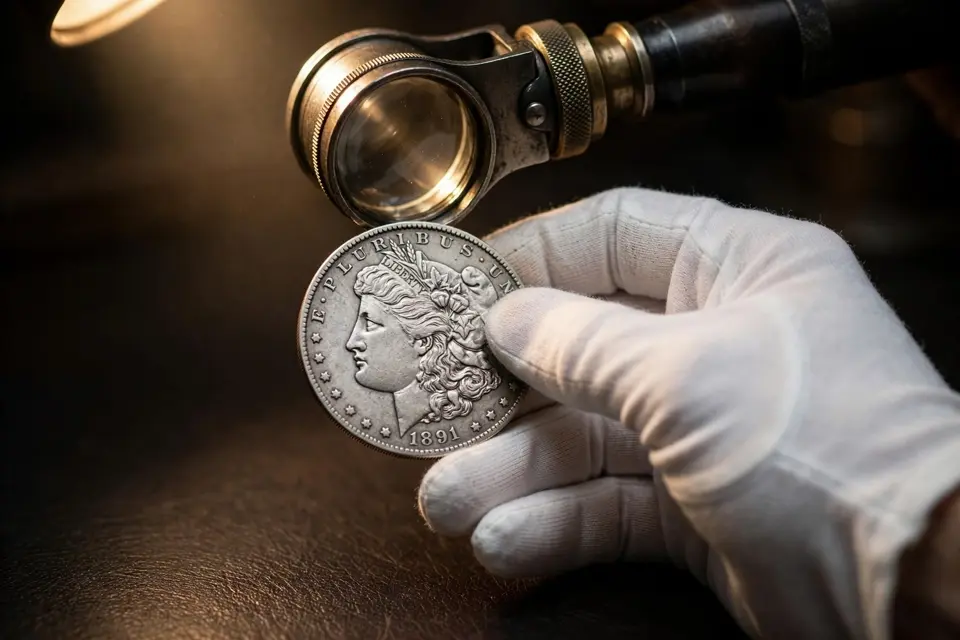
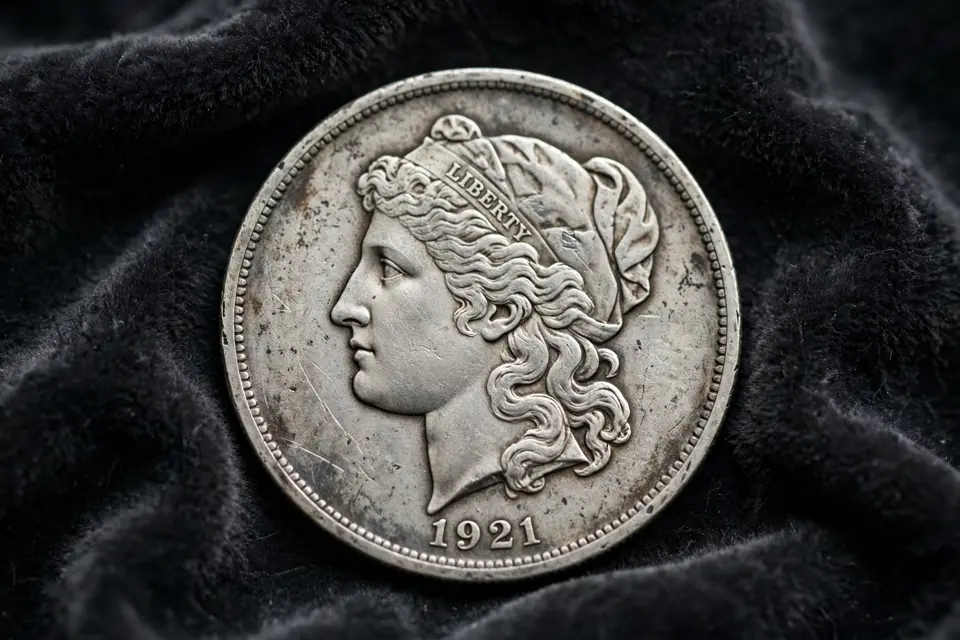
The Morgan obverse shows Liberty facing left in a Phrygian cap with LIBERTY on the headband; its reverse shows a heraldic eagle in a wreath above ONE DOLLAR. The Peace dollar shows Liberty in a radiate crown and an eagle perched on a rock above PEACE. Phrygian cap plus wreath eagle means Morgan; crown of rays plus eagle on a rock means Peace.
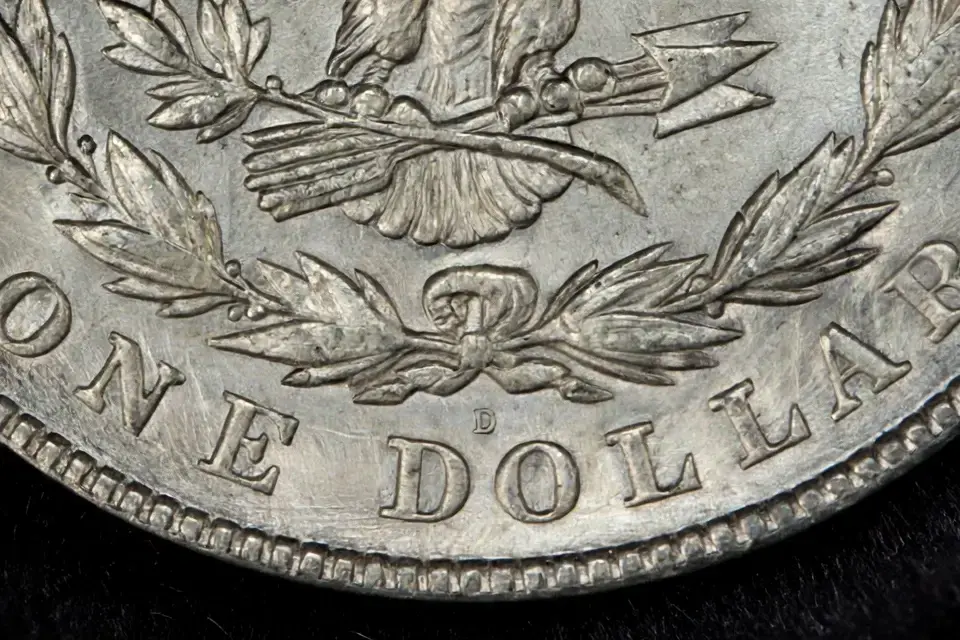
The mint mark is the second check: on a Morgan it sits on the reverse, below the wreath, just above DO in DOLLAR — no mark means Philadelphia, D means Denver, S means San Francisco. The 1921 Peace dollar was struck only at Philadelphia, so a genuine Peace dollar never carries a mint mark, and any 1921 dollar with a D or S is automatically a Morgan. Peace mintage was just 1,006,473 against the Morgan's 86,730,000, which is why circulated Peace dollars start at $100+ to $200+, reach $900+ to $1,500+ in MS63, and can reach six figures in superb MS67.
Prooflike, Deep Mirror Prooflike, and the Chapman Proofs
Beyond mint mark and grade, surface type separates ordinary 1921 Morgans from expensive ones. Coins struck from freshly polished dies show mirror-like fields: Prooflike (PL) means reflective fields with frosted devices, Deep Mirror Prooflike (DMPL) means deeply mirrored fields. In MS63, Prooflike runs $300+ and DMPL $1,100+; in MS65, Prooflike reaches $1,700+ and DMPL $4,700+, with top DMPL examples averaging $8,000+.
At the very top sit the Chapman Proofs, a tiny presentation striking with only about 40 believed struck and around 30 surviving. Their prices belong to a different world: a PR67 Chapman Proof has reached $240,000, and a PR64CAM Cameo example has sold for $96,000. If a coin in your collection looks proof-like — razor-sharp, deeply mirrored, frosted devices against mirror fields — treat it as a possible Chapman Proof and get it certified before accepting any offer.
| Coin | Grade | Sale | Price |
|---|---|---|---|
| 1921 Chapman Proof Morgan | PR67 | Reported top sale | $240,000 |
| 1921 Chapman Proof, Cameo | PR64CAM | Reported sale | $96,000 |
| 1921-D Morgan | MS65 (NGC) | Heritage, June 2024 | $50,400 |
| 1921-S Morgan, gem | MS65+ | Retail range | $1,600+ |
| 1921 Morgan, DMPL top examples | Mint State | Market average | $8,000+ |
What Lowers a 1921 Morgan's Value
Three things destroy value here, and all three are avoidable. First, cleaning: a polished Morgan loses its original surface, and grading services mark cleaned coins as Details instead of a numeric grade — cutting value to a fraction. Never polish one or dip it in a home solution. Second, damage: rim dings, deep scratches, and holes turn a collectible into a melt coin.
Third, counterfeits: the 1921 Morgan is one of America's most faked coins. Check the basics before buying: a genuine example weighs 26.73 grams and measures 38.1 millimeters — fakes are often light or the wrong diameter. Silver is not magnetic, so a coin that sticks to a magnet is not silver. Genuine lettering is sharp and even; mushy letters and a pitted surface warn of a fake.
Should You Get Your 1921 Morgan Graded?
For most circulated 1921 Morgans, grading is not worth the fee — the coin is worth $40+ to $60+. Grade it when it looks uncirculated with full luster, is a Denver or San Francisco gem, shows Prooflike or DMPL surfaces, may be a Chapman Proof, or is worth $200+ and needs buyer trust. Certification also settles the Morgan-versus-Peace question permanently. Otherwise, a good holder, a correct identification, and a realistic price are all you need.
Final Thoughts
How much is a 1921 Morgan dollar worth comes down to four questions: which mint struck it, what grade it holds, whether its surfaces are Prooflike, and whether it is a proof. A worn Philadelphia coin is worth $40+ in silver and history; a gem Denver or San Francisco coin is worth hundreds to thousands; a mirror-surfaced proof is worth a house deposit. Flip it over, find the mint mark below the wreath, and never spend one before you know which mint made it.
Frequently Asked Questions
How much is a 1921 Morgan silver dollar worth?
Most circulated 1921 Morgan dollars are worth $40+ to $60+, driven by about $42 in silver at late-October 2026 prices. Uncirculated examples start around $75+, MS63 coins run $110+ to $160+, MS65 coins run $175+ to $875+ by mint, and the Chapman Proof has reached $240,000.
How do I tell a 1921 Morgan dollar from a 1921 Peace dollar?
Look at Liberty: the Morgan shows Liberty facing left in a Phrygian cap with LIBERTY on the headband, and a heraldic eagle in a wreath on the reverse. The Peace dollar shows Liberty in a radiate crown and an eagle on a rock above PEACE. Any 1921 dollar with a D or S mint mark is a Morgan, since Peace dollars were struck only at Philadelphia.
What makes the 1921-D Morgan dollar special?
Denver struck Morgan dollars in 1921 only — never before, never after — making the 1921-D a one-year-only type coin in the entire series. It is also scarce in gem condition: an NGC MS65 sold for $50,400 at Heritage in June 2024, far above the Philadelphia price at the same grade.
Is a 1921 Peace dollar worth more than a Morgan dollar?
Yes, typically. Only 1,006,473 Peace dollars were struck in 1921, all at Philadelphia in late December, against 86,730,000 Morgans. Circulated Peace dollars bring $100+ to $200+, MS63 examples reach $900+ to $1,500+, and superb MS67 examples can reach six figures — well above the Morgan curve at every grade.
Why do 1921 Morgan dollars look flat compared to earlier issues?
New master dies and hubs were prepared for the 1921 return, with subtle differences from the 1878–1904 issues, and the coins were struck at high speed to meet Pittman Act quotas. The result is often a slightly softer strike, especially on Liberty's hair and the eagle's breast — a mint characteristic, not damage, that does not by itself lower the grade.
Should I clean my 1921 Morgan dollar?
No. Cleaning strips the coin's original surface and causes grading services to mark it as Details instead of giving it a numeric grade, cutting its value sharply. Handle the coin by its edge, store it in a holder, and leave the surfaces exactly as you found them.
A 1921 Morgan dollar costs nothing to check, and the difference between a $40 coin and a $240,000 coin is one mint mark, one grade step, and one mirror surface. Before you sell any silver dollar you are unsure about, run it through The Diggin Dave's free Coin Value Checker to confirm its date, mint mark, and value range, use the Key Date Checker to see whether your date is a key issue, and if your coin looks uncirculated, Grade-or-Not helps decide whether certification is worth the fee.
Related Reading
- Gold Dollar Coin Value: How Much Is a Gold Dollar Worth Today? — common gold dollars start at $450+
- How Many Dollars in a Roll? The Complete Dollar Roll Guide — Values, Silver Finds & Roll-Hunting Tips — 25 small dollars to a roll, $25 face, plus silver-dollar roll math
- How to Grade a Coin: The Complete Guide to the 1–70 Scale, Luster, Wear & Value — the grading scale behind every MS price in this guide