How Much Is a Bicentennial Quarter Worth? From 25 Cents to $19,200+
Quarters · 9 min read · Published October 26, 2026
How much is a bicentennial quarter worth? Most bicentennial quarters are worth 25 cents — the same face value they carried in 1976. The exceptions are what make the coin worth checking: 40% silver collector versions start at $5+, high-grade clad examples reach $1,000+, and the finest known 1976-S silver quarter sold for $19,200. In 2026, the 250th anniversary of American independence, these drummer-boy quarters are back in the spotlight as Americans recheck jars and old collections — so it pays to know exactly which version you are holding.
What Is a Bicentennial Quarter?
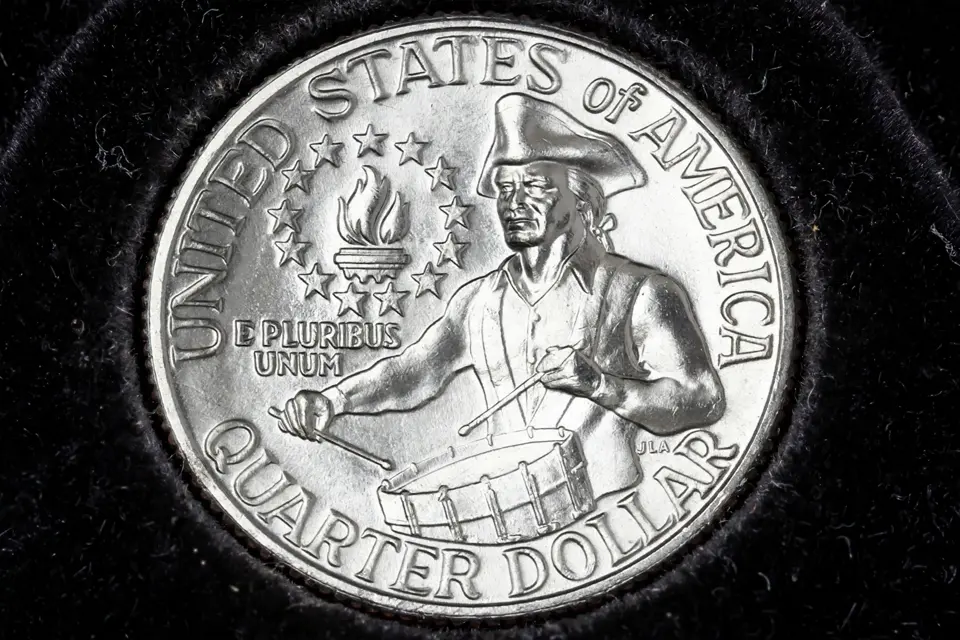
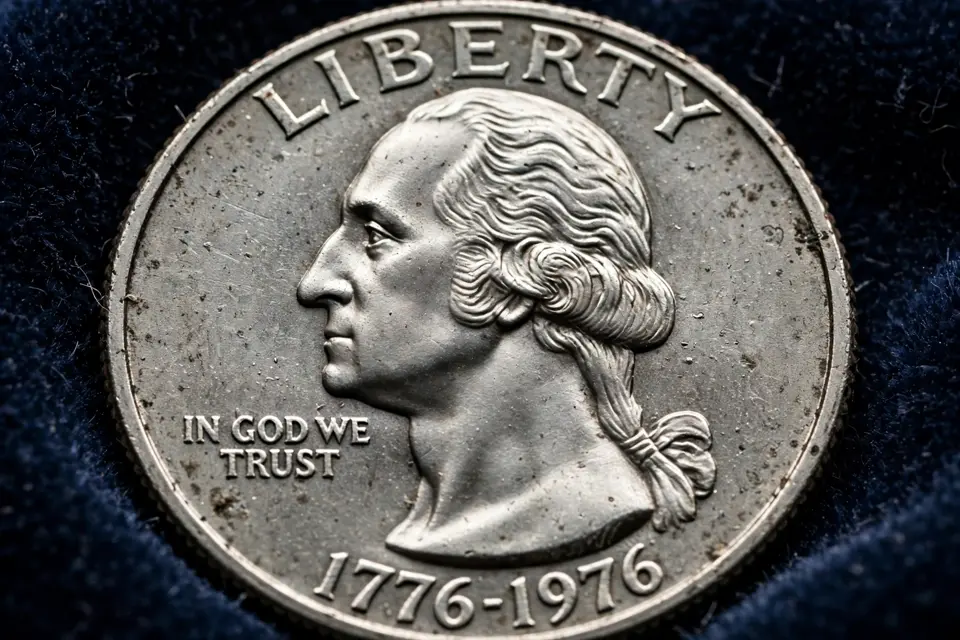
The bicentennial quarter is the special Washington quarter struck to mark the 200th anniversary of the Declaration of Independence. On October 18, 1973, President Richard Nixon signed legislation (Public Law 93-127) ordering a temporary redesign of the quarter, half dollar, and dollar for coins issued between July 4, 1975 and January 1, 1977. Every bicentennial quarter carries the dual date "1776-1976" — and no quarter bearing only a 1975 date was ever struck: quarters produced through 1975 and 1976 both carry the bicentennial design.
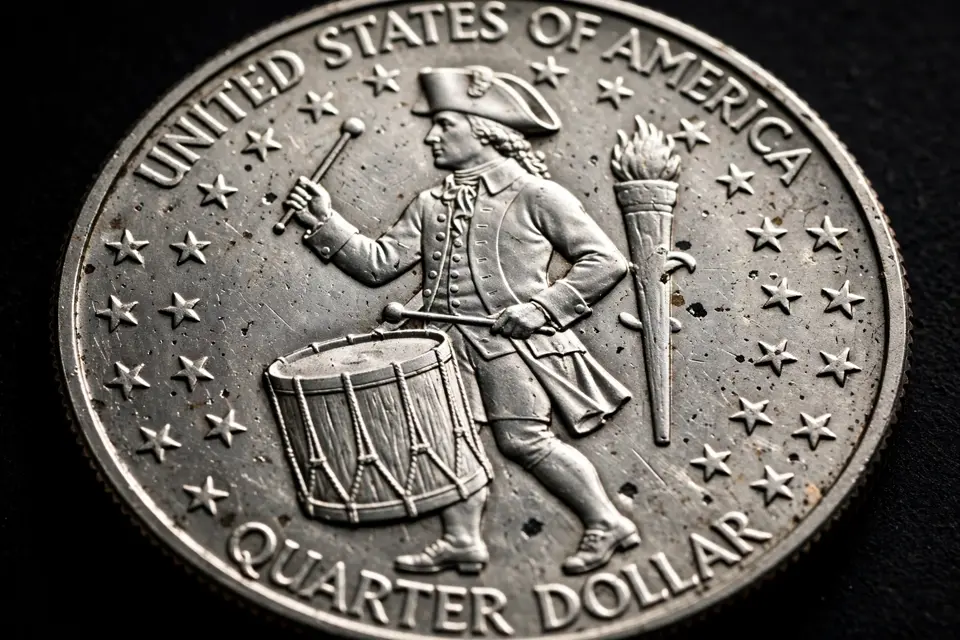
The obverse kept John Flanagan's portrait of George Washington, updated with the dual date below the bust. The reverse, chosen through a nationwide design competition, shows a colonial drummer boy by artist Jack L. Ahr, with a victory torch encircled by 13 stars for the original 13 colonies. It replaced the familiar eagle reverse for exactly one issue — the first time in 40 years a circulating quarter carried a different reverse.
Bicentennial Quarter Value by Type
The single biggest factor in bicentennial quarter value is composition, followed by condition. Circulated clad quarters are worth face value; silver versions and top-grade examples are where the money sits.
| Type | How to spot it | Typical value |
|---|---|---|
| Clad, circulated (P or D) | Copper stripe on the edge, light to heavy wear | $0.25 |
| Clad, uncirculated (P or D) | Full luster, no wear | $1–$5 |
| Clad proof (S) | Mirror fields, sharp strike, S mint mark | $1–$20 |
| 40% silver, uncirculated (S) | Solid silver edge, no copper stripe, S mint mark | $5–$15 |
| 40% silver, proof (S) | Deep mirror finish, S mint mark | $10–$20+ |
| Top-grade clad (MS67+) | Certified near-perfect | $1,000–$4,500+ |
| Top-grade silver (MS69) | Certified near-perfect | Up to $19,200 |
The finest bicentennial quarter ever sold is a 1976-S 40% silver example graded MS69 that realized $19,200 at Heritage Auctions in 2019 — the reason every silver bicentennial quarter deserves a second look before it goes back into a jar.
How Many Bicentennial Quarters Were Made?
The Mint's goal was mass distribution: the bicentennial quarter was meant to be a souvenir every American could own — more than 1.6 billion circulation strikes, plus tens of millions of collector issues.
| Mint | Variety | Mintage |
|---|---|---|
| Philadelphia (no mint mark) | Clad | 809,784,016 |
| Denver (D) | Clad | 860,118,839 |
| San Francisco (S) | Clad proof | 7,059,099 |
| San Francisco (S) | 40% silver, uncirculated | ~11,000,000 |
| San Francisco (S) | 40% silver, proof | ~4,000,000 |
That enormous mintage is why circulated clad bicentennial quarters are worth face value: with over 1.6 billion struck, scarcity does not exist in worn grades. It also explains why so many still turn up — a large share was tucked away in keepsake jars the moment they appeared, and those coins are still coming back into circulation decades later.
How to Tell If Your Bicentennial Quarter Is Silver
This is the test that matters, because the silver version is the only bicentennial quarter with real built-in value:
1. Check the mint mark. The mint mark sits on the obverse, to the right of Washington's neck, just below the dual date. No mint mark means Philadelphia, D means Denver, S means San Francisco. Only San Francisco struck silver bicentennial quarters — so a P or D coin cannot be silver. But an S mint mark alone does not prove silver: San Francisco also struck clad proofs.
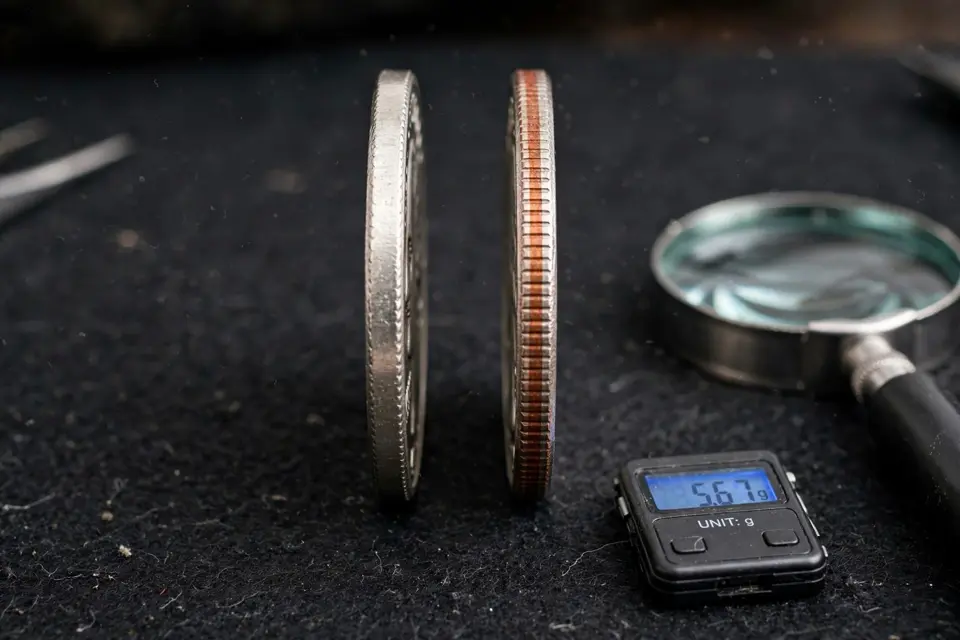
2. Check the edge. This is the fastest reliable test. A clad quarter shows a copper stripe — a brownish-orange line sandwiched between silver-colored outer layers. A 40% silver quarter has a solid, uniform silvery edge with no copper stripe at all.
3. Weigh it. A clad bicentennial quarter weighs 5.67 grams. A 40% silver bicentennial quarter weighs 5.75 grams and measures the same 24.3 millimeters across. The weight gap is small, so use a scale that reads to at least 0.01 grams — and combine it with the edge test rather than trusting weight alone.
One more clue: silver quarters were sold only in collector sets and never circulated, so a genuine silver example should show no wear. A worn quarter with a silver-colored edge is almost certainly clad — or a plated novelty, not a Mint silver issue.
The Valuable Bicentennial Quarter Errors
Errors are the second path to real money in this series. The doubled die obverse matters most, but several striking errors carry premiums:
| Error or variety | What to look for | Value range |
|---|---|---|
| 1976-D Doubled Die Obverse (FS-101) | Clear doubling on LIBERTY, the motto, and the date | $50–$8,400 |
| Double denomination (struck on a dime planchet) | Quarter design on a small, thin dime-sized planchet | $9,200+ |
| Wrong planchet error | Quarter struck on a foreign or wrong-denomination blank | $5,000–$12,000+ |
| Off-center strike | Part of the design missing, blank crescent showing | $20–$575+ |
| Filled D mint mark | Denver mint mark clogged or blob-like | $10–$300+ |
| Missing clad layer | One side dull copper-colored, underweight | $100+ |
The 1976-D DDO FS-101 is the error to memorize: a certified example sold for $8,400 in 2023. Check the obverse lettering under magnification — genuine doubled die doubling is raised and rounded with a clear split between images, while flat, shelf-like doubling is machine doubling worth no premium.
Record Bicentennial Quarter Sales
These verified auction results set the market for this series:
| Coin | Grade | Sale | Price |
|---|---|---|---|
| 1976-S 40% silver quarter | MS69 | Heritage, 2019 | $19,200 |
| 1976-S 40% silver proof quarter | Proof | 2019 | $13,500 |
| 1976-D DDO FS-101 | Mint State | 2023 | $8,400 |
| 1976-D clad, regular strike | Mint State | 2017 | $6,463 |
| 1976-S clad proof quarter | Proof | 2010 | $6,038 |
| 1976-S 40% silver proof, Deep Cameo | Proof | 2007 | $2,760 |
| 1976 clad, regular strike | Mint State | 2023 | $1,821 |
The pattern is consistent: silver and top-grade examples set the records, while ordinary circulated clad coins stay at face value. A coin that looks shiny is not automatically valuable — it needs to grade near the top of the scale, generally MS67 or better, before a real premium appears.
Why Bicentennial Quarters Matter Again in 2026
2026 is the 250th anniversary of independence, and bicentennial quarters are the coins most Americans already own from the last great anniversary. That renewed attention is driving collectors to recheck old coin jars and pocket change — just as the 1976 issues drove a generation of new collectors fifty years ago. Most rechecked coins will be worth 25 cents. But the silver versions, proofs, and doubled dies hiding among them are the reason to look before you spend.
Common Bicentennial Quarter Traps
Be skeptical of hype: claims of a "rare $10,000 quarter" without documentation are almost always wrong — the documented records above are the real ceiling, and they belong to certified silver or error coins, not pocket change. Silver-plated clad quarters are a common novelty: plating adds a silver color but no silver content, and the edge and weight tests expose them immediately. And remember that an S mint mark does not guarantee silver — San Francisco struck millions of clad proofs too. Finally, never clean a bicentennial quarter you suspect is valuable: cleaning strips the original surface and can cut a collectible coin down to a fraction of its worth.
Final Thoughts
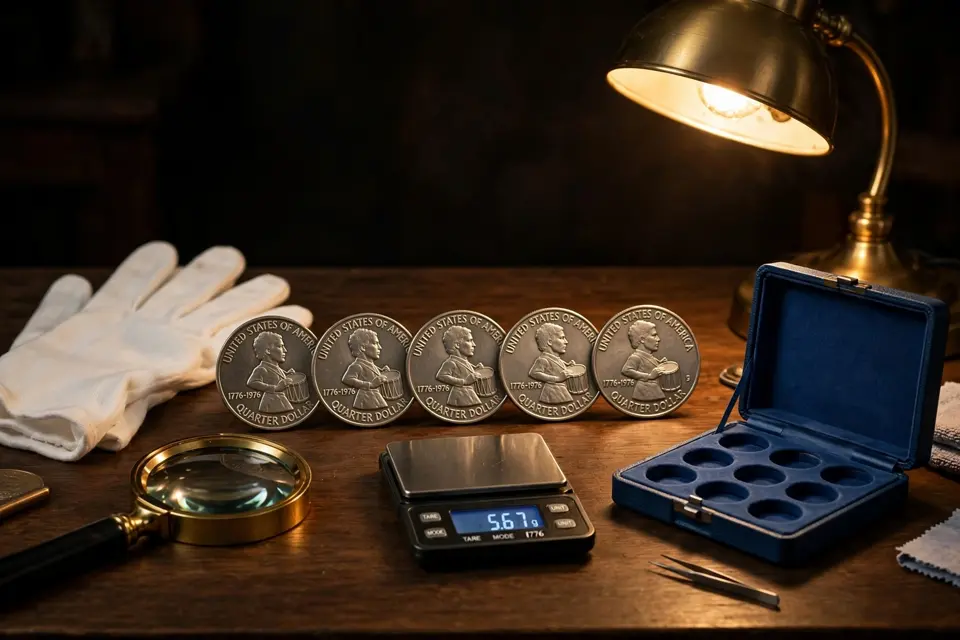
How much is a bicentennial quarter worth comes down to three questions: is it silver, is it a top grade, or is it an error? A circulated clad quarter is worth 25 cents — a souvenir of America's 200th birthday. A silver quarter is worth $5+ and deserves a holder, not a cash register. And a certified MS69 silver quarter, a $8,400 doubled die, or a double-denomination error is the reason to check every drummer boy quarter that crosses your path. In this 250th anniversary year, the next one you find could be the one worth keeping.
Frequently Asked Questions
How much is a bicentennial quarter worth?
Most bicentennial quarters are worth 25 cents in circulated condition. Uncirculated clad examples trade for $1–$5, 40% silver versions start at $5+, and the finest certified silver example sold for $19,200.
Is a 1776-1976 quarter silver?
Most are not. Only the San Francisco collector issues are 40% silver; Philadelphia and Denver circulation strikes are copper-nickel clad. Check the edge: a solid silvery edge with no copper stripe indicates silver.
How can I tell if my bicentennial quarter is silver?
Three tests: an S mint mark (required but not sufficient alone), a solid silvery edge with no copper stripe, and a weight of 5.75 grams versus 5.67 grams for clad. Silver bicentennial quarters were sold only in collector sets and never circulated.
What is the 1976-D doubled die obverse (FS-101)?
It is the major doubled die variety of the series, showing clear raised doubling on LIBERTY, the motto, and the date of Denver bicentennial quarters. Certified examples have sold for up to $8,400, while flat, shelf-like machine doubling carries no premium.
Are bicentennial quarters rare?
No. More than 1.6 billion circulation strikes were produced, so circulated clad examples are common and worth face value. Rarity here comes from composition, top grades, and errors — not the design itself.
What is the most valuable bicentennial quarter?
A 1976-S 40% silver quarter graded MS69 holds the record at $19,200, sold at Heritage Auctions in 2019. A 1976-S silver proof reached $13,500 the same year, and the 1976-D doubled die obverse reached $8,400 in 2023.
A bicentennial quarter costs nothing to check, and the difference between a 25-cent coin and a $19,200 coin is one mint mark, one edge stripe, and one doubled letter. Before you spend any quarter you are unsure about, run it through The Diggin Dave's free Coin Value Checker to confirm its date, mint mark, and value range, and use the Key Date Checker to see whether your date is a key issue. If a coin shows doubled lettering, the Error Identifier walks through the diagnostics.
Related Reading
- How Much Is a Quarter Worth? From Pocket Change to $207,400+ — most quarters are worth 25 cents, but silver quarters bring $10+ and the rarest hit $207,400
- How Many Quarters in a Roll? The Complete Quarter Roll Guide — Values, Silver Finds & Roll-Hunting Tips — 40 quarters worth $10, plus silver-roll melt math, box math, and key dates to check for
- How to Tell If a Quarter Is Silver: 6 Tests That Work in Seconds — six tests that tell silver from clad in seconds, plus the three post-1964 silver exceptions