How Much Is a Franklin Half Dollar Worth? From $20+ Silver to $129,500+ Keys
Half Dollars · 9 min read · Published October 28, 2026
A Franklin half dollar is worth $20+ circulated for a common date, because every Franklin half holds 0.36169 troy ounces of 90% silver. Most common dates trade $20+ to $30+ worn, mint-state examples run $35+ to $150+, and the keys climb far higher: the 1949-S reaches $1,000+ in gem, the low-mintage 1955 brings $85+ in gem, and the finest known Franklin half, a toned 1958 graded MS67+ Full Bell Lines, sold for $129,500+. Date, mint mark, strike, and grade decide where your coin sits.
What Is a Franklin Half Dollar?
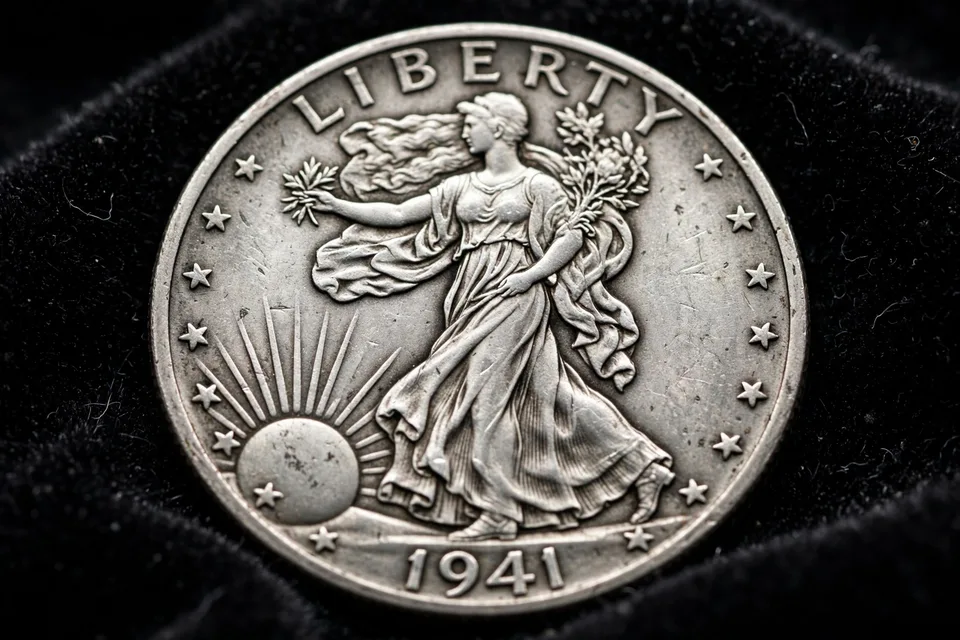
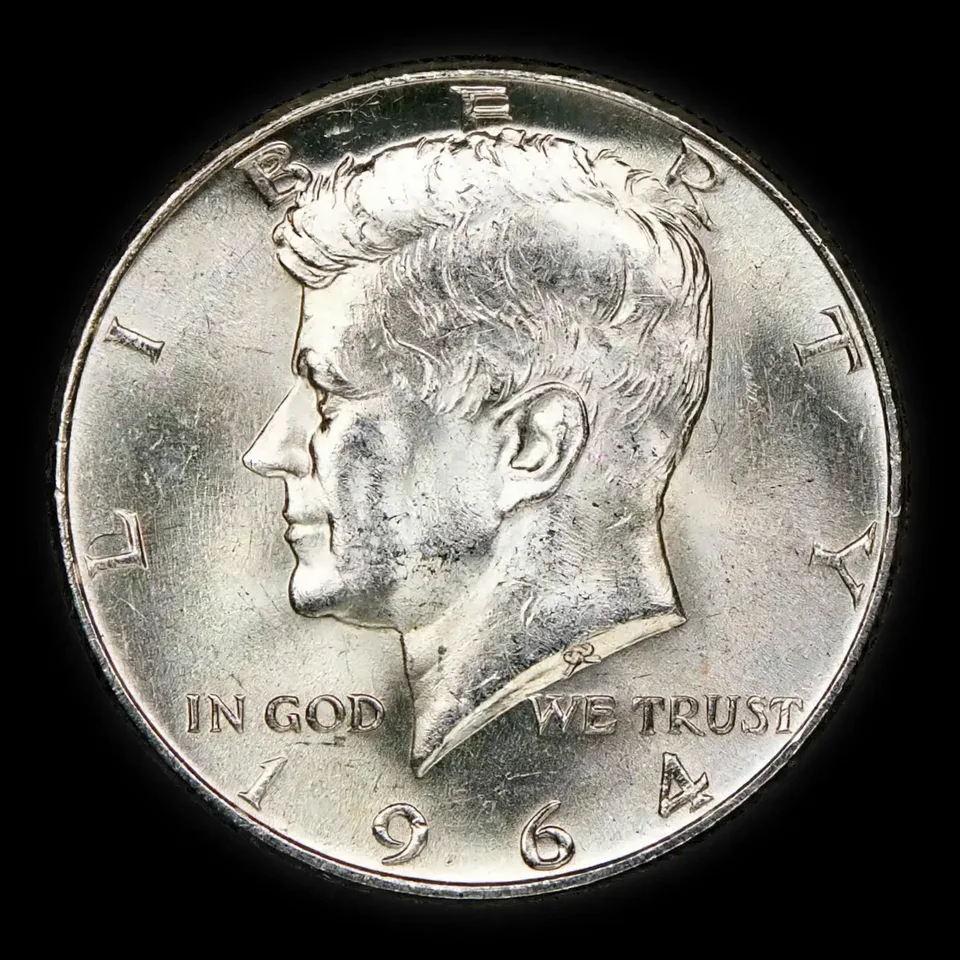
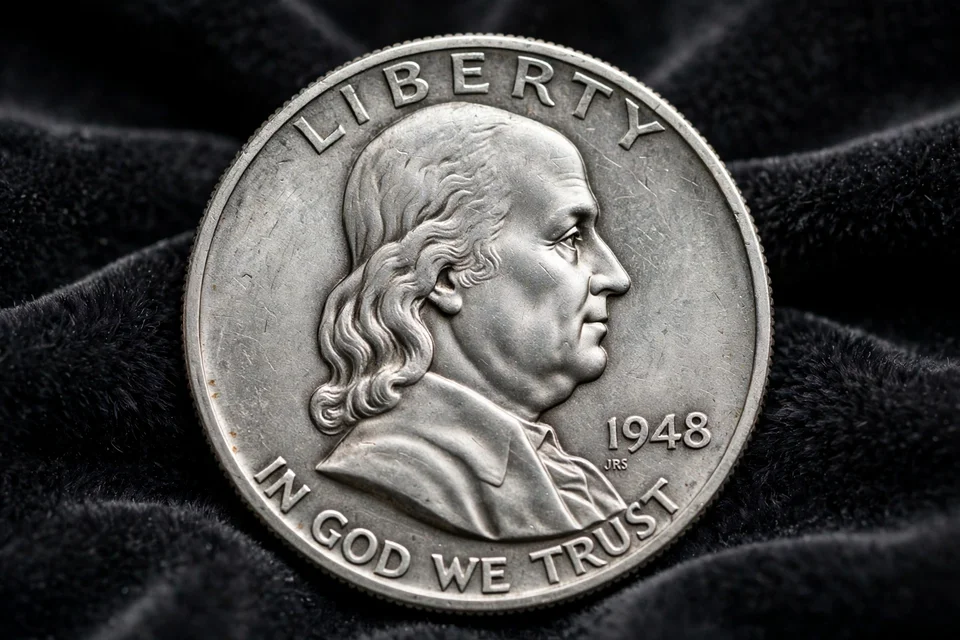
The Franklin half dollar replaced the Walking Liberty half in 1948 and ran through 1963, the shortest-lived regular-issue half dollar design of the twentieth century. Chief Engraver John R. Sinnock designed the obverse, a head-and-shoulders portrait of Benjamin Franklin facing right, and Gilroy Roberts finished the reverse after Sinnock died in 1947. The first Franklin halves reached the public on April 30, 1948. The series ended in 1963: after President Kennedy was assassinated that November, Congress put Kennedy on the half dollar in 1964, and no Franklin half was ever struck for circulation again.
The design was controversial at first: collectors used to grand Liberty figures found Franklin plain, and Sinnock's JRS initials were briefly mistaken for Joseph Stalin's. Today the Franklin half is one of the most collected silver series in America, because the set is short and every coin is silver.
How to Identify Your Franklin Half Dollar
Read the date and the mint mark first
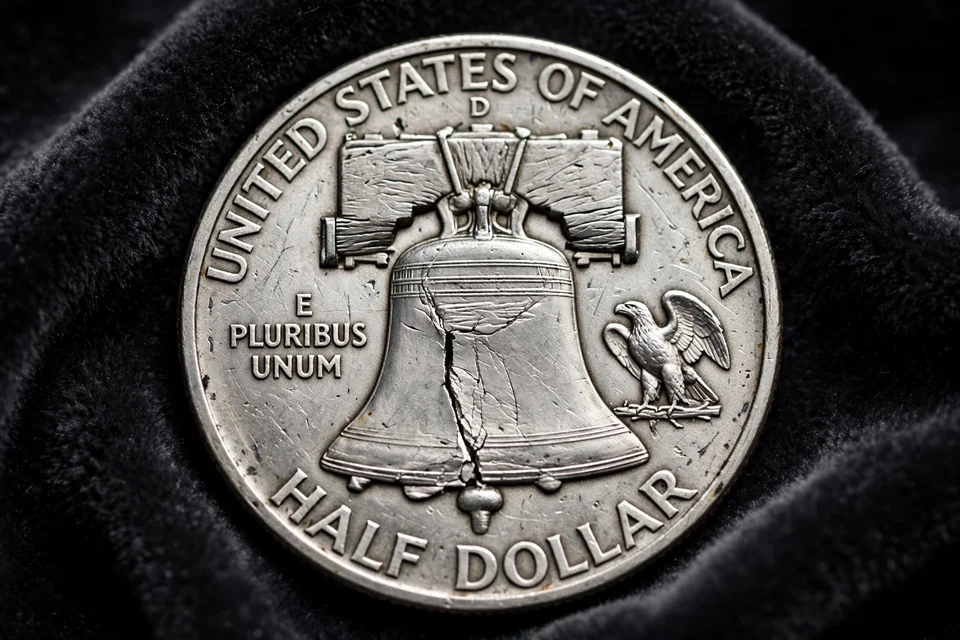
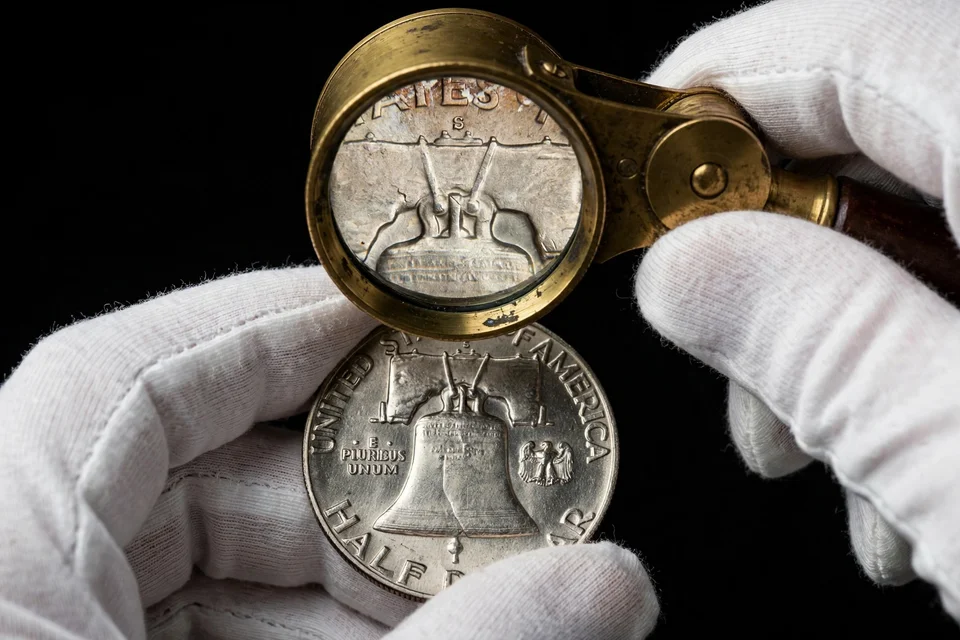
The date sits on the obverse, to the right of Franklin's portrait. The mint mark, when present, sits on the reverse, directly above the wooden yoke of the Liberty Bell and below the E in STATES. Philadelphia coins carry no mint mark; D means Denver and S means San Francisco. Check a faint mark under a 10x loupe: the mint mark is often the difference between a $20 coin and a $100 coin.
Know the design you are holding
The obverse shows Franklin facing right, with LIBERTY above, IN GOD WE TRUST below, and Sinnock's JRS initials under his shoulder. The reverse is dominated by the Liberty Bell, complete with its famous crack, with UNITED STATES OF AMERICA above and HALF DOLLAR below. E PLURIBUS UNUM appears in three lines to the left of the bell, and a small eagle perches to the right, required by the Coinage Act of 1873.
Check the silver first
Every Franklin half is 90% silver and 10% copper, weighs 12.50 grams, measures 30.6 millimeters across, and carries a reeded edge. At late-October 2026 silver prices, around $54+ per ounce, melt value sits near $19+, and no problem-free example should trade below that floor. Common late-1950s and early-1960s dates trade closest to it, typically $20+ to $25+ worn.
Grade-by-Grade Values for Common Dates
Grade is the first multiplier on a Franklin half, and strike is the second. A worn common date is a silver coin; the same date in gem mint state is a collector coin, and with Full Bell Lines it can be worth several times more again. This table covers common dates, not the key dates below.
| Grade | What to look for | Common-date value |
|---|---|---|
| Good (G-4) | Heavy wear, flat hair | $20+ |
| Fine (F-12) | Moderate wear, partial bell lines | $22+ |
| Extremely Fine (XF-40) | Light wear on cheek and bell crown | $25+ |
| About Uncirculated (AU-50) | Trace wear, most luster intact | $30+ |
| Mint State 60 (MS-60) | No wear, bag marks, dull luster | $35+ |
| Mint State 63 (MS-63) | Choice, few marks, good luster | $45+ |
| Mint State 65 (MS-65) | Gem, sharp strike, clean fields | $100+ |
| Mint State 65 Full Bell Lines (MS-65 FBL) | Gem, complete bell lines | $200+ |
Wear shows first on Franklin's cheek, the hair around his ear, and the upper bell. Bag marks are the enemy of gem grades: late-1950s coins were heavily hoarded in bags, so a clean MS-65 is far scarcer than the mintage suggests.
The Key Dates That Drive the Series
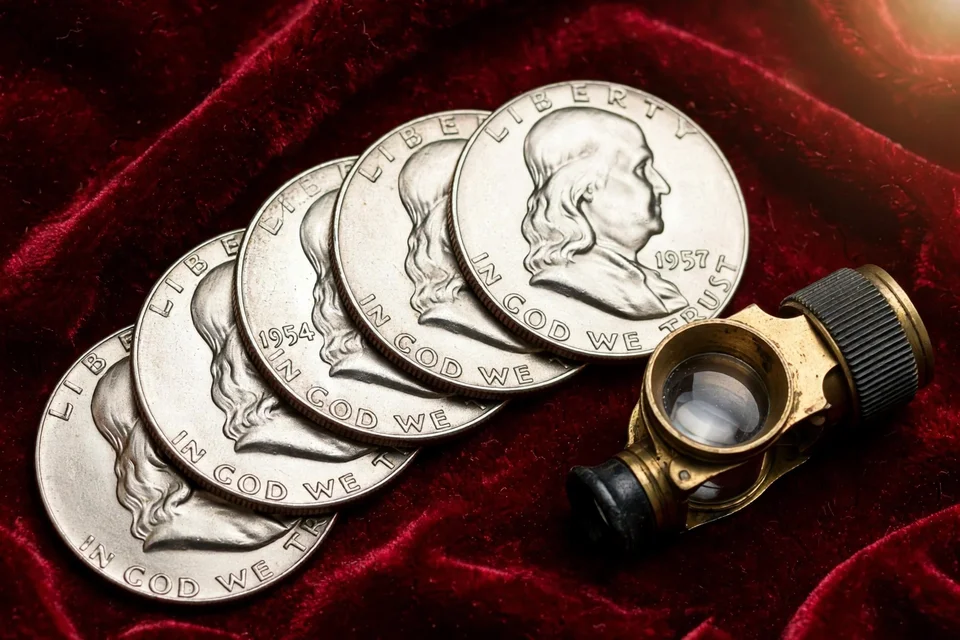
No regular-issue Franklin half is truly rare, but a handful of dates carry real premiums in every grade, and several more become condition rarities at the top of the scale.
| Date and mint | Mintage | Worn value | Mint-state value |
|---|---|---|---|
| 1949-S San Francisco (key date) | 3,744,000 | $40+ | $150+ |
| 1955 Philadelphia (lowest mintage) | 2,498,181 | $25+ | $85+ |
| 1958 Philadelphia | 4,042,000 | $20+ | $75+ |
The 1949-S key date
The 1949-S is the key date by mintage, at 3,744,000 coins, and it is notoriously poorly struck: San Francisco ran worn dies through 1949, so most examples show soft, incomplete bell lines. A worn 1949-S brings $40+, a mint-state example $150+, and an MS67+ FBL example has reached $31,725+. Only around 672 FBL specimens have been certified against more than 4,400 standard uncirculated examples.
The 1955 low-mintage date
The 1955 Philadelphia issue, at 2,498,181 coins, is the lowest-mintage issue of the series. It is a bit more valuable in all grades, and it carries the Bugs Bunny die clash. A worn 1955 brings $25+, a gem $85+, and a Bugs Bunny example in top grade has sold for $3,120+.
The 1948 first year and the 1953-S
The 1948 first-year issue is popular as a type coin; a 1948 graded MS68 FBL sold for $84,000+ at Stack's Bowers in April 2024. The 1953-S is the standout strike rarity: it almost never comes fully struck with Full Bell Lines, though circulated examples trade near $25+.
Full Bell Lines: The Designation That Changes Everything
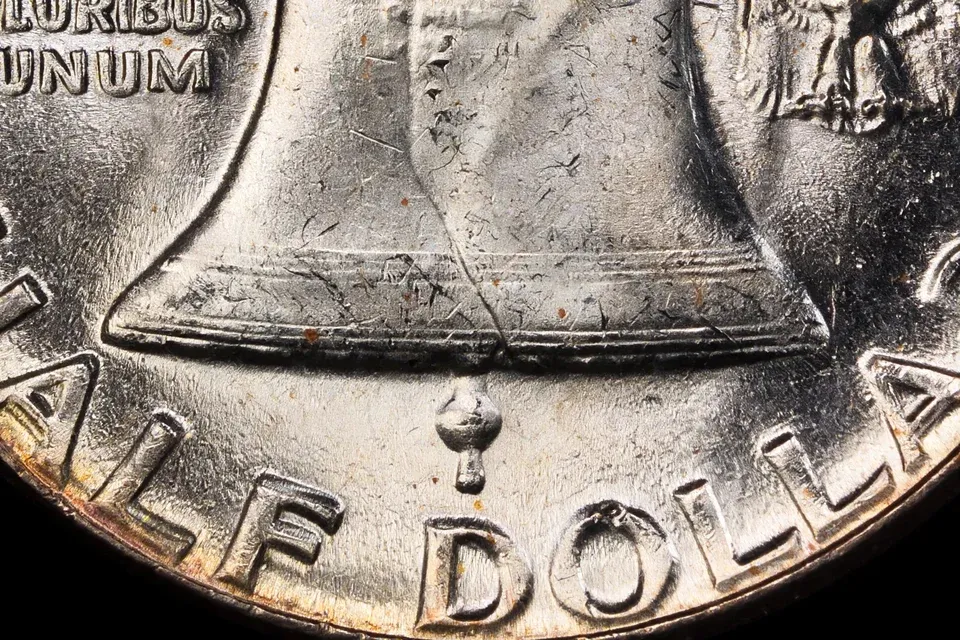
Full Bell Lines, abbreviated FBL, is the most important value factor on a Franklin half after date and grade. It means the horizontal lines across the bottom of the Liberty Bell are complete and fully separated. To qualify, all seven incuse lines must show completely across the bell, and the three wisps of hair to the right of Franklin's ear must be distinct rather than blended. PCGS awards it only at MS60 or better.
The lines were often weakly struck because the dies wore quickly, especially on San Francisco coins and the worn-hub issues of 1952 through 1959. That is why an FBL coin can be worth two to ten times a standard-strike coin of the same date and grade: a 1958 Philadelphia half with no distinct bell detail retails around $400+ in MS67, while an MS67 FBL example trades near $1,850+.
In September 2018, a toned 1958 Philadelphia half graded PCGS MS67+ Full Bell Lines, one of only two graded that high, sold for $129,500+ at Legend Rare Coin Auctions' Regency 28 sale against a $15,000+ to $17,500+ estimate. No finer Franklin half of any date has been graded by PCGS.
Varieties and Errors Worth Checking
The 1955 Bugs Bunny die clash
The Bugs Bunny variety, cataloged as FS-401, is a die clash: the dies struck each other without a planchet between them, and the eagle's wing feathers transferred onto the obverse die near Franklin's mouth, so Franklin appears to have two protruding buck teeth. Most famous on the 1955 Philadelphia issue, it adds roughly 20% to 60% over a regular example. Circulated examples trade $25+ to $50+, mint-state $100+, and the finest have topped $3,000+.
The 1961 Doubled Die Reverse proof
The 1961 proof Doubled Die Reverse, cataloged as FS-801, shows strong doubling on the reverse lettering, most clearly on E PLURIBUS UNUM. Struck in proof condition only, among 3,028,244 proof halves that year, it trades $600+ in lower grades and $3,000+ in gem. Check any 1961 proof under a loupe before assuming it is ordinary.
The Goiter and other die clashes
The Goiter variety, cataloged as FS-402, is another die clash, leaving a raised lump near Franklin's neck or jawline, valued $95+ to $775+. Doubled die reverses on other dates trade $30+ to $425+. Any Franklin half with a raised lump, a doubled legend, or teeth on Franklin that should not be there deserves a closer look before it is spent or sold as silver.
Proofs, Cameo, and the 1950 Low
Proof Franklin halves were struck at Philadelphia only, from 1950 through 1963. The 1950 proof set is the lowest-mintage proof issue at 51,386 sets, while the 1962 proof mintage reached 3,218,019. A standard proof in PR65 trades $20+ to $50+, cameo proofs $30+ to $1,500+, and the rarest Deep Cameo examples $240+ to $46,000+.
Before You Sell or Spend One
Never clean a Franklin half: cleaning strips surfaces and turns a $100 coin into a $20 coin with a Details grade. Weigh any coin you doubt: a genuine Franklin half weighs 12.50 grams and is non-magnetic. Check date, mint mark, then bell lines: a common date with full lines can beat a key date without them. If your coin looks uncirculated or shows doubling or a clash, get it certified before selling.
Frequently Asked Questions
How much is a Franklin half dollar worth?
Most Franklin half dollars are worth $20+ to $30+ circulated, because every one holds 0.36169 troy ounces of 90% silver worth near $19+ in melt alone. Mint-state common dates run $35+ to $150+, the 1949-S reaches $1,000+ in gem, and the finest known example sold for $129,500+.
What is a Full Bell Lines Franklin half dollar?
A Full Bell Lines, or FBL, Franklin half shows all seven incuse lines completely across the bottom of the Liberty Bell, plus three distinct wisps of hair beside Franklin's ear. PCGS awards it only at MS60 or better, and FBL coins often trade two to ten times a standard-strike coin.
Where is the mint mark on a Franklin half dollar?
The mint mark sits on the reverse, above the wooden yoke of the Liberty Bell. Philadelphia coins have no mint mark, Denver coins show a D, and San Francisco coins show an S. Use a 10x loupe: the mark is small and can be weakly struck.
Is a Franklin half dollar made of real silver?
Yes. Every Franklin half dollar from 1948 through 1963 is 90% silver and 10% copper, weighs 12.50 grams, and holds 0.36169 troy ounces of pure silver, giving every problem-free example a melt floor near $19+ at late-October 2026 silver prices.
What is the Bugs Bunny Franklin half dollar?
The Bugs Bunny variety, cataloged as FS-401, is a die clash in which the eagle's wing feathers impressed onto the obverse die near Franklin's mouth, making him appear to have buck teeth. Most famous on the 1955 Philadelphia issue, it adds roughly 20% to 60% and trades from $25+ circulated to $3,000+ in top grade.
Which Franklin half dollar is the most valuable?
By auction record, the most valuable Franklin half dollar is the toned 1958 Philadelphia issue graded PCGS MS67+ Full Bell Lines, sold for $129,500+ at Legend in September 2018. By date, the 1949-S is the key date; by condition, the 1948 MS68 FBL at $84,000+ and the 1949-D MS67 FBL at $25,200+ show how far strike and grade can carry one coin.
A Franklin half costs nothing to check, and the difference between a $20 coin and a $129,500 coin is one date, one mint mark, and one set of bell lines. Before you sell any silver half dollar you are unsure about, run it through The Diggin Dave's free Coin Value Checker to confirm its date, mint mark, and value range, use the Key Date Checker to see whether your date is a key issue, and if your coin looks uncirculated, Grade-or-Not helps decide whether certification is worth the fee.
Related Reading
- How Much Is a Walking Liberty Half Dollar Worth? From $25+ Silver to $188,000+ Keys — the half dollar the Franklin replaced, with the same 0.36169 ounces of silver
- 1964 Kennedy Half Dollar Value: What Yours Is Worth — the half dollar that replaced Franklin in 1964, and the only 90% silver Kennedy issue
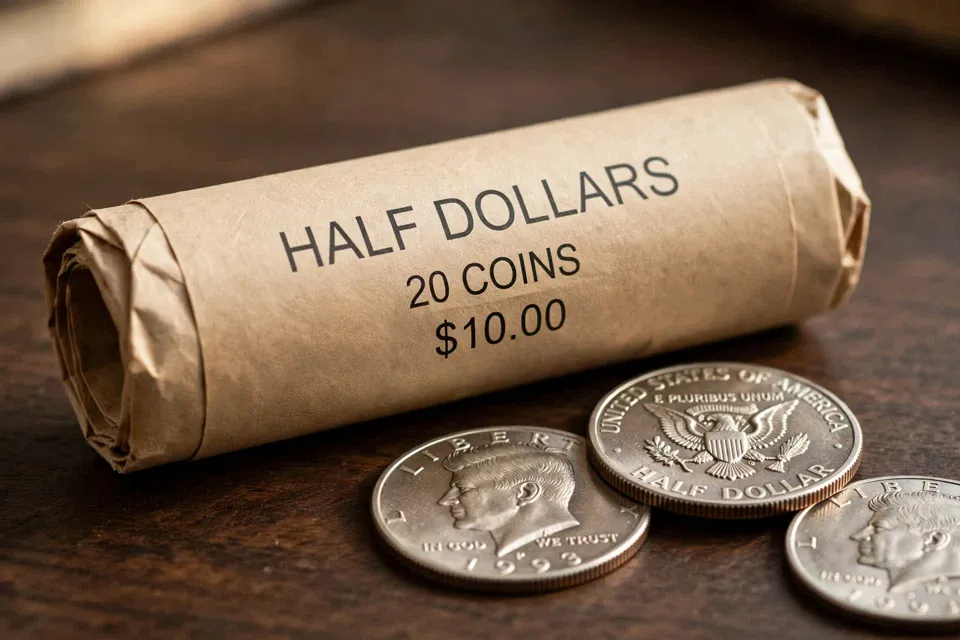
- How Many Half Dollars in a Roll? The Complete Half Dollar Roll Guide — Values, Silver Finds & Roll-Hunting Tips — 20 half dollars per roll, and what a roll of silver halves is worth in melt