How Much Is a Walking Liberty Half Dollar Worth? From $25+ Silver to $188,000+ Keys
Half Dollars · 9 min read · Published October 27, 2026
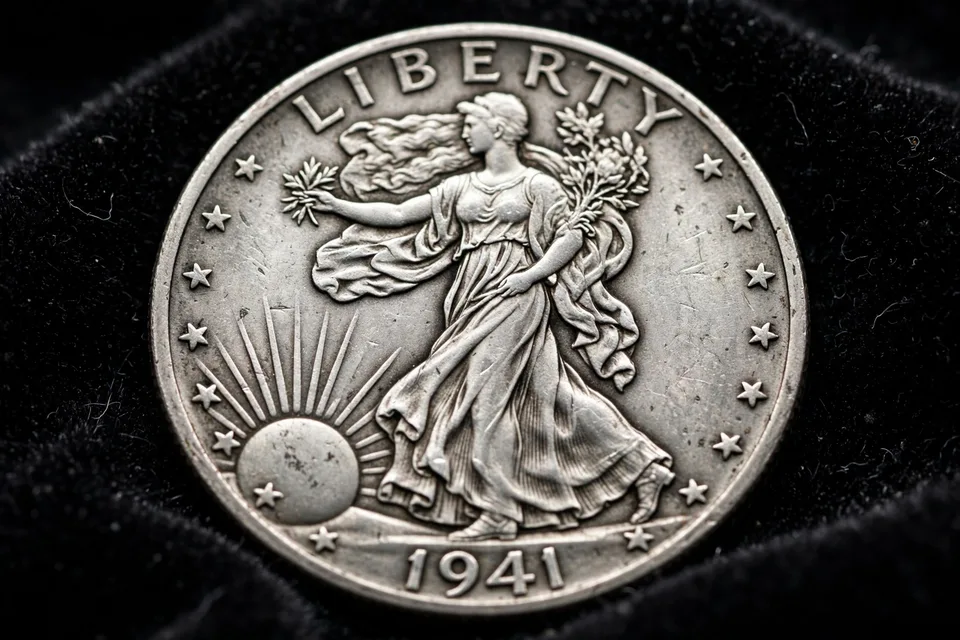
How much is a Walking Liberty half dollar worth? Most circulated Walking Liberty half dollars are worth $25+ — the silver inside alone is worth about $20 at late-October 2026 prices — while common-date uncirculated examples start around $60+ and key dates climb fast: a worn 1921-D starts around $250+, a 1938-D in mint state reaches $950+, and the finest 1921-S has sold for $188,000. Struck from 1916 to 1947 and designed by Adolph A. Weinman, the Walking Liberty half is widely called America's most beautiful circulating coin — and its value comes down to three things: the date, the mint mark, and the grade.
Why the Walking Liberty Half Is Worth More Than Fifty Cents
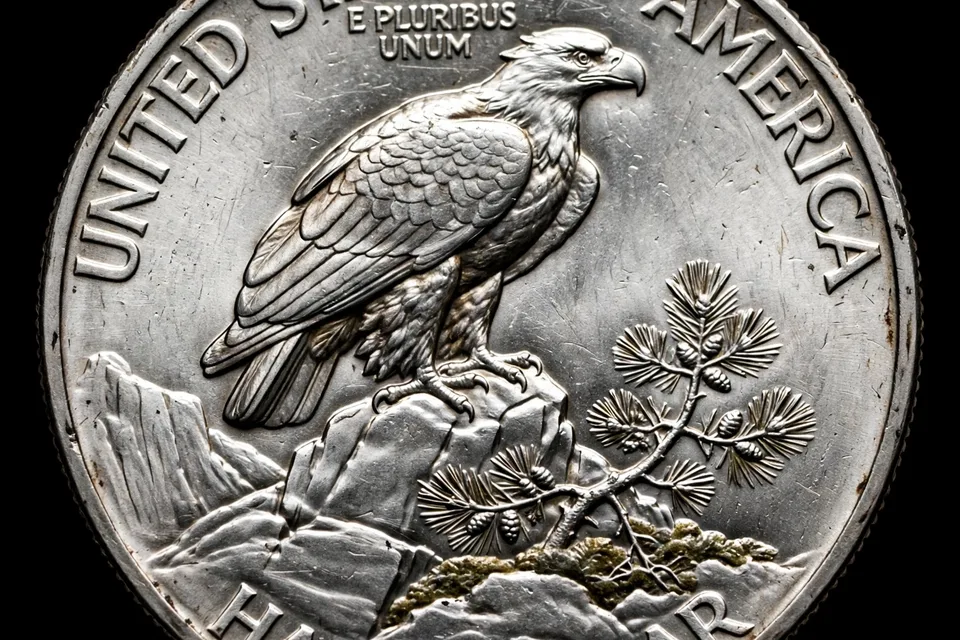
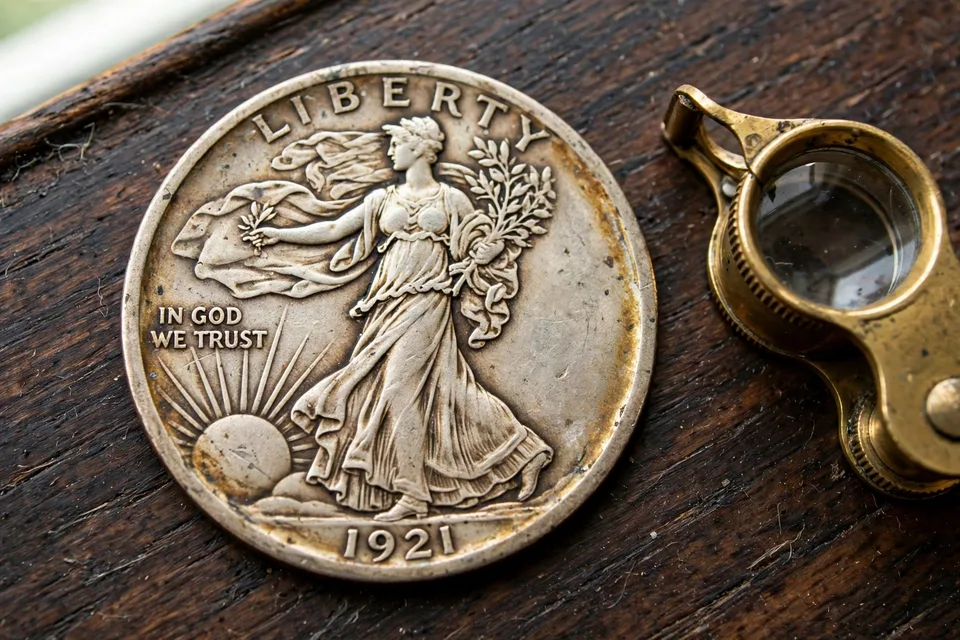
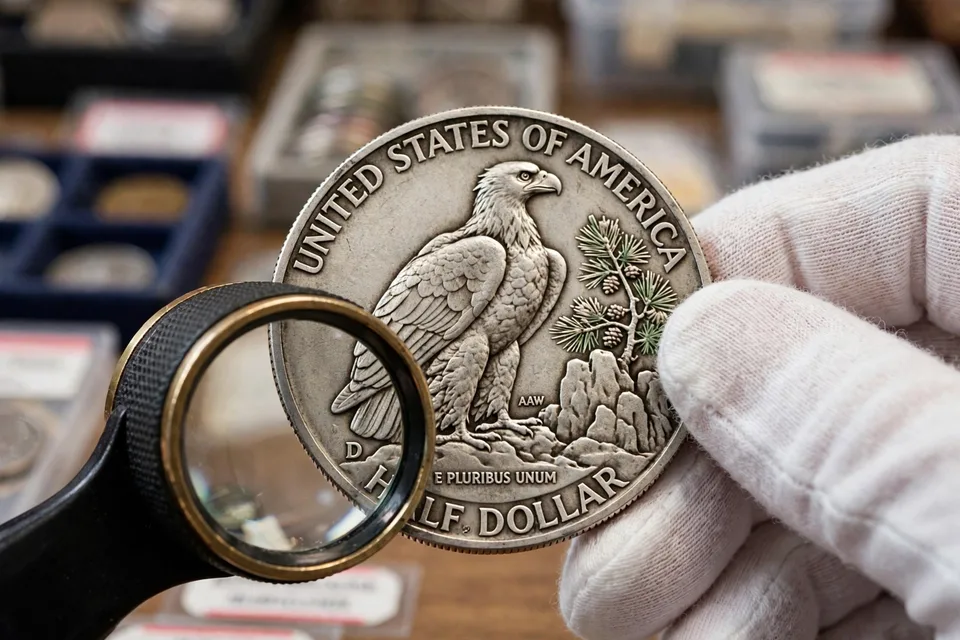
The Walking Liberty half dollar replaced the Barber half dollar in 1916, after Mint Director Robert W. Woolley ordered new designs for the dime, quarter, and half dollar. Weinman, a sculptor, won the competition for the dime and the half dollar. His obverse shows Liberty draped in the American flag, walking toward a rising sun. His reverse shows a bald eagle perched on a rocky mountain crag beside a pine sapling.
The design was so admired that the Mint brought it back in 1986 for the obverse of the American Silver Eagle, where it still appears today. That second life keeps the Walking Liberty half in front of millions of collectors, and it is one reason even common-date examples sell above their silver value.
Every Walking Liberty half dollar is 90% silver and 10% copper, weighs 12.50 grams, measures 30.6 millimeters across, and has a reeded edge. Each one contains 0.36169 troy ounces of pure silver — the floor under every genuine example, no matter how worn, and the reason none should ever be spent as fifty cents.
Walking Liberty Half Dollar Value by Date and Grade
Grade is the great divider in this series. A common-date coin in Good condition is a silver coin; the same date in gem mint state is a collector's prize. Key dates carry premiums in every grade — even heavily worn 1921 issues are worth ten times a common date.
| Date | Good-4 | Very Fine-20 | MS-65 |
|---|---|---|---|
| Common dates (1940s) | $25+ | $30+ | $150+ |
| 1916 (Philadelphia) | $100+ | $225+ | $1,150+ |
| 1916-D, obverse mint mark | $100+ | $225+ | $1,075+ |
| 1916-S, obverse mint mark | $150+ | $800+ | $4,500+ |
| 1921 (Philadelphia) | $150+ | $2,000+ | $11,250+ |
| 1921-D | $250+ | $3,250+ | $13,250+ |
| 1921-S | $200+ | $3,750+ | $45,000+ |
| 1938-D | $75+ | $150+ | $950+ |
Three patterns stand out. First, the 1940s coins are the affordable entry point: high mintages, plenty of survivors, prices close to silver in circulated grades. Second, the first-year 1916 issues are scarce in every grade — only 608,000 Philadelphia, 1,014,400 Denver, and 508,000 San Francisco coins were struck. Third, the 1921 trio is in a different league: with mintages of just 246,000, 208,000, and 548,000, all three are key dates, and the 1921-D is the scarcest Walking Liberty in circulated grades.
The Silver Floor: What the Metal Alone Is Worth
At silver near $55 per ounce, the 0.36169 ounces inside a Walking Liberty half dollar are worth about $20. That is the absolute floor: a genuine example in any condition is worth at least its melt value, and dealers pay melt plus a small premium for common-date circulated coins, putting the 1940s circulated band at $25+ to $45+.
The floor also explains why condition matters: an MS65 coin holds the same silver as a Good-4 coin, but it survived eighty years without a mark or a rub. Silver sets the minimum; rarity and preservation set the maximum.
How to Find Your Mint Mark — and Why 1917 Has Two Kinds
The mint mark is the first thing to check, because it can change a coin's value by thousands of dollars. Philadelphia coins carry no mark, Denver coins a D, San Francisco coins an S — but where you look depends on the year.
On 1916 coins and early 1917 coins, the mint mark sits on the obverse, below IN GOD WE TRUST near the letters "Tr". Midway through 1917, the Mint moved it to the reverse, at the lower left near the edge at the 7 o'clock position, below the pine branch. Both placements exist for 1917-D and 1917-S — and the obverse-mark varieties are scarcer: the 1917-S obverse-mark mintage was just 952,000 against 5,554,000 for the reverse-mark version, and the 1917-D obverse-mark issue, at 765,400, is far scarcer than its 1,940,000-coin reverse-mark counterpart.
From 1918 onward, every mint mark sits on the reverse at the lower left. If your 1916 or 1917 coin shows no mark on the reverse, check the obverse before concluding it is a Philadelphia coin — an obverse-mark Denver or San Francisco coin misidentified as Philadelphia is one of the most common and most expensive mistakes in this series.
The Key Dates That Drive the Series
The 1916 trio opens the series with low mintages across the board, and the 1916-S, with only 508,000 struck, is the scarcest first-year issue — worth $150+ even heavily worn and $4,500+ in choice uncirculated condition.
The 1921 trio is the heart of the series. After the First World War, demand for coinage collapsed and the Mint struck only tiny numbers: 246,000 at Philadelphia, 208,000 at Denver, and 548,000 at San Francisco. No Walking Liberty halves were struck in 1922, which makes the 1921 issues the last of their era. The 1921-D is the key date by mintage and the scarcest in circulated grades; the 1921-S is the condition rarity, weakly struck and hardest to find in gem condition — which is why the series auction record belongs to a 1921-S.
The 1938-D is the sleeper key date. With just 491,600 struck, it is the lowest-mintage late-series issue, and gem examples have sold for $50,000+. The 1919-D and 1919-S are condition rarities the same way: available worn, but extremely scarce with sharp strikes in mint state. Variety collectors chase the 1946 doubled die obverse, worth $125+ in Very Fine and $950+ in choice uncirculated condition.
Record Sales: What the Best Walkers Actually Bring
The market is moving right now. The Mack C. Chase Collection, offered by Stack's Bowers, put fresh records on the board in September 2026: a 1921-D graded PCGS MS-66 with CAC and CMQ approval brought $183,000, a 1917-D with the reverse mint mark in PCGS MS-67 brought $122,000, a 1918-D in MS-66 brought $115,900, and a 1921-S in MS-65 brought $109,800. The sale totaled $2,448,125 across 253 lots, with a second Chase offering following in November 2026.
| Coin | Grade | Sale | Price |
|---|---|---|---|
| 1921-S | NGC MS-66 | Heritage, June 2016 | $188,000 |
| 1921-D | PCGS MS-66, CAC/CMQ | Stack's Bowers (Chase), Sept 2026 | $183,000 |
| 1921-D | PCGS MS-66 | Heritage, Jan 2018 | $168,000 |
| 1917-D, reverse mint mark | PCGS MS-67 | Stack's Bowers (Chase), Sept 2026 | $122,000 |
| 1943 | MS-68+ | Stack's Bowers, June 2021 | $120,000 |
| 1918-D | MS-66 | Stack's Bowers (Chase), Sept 2026 | $115,900 |
| 1944 | MS-68 | Heritage, 2010 | $109,250 |
| 1921-S | MS-65 | Stack's Bowers (Chase), Sept 2026 | $109,800 |
| 1929-D | PCGS MS-67+ | Heritage | $82,250 |
The lesson is consistent: strike quality and preservation beat mintage alone. San Francisco coins from 1940 to 1944 are notorious for weak strikes — Liberty's left hand and skirt lines often come out flat — so a sharply struck 1943-S or 1944-S in gem condition is worth multiples of a softly struck twin.
What Lowers a Walking Liberty Half's Value
Four things cut value. First, cleaning: a polished Walker loses its original surface, and grading services mark cleaned coins as Details instead of a numeric grade — cutting value to a fraction. Never polish one. Second, damage: rim dings, deep scratches, and holes turn a collectible into a melt coin. Third, weak strike: common on San Francisco issues, it caps the grade no matter how mark-free the surfaces are. Fourth, counterfeits: a genuine example weighs 12.50 grams and measures 30.6 millimeters, silver is not magnetic, and genuine lettering is sharp and even — mushy letters and a pitted surface warn of a cast fake. For any coin worth $200+, certification removes the doubt.
Should You Get Your Walking Liberty Half Graded?
For most circulated common-date Walkers, grading is not worth the fee — the coin is worth $25+ to $45+. Grade it when it looks uncirculated with full luster, is a key date in any grade, is a 1916 or 1917 obverse-mark variety, or is worth $200+ and needs buyer trust. Certification also settles the mint-mark question permanently, which matters most for the 1917 varieties.
Final Thoughts
How much is a Walking Liberty half dollar worth comes down to four questions: what date is it, which mint struck it, where is the mint mark, and what grade does it hold. A worn 1940s coin is worth $25+ in silver and history; a 1938-D or 1916-S is worth hundreds to thousands; a gem 1921-S is worth $188,000. Check the date, check both sides for the mint mark, and never spend one before you know which mint made it.
Frequently Asked Questions
How much is a Walking Liberty half dollar worth?
Most circulated examples are worth $25+ to $45+, driven by about $20 in silver at late-October 2026 prices. Common-date uncirculated examples start around $60+, the 1921-D starts around $250+ even worn, and the finest 1921-S has sold for $188,000.
What is the most valuable Walking Liberty half dollar?
The 1921-S holds the series record: an NGC MS-66 sold for $188,000 at Heritage in June 2016. The 1921-D is the key date by mintage, with just 208,000 struck, and a PCGS MS-66 brought $183,000 at Stack's Bowers in September 2026.
Where is the mint mark on a Walking Liberty half dollar?
On 1916 and early 1917 coins, it is on the obverse below IN GOD WE TRUST. From mid-1917 through 1947, it is on the reverse at the lower left, below the pine branch. Philadelphia coins have no mark; D means Denver, S means San Francisco.
Are Walking Liberty half dollars silver?
Yes. Every one struck from 1916 to 1947 is 90% silver and 10% copper, weighing 12.50 grams and containing 0.36169 troy ounces of pure silver — worth about $20 at late-October 2026 prices.
Why is the 1938-D Walking Liberty half dollar so valuable?
Only 491,600 were struck at Denver in 1938 — the lowest mintage of any late-series issue — and gem survivors are scarce. It is a required date for a complete set, which is why worn examples start around $75+ and gem examples have sold for $50,000+.
Should I clean my Walking Liberty half dollar?
No. Cleaning strips the original surface and causes grading services to mark it as Details instead of a numeric grade, cutting its value sharply. Handle it by its edge, store it in a holder, and leave the surfaces as you found them.
A Walking Liberty half dollar costs nothing to check, and the difference between a $25 coin and a $188,000 coin is one date, one mint mark, and one grade step. Before you sell any silver half dollar you are unsure about, run it through The Diggin Dave's free Coin Value Checker to confirm its date, mint mark, and value range, use the Key Date Checker to see whether your date is a key issue, and if your coin looks uncirculated, Grade-or-Not helps decide whether certification is worth the fee.
Related Reading
- 1964 Kennedy Half Dollar Value: How Much Is a 1964 Half Dollar Worth? — the only 90% silver Kennedy half, worth $20+ in melt alone
- How Many Half Dollars in a Roll? The Complete Half Dollar Roll Guide — Values, Silver Finds & Roll-Hunting Tips — 20 halves to a roll, $10 face, plus silver-half roll math
- How to Grade a Coin: The Complete Guide to the 1–70 Scale, Luster, Wear & Value — the grading scale behind every MS price in this guide