How Much Is a Peace Dollar Worth? From $40+ Silver to $129,250+ Keys
Dollar Coins · 9 min read · Published October 28, 2026
A Peace dollar is worth $40+ in circulated condition for a common date, because every original Peace dollar holds 0.7734 troy ounces of 90% silver. Most common dates trade $40+ to $75+ worn, mint-state examples run $75+ to $500+, and the keys climb far higher: the 1928 Philadelphia issue starts near $275+ worn and has sold for $129,250+ in top grade, while the 1921 high-relief issue brings $150+ circulated and $1,100+ choice uncirculated. Date, mint mark, and grade decide where your coin sits.
The Silver Floor: What the Metal Alone Is Worth
Every Peace dollar struck for circulation between 1921 and 1935 carries the same silver: 26.73 grams of 90% silver and 10% copper, equal to 0.7734 troy ounces of pure silver, in a 38.1-millimeter coin with a reeded edge. At late-October 2026 silver prices, around $54+ per ounce, the melt value of a Peace dollar sits near $42+. No original Peace dollar should trade below that floor unless it is damaged, holed, or a counterfeit. Common Philadelphia dates from 1922 through 1925 trade closest to the floor, typically $40+ to $60+ worn.
How to Identify Your Peace Dollar
Read the date and the mint mark first
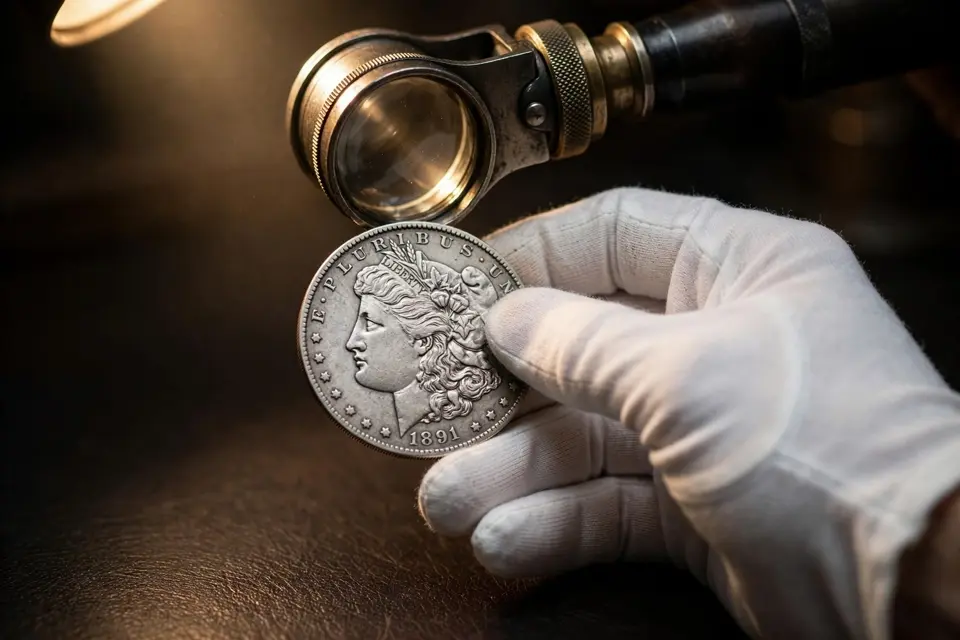
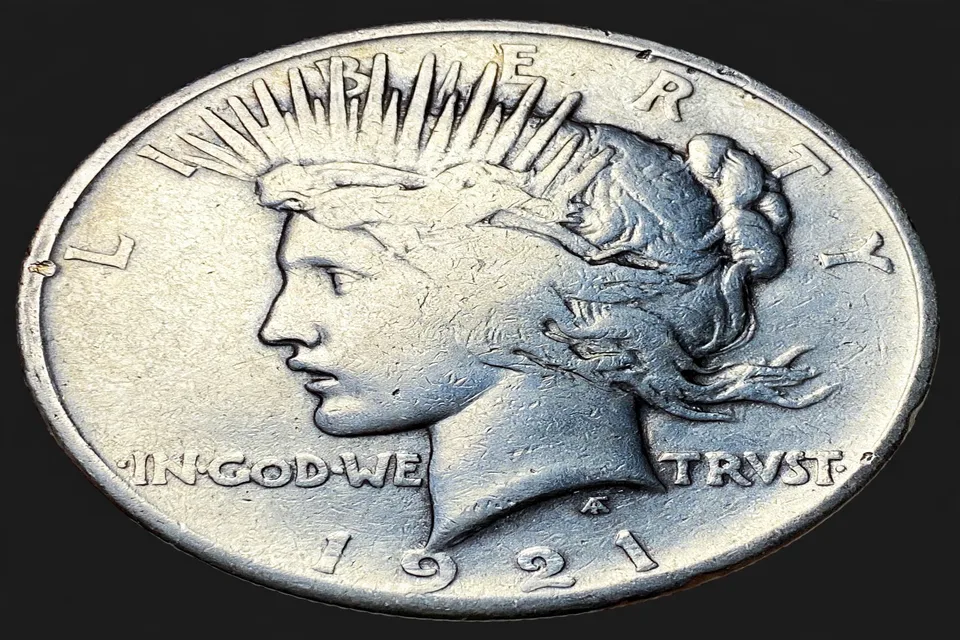
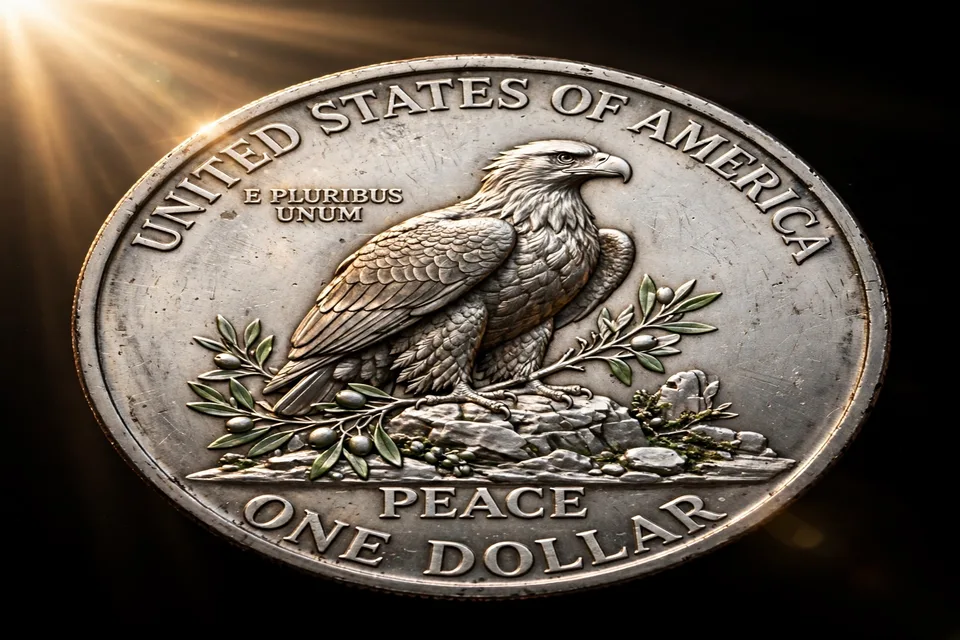
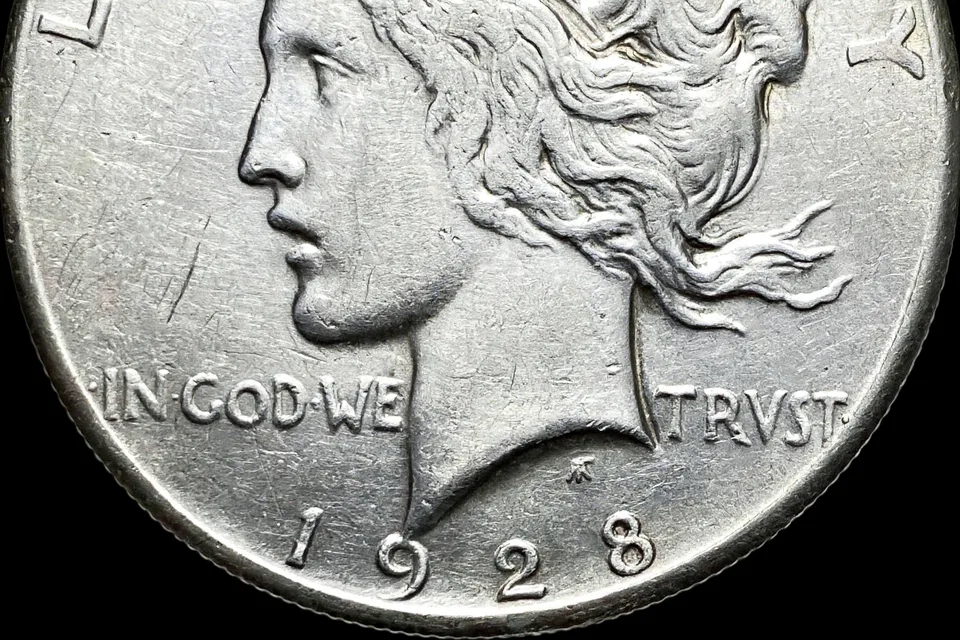
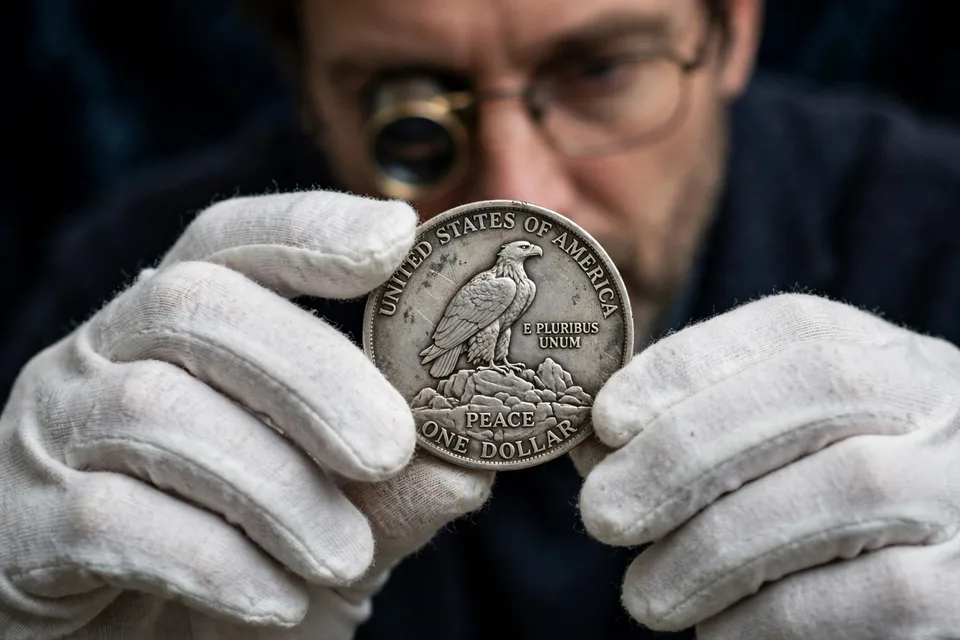
The date sits on the obverse, below Liberty and the motto IN GOD WE TRVST, where the letter V stands in for U in the classical Latin style. The mint mark, when present, sits on the reverse, just below the eagle's tail feathers and above the word ONE in ONE DOLLAR. Philadelphia coins carry no mint mark. A small D means Denver and a small S means San Francisco; check faint mint marks under a 10x loupe. A 1928 with no mint mark is the series key date, while a 1928-S is common in circulated grades.
High relief versus low relief
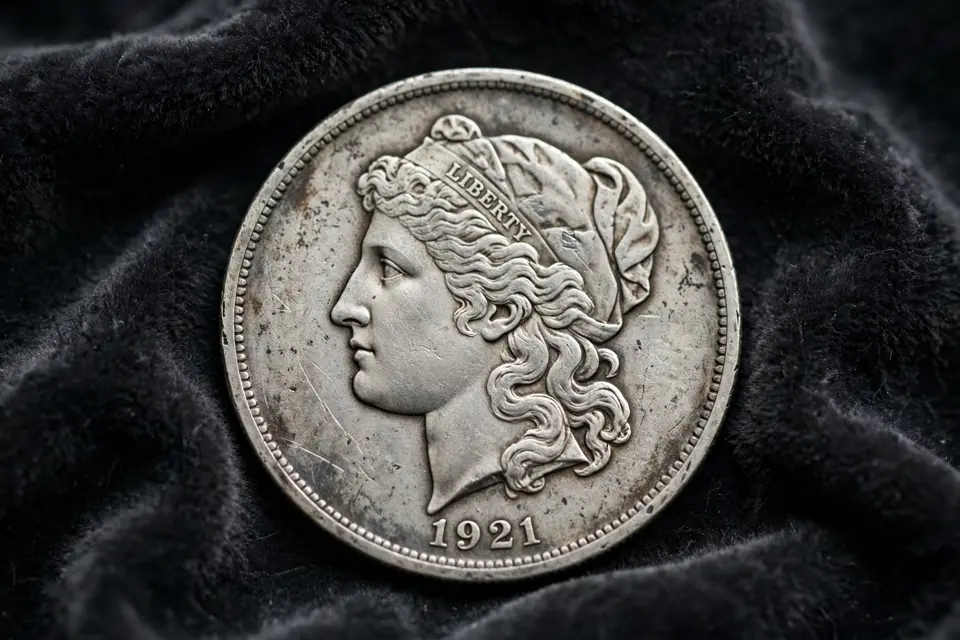
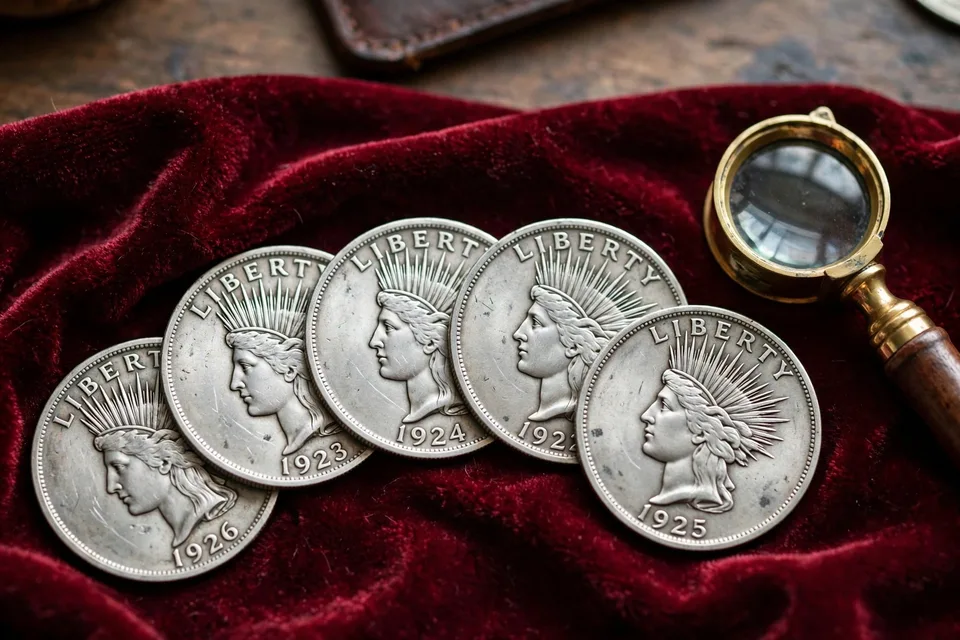
The 1921 Peace dollar is the only regular-issue year struck in high relief: Liberty's features stand up sharply from the field, the rim is high, and the centers often show weak striking. The high-relief dies wore out after fewer than 25,000 strikes per die pair, compared with up to 200,000 for a Morgan die, so in February 1922 the relief was lowered for every Peace dollar through 1935. A small number of 1922 high-relief proofs also exist, but they never circulated.
Know the design you are holding
Anthony de Francisci, a 34-year-old sculptor, won the 1921 design competition run by the Commission of Fine Arts, beating seven other artists for a $1,500 prize. He modeled Liberty on his wife, Teresa, wearing a spiked diadem. The reverse shows a bald eagle perched on a rock at sunrise, clutching an olive branch, with PEACE below it. His first reverse showed the eagle over a broken sword, but critics read it as defeat rather than peace, so Chief Engraver George Morgan carved the sword out of the hub by hand. The coin was Farran Zerbe's idea: a dollar marking the peace after the First World War, struck under the Pittman Act of 1918, which had ordered hundreds of millions of Morgan dollars melted for wartime silver.
The Key Dates That Drive the Series
| Date and mint | Mintage | Worn value | Mint-state value |
|---|---|---|---|
| 1921 high relief (Philadelphia) | 1,006,473 | $150+ | $1,100+ |
| 1922 Philadelphia (common) | 51,737,000 | $40+ | $75+ |
| 1923 Philadelphia (common) | 30,800,000 | $40+ | $75+ |
| 1927 Philadelphia | 848,000 | $60+ | $325+ |
| 1928 Philadelphia (key date) | 360,649 | $275+ | $900+ |
| 1928 San Francisco | 1,632,000 | $45+ | $500+ |
| 1934 San Francisco | 1,011,000 | $75+ | $1,000+ |
| 1935 San Francisco | 1,964,000 | $45+ | $300+ |
The 1928 Philadelphia key date
The 1928 Philadelphia Peace dollar is the key date of the series, with the lowest mintage of any regular-issue Peace dollar at just 360,649 coins. It is not as rare in mint state as its mintage suggests, because the Mint announced the small production in advance and collectors saved the coins: about 40,000 survive, more than half mint-state. Only around 800 are believed to grade MS65 or better. A worn example brings $275+, an MS63 $900+, an MS65 above $4,000+, an MS66 around $28,000+, and the record stands at $129,250+ for a PCGS MS66+ example sold by Legend Rare Coin Auctions in April 2023.
The 1921 high-relief first year
The 1921 Peace dollar was struck only in December 1921 and released on January 4, 1922, through the Federal Reserve Bank of New York, with each customer limited to a single dollar. Its mintage of 1,006,473 makes it a one-year type: no other circulating Peace dollar shares its high relief. Worn examples trade at $150+, About Uncirculated examples at $400+, and choice uncirculated examples at $1,100+, with fully struck gems reaching $25,000+. Because the high-relief design struck so weakly, most surviving 1921 dollars show softness on Liberty's hair and the eagle's feathers even when never circulated, so a sharply struck example commands a real premium.
The 1934-S condition rarity
The 1934-S is the great trap of the series: it looks common on paper, with a mintage of 1,011,000, yet it is the rarest Peace dollar in MS63 and MS64 grades, with only an estimated 1,600 to 3,200 survivors in MS63 and 800 to 1,500 in MS64. Unlike the 1928 Philadelphia issue, nobody saved the 1934-S in quantity, and survivors spent decades in bags, picking up marks. Circulated, a 1934-S brings $75+, but in MS63 it trades in the low four figures and in MS65 well into five figures.
The other dates to check
The 1927 Philadelphia issue, at 848,000 struck, is the second-lowest mintage in the series, bringing $60+ worn and an MS66 record of $36,000+ at Stack's Bowers in August 2018. The 1927-D brings $850+ choice uncirculated, the 1924-S $725+ with an MS66 record of $54,625+ at Heritage in April 2011, and the 1925 Philadelphia issue produced a unique PCGS MS68 that sold for $89,125+ at Heritage in August 2011.
VAM Varieties Worth a Second Look
Peace dollar collectors also chase VAM varieties, named for researchers Leroy Van Allen and A. George Mallis, which catalog die differences from doubled letters to repunched mint marks. The 1928-S VAM-3 Doubled Motto, a Top 50 variety, shows clear doubling on the reverse motto, with fewer than 140 examples certified combined; an MS64 sold for $1,380+ at Heritage in January 2022. The 1923 Doubled Tiara, VAM-2, shows separation lines between the doubled tiara rays, and an MS64 sold for $5,000+.
Grade-by-Grade Values for Common Dates
| Grade | Common date value | What to look for |
|---|---|---|
| Good to Fine | $40+ | Full rims, readable date, heavy wear on cheek and breast |
| Very Fine | $45+ | Light wear on highest points, most hair detail visible |
| Extremely Fine | $55+ | Slight wear on cheek and feathers, strong protected luster |
| About Uncirculated | $60+ | Trace of rub on highest points, nearly full luster |
| MS63 | $75+ | Uncirculated with moderate marks, attractive luster |
| MS65 gem | $150+ | Sharp strike, minimal marks, strong luster and eye appeal |
Grading matters more than date for most Peace dollars: the gap between a worn and a gem common date is only about $100+, while the gap for a key date can be tens of thousands of dollars. Cleaned coins are the biggest value killer: a cleaned Peace dollar, recognizable by hairline scratches and a dull surface, routinely sells for little more than melt even when it is a key date. Never clean a Peace dollar.
The 1964-D That Never Was, and the Modern Reissues
In 1965 the Denver Mint struck 316,106 Peace dollars dated 1964, but Congress cancelled the program before any were released, and every coin was ordered melted. No 1964-D Peace dollar has ever been officially authenticated, and any offered for sale should be treated as a fake unless it carries authentication that has never yet existed. Peace dollars are among the most counterfeited American coins, so weight, diameter, and a certified holder are the real defenses, and certification by PCGS or NGC is worth the fee above $200+. The Mint returned to the design in 2021 for the centennial, striking 200,000 collector coins, and has issued annual collector Peace dollars since 2023 at 99.9% silver, trading as modern collectibles rather than as part of the classic series.
Final Thoughts
A Peace dollar is the most approachable classic silver dollar in American numismatics: a short series of just 24 regular issues, a beautiful design, and a silver floor under every example. Check the date and mint mark, then the relief on a 1921, then the surfaces for cleaning. Most coins you find will be common dates worth $40+ to $75+, but check twice for a 1928 Philadelphia dollar, a 1934-S in mint state, or any sharply struck 1921, because those are where a few minutes with a loupe can turn $40+ into a four- or five-figure discovery.
Frequently Asked Questions
How much is a common Peace dollar worth?
A common-date Peace dollar from 1922 through 1925 in worn condition is worth $40+ to $60+, tracking its melt value of about $42+ at late-October 2026 silver prices. Mint-state examples bring $75+ to $150+.
Why is the 1928 Peace dollar so valuable?
The 1928 Philadelphia Peace dollar had the lowest mintage in the series at just 360,649 coins. Even worn examples bring $275+, mint-state examples start at $900+, and the finest known example, graded PCGS MS66+, sold for $129,250+ at Legend Rare Coin Auctions in April 2023.
Where is the mint mark on a Peace dollar?
The mint mark sits on the reverse, just below the eagle's tail feathers and above the word ONE in ONE DOLLAR. Philadelphia coins have no mint mark, Denver coins show a D, and San Francisco coins show an S. Use a 10x loupe, because the mint mark is small and can be faint on worn coins.
How do I tell a 1921 high-relief Peace dollar from a 1922?
The 1921 dollar is the only regular-issue Peace dollar struck in high relief, so Liberty's features stand up sharply from the field and the rim is high, while 1922 and later dollars are noticeably flatter.
Is a Peace dollar real silver?
Yes. Every classic Peace dollar struck from 1921 through 1935 is 90% silver and 10% copper, weighing 26.73 grams and containing 0.7734 troy ounces of pure silver, giving even the most worn common date a melt value near $42+ at late-October 2026 prices. Modern collector Peace dollars struck since 2021 are a different product at 99.9% silver.
What is a 1964-D Peace dollar, and is it legal to own?
The Denver Mint struck 316,106 Peace dollars dated 1964 in 1965, but Congress cancelled the issue before release and ordered all of them melted. No example has ever been officially authenticated, so any 1964-D offered for sale should be treated as a counterfeit or fantasy piece.
A Peace dollar costs nothing to check, and the difference between a $40 coin and a $129,250 coin is one date, one mint mark, and one grade. Before you sell any silver dollar you are unsure about, run it through The Diggin Dave's free Coin Value Checker to confirm its date, mint mark, and value range, use the Key Date Checker to see whether your date is a key issue, and if your coin looks uncirculated, Grade-or-Not helps decide whether certification is worth the fee.
Related Reading
- How Much Is a 1921 Morgan Dollar Worth? From $40+ Melt to $240,000+ Proofs — the Morgan dollar that the Peace dollar replaced, with the same 0.7734 ounces of silver
- How Many Dollars in a Roll? The Complete Dollar Roll Guide — Values, Silver Finds & Roll-Hunting Tips — 25 dollar coins per roll, and what a roll of silver dollars is worth in melt
- How to Grade a Coin: The Complete Guide to the 1–70 Scale, Luster, Wear & Value — the grade scale that turns a $40 Peace dollar into a four- or five-figure coin