How Much Is a Standing Liberty Quarter Worth? From $10+ Silver to $195,500+ Keys
Quarters · 9 min read · Published October 27, 2026
A Standing Liberty quarter is worth $10+ in worn condition for its silver alone, $20+ to $60+ for most circulated common dates, $175+ in mint state, and $3,700+ even in worn Good condition for the 1916 key date — with the finest 1916 examples topping $195,000 at auction. The exact value comes down to four things: date, mint mark, Full Head designation, and grade. A common 1929 quarter and a 1916 quarter can look almost identical at arm's length, yet sit $3,700 apart in value.
Why the Standing Liberty Quarter Commands a Premium
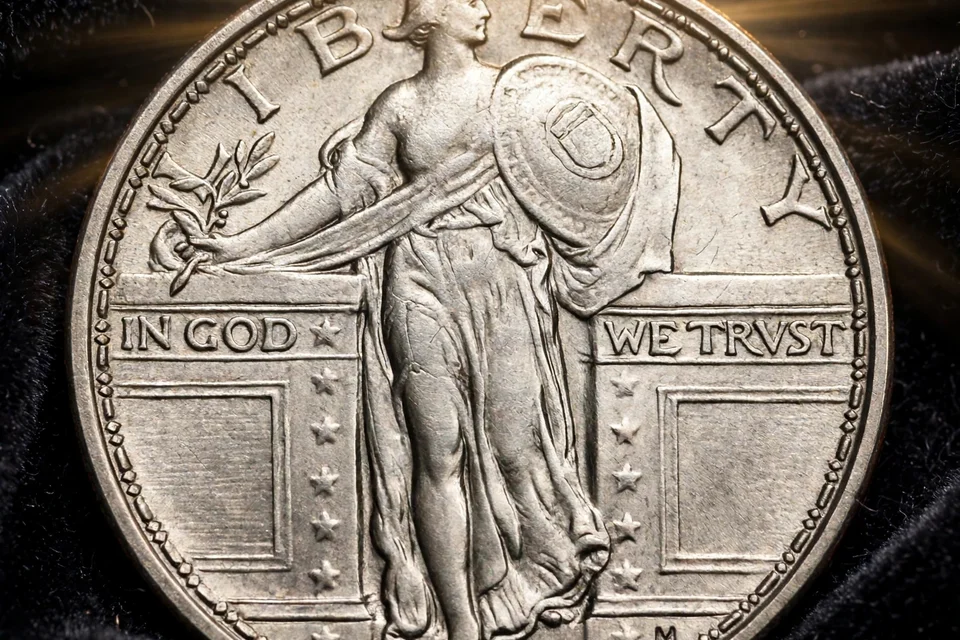
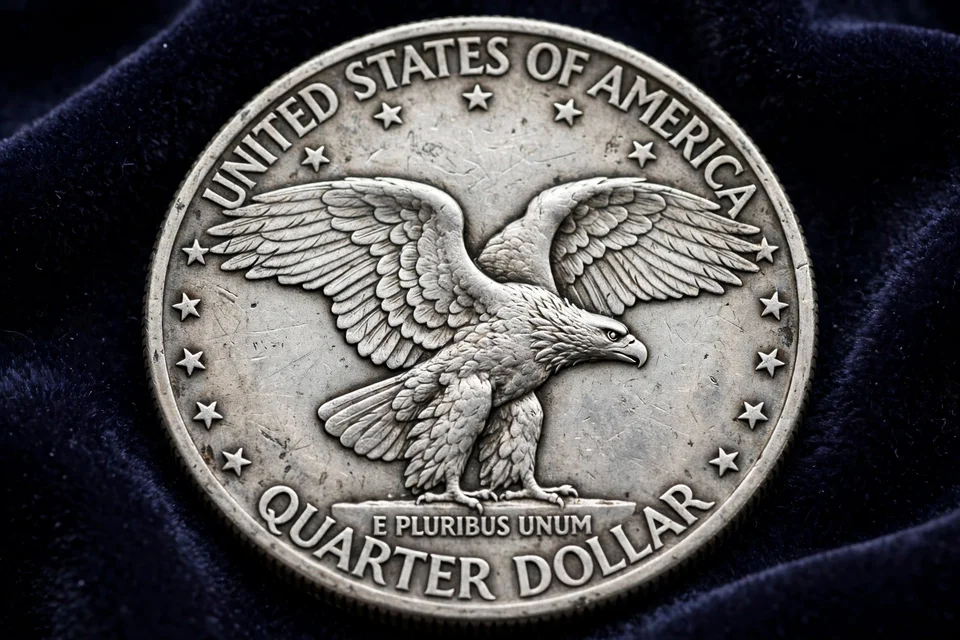
The Standing Liberty quarter ran for just 15 years, from 1916 through 1930, making it the shortest-lived quarter design of the twentieth century. Hermon A. MacNeil's design shows Liberty standing full-length on a pedestal, shield in one arm and olive branch in the other, with a bald eagle in flight on the reverse. It replaced the Barber quarter in 1916 and was replaced by the Washington quarter in 1932. No quarters were struck in 1922 or 1931, so a complete date set stops at 1930 and jumps from 1921 to 1923.
Collectors prize the series because it is short — a full set is achievable — and famously fragile: the date sits high on the pedestal where circulation wears it away, so sharp, fully dated survivors are scarcer than the mintages suggest.
Specifications: 1916–1930 (no quarters struck in 1922), Hermon A. MacNeil, 90% silver and 10% copper, 6.25 grams, 0.1808 troy ounces of silver, 24.3 mm, reeded edge, Philadelphia (no mint mark), Denver (D), San Francisco (S).
Standing Liberty Quarter Value by Date and Grade
Values below follow the most recent published retail guides, updated October 26, 2026.
| Date | Good (G-4) | Fine (F-12) | Extremely Fine (EF-40) | Mint State (MS-60+) |
|---|---|---|---|---|
| Common dates (1925–1930, Philadelphia) | $10+ | $13+ | $34+ | $175+ |
| 1916 (Philadelphia only) | $3,700+ | $9,000+ | $13,000+ | $25,000+ |
| 1918/7-S overdate | $1,425+ | $2,100+ | $4,000+ | $10,000+ |
| 1923-S | $270+ | $350+ | $1,270+ | $1,565+ |
| 1921 (Philadelphia only) | $144+ | $341+ | $607+ | $875+ |
| 1927-S | $44+ | $126+ | $998+ | $6,565+ |
| 1927-D | $19+ | $35+ | $170+ | $229+ |
A worn common-date quarter is essentially a silver coin with a small premium. The jump comes with the keys, and at the top end grade and strike quality take over — a 1927-S is a $44 coin in Good condition but a $6,500+ coin in high mint state, and Full Head examples go far beyond the table.
The Silver Floor: What the Metal Alone Is Worth
Every Standing Liberty quarter contains 0.1808 troy ounces of silver. At late-October 2026 silver prices near $57 per ounce, that metal is worth about $10. No genuine example is worth less than its silver content, and dealers pay $10+ even for dateless, heavily worn coins. That floor is your downside protection; the premium above melt is where the real money sits.
A quarter with no readable date is still a $10+ silver coin — but check the design first. A dateless Type 1 coin can only be a 1916 or 1917 issue, and a dateless Type 2 with a mint mark still narrows the range.
The Three Types: Type 1, Type 2, and the Recessed Date
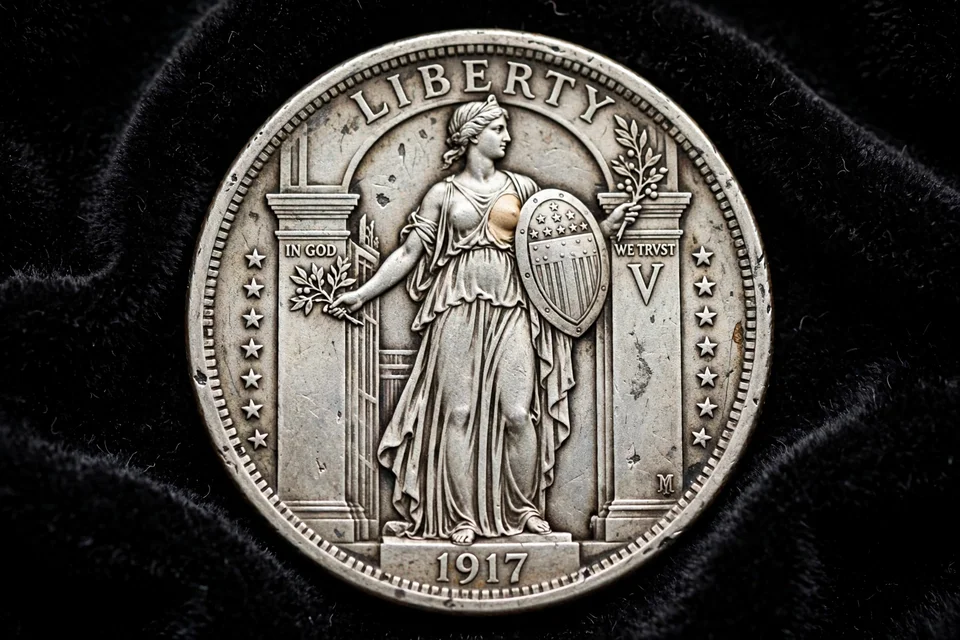
Type 1 (1916 through early 1917) shows Liberty with her right breast exposed in the classical style, and the reverse eagle flies with no stars beneath it. In mid-1917, Type 2 covered Liberty's chest with a coat of chain mail and added three stars below the eagle. Because the change came mid-year, 1917 exists in both types, and Type 1 coins generally carry higher premiums.
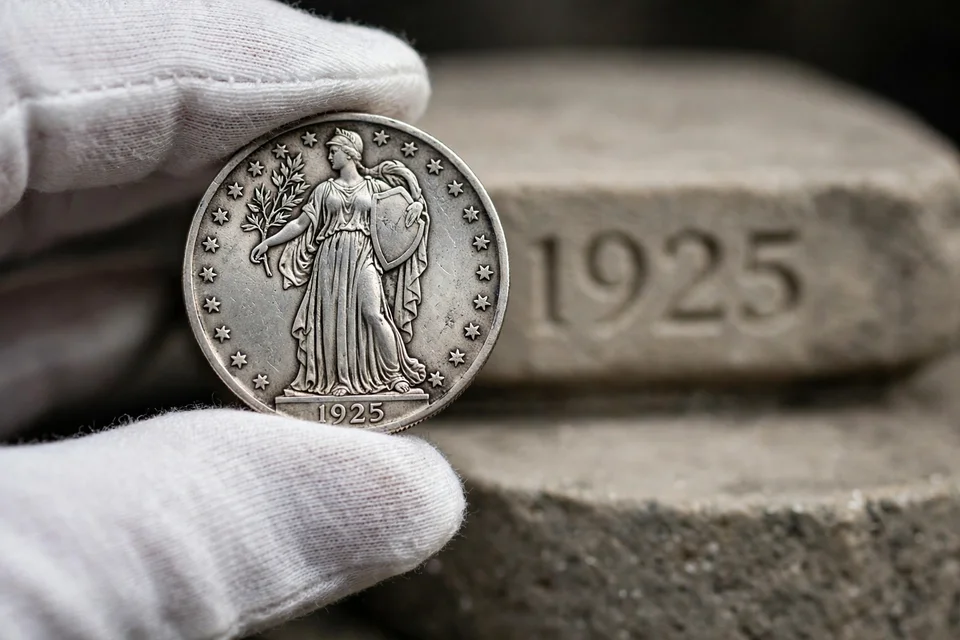
Type 3, struck from 1925 through 1930, looks like Type 2 except for one crucial fix: the date is recessed into the pedestal instead of standing proud on it. From 1916 through 1924 the date sat on the highest point of the design and wore away first, which is why so many early quarters are dateless.
How to Find Your Mint Mark
On every Standing Liberty quarter, the mint mark sits on the obverse, to the left of the date, beside Liberty's feet at the lowest star on the left side. Philadelphia coins carry no mint mark; D means Denver, S means San Francisco. A 1923 with no mint mark is a $21 coin in Good condition; a 1923-S is a $270 coin in the same grade, from a mintage of just 1,360,000 against Philadelphia's 9,716,000. Watch for added mint marks: because the S on a 1923-S or 1927-S is worth hundreds of dollars, counterfeiters add S marks to Philadelphia coins. An added mark usually sits slightly off position, with tooling visible under magnification, so any suspected key-date mint mark deserves professional authentication before sale.
Full Head: The Designation That Multiplies Value
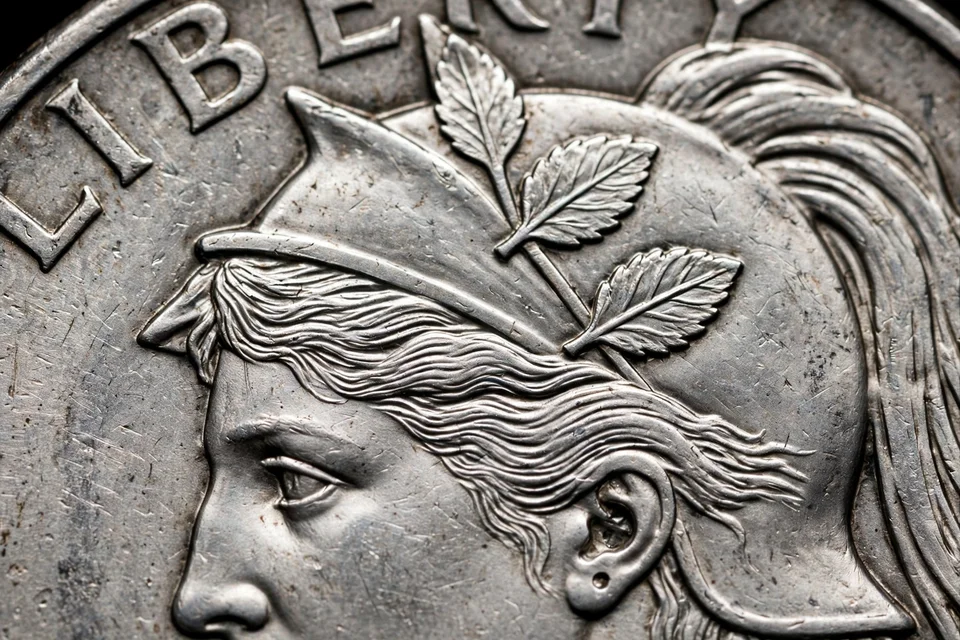
Full Head (FH) is the strike-quality designation awarded by PCGS and NGC to quarters showing complete detail in Liberty's head: three distinct helmet leaves, a complete helmet outline, a visible ear hole, and a complete hairline along the brow. The head was the highest-relief point of the design, so it struck weakly on most coins, and genuine Full Head examples are rare — with an extreme premium. The 1929-D tells the story: a standard MS-65 sells for around $450, while an MS-65 Full Head commands around $7,500 — a 16-fold difference. Only about 2% of the 1929-D mintage achieved Full Head quality. If your uncirculated quarter shows a fully separated hairline, three crisp helmet leaves, and a clear ear hole, do not sell it as an ordinary mint-state coin.
The Key Dates That Drive the Series
The 1916 is the undisputed king. Only 52,000 were struck, all at Philadelphia in the last two weeks of December 1916, and most went straight into circulation when the new design was released without announcement in January 1917. Even heavily worn examples start above $3,700. The 1918/7-S overdate is the series' most famous variety: a 1917 die repunched with a 1918 date, leaving a 7 visible beneath the 8 under magnification. It starts at $1,425+ in Good condition and is considered the second-rarest coin in the series. The 1923-S (1,360,000 struck) is notorious for weak strikes, which makes sharp examples genuinely scarce. The 1921 (1,916,000 struck, Philadelphia only) is the lowest-mintage later date, and the 1927-S (396,000 struck) is the lowest-mintage branch-mint issue and the hardest key to find with a Full Head. The 1927-D, 1919-D, and 1919-S round out the keys.
Record Sales: What the Best Standing Liberty Quarters Actually Bring
The finest known 1916, graded MS-67+ Full Head with CAC approval, sold for $195,500 at a Stack's Bowers auction in 2010, and a 1916 graded MS-67 brought $50,400 at Heritage in August 2025. A 1928 Philadelphia MS-67 Full Head sold for $120,000 at Heritage, the finest 1929-D Full Head realized $58,800 in August 2021, and a 1925 MS-67 Full Head — a common date made rare by strike quality alone — set its date record at $22,913. For this series, strike quality pays as much as rarity.
What Lowers a Standing Liberty Quarter's Value
Cleaning is the fastest way to destroy value. A polished or harshly cleaned quarter loses its original surfaces and its collector premium, often falling to near melt regardless of date. Never clean a Standing Liberty quarter. Damage — rim bumps, scratches, holes, jewelry mounts — has the same effect, though a missing date on a pre-1925 coin costs far less because it is honest wear. Counterfeits concentrate on the keys: cast copies feel wrong in weight — a genuine quarter weighs 6.25 grams — and show soft, mushy details. If a deal looks too good for a key date, it almost certainly is. Buy certified keys, or buy raw only from dealers you trust.
Should You Get Your Standing Liberty Quarter Graded?
Certification pays when the coin is a key date, a suspected Full Head, an overdate, or a genuinely uncirculated common date. The fee is quickly recovered on a coin that confirms as Full Head — a non-FH MS-64 may bring $2,440 while the same grade with FH can reach $3,880 or more on dates like 1921. For a worn common date worth $10+ to $20+, certification costs more than the coin, so keep it raw. For a key, an overdate, or a Full Head, certification also removes the counterfeit risk for your buyer, which is why certified keys sell faster and for more.
Final Thoughts
The Standing Liberty quarter rewards the looking most collectors already do: check the date, the mint mark beside it, the head for Full Head detail, and the type. Most quarters you find will be $10+ silver coins with a small premium. But the series hides $3,700 coins in worn condition, $1,400 overdates, and five-figure Full Head gems among coins that look ordinary. The difference between a $10 coin and a $195,500 coin is one date, one mint mark, and one fully struck head.
Frequently Asked Questions
How much is a 1916 Standing Liberty quarter worth?
A 1916 Standing Liberty quarter is worth $3,700+ in Good condition, $9,000+ in Fine, and $25,000+ in mint state, with the finest known MS-67+ Full Head example selling for $195,500.
What is the difference between a Type 1 and a Type 2 Standing Liberty quarter?
Type 1 quarters (1916 through early 1917) show Liberty with her right breast exposed and no stars below the eagle. Type 2 quarters (mid-1917 through 1930) show Liberty in chain mail, with three stars added below the eagle. The year 1917 exists in both types.
Where is the mint mark on a Standing Liberty quarter?
The mint mark is on the obverse, to the left of the date beside Liberty's feet. Philadelphia coins have no mint mark, Denver coins show a D, and San Francisco coins show an S.
What does Full Head mean on a Standing Liberty quarter?
Full Head (FH) is a designation from PCGS and NGC for quarters showing complete detail in Liberty's head: three distinct helmet leaves, a complete helmet outline, a visible ear hole, and a complete hairline. Because the head was the highest-relief point of the design, most quarters struck weakly there, so Full Head examples can be worth many times more.
Why is my Standing Liberty quarter dateless?
From 1916 through 1924, the date stood proud on the pedestal — the highest point of the design — so circulation wore it away first. In 1925 the Mint recessed the date into the pedestal, so later quarters usually keep readable dates.
Are Standing Liberty quarters silver?
Yes. Every Standing Liberty quarter from 1916 through 1930 is 90% silver and 10% copper, weighing 6.25 grams with 0.1808 troy ounces of pure silver. That silver alone is worth about $10 at late-October 2026 prices.
A Standing Liberty quarter costs nothing to check, and the difference between a $10 coin and a $195,500 coin is one date, one mint mark, and one fully struck head. Before you sell any silver quarter you are unsure about, run it through The Diggin Dave's free Coin Value Checker to confirm its date, mint mark, and value range, use the Key Date Checker to see whether your date is a key issue, and if your coin looks uncirculated, Grade-or-Not helps decide whether certification is worth the fee.
Related Reading
- How Much Is a Quarter Worth? From Pocket Change to $207,400+ — silver quarters (1932–1964) bring $10+, key dates top $100+, and the rarest hit $207,400 at auction
- How Many Quarters in a Roll? The Complete Quarter Roll Guide — Values, Silver Finds & Roll-Hunting Tips — 40 quarters worth $10, but a silver roll tops $390+ in melt
- How to Tell If a Quarter Is Silver: 6 Tests That Work in Seconds — the date, edge, weight and sound tests that separate a $10+ silver quarter from a 25-cent clad quarter in seconds