How Much Is an Eisenhower Dollar Worth? From $1+ Clad to $21,600+ Rare Errors
Dollar Coins · 9 min read · Published October 28, 2026
Most Eisenhower dollars are worth $1+ to $5 circulated, because the clad issues that filled cash registers and casino trays carry no precious metal. Uncirculated common dates run $3+ to $15, the 40% silver collector issues start at $12+, and the rare varieties change everything: the 1972 Type 2 trades $25+ even worn and $10,500 in top grade, while the 1977-D silver planchet error sold for $21,600. Date, mint mark, and reverse variety decide where your coin lands.
What Is an Eisenhower Dollar?
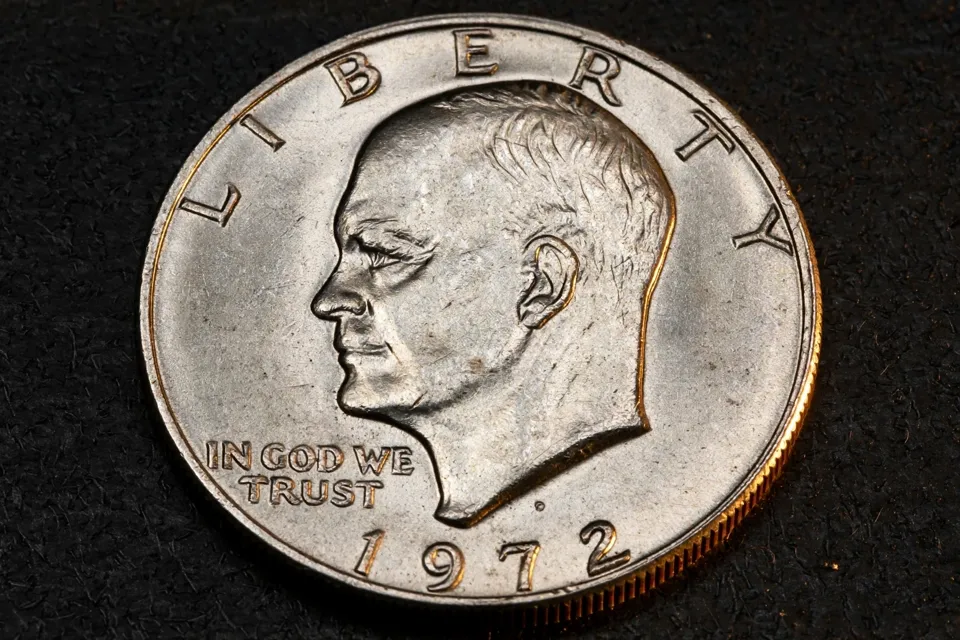
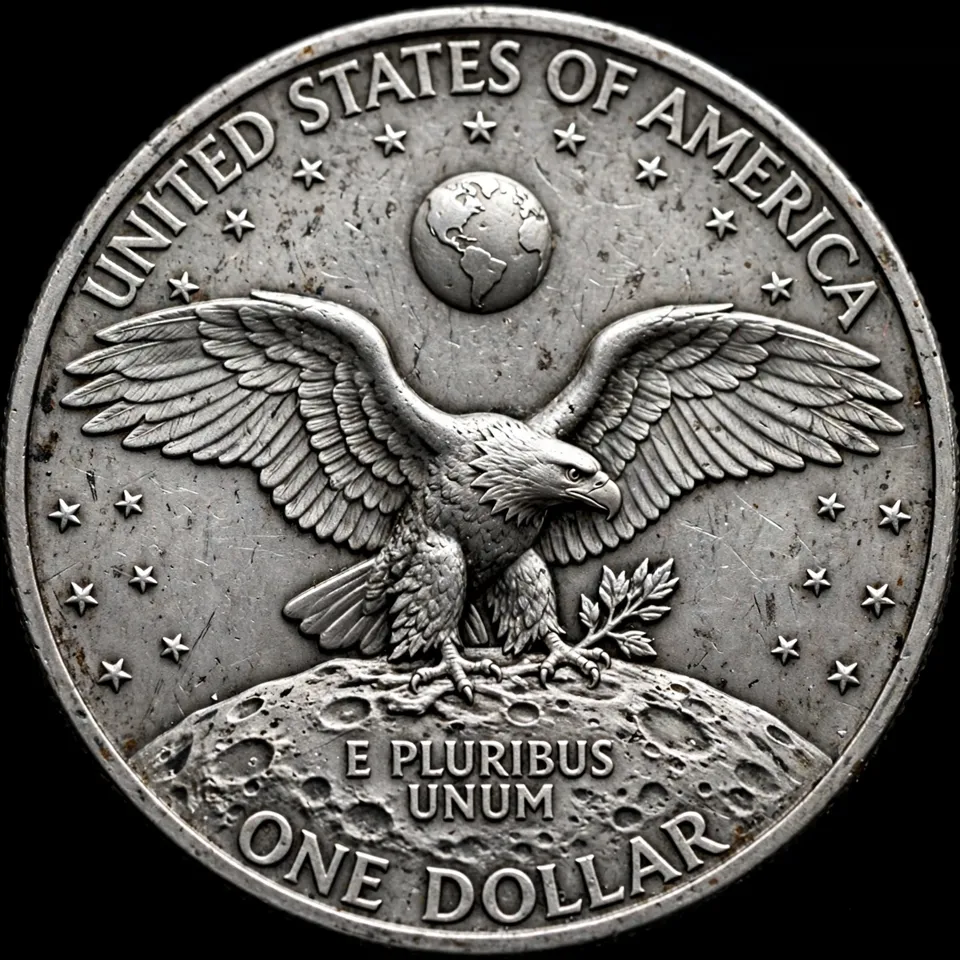
Struck from 1971 through 1978, the Eisenhower dollar was America's last large-size circulating dollar. Congress authorized it after President Dwight D. Eisenhower's death in 1969. Chief Engraver Frank Gasparro's left-facing portrait went on the obverse, and the reverse adapts the Apollo 11 mission insignia designed by astronaut Michael Collins: a bald eagle landing on the cratered moon, clutching an olive branch, with the Earth above and 13 stars circling the field.
At 38.1 millimeters across with a reeded edge, it is the biggest coin most Americans have handled. Circulation strikes are copper-nickel clad at 22.68 grams; San Francisco collector issues are 40% silver clad at 24.59 grams, holding 0.3162 troy ounces of silver. The public never took to the big dollar, and huge numbers ended up in Nevada casinos. Production ended after 1978, replaced by the smaller Susan B. Anthony dollar in 1979.
How to Identify Your Eisenhower Dollar
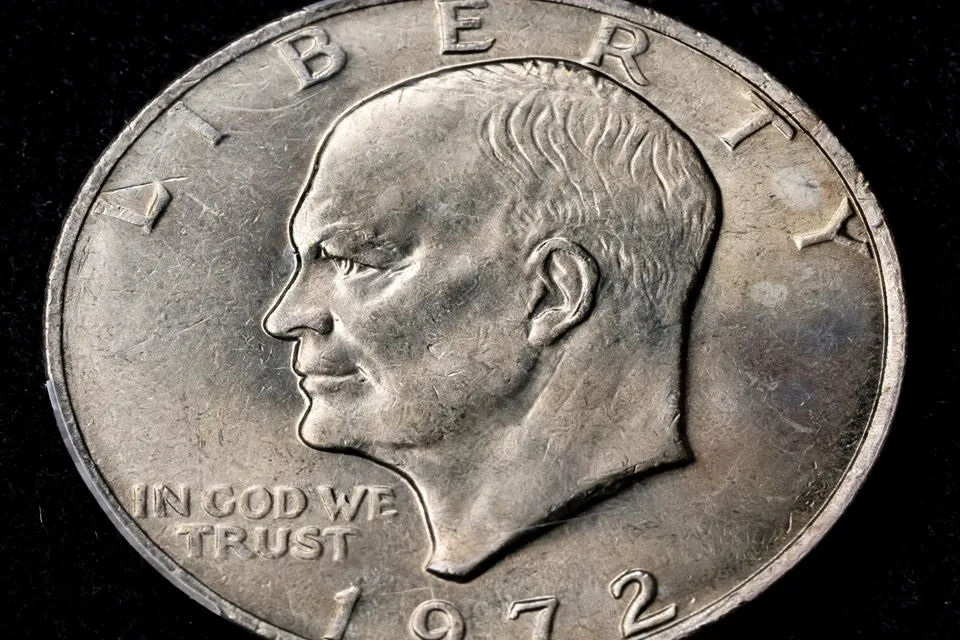
Three checks identify almost any Eisenhower dollar in under a minute. First, read the date on the obverse, below Eisenhower's portrait. Bicentennial issues carry the dual date 1776-1976: no Eisenhower dollars were dated 1975.
Second, find the mint mark below Eisenhower's neck, just above the date: no mark for Philadelphia, D for Denver, S for San Francisco. The mint mark is your fastest route to value, because every 40% silver Eisenhower dollar came from San Francisco.
Third, test for silver: a silver-clad dollar weighs 24.59 grams against 22.68 grams for clad, and its edge is solid silver-grey with no copper stripe, while a clad coin shows a clear copper band. No circulation strike contains silver: if your coin has no S mint mark, it is clad, and its value comes from condition and variety, not metal.
Eisenhower Dollar Value by Grade
Condition drives Eisenhower dollar values harder than date for most issues, because the big, heavy coins picked up bag marks easily and gem survivors are genuinely scarce.
| Coin and condition | Typical value |
|---|---|
| Common clad date, circulated | $1 to $3 |
| Common clad date, uncirculated MS60 to MS63 | $3 to $15 |
| Common clad date, gem MS65 | $20 to $50 |
| Top-grade clad, MS66 to MS67 | $100 to $10,200 |
| 40% silver uncirculated, San Francisco | $12 to $25 |
| 40% silver proof, San Francisco | $12 to $30 |
| 1972 Type 2 variety | $25 to $10,500 |
| 1973 mint-set issues, uncirculated | $5 to $50 |
| Bicentennial clad Type 1, uncirculated | $3 to $15 |
A circulated clad dollar is never worth certifying at $30+ in grading fees. The money sits in uncirculated coins, silver issues, and the varieties below.
The 1972 Type 2: The Series Key
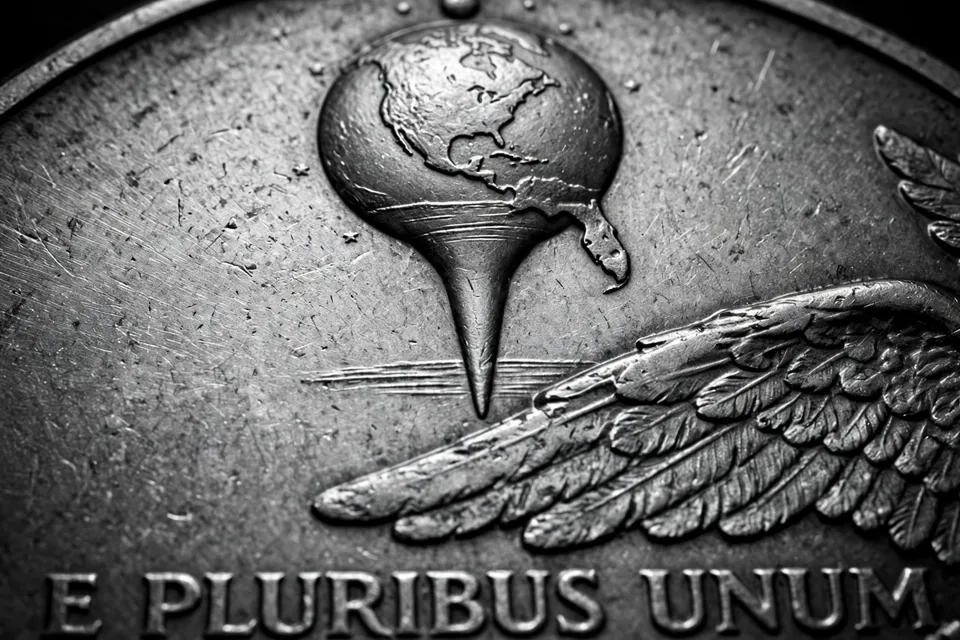
The 1972 Type 2 is the series key, hiding in plain sight among the most common date. Philadelphia struck 75,890,000 dollars in 1972, but only about 100,000 with a single proof reverse die mistakenly put into production. Fewer than 40,000 survive in attributable state.
Identification comes down to the Earth above the eagle. On the common Type 1, Florida is a rounded stump and the islands are thick, distinct marks; on the Type 3, the Earth is geographically refined. On the Type 2, Florida is long and funnel-like, the Earth stands in high relief, and the islands are barely visible, reduced to faint water lines. The reverse lettering is also thinner than the bold Type 1 letters.
Even worn Type 2 examples trade $25+ to $50 in XF and AU, uncirculated examples bring $75+ to $300, MS65 trades around $1,000, and the finest known MS66 specimens command as much as $10,500. Check every no-mint-mark 1972 dollar with a loupe before spending it: the Type 2 turns pocket change into four figures.
The 1973 Mint-Set-Only Issues
The 1973 Eisenhower dollar is the series' quiet oddity: with no appetite for another hundred million dollar coins, the Mint struck none for circulation. Philadelphia produced 2,000,056 and Denver 2,000,000 business strikes, sold only inside the 1973 Uncirculated Mint Sets; only 1,769,258 sets were distributed, and the unsold balance was melted.
That tiny distribution makes 1973 the lowest-mintage business-strike date, yet neither the 1973 Philadelphia nor the 1973-D is rare in ordinary grades: survivors never circulated, so they trade $5+ to $10 in MS60 to MS64. Real money appears in high grades, with MS65 Philadelphia around $50 and Denver around $45, a 1973 record of $7,637.50 for a PCGS MS66+ at Heritage in 2016, and a 1973-D in PCGS MS67 reaching $12,925 at Heritage in 2013. An intact sealed 1973 mint set is the surest way to hold one in top condition.
The Bicentennial Dollars: Type 1 vs Type 2
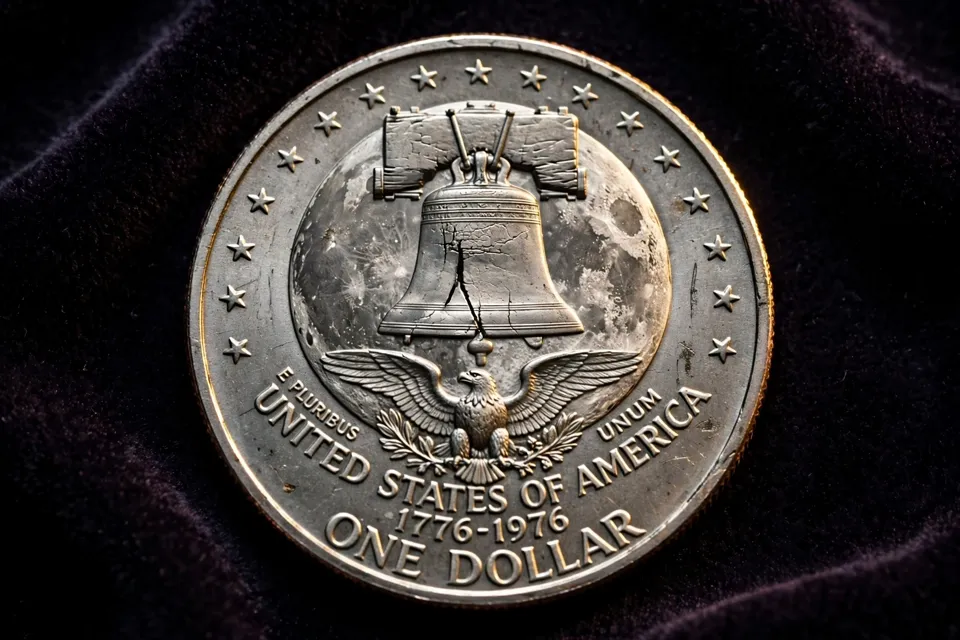
The 1776-1976 Bicentennial dollar is the most saved coin in the series. Its reverse, designed by Dennis R. Williams, shows the Liberty Bell superimposed over the moon. Two varieties exist, told apart by lettering: Type 1 has bold, blocky lettering in lower relief, while Type 2 has sharper, narrower lettering in higher relief.
Philadelphia struck only about 4,019,000 Type 1 dollars against more than 113,318,000 Type 2, and Denver struck 21,048,710 Type 1 against 82,179,564 Type 2. The Type 1 is scarcer at both mints and carries a real premium uncirculated, while the Type 2 is the common coin in nearly every drawer. Every 40% silver Bicentennial dollar is Type 1: the Type 2 die was never used on silver planchets.
Common clad Bicentennial dollars trade $1+ to $3 circulated and $3+ to $15 uncirculated. The 40% silver San Francisco issues average $12+ to $25 uncirculated, and the finest certified MS69 silver examples have sold for $20,800. Check the reverse lettering on every Bicentennial dollar before assuming it is common.
The 40% Silver Eisenhower Dollars
San Francisco struck 40% silver Eisenhower dollars for collectors in 1971 through 1974 and again for the Bicentennial in 1976. Sold by mail order and never released into circulation, they came as uncirculated Blue Ikes and proof Brown Ikes. The 1971-S silver uncirculated issue alone had a mintage of 6,868,000, and the 1973-S silver issues totaled 1,883,140 uncirculated and 1,013,646 proofs.
Confirm silver by the S mint mark, the 24.59-gram weight, and the solid silver-grey edge with no copper stripe. Typical uncirculated silver issues trade $12+ to $25, proofs $12+ to $30, with top-grade and cameo proofs higher. Their silver content gives them a melt floor clad coins lack, but condition drives the real premium: sharply struck, mark-free pieces climb.
Rare Errors Worth Checking
Beyond the Type 2, two errors deserve every roll searcher's attention. The 1977-D silver planchet error was struck at Denver on leftover 40% silver Bicentennial planchets that should have been melted when the program ended. Only about 10 to 20 are believed to exist, and an NGC MS63 example sold for $21,600 at Heritage in May 2022. Weigh any unusually bright 1977-D dollar: at 24.59 grams, a silver planchet weighs nearly two grams more than a clad coin.
The rarest Eisenhower dollar of all is the 1976 No-S Silver Proof, a unique Philadelphia trial piece combining three traits no regular issue ever shared: a proof strike with no mint mark, on a 40% silver planchet, with the Type 2 reverse never officially used on silver. Its private-treaty valuation sits around $850,000, making it one of the rarest modern American coins. Off-center strikes, doubled dies, and wrong-planchet errors also exist across the series, and any Eisenhower dollar with a visible error and a readable date deserves professional examination before it is sold.
Before You Spend or Sell One
Never clean an Eisenhower dollar: cleaning strips the original surface and destroys collector value. Work through the checks in order: date, mint mark, weight and edge for silver, Florida shape on any 1972, lettering style on any 1976, and original packaging on any 1973. Keep mint sets sealed until you have checked the variety, and certify only coins whose value clears the $30+ to $65 grading fee: the 1972 Type 2, a shot at MS66 or better, or a confirmed error. Most Eisenhower dollars are worth a dollar or two, but the $10,500 Type 2 and the $21,600 silver error look exactly like ordinary dollar coins until you know what to look for.
Frequently Asked Questions
How much is an Eisenhower dollar worth?
Most Eisenhower dollars are worth $1+ to $5 circulated, because circulation strikes are copper-nickel clad with no silver content. Uncirculated common dates run $3+ to $15, 40% silver San Francisco issues start at $12+, the 1972 Type 2 reaches $10,500 in MS66, and the 1977-D silver error sold for $21,600.
Are Eisenhower dollars made of silver?
Only the San Francisco collector issues are silver: 40% silver clad coins struck in 1971 through 1974 and for the Bicentennial in 1976, sold in mint packaging, never released into circulation. Every circulation strike from Philadelphia and Denver is copper-nickel clad over a pure copper core.
What is a 1972 Type 2 Eisenhower dollar?
The 1972 Type 2 is the series key variety, struck when a single proof reverse die was mistakenly used for Philadelphia business strikes. About 100,000 were made and fewer than 40,000 attributable examples survive. Identify it by the long, funnel-like Florida peninsula and barely visible Caribbean islands on the high-relief Earth above the eagle. Worn examples trade $25+ to $50, MS65 around $1,000, MS66 up to $10,500.
Where is the mint mark on an Eisenhower dollar?
The mint mark sits on the obverse, below Eisenhower's neck and just above the date: no mark for Philadelphia, D for Denver, S for San Francisco. The S mint mark is the first clue that a coin may be a 40% silver collector issue rather than a clad strike.
What is the rarest Eisenhower dollar?
The rarest Eisenhower dollar is the unique 1976 No-S Silver Proof, a Philadelphia trial piece on a 40% silver planchet with the Type 2 reverse, valued around $850,000 in a private treaty. Among coins collectors can realistically find, the 1977-D silver error is rarest with only 10 to 20 known, and the 1972 Type 2 is the series key variety.
How much is a 1976 Bicentennial Eisenhower dollar worth?
Common clad Bicentennial dollars are worth $1+ to $3 circulated and $3+ to $15 uncirculated, with the scarcer Type 1 bold-lettering variety carrying a premium. The 40% silver San Francisco issues average $12+ to $25 uncirculated, and the finest certified MS69 silver examples have sold for $20,800.
An Eisenhower dollar costs nothing to check, and the difference between a $1 coin and a $21,600 coin is one date, one mint mark, and the shape of Florida on the reverse. Before you spend or sell any big dollar you are unsure about, run it through The Diggin Dave's free Coin Value Checker to confirm its date, mint mark, and value range, use the Key Date Checker to see whether your date is a key issue, and if your coin looks uncirculated, Grade-or-Not helps decide whether certification is worth the fee.
Related Reading
- How Much Is a 1921 Morgan Dollar Worth? From $40+ Melt to $240,000+ Proofs — the classic 90% silver dollar, with mint-by-mint grade tables and the proof records
- How Much Is a Peace Dollar Worth? From $40+ Silver to $129,250+ Keys — the silver dollar series that came before the Eisenhower dollar, with the 1928 key date and high-relief diagnostics
- How Many Dollars in a Roll? The Complete Dollar Roll Guide — Values, Silver Finds & Roll-Hunting Tips — 25 dollar coins per roll, and what a roll of Eisenhower dollars is worth in melt and collector value