How Much Is a Shield Nickel Worth? 1866–1883 Guide
Nickels · 10 min read · Published November 6, 2026 · Updated November 6, 2026
A Shield nickel is worth $15+ to $50+ in circulated condition, $100+ to $300+ uncirculated, and up to $56,400+ for the rarest dates in top grade. The coin to look for is the 1880, worth $200+ even worn and the holder of the series record, while the proof-only 1877 and 1878 and the 1883/2 overdate are the other four-figure chases. Every Shield nickel was struck at Philadelphia with no mint mark, the series ran from 1866 to 1883, and even common dates are worth three hundred times face value.
The Shield nickel is the first five-cent coin the United States ever struck, born out of the Civil War. Before 1866 there was no nickel at all — the five-cent piece was a tiny silver half dime, and wartime hoarding had drained silver from circulation.
Shield nickel value at a glance
| Date | Circulated | Fine | Mint State | Why it matters |
|---|---|---|---|---|
| 1866 With Rays | $23+ | $48+ | $309+ | First year, rays variety |
| 1867 With Rays | $27+ | $60+ | $244+ | Short-lived rays design |
| 1877 (proof only) | $900+ | $2,000+ | $25,000+ | No business strikes exist |
| 1878 (proof only) | $400+ | $900+ | $15,000+ | No business strikes exist |
| 1879 | $293+ | $975+ | $5,000+ | Only 25,900 struck |
| 1880 | $200+ | $1,000+ | $56,400+ | Only 16,000 struck, series record |
| 1883/2 overdate | $1,900+ | $2,100+ | $10,000+ | 2 visible under the 3 |
Values are retail estimates for problem-free coins. A Shield nickel contains no silver, so its price moves on date, grade, and variety alone.
America's first nickel: a coin the Civil War created
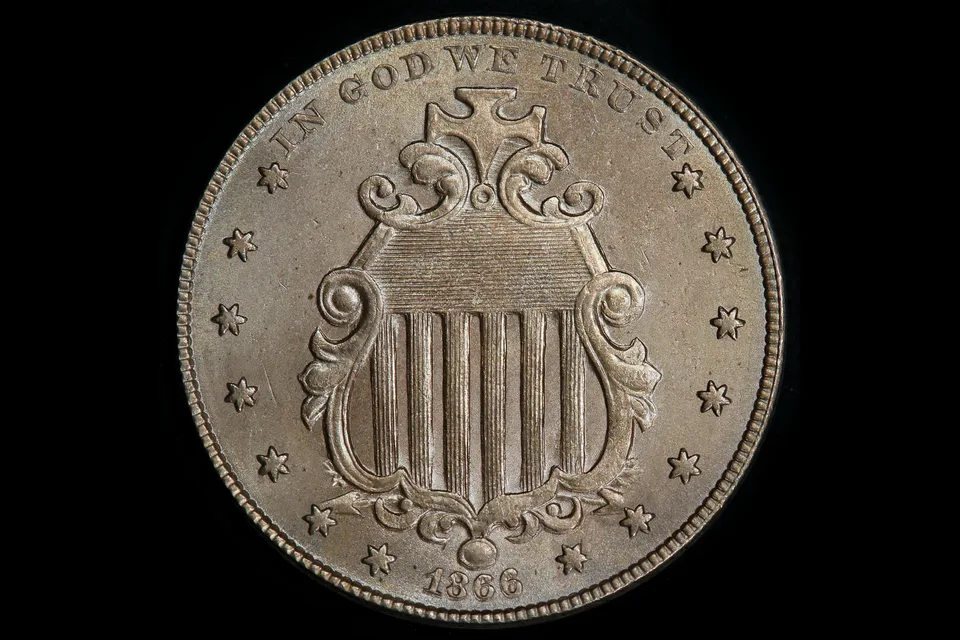
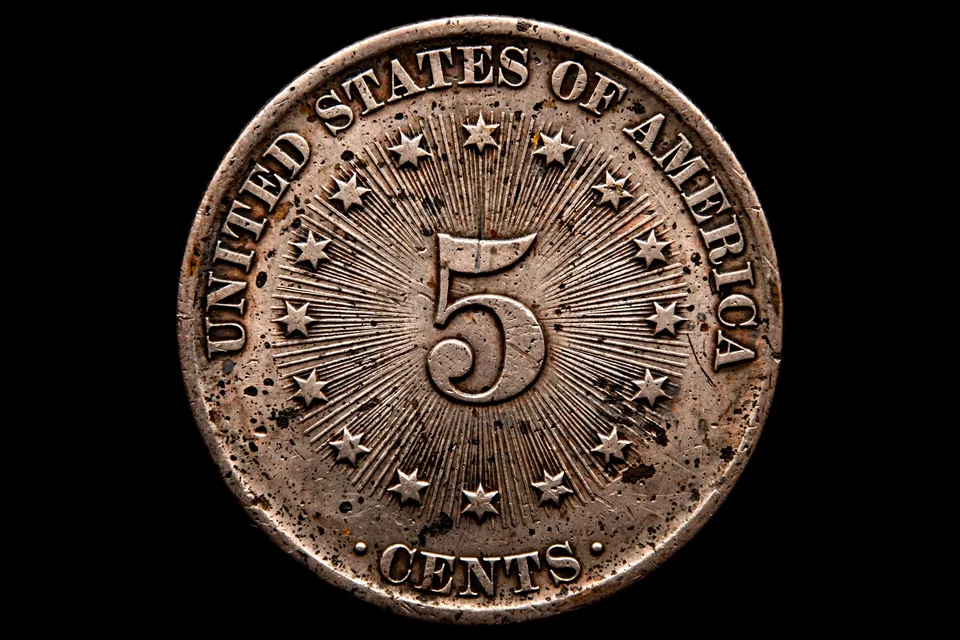
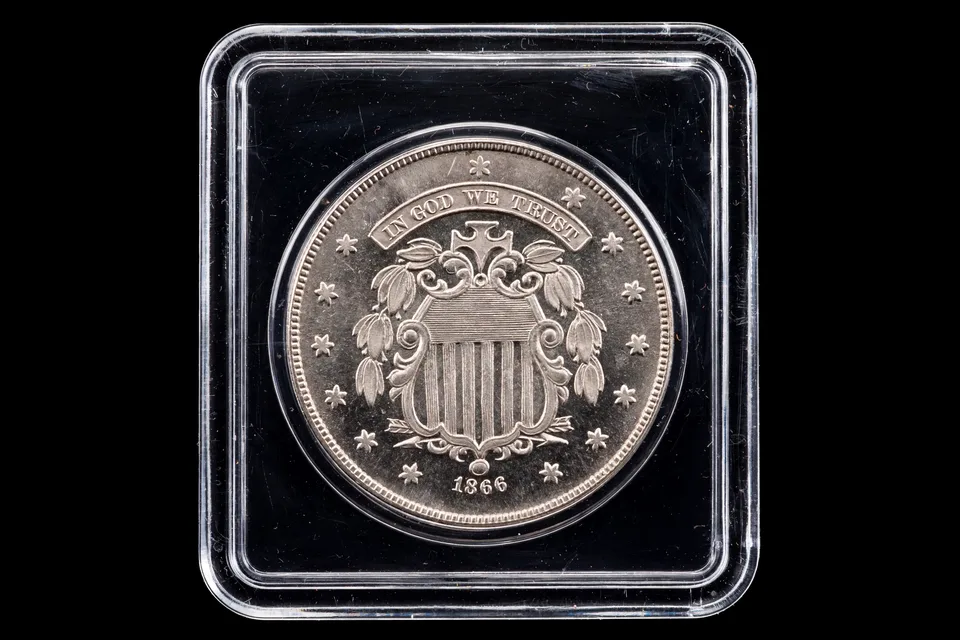
Congress answered in 1866 by authorising a five-cent coin in copper-nickel: 75 percent copper, 25 percent nickel, weighing 5 grams and measuring 20.5 millimetres across. Longacre designed both sides. The obverse shows a shield with a cross, thirteen stars around it, IN GOD WE TRUST on a ribbon, and the date below. The reverse carries a large 5 inside a circle of thirteen stars, with UNITED STATES OF AMERICA around the rim and CENTS below. There is no mint mark anywhere on the coin: every Shield nickel was struck at Philadelphia, so a Shield nickel with a D or an S mint mark is not a rarity — it is a fake.
With Rays or No Rays: the detail that changes everything
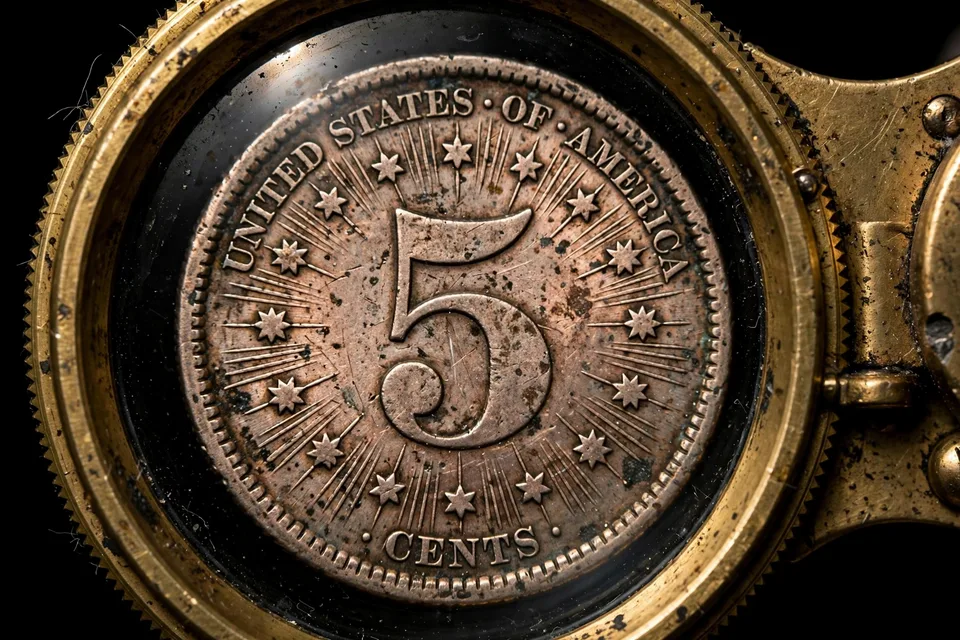
The first two years carry a design detail collectors pay for: rays. On the 1866 and early 1867 reverse, thin rays fan out between the thirteen stars around the 5. The rays looked impressive, but they broke the dies fast, and the Mint dropped them partway through 1867.
Turn the coin to the reverse and look at the ring of stars around the 5. If fine lines radiate between the stars, it is a With Rays coin; if the field between the stars is smooth, it is a No Rays coin. Only 1866 and 1867 exist in the With Rays type, and both are worth more than their No Rays cousins in the same grade — an 1866 With Rays is $23+ worn and $309+ in mint state. The rays coins also lead the proof market: in January 2026 an 1867 Rays proof graded PR65 Cameo with CAC approval sold for $52,875.
The key dates: 1877, 1878, 1879, and 1880
Four dates carry the series, and two of them never circulated at all. In 1877 and 1878 the Mint struck no Shield nickels for circulation — only proofs, about 900 in 1877 and 2,350 in 1878, and that is the entire supply. A genuine 1877 Shield nickel is therefore always a proof, worth $900+ to $25,000+; a 1878 proof is $400+ to $15,000+. If someone offers you a worn 1877 or 1878 Shield nickel, walk away: the date was never struck for circulation, so a worn one is either a mishandled proof or a fake.
The 1880 is the king of the series. Only 16,000 business strikes were made, the lowest circulation mintage of any Shield nickel, and the date is rare in every grade. A worn 1880 starts at $200+, a fine example is $1,000+, and the auction record stands at $56,400+. It is also the date most often faked, usually by altering the date on a common 1883 coin, so check the last digit under magnification.
The 1879 is the quieter key date: only 25,900 business strikes, worth $293+ in Good and $975+ in Fine. The 1881, at 68,800 struck, is the most affordable key date at $221+ worn, and the 1871, at 561,000 struck, is the low-mintage common date to watch at $78+ worn.
Shield nickel value by date and grade
| Date | Good-4 | Fine-12 | Extremely Fine | Mint State-63 |
|---|---|---|---|---|
| 1866 With Rays | $23+ | $48+ | $125+ | $309+ |
| 1867 With Rays | $27+ | $60+ | $126+ | $244+ |
| 1867 No Rays | $15+ | $30+ | $60+ | $150+ |
| 1871 | $78+ | $113+ | $192+ | $629+ |
| 1879 | $293+ | $975+ | $1,268+ | $5,000+ |
| 1880 | $200+ | $1,000+ | $5,000+ | $56,400+ |
| 1881 | $221+ | $257+ | $493+ | $953+ |
| 1883 | $23+ | $28+ | $56+ | $121+ |
Common dates not listed — 1868, 1869, 1870, 1872, 1873, 1874, 1875, 1876, 1882 — fall in the same $15+ to $30+ circulated band as their neighbours. Grade, strike, and original surfaces move a coin inside those bands: a jump from Fine to Mint State can multiply a common date by five, and a cleaned coin is worth far less than an untouched one — cleaning is the fastest way to destroy a Shield nickel's value.
Proofs: the quiet premium in every year
Proof Shield nickels were struck in every year from 1866 to 1883, and they are the sleeper of the series. A proof is a specially made collector coin with mirror fields and frosted devices, struck on polished planchets — and in the 1870s and 1880s, almost nobody saved them. Most years saw only 600 to 3,000 proofs, and many were spent, damaged, or lost. A common-date proof in PR63 is $180+ to $500+, a PR65 is $500+ to $1,500+, and cameo proofs run several times higher. The proof-only years are the headliners: 1877 at $900+ to $25,000+ and 1878 at $400+ to $15,000+.
A proof has mirror fields, frosted devices, and a sharp, squared rim; a business strike has satiny, grainy fields. If your Shield nickel looks like a mirror, get it authenticated — it may be worth ten times the business strike of the same date.
Varieties and errors worth real money
The Shield nickel's most famous variety is the 1883/2 overdate. In 1883 the Mint reused a die dated 1882, punching the 3 over the 2 — and under a loupe you can still see the curve of the 2 beneath the 3. A worn 1883/2 is $1,900+, a fine example is $2,100+, and mint-state pieces reach $10,000+. It is the most valuable variety in the series, and many sat in collections for decades misattributed as ordinary 1883s.
The second variety to check is the 1870 Indian Cent clash, known as FS-301, worth $600+ to $1,600+ depending on grade. Doubled dies and the scarcer 1873 Closed 3 are worth checking too. True mint errors — off-centre strikes, clipped planchets, wrong-planchet strikes — are scarce, and dramatic examples command strong premiums.
How to check your Shield nickel in five minutes
Start with the basics. Weigh it: a genuine Shield nickel is 5 grams. Measure it: 20.5 millimetres across, with a plain edge — no reeding. It is copper-nickel, so it is not magnetic and has no silver colour. Then read the date and the reverse: the date sits below the shield, and the reverse tells you With Rays or No Rays in one glance. If the date is 1877 or 1878, remember those years were proof-only, so a circulated-looking example needs authentication. If the date is 1880, check the last digit under a 10x loupe — altered dates are the most common fake. If the date is 1883, look for the 2 under the 3. Never clean the coin, and if it looks valuable, put it in a holder and let a professional grader confirm it.
Frequently Asked Questions
How much is a Shield nickel worth?
Most are worth $15+ to $50+ circulated and $100+ to $300+ uncirculated. The exceptions: the 1880 at $200+ worn to a $56,400+ record, the proof-only 1877 and 1878, the 1879 at $293+ worn, and the 1883/2 overdate at $1,900+.
What is the difference between a With Rays and a No Rays Shield nickel?
On the reverse, With Rays coins have thin rays fanning out between the thirteen stars around the 5; No Rays coins have a smooth field between the stars. Only 1866 and early 1867 exist With Rays — the Mint dropped the rays because they broke the dies.
Are Shield nickels silver?
No. Shield nickels are 75 percent copper and 25 percent nickel, with no silver at all. They carry no melt premium — value comes entirely from date, grade, variety, and collector demand. A genuine Shield nickel weighs 5 grams and measures 20.5 millimetres.
Why are the 1877 and 1878 Shield nickels so expensive?
The Mint struck no Shield nickels for circulation in 1877 or 1878 — only proofs for collectors, about 900 in 1877 and 2,350 in 1878. That tiny supply makes them the scarcest dates: $900+ to $25,000+ for the 1877 and $400+ to $15,000+ for the 1878.
What is an 1883/2 Shield nickel worth?
An 1883/2 overdate is worth $1,900+ worn, $2,100+ in Fine, and up to $10,000+ in mint state. Look for the curve of a 2 beneath the 3 in the date under a 10x loupe.
How do I know if my Shield nickel is real?
Check the weight (5 grams), the diameter (20.5 millimetres), and the plain edge, and confirm there is no mint mark — every Shield nickel was struck at Philadelphia. The most common fakes are altered dates, especially on the 1880, so get any key date authenticated before buying or selling.
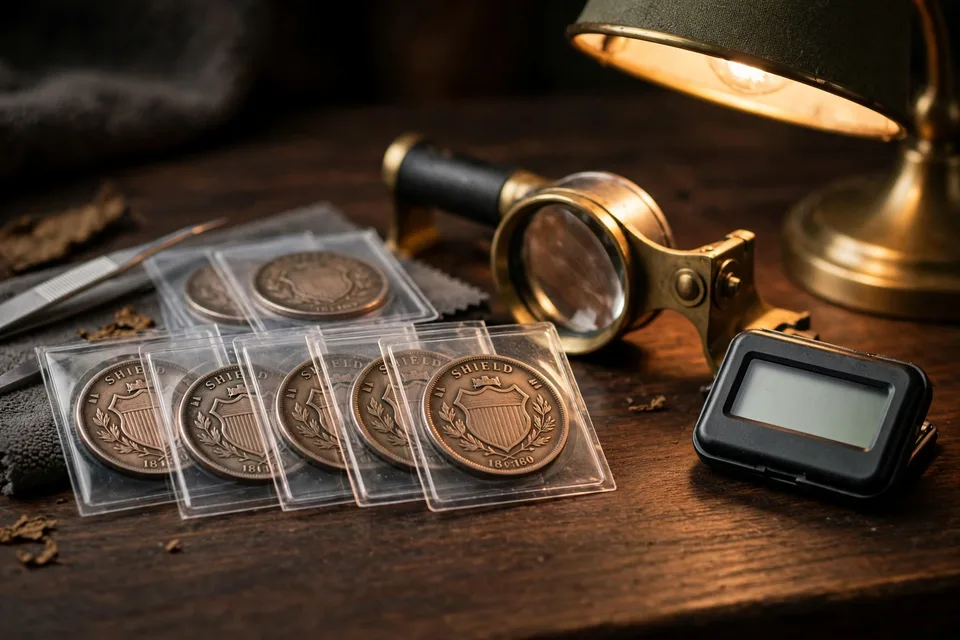
A Shield nickel costs nothing to check, and the difference between a $15+ common date and a $56,400+ 1880 is one careful look at the date and the reverse. Before you spend or sell any coin you are unsure about, run it through The Diggin Dave's free Coin Value Checker to confirm its value range, and try Grade-or-Not for a grade verdict on your best examples. A 30x loupe, 20.5mm coin capsules, and a nickel coin album are the only tools the checks in this guide need.
As an Amazon Associate, this site may earn from qualifying purchases.
Further Reading on Shield Nickels
- Nickel Values: 5¢ Coins Worth Up to $4.56 Million — most nickels are worth five cents, but key dates like the 1885 V nickel start at $500+ and the 1913 Liberty Head sold for $4,560,000
- Buffalo Nickels to Look For: 50¢ to $511,875+ — the nickel that replaced the Shield nickel's successor, from 50¢ commons to the 1918/7-D overdate at $511,875+
- How Many Nickels in a Roll? $2 Rolls to $500,000+ — a standard roll holds 40 nickels worth $2, but rare rolls and key dates inside can reach $500,000+