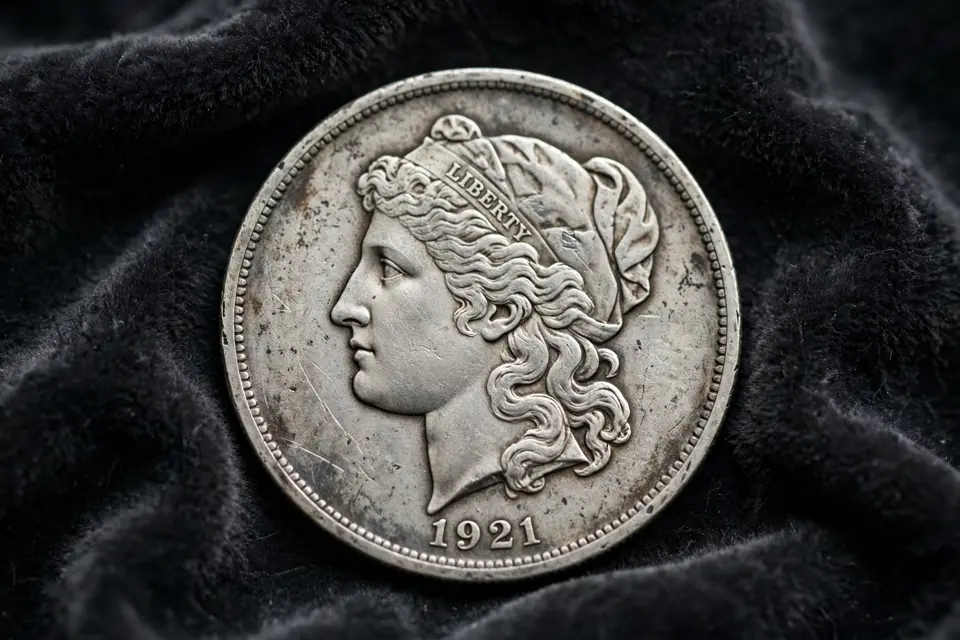
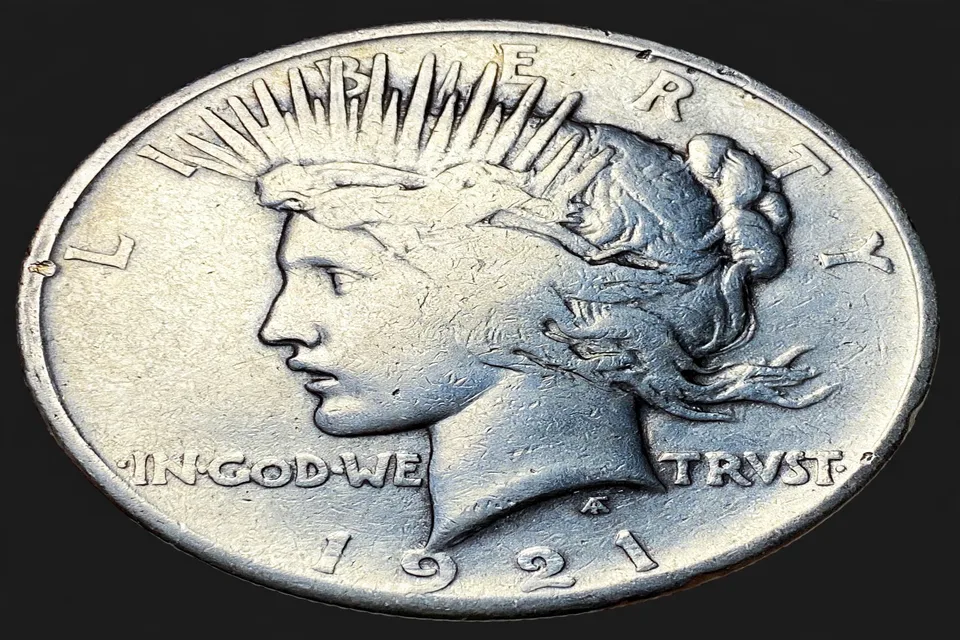
How to Grade a Morgan Dollar: Cheek, Hair, Eagle Breast & Real Values
Coin grading · 10 min read · Published November 2, 2026 · Updated November 2, 2026
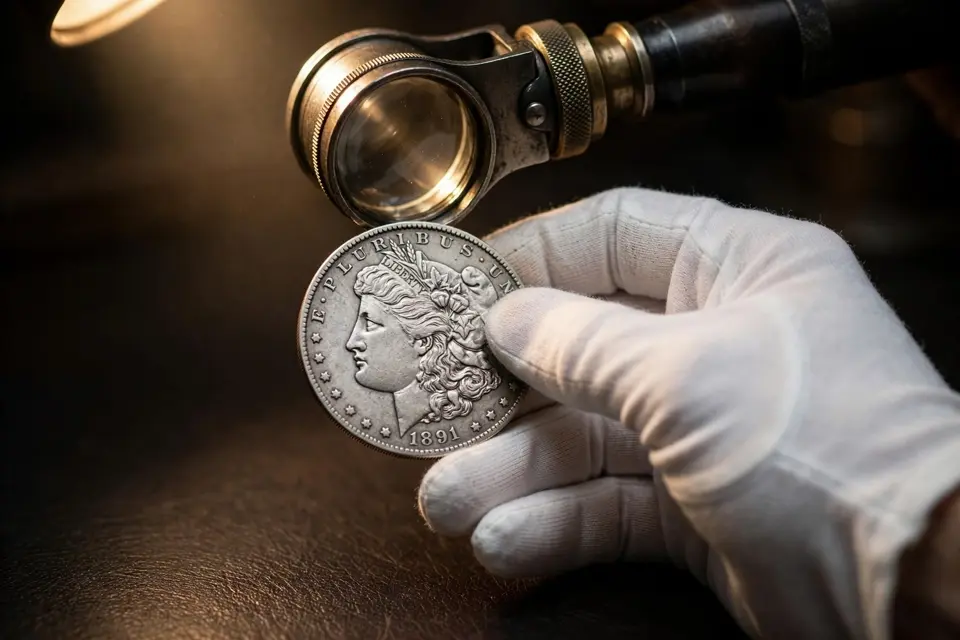
Learning how to grade a Morgan dollar comes down to three checks: wear on the high points, the quality of the mint luster, and the number of marks on the surfaces. Start with Liberty's cheek. It is the highest, flattest area on the obverse, and it shows wear before anywhere else. Then check the hair above her ear and the eagle's breast on the reverse. If those three spots are sharp and the luster rolls unbroken across the fields, you are looking at an uncirculated coin. If the cheek is flat and dull, the coin has circulated, and its grade — and value — drops with every step down the scale. This guide walks through every grade, the strike traps that fool beginners, and the values each grade carries, from a $38+ common date to the $2,086,875 record held by the 1893-S.
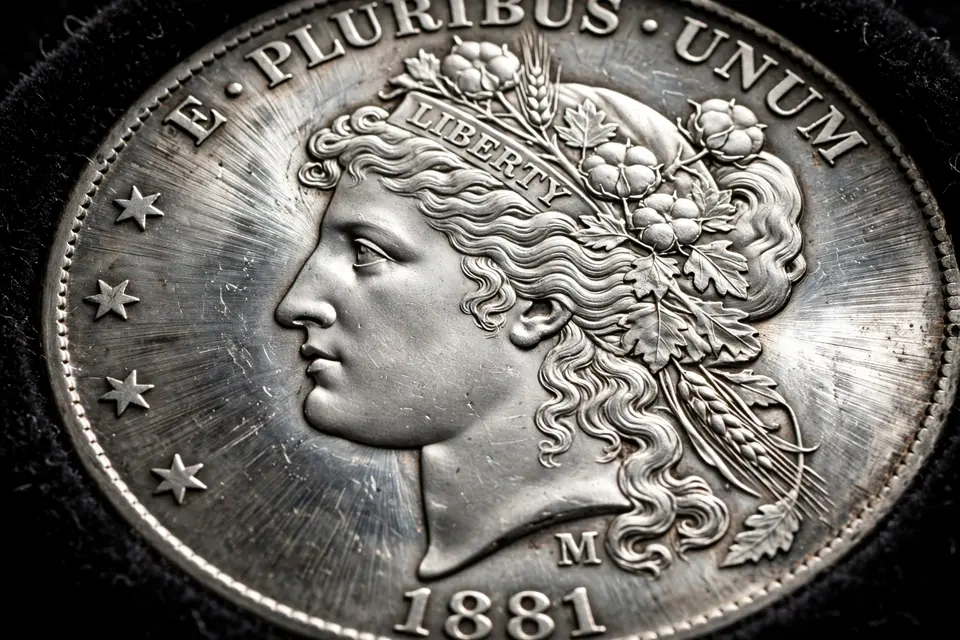
What Morgan Dollar Grading Actually Measures
Morgan dollars are graded on the Sheldon scale, which runs from 1 to 70. Coins with wear fall between About Good (AG-3) and About Uncirculated (AU-58). Coins with no wear at all are Mint State, from MS-60 to MS-70. Four factors decide where a coin lands: wear, luster, surface marks, and strike. Wear is the most important factor for circulated coins. Luster and marks decide the grade for uncirculated coins. Strike matters because a weakly struck coin can look worn when it is not, and Morgan dollars are famous for this trap, especially from New Orleans.
A Morgan dollar is a big coin — 38.1 millimeters across, 26.73 grams, struck in 90% silver and 10% copper from 1878 to 1921. Because the Mint shipped these dollars in canvas bags of a thousand, even uncirculated examples picked up contact marks, called bag marks, as they knocked against each other. That is why a Mint State Morgan is never judged on wear alone: a coin can be fully uncirculated and still grade MS-60 if its cheek is covered in heavy bag marks, while a lightly marked example with booming luster can reach MS-65 or higher.
The High Points to Check First
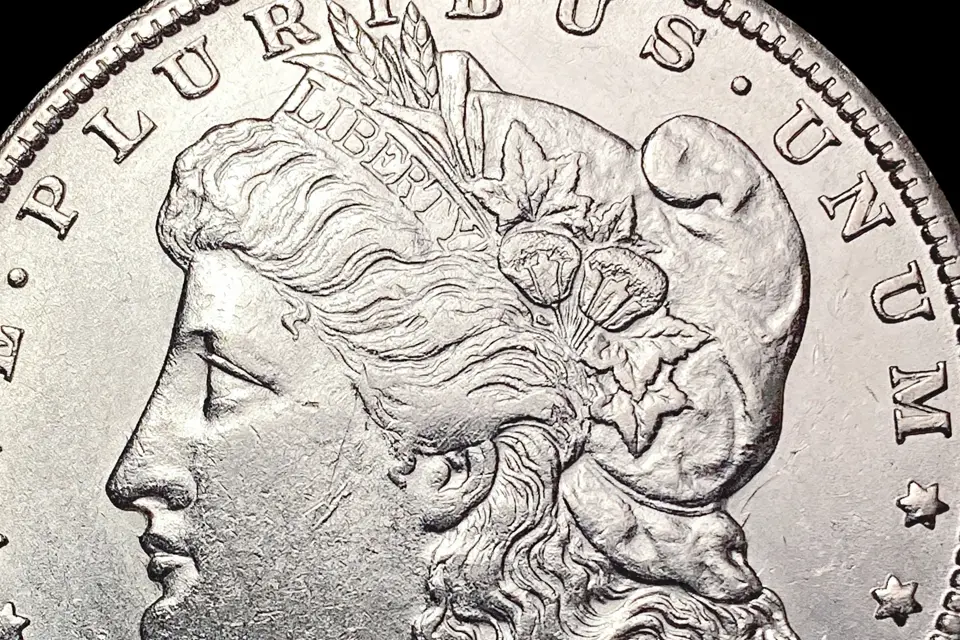
Every Morgan dollar wears in the same places, so graders always look at the same five spots in the same order. On the obverse, start with Liberty's cheek, the broad flat plane below her eye. Next, look at the hair above her ear and the curls over the date, then the top of her cap. On the reverse, check the eagle's breast feathers first, then the leg feathers and the tips of the wings. When a Morgan begins to circulate, the cheek goes dull and flat first, the fine hair lines above the ear merge, and the breast feathers lose their separation. By the time the wing tips are smooth, the coin is well worn.
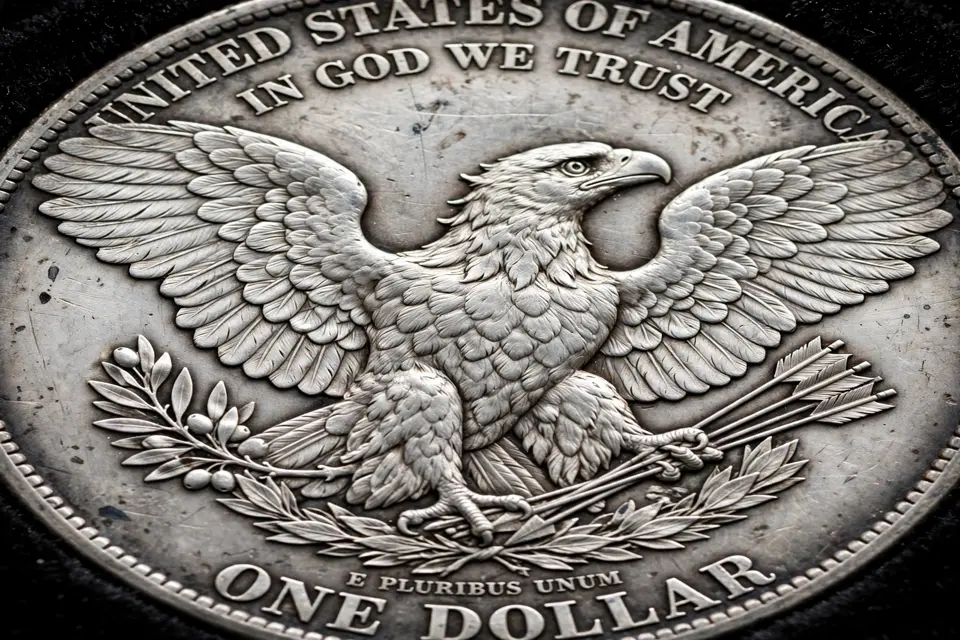
Hold the coin under a single lamp and tilt it slowly. Wear shows as a dull, flat patch that breaks the luster, while an uncirculated high point keeps its frosty texture even if it carries a small mark. Check both sides before deciding anything: a Morgan can look uncirculated on the obverse and carry a soft, weakly struck reverse.
Grade by Grade: What Each Grade Looks Like
In Good (G-4), Liberty's outline is clear but the hair, cap, and eagle feathers are mostly smooth, and the date and stars are readable. Very Good (VG-8) shows a little more hair detail and a partial eagle outline. Fine (F-12) brings back moderate detail, and the eagle's wing feathers begin to separate. Very Fine (VF-20) shows light wear on the high points only, with most hair and breast feather detail present. Extremely Fine (XF-40 to XF-45) shows only light friction on the cheek, hair above the ear, and breast, with nearly all detail sharp.
About Uncirculated (AU-50 to AU-58) is where most beginners hesitate. An AU coin shows just a trace of friction on the highest points, and almost all of its original mint luster survives. An AU-58 Morgan can look uncirculated at a glance and often has better eye appeal than a bag-marked MS-60. The difference is luster: on an AU coin it is broken on the cheek and breast, while on a Mint State coin it flows unbroken over every high point.
Common-Date Morgan Dollar Values by Grade
For a common date such as a 1921 Philadelphia or an 1881-S, values follow the grade in a steady staircase. Every circulated Morgan carries at least its silver melt value, about $38+ at recent silver prices, since each coin holds 0.7734 troy ounces of pure silver. The table below gives realistic starting values for a problem-free common date.
| Grade | What you see | Value from |
|---|---|---|
| G-4 Good | Outline clear, details smooth | $38+ |
| VG-8 Very Good | Some hair and wing detail | $40+ |
| F-12 Fine | Moderate detail throughout | $42+ |
| VF-20 Very Fine | Light wear on high points only | $45+ |
| XF-40 Extremely Fine | Slight friction on cheek and breast | $50+ |
| AU-50 About Uncirculated | Trace of friction, most luster intact | $60+ |
| MS-60 Mint State | No wear, heavy marks or dull luster | $70+ |
| MS-63 Choice Mint State | Few marks, strong luster | $90+ |
| MS-65 Gem Mint State | Light marks only, booming luster | $150+ |
The jump from MS-63 to MS-65 is where money concentrates. A common-date Morgan gains only a little from MS-60 to MS-63, but a true gem with clean fields and full cartwheel luster commands a clear premium, and the same pattern repeats at every date. That is why graders are strictest about the cheek: one heavy mark there can cost a full grade point, and a full grade point at Mint State can cost $60+ or far more on a scarce date.
Mint State in Detail: Bag Marks, Luster, and Strike
Mint State Morgans are separated almost entirely by the cheek and the fields around it. Count the marks on the cheek first, then the field in front of Liberty's face, then the field behind her head. MS-60 coins show heavy, distracting marks and possibly dull luster. MS-63, the most popular collector grade, shows moderate marks that stay out of the prime focal areas, with attractive luster. MS-64 is nearly gem, with only light scattered marks. MS-65, gem, shows a clean cheek, strong cartwheel luster, and a sharp strike.
Luster is the tiebreaker between two coins with similar marks. Cartwheel luster — the rotating wagon-wheel shine that sweeps across the surface as the coin turns — signals original, undisturbed surfaces. Dull or patchy luster pulls the grade down even when marks are few, because it suggests the coin was dipped too hard, wiped, or stored badly. Strike is the third factor: a fully struck Morgan shows complete hair curls and crisp stars, while a soft strike leaves the hair above the ear and the breast mushy even on a coin that never circulated. Never call a soft strike wear. Wear breaks luster; a soft strike keeps it.
Prooflike and Deep Mirror Prooflike Explained
Some Morgan dollars were struck from freshly polished dies and carry mirror-like fields that reflect like a proof coin. These earn the Prooflike (PL) designation when the mirrors are clear, and Deep Mirror Prooflike (DMPL) when the reflection is deep and sharp, typically readable from 2 to 4 inches away. The mirrors must appear on both sides. A one-sided mirror does not qualify.
PL and DMPL carry real premiums over the same numeric grade. A common-date PL Morgan starts around $100+, and a DMPL example starts around $175+, with scarce dates multiplying those figures fast. But mirrors also magnify every flaw, so a DMPL coin with heavy cheek marks can still grade low. Check for hairlines — fine parallel scratches from wiping — because they kill mirror surfaces faster than anything else.
Strike Traps: When a Morgan Looks Worn but Is Not
New Orleans dollars are the classic trap. The New Orleans Mint often struck Morgans with soft central details, so a fully lustrous 1899-O or 1904-O can show flat hair above the ear and a mushy eagle breast and still be completely uncirculated. If the luster flows unbroken across the flat area, the coin has not worn — it was simply struck softly. Calling that coin AU instead of MS is the most common beginner grading mistake, and it can cost hundreds on a better date.
Carson City dollars sit at the other end: they are usually sharply struck with clean, frosty surfaces, which is one reason CC Morgans are so popular. San Francisco dollars are generally well struck too, while Philadelphia strikes vary by year. Judge each coin against its own mint and year, not against a perfect example from another mint. A soft 1904-O and a sharp 1881-S can both be MS-65; the strike difference is a mint characteristic, not a grade difference.
Key Dates That Change Everything
Most Morgans follow the common-date table, but a handful of dates rewrite the math completely. The 1893-S is the king of the series: only 100,000 were struck at San Francisco, the lowest business-strike mintage of any Morgan dollar, and fewer than 125 are known in any Mint State grade. Even a worn example starts at $2,500+, and the finest known example, graded MS-67, sold for $2,086,875 in 2021, the all-time record for a Morgan dollar. The 1889-CC is the Carson City key, worth four figures even in low grades and six figures in gem. The 1895 Philadelphia issue is proof-only in practice, with 880 proofs struck, and proofs start around $40,000+.
| 1893-S Morgan dollar | Value from |
|---|---|
| G-4 Good | $2,500+ |
| VF-20 Very Fine | $7,500+ |
| XF-40 Extremely Fine | $16,000+ |
| MS-60 Mint State | $200,000+ |
| MS-65 Gem Mint State | $500,000+ |
| MS-67 Finest known, 2021 record | $2,086,875 |
Because the 1893-S is so valuable, it is also one of the most counterfeited American coins. Added mint marks are the usual trick: an altered 1893 Philadelphia or New Orleans dollar with a glued or engraved S. Never buy a raw 1893-S, 1889-CC, or 1895 proof without certification from a major grading service. If the price looks like a bargain for the date, it is almost certainly a fake, and a genuine key date never sells at a common-date price.
Cleaning, Damage, and Details Grades
Cleaning is the fastest way to destroy a Morgan dollar's value. A cleaned coin shows fine hairlines under magnification, a dull or washed-out surface, and sometimes an unnatural shine in the protected areas around the lettering. Professional graders refuse a numeric grade to a cleaned or damaged coin and instead assign a Details grade, which means the coin is genuine but impaired. A Details-graded Morgan typically sells for a fraction of its problem-free value, sometimes little more than melt for a common date.
Other problems that trigger a Details grade include rim dings, deep scratches, graffiti, corrosion, and holes. Handle every Morgan by its edges, never touch the faces, and store valuable examples in an acid-free flip or a certified holder. If a coin arrives with old toning — the natural rainbow or gold color silver develops over decades — leave it alone. Original toning can add a premium; stripped, dipped-white surfaces rarely do.
The 5-Minute Grading Routine
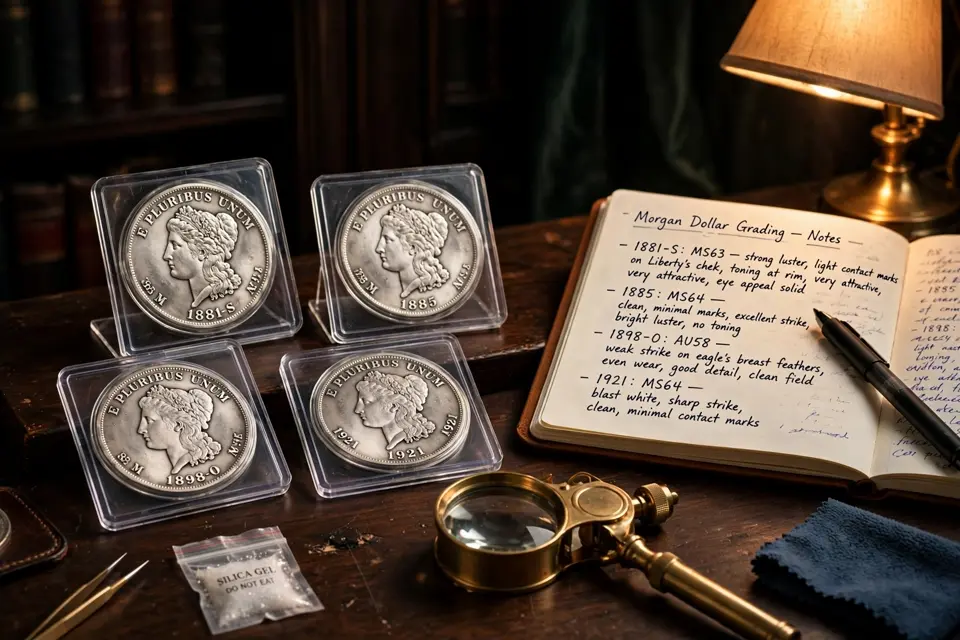
Work through every Morgan in the same order so nothing gets missed. First, photograph both faces of the coin straight on in good light, so you have a record before handling it further. Second, check the date and mint mark: the mint mark sits on the reverse below the eagle, and the date decides whether you are holding a common coin or a key date that needs certification. Third, run the high-point check under a single lamp with 10x magnification, starting at the cheek, then the hair above the ear, then the eagle's breast, tilting the coin to watch the luster. Fourth, count the bag marks on the cheek and fields to place the Mint State grade, or confirm the wear pattern for a circulated grade. Fifth, check the edge and weight — 26.73 grams and a reeded edge — and look for the mirror fields that earn a PL or DMPL designation.
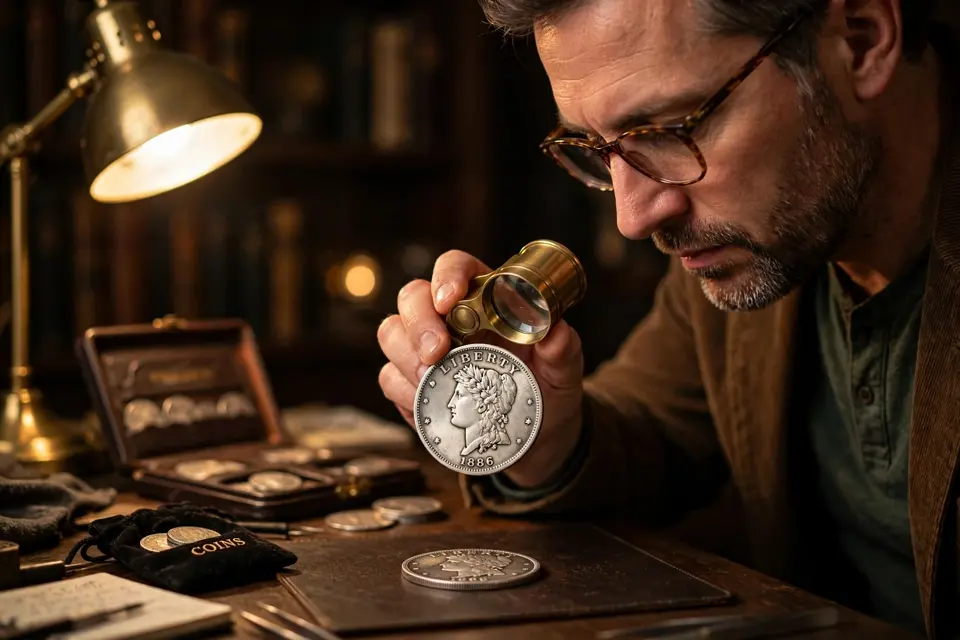
Do the same check in the other direction before you settle on a grade: flip the coin and grade the reverse independently, because many Morgans carry a stronger obverse than reverse. If the two sides disagree by more than a point, the weaker side usually sets the grade, and a soft strike on one side should not be mistaken for wear. Write the grade down with the date, mint mark, and any marks you noticed.
When to Send a Morgan for Professional Grading
Certification makes sense when the coin's value clears the cost of grading by a comfortable margin. As a rule, certify any key date, any coin you believe is MS-63 or better, any PL or DMPL candidate, and any Morgan you plan to sell to a stranger. A certified grade removes doubt for the buyer and usually returns more than the grading fee on better coins. For common-date circulated Morgans worth $38+ to $60+, certification rarely pays, and a good holder plus an honest grade note is the smarter choice.
Frequently Asked Questions
What grade is my Morgan dollar if Liberty's cheek is worn flat?
A flat, dull cheek with merged hair above the ear usually means Fine to Very Fine, depending on how much breast feather detail survives. If the cheek is only slightly dulled and the luster is mostly intact, the coin is more likely Extremely Fine or About Uncirculated. Check the luster break carefully, since that is what separates a circulated coin from a softly struck uncirculated one.
What is the difference between MS-63 and MS-65 for a Morgan dollar?
MS-63 shows moderate bag marks, often including a few on the cheek, with strong luster and good eye appeal. MS-65 shows a clean cheek, only light scattered marks away from the focal areas, and full booming cartwheel luster. The price gap is large because gem Morgans are much scarcer than choice examples, especially for better dates.
How do I tell a prooflike Morgan dollar from a polished one?
A genuine prooflike Morgan has deep, watery mirror fields on both sides with crisp, fully struck details and natural frost on the devices. A polished coin shows a dull, smeared shine, softened details, and fine hairlines from wiping. If the mirrors look hazy or the devices look washed out, treat the coin as polished, not prooflike.
How can I tell weak strike from wear on a New Orleans Morgan?
Look at the luster, not the detail. A weakly struck New Orleans dollar keeps unbroken, satiny luster across the flat hair and breast even though the detail is mushy. A worn coin shows a dull, flat patch where the luster is broken on those same spots. If the luster flows cleanly, the coin is uncirculated with a soft strike.
What is the most valuable Morgan dollar?
The 1893-S holds the series record: an MS-67 example sold for $2,086,875 in 2021. It is also the lowest-mintage business strike in the series at 100,000 coins, with fewer than 125 known in Mint State. The 1889-CC and the 1895 proof are the other six-figure keys, and all three should only be bought certified.
Should I clean my Morgan dollar before grading it?
No. Cleaning leaves hairlines and strips original surfaces, and graders assign a Details grade instead of a numeric grade to cleaned coins. That can cut the value by half or more, even on a scarce date. Leave original toning alone, handle the coin by its edges, and store it in a protective holder.
Grading a Morgan dollar takes five minutes and one careful look at the cheek, the hair, and the eagle’s breast — and that look can be worth hundreds on a better date. Before you spend or sell any coin you are unsure about, try The Diggin Dave’s free Grade-or-Not for a grade verdict, use the Coin Value Checker to confirm its value range, and run it through the Error Identifier to rule out a valuable error first.
As an Amazon Associate, this site may earn from qualifying purchases.
Related Reading
- How Much Is a 1921 Morgan Dollar Worth? From $40+ Melt to $240,000+ Proofs — mint-by-mint values for the final-year Morgan, the natural companion to this grading guide
- How to Grade a Coin: The Complete Guide to the 1–70 Scale, Luster, Wear & Value — the general grading guide this Morgan-specific guide builds on
- How Much Is a Peace Dollar Worth? From $40+ Silver to $129,250+ Keys — the Peace dollar sequel, with high-relief diagnostics and VAM varieties