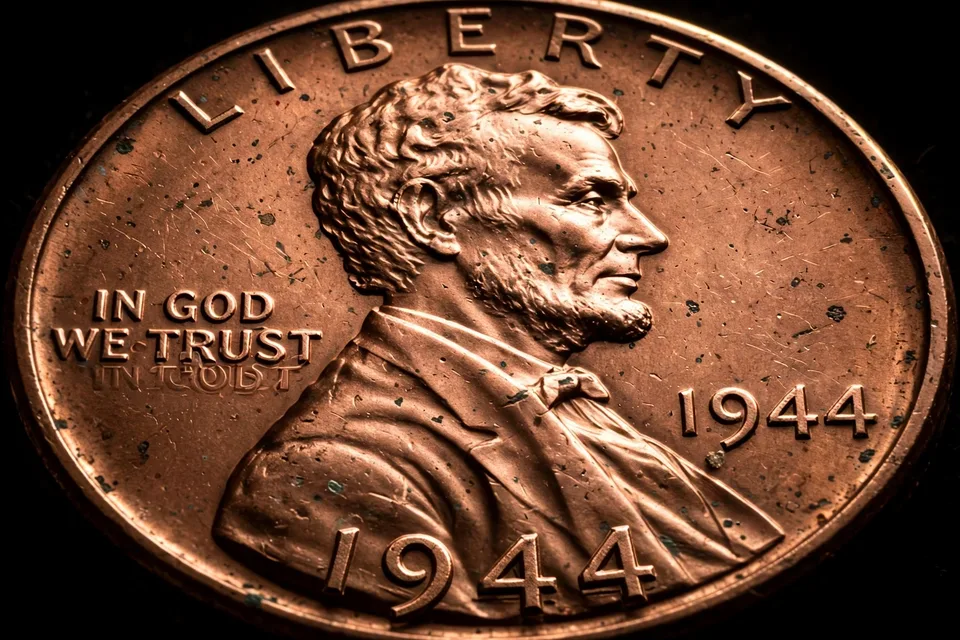
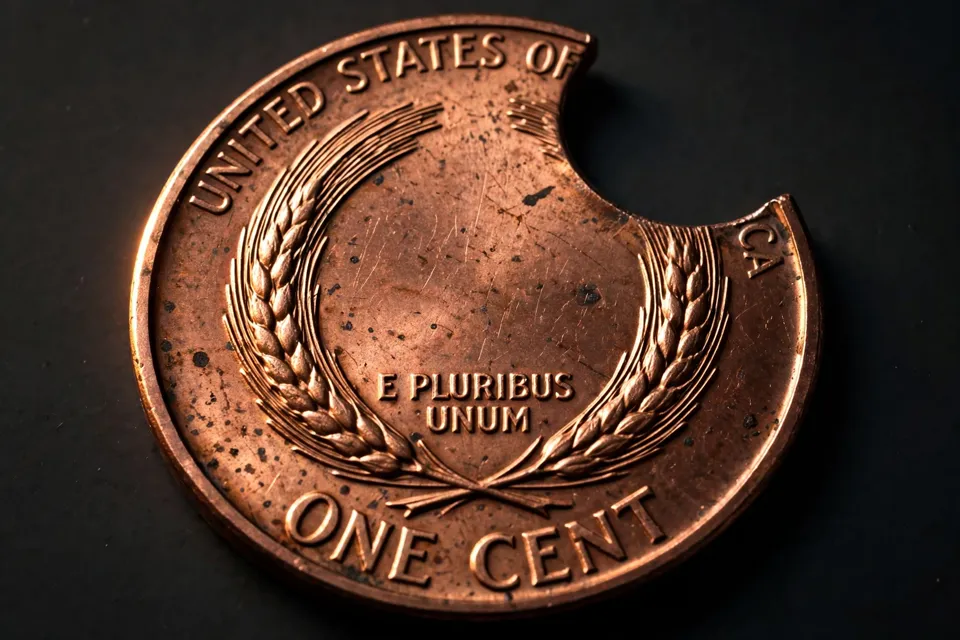
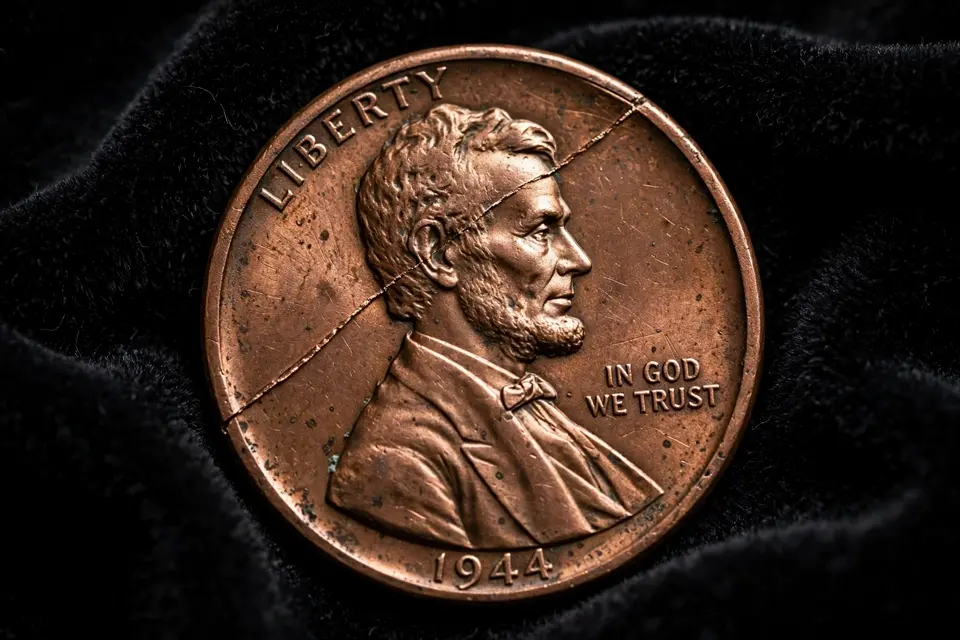
How to Identify a Lamination Error Coin: Peeling, Flakes & Real Values
Coin errors · 9 min read · Published November 1, 2026 · Updated November 1, 2026
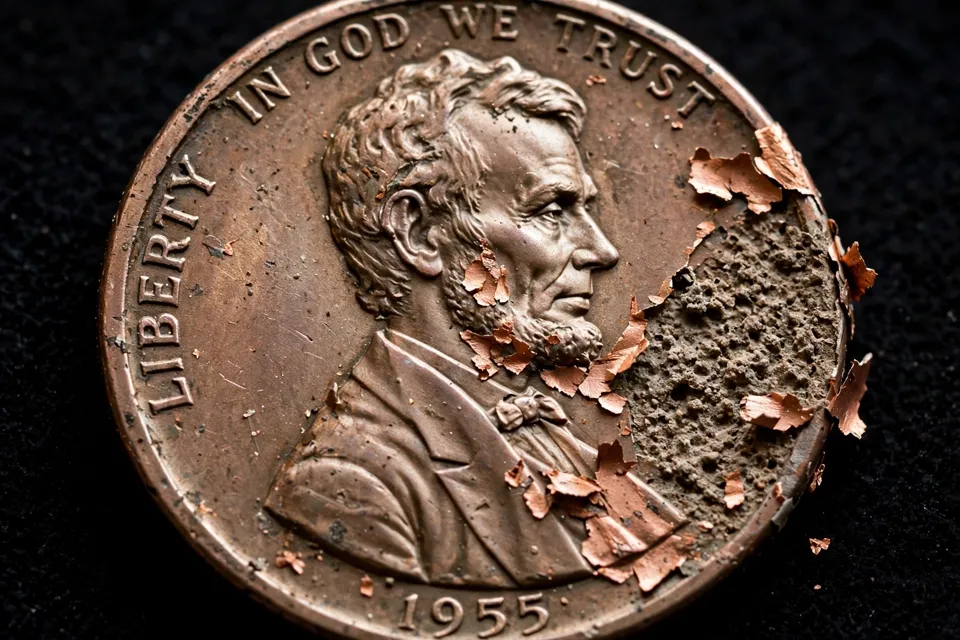
A lamination error coin is a coin whose surface metal is peeling, flaking, or lifting away because the planchet itself failed to bond together before it was struck. If the suspect spot looks like a thin sheet of metal leaf lifting from the surface, or a shallow grainy patch where such a sheet has already come off, you are almost certainly looking at a lamination error. Most examples are worth $1+ to $15+, while dramatic retained flaps and silver type coins reach $100+ to $220+.
Lamination is a planchet error, not a die error, and that distinction tells you where to look for proof. A die crack is a raised line left when metal fills a crack in the die. A lamination is a failure inside the coin blank itself: the metal strip from which the blank was cut never fully bonded, so a layer of it separates along a horizontal plane.
What a Lamination Error Actually Is
Every coin starts as a strip of metal rolled to the right thickness, then cut into blanks and struck. When that strip carries a contaminant, trapped gas, or an incompletely mixed alloy, the layers do not fuse cleanly. The weak layer sits just below the surface, invisible until the strike, circulation, or handling lets it lift. Collectors call the result a lamination error. Strictly speaking, the metal is delaminating, which is why some references call it a delamination error, but lamination is the name the hobby uses,.
Lamination errors are most common on solid-alloy coins, Copper cents, wartime nickels, and silver coins are the classic hosts. Clad coins can separate too, but the failure there is between layers of the clad sandwich, and the outer layer lifts to expose the copper core beneath.
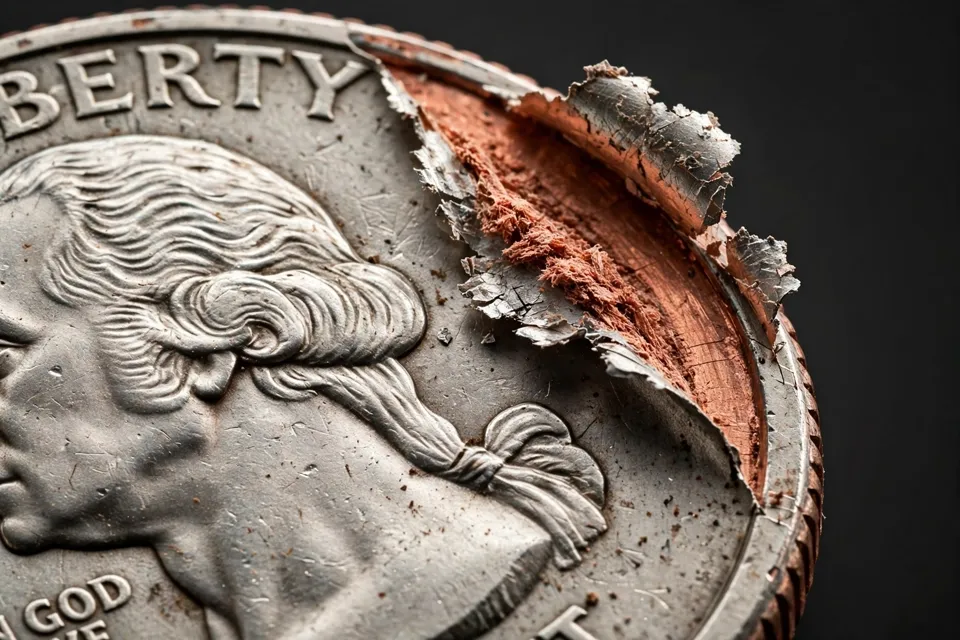
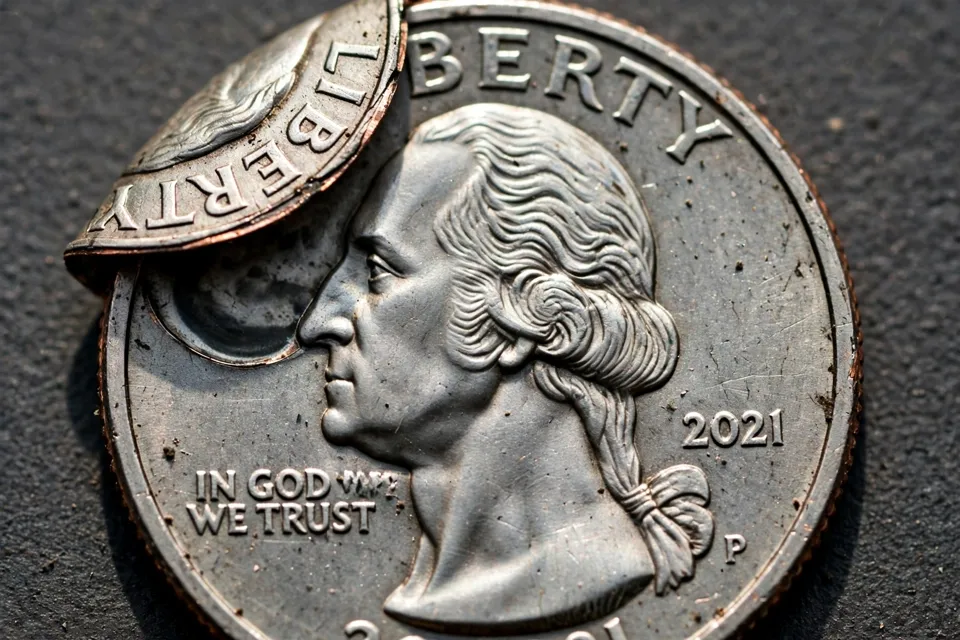
A lamination can separate at three moments, and the timing changes what you see. If the flake comes off before the strike, the exposed recess is struck flat and carries a weak, blurred version of the design. If it comes off after the strike, the recess is rough and grainy with no design at all, and the surrounding design stays sharp. If the flap stays attached and folds over before the strike, the result is the most dramatic form of all: a half-moon depression where the flap bent, with the folded flap carrying a struck design on its outer face.
The 5-Step Lamination Identification Checklist
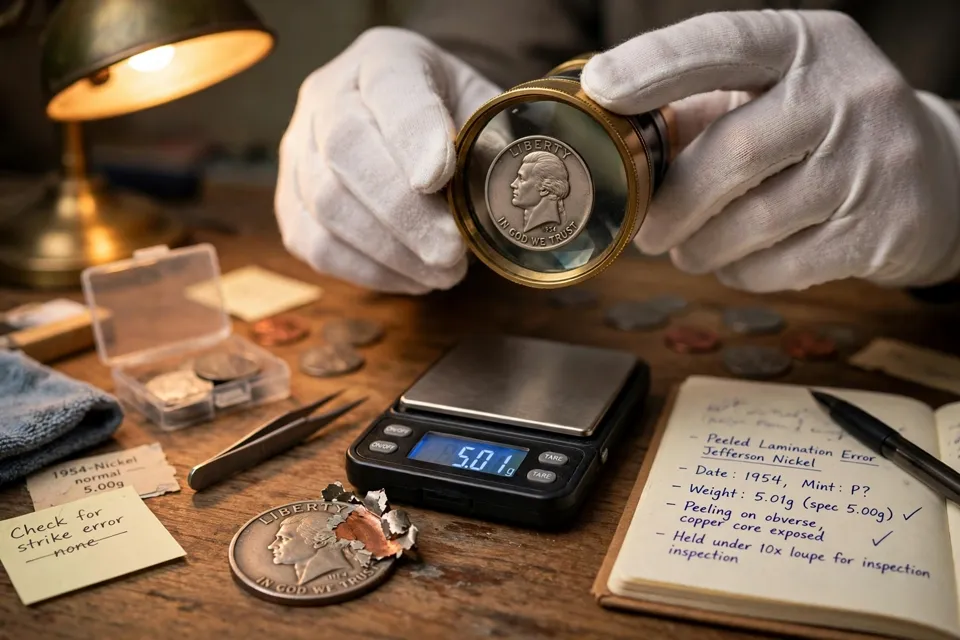
First, look at the surface, then under magnification. A genuine lamination looks like metal leaf: a thin sheet with a torn edge, still attached at one side or missing entirely. Under a 10x jeweler's loupe, the lifted edge is paper-thin and the metal beneath it is granular. A scratch or gouge leaves a bright, sharp-walled groove instead. If the area looks cut, scraped, or polished, it is damage, not a mint error.
Second, read the floor of the recess. Where a flake has come away, the exposed surface is rough and grainy, often slightly darker than the surrounding metal, because the unbonded layer never fully fused. A struck-through error, where a foreign object lay on the planchet during striking, leaves a smoother, cleaner depression. Grainy and shallow points to lamination; smooth and deep points elsewhere.
Third, follow the design across the defect. On a real lamination, the design behaves as the timing predicts: it continues weakly into a pre-strike recess, stops cleanly at a post-strike flake, or appears on the outer face of a retained flap. If a letter or portrait detail runs unbroken across the lifted sheet, that sheet was there when the die struck. If the design is simply missing in a patch with torn, bright edges, suspect a coin peeled by hand after it left the Mint.
Fourth, weigh the coin on a digital coin scale against the standard for its denomination: 3.11 grams for a solid copper cent, 2.50 grams for a zinc cent, 5.00 grams for a nickel, 2.27 grams for a clad dime, and 5.67 grams for a clad quarter. A small flake changes the weight by almost nothing, so a coin near standard supports lamination. A coin that is clearly light, with a rough, design-free back, has more likely split apart entirely, a split planchet error. Weight alone never proves lamination.
Fifth, check both faces and the edge before you name the error. Laminations can appear on either face and sometimes on both, and a large one can weaken the strike directly opposite it, because metal that should have filled the design flowed into the gap instead. That opposite-side weakness is genuine mint evidence, not wear. A raised line from the rim instead of a peeling layer is a die crack, a different error family. Record the denomination, date, mint mark, weight, and where the peeling sits before you put the coin away.
The Main Types of Lamination Errors
The type decides the price. A lamination crack is the mildest form: a thin surface crack where the layer has started to separate but has not lifted. A detached lamination is the classic flake-off form, with a grainy recess where the sheet is gone. A retained lamination keeps its flap attached, hinged at one edge. A folded-over lamination is a retained flap that bent across the coin before the strike, leaving the famous half-moon depression with blurred design beneath it. A clad separation is the clad-coin version, where the outer layer peels from the copper core.
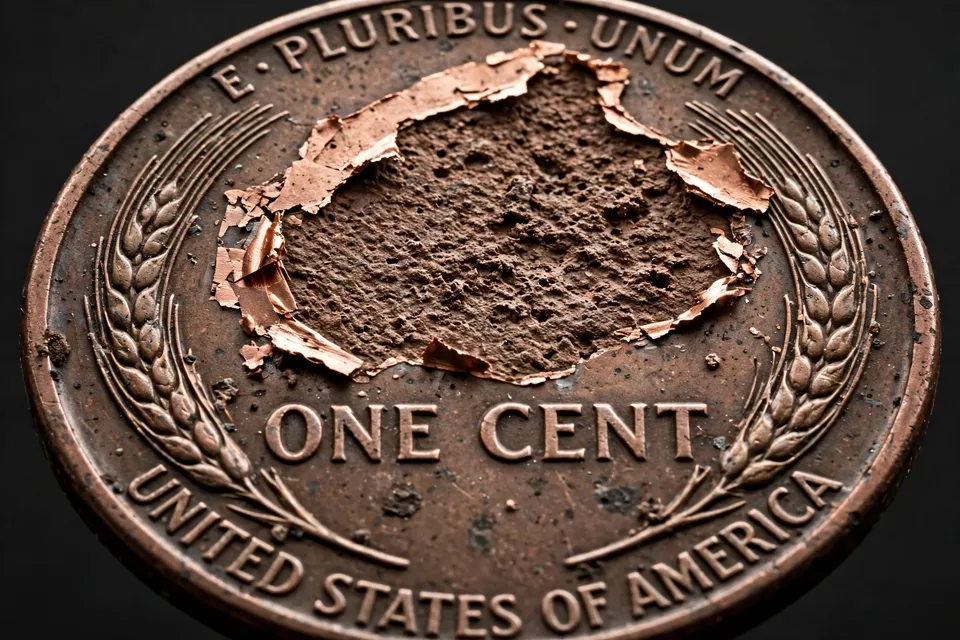
A wheat cent reverse shows the detached form clearly: a broad grainy patch where the sheet is gone, framed by curled fragments, while the surrounding design stays sharp. On a quarter, the lifted layer is thicker, and the copper core shows as a warm brown band beneath the outer skin.
| Type | What you see | Typical value range |
|---|---|---|
| Retained flap, dramatic | Large flap still attached, design on its outer face | $25+ to $100+ |
| Folded-over flap | Half-moon depression, blurred design beneath the flap | $25+ to $100+ |
| Detached flake, silver or type coin | Grainy recess on a silver dollar, nickel, or older type coin | $100+ to $220+ |
| Detached flake, common cent | Small grainy patch on a common Lincoln cent | $1+ to $15+ |
| Lamination crack only | Thin surface crack, no lifting or missing metal | $1+ to $5+ |
| Clad separation, quarter or dime | Outer layer lifting to expose the copper core | $10+ to $50+ |
Lamination vs the Lookalikes
Five common conditions imitate peeling metal. Work through the table below before you pay a premium or send a coin for grading.
| Condition | How it differs from lamination | Value effect |
|---|---|---|
| Plating bubble, post-1982 cent | Round or linear blister in the copper plating over zinc; can be poked and burst; often leads to zinc rot | No premium |
| Corrosion and zinc rot | Crusty, pitted, irregular eating of the surface, often with green or white deposits | Destroys value |
| Struck-through error | Smooth depression from an object on the planchet during striking, sometimes with a ghost image | Separate error, own values |
| Split planchet | Coin split into layers, rough striated surface, always weighs clearly less than standard | Separate error, own values |
| Die crack | Raised line of metal from a cracked die, no peeling layer, no grainy recess | Separate error, own values |
| Post-mint peeling and damage | Bright torn edges, tool marks, design cut through rather than struck over | No premium |
The plating bubble is the trap that catches the most collectors. Cents struck since 1982 are zinc cores with a thin copper plating, and early plating did not always bond. A bubble looks like a lamination, but it is a plating failure, not an alloy failure: it is hollow, it bursts under light pressure, and the zinc beneath it soon corrodes. Genuine lamination on a solid copper cent is a solid sheet of alloy metal, grainy beneath, with no hollow pocket and no zinc rot. On a post-1982 cent, a blister-like spot is plating until proven otherwise.
A split planchet is the closest true relative. Both errors start with the same weak bonding, but a split goes all the way through: the planchet separates into layers, sometimes hinged like a clamshell, and weighs measurably less than normal. If your coin is light and the back is a rough, striated slab with no design, you have a split planchet. If the weight is normal and only the surface has peeled, lamination is the right call.
How Much Is a Lamination Error Coin Worth?
Honest lamination values start with an uncomfortable fact: most laminations are common, and common errors earn small premiums. A small detached flake on an ordinary Lincoln cent is usually worth $1+ to $15+, and the best-documented ceiling for a post-1982 cent lamination is about $15+. Many trade for little more than face value. The money sits in size, flap survival, host coin, and condition.
A large retained flap changes the picture, because collectors pay for drama they can see across the room. A retained or folded-over flap on a cent or nickel typically brings $25+ to $100+, with the top of that range reserved for flaps covering a large part of the design and firmly attached. Silver and older type coins start higher, because the host coin already carries collector value and the error multiplies it: a certified 1926-S Peace dollar with reverse lamination, graded NGC XF45, has been listed at $220+, and certified Buffalo nickel laminations at $115+. Condition still rules.
Certification is worth the fee only when the coin clears a clear threshold. A common cent with a small flake will never repay a grading fee, and an uncertified description is enough for a low-value sale. A dramatic retained flap, a silver type coin, or any lamination you plan to sell as a featured error earns its holder. Store keepers in acid-free coin flips, handle them by the edge, and never clean, bend, or peel at a loose flap.
What to Do With a Suspect Coin
If a coin in your change or roll shows peeling metal, run the five checks in order and photograph both sides before handling it further. Before you spend or sell any coin you are unsure about, run it through the free Error Identifier to confirm the error type, use the Coin Value Checker to confirm its value range, and try Grade-or-Not for a grade verdict on your best examples.
Frequently Asked Questions
What is a lamination error on a coin?
A lamination error is a planchet error in which a surface layer of the coin blank fails to bond and then peels, flakes, or lifts away. It is caused by contaminants, trapped gas, or an incompletely mixed alloy in the metal strip.
How do I know if my coin has a lamination error?
Look for a thin, metal-leaf sheet lifting from the surface or a shallow, grainy recess where such a sheet has come off. Under magnification the lifted edge is paper-thin, the floor beneath it is granular, and the weight stays near standard. If the spot looks cut, scraped, or hollow, it is damage or a plating bubble.
Are lamination error coins valuable?
Most are modestly valuable: common cent laminations typically bring $1+ to $15+, dramatic retained flaps reach $25+ to $100+, and silver type coins reach $100+ to $220+. Size, flap survival, host coin, and condition decide the price, and simple small laminations on common coins carry only a slight premium.
What is the difference between lamination and delamination?
There is no difference in the coin itself: delamination is the technically precise word for layers separating, while lamination is the traditional name the hobby and the grading services use. Both terms describe the same peeling-layer planchet error.
How is a lamination different from a split planchet?
A lamination is a surface failure: only the outer layer peels, and the weight stays near normal. A split planchet separates through the whole thickness of the blank, leaves a rough striated surface, and always weighs clearly less than standard. Weight and depth decide between the two.
Should I get a lamination error coin graded?
Grade a lamination only when its value clearly exceeds the grading fee: dramatic retained flaps, silver or older type coins, and errors you plan to sell as featured pieces. A common cent with a small flake will not repay the fee; for low-value examples a clear photograph and an accurate description are enough.
A lamination costs nothing to check, and the difference between a $220+ silver error and a face-value coin is one careful look under magnification. Before you spend or sell any coin you are unsure about, run it through The Diggin Dave's free Error Identifier to confirm the error type, use the Coin Value Checker to confirm its value range, and try Grade-or-Not for a grade verdict on your best examples.
As an Amazon Associate, this site may earn from qualifying purchases.
Related Reading
- How to Identify a Doubled Die Coin: Real Doubling vs Machine Doubling — the raised-vs-flat test that separates true doubling from machine doubling
- How to Identify a Clipped Planchet Coin: Real Clips, Fake Cuts & Values — the Blakesley effect test for clipped blanks
- How to Identify a Die Crack Coin: Raised Lines, Cuds & Real Values — the raised-line test that separates genuine die cracks from scratches, plus cud values