How to Identify a Rotated Die Coin: The Flip Test, Clock Positions & Real Values
Coin errors · 9 min read · Published November 1, 2026 · Updated November 1, 2026
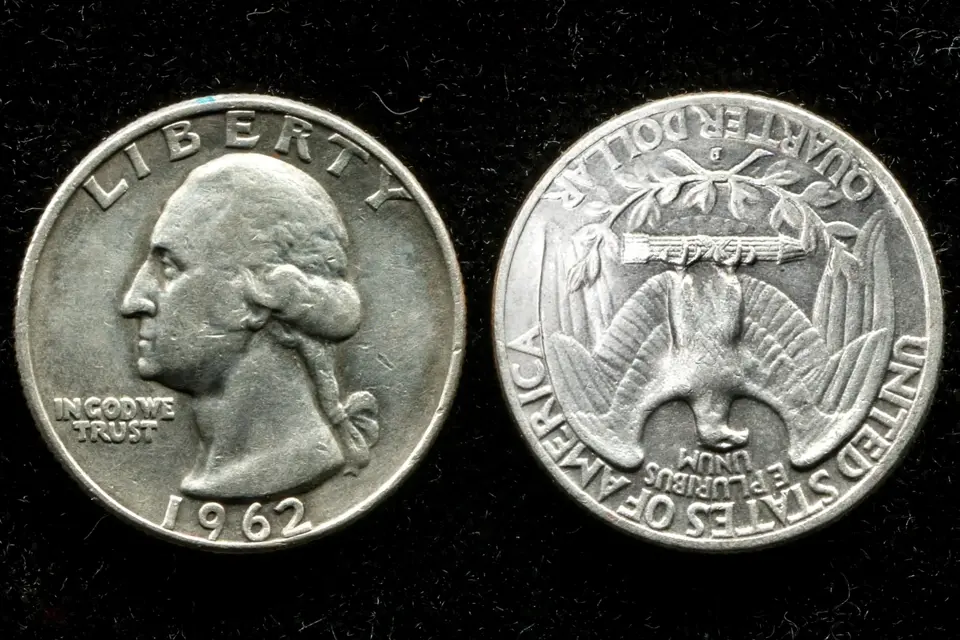
A rotated die coin is a coin whose reverse design sits turned away from where it should be. Hold the coin upright by its edges, flip it top to bottom, and the reverse should come up upright too. If the reverse comes up tilted, sideways, or completely upside down, you have a rotated die error. Rotations of 15 degrees or less usually carry no premium, rotations from 16 to 45 degrees carry a small premium, and the strongest values sit at 90 degrees and especially at 180 degrees, where the reverse is fully upside down.
What a Rotated Die Error Actually Is
Every United States coin is struck between two dies, an obverse die and a reverse die, and the two dies are supposed to sit in a fixed relationship to each other. On a normal United States coin, that relationship is called coin alignment. Hold the coin by the edges at 3 and 9 o'clock with the obverse upright, rotate it top to bottom, and the reverse design appears upright as well. That is the alignment your pocket change should show, and it is the baseline every rotated die check starts from.
The other alignment you will meet is medal alignment, where the obverse and reverse designs point the same way, so flipping the coin top to bottom leaves the reverse upside down. Medals and tokens are struck this way on purpose. A United States coin struck in medal alignment is not a normal coin at all. It is a 180-degree rotated die error, because one die was installed a half-turn away from its correct position.
A rotated die error happens in three ways. A die can be installed in the wrong orientation relative to its partner die. The flat ground on the die shank can sit in the wrong spot relative to the design on the die face, which forces the same wrong installation. Or a die can work loose in its recess during a production run and slowly turn on its axis. Each cause leaves the same signature on the finished coin: a full, sharp design that is simply turned.
Stable Rotation vs Dynamic Rotation
In a stable rotation error, the die sits in one wrong position and stays there, so every coin it strikes shows the same angle of rotation. Collectors can then hunt a known variety, because the same turned reverse appears again and again. A documented 1994 Lincoln cent, for example, shows a stable rotation of 165 degrees counterclockwise, coin after coin.
In a dynamic rotation error, the die keeps turning while the press runs, so the angle changes from coin to coin across the run. One production run can produce coins rotated by a few degrees, by 90 degrees, and by nearly a full turn, all from the same die pair. Dynamic rotations are harder to catalog, and at the dramatic end of the range harder to find in any single angle, because the run spreads its output across the whole clock face.
One more distinction belongs here. In an ordinary in-collar rotated die error, it is impossible to tell which die rotated, because both sides are struck correctly and only their relationship to each other is wrong. In the great majority of cases the hammer die, the moving upper die, is the one that turned.
The 60-Second Flip Test
You do not need special equipment to spot a rotated die coin. You need good light and the discipline to flip the coin the right way every time.
First, hold the coin by its edges between thumb and forefinger at 3 and 9 o'clock, with the obverse design upright and facing you. Never hold it by the faces, and never flip it side to side, because a sideways flip turns every normal coin upside down and tells you nothing.
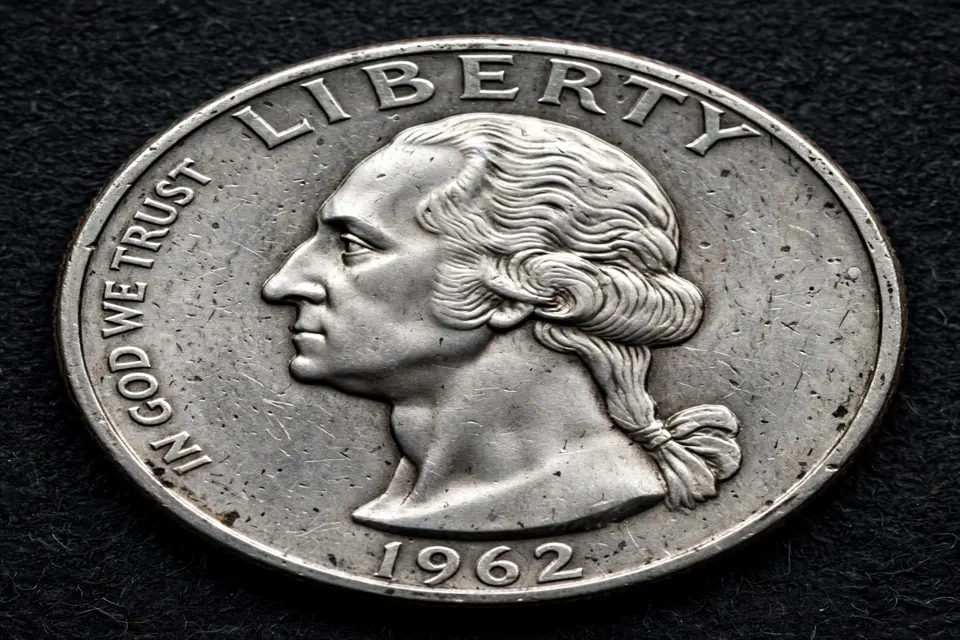
Second, rotate the coin top to bottom, as if you were turning a page, keeping your grip on the same two edge points. On a normal coin struck in coin alignment, the reverse design is upright. On a rotated die coin, the reverse design leans, lies sideways, or stands fully upside down.
Third, check the result twice. Turn the coin back to the obverse, set it upright again, and repeat the flip. A genuine rotation repeats exactly. If the angle seems to change between flips, you are probably shifting your grip rather than reading the coin.
Fourth, confirm the coin should show coin alignment before you celebrate. Medals, tokens, and some foreign coins are struck in medal alignment on purpose, and their reverses will always come up upside down on the flip test. The test only means something when the coin should show coin alignment in the first place.
Measuring the Rotation: Degrees and Clock Positions
Once the flip test says the reverse is turned, measure how far it turned. Collectors describe rotation in degrees and in clock positions, and both describe the same thing.
Stand the reverse design upright in your mind, then note how far it actually sits from upright. A reverse tilted slightly to the right sits at about 1 or 2 o'clock. A reverse lying on its side sits at 3 or 9 o'clock, which is 90 degrees. A reverse standing fully upside down sits at 6 o'clock, which is 180 degrees. Always note the direction as well: clockwise, written CW, or counterclockwise, written CCW. A 165-degree counterclockwise rotation and a 165-degree clockwise rotation are different coins from different die positions.
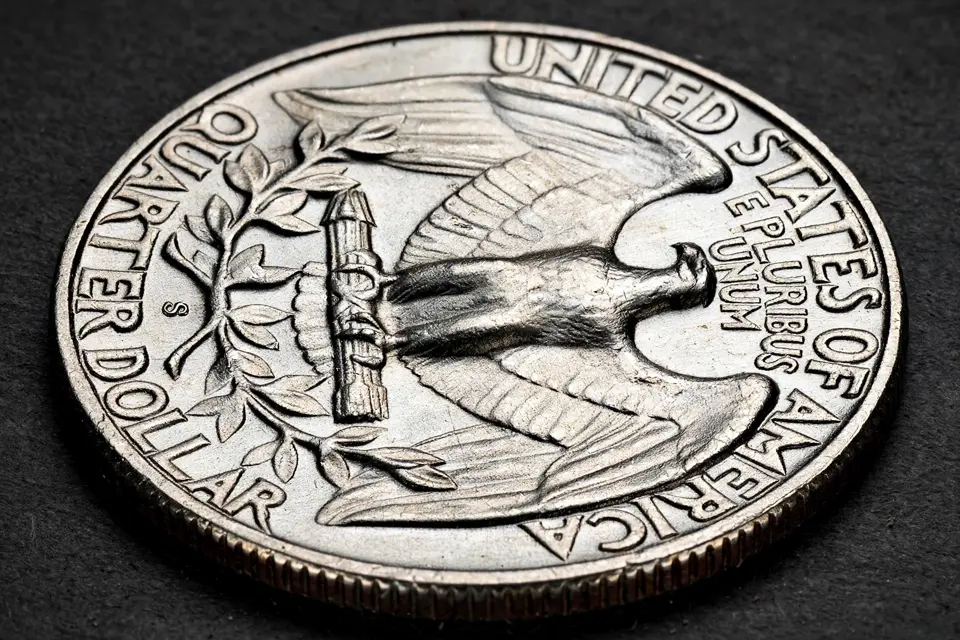
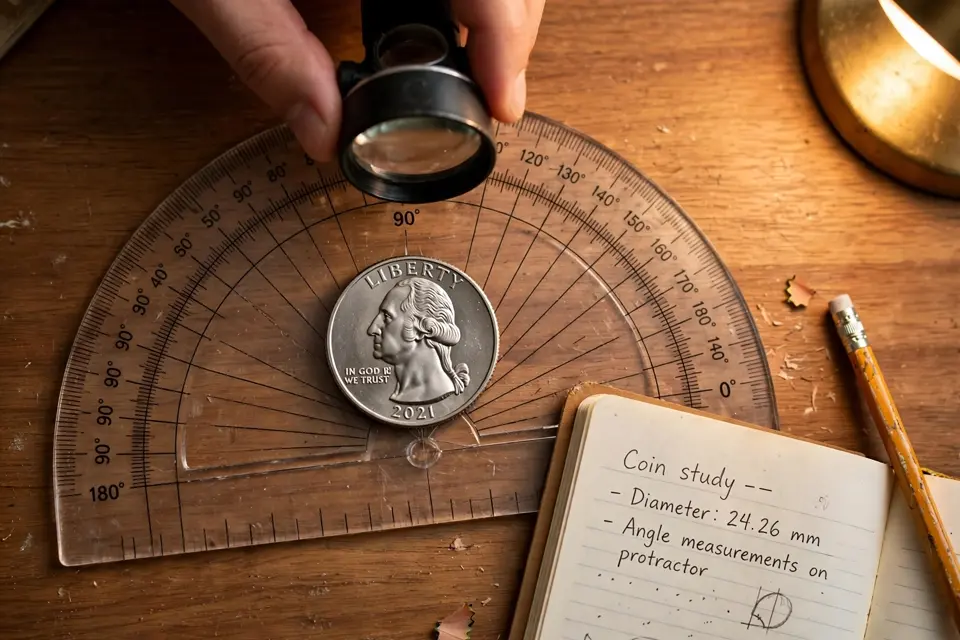
For a careful measurement, lay the coin on a protractor or a printed clock face with the obverse upright, then flip it top to bottom onto the same guide and read the reverse angle against the markings. Under 10x magnification the fine details of the reverse give you reference points that are easy to read against the scale. Photograph the coin in both positions before you move it.
Error collectors classify rotated strikes in the III-G family. A rotation of 16 to 45 degrees is III-G-3, a rotation of 46 to 135 degrees is III-G-4, and a rotation of 136 to 180 degrees is III-G-5. Those bands are also the bands that drive value, because the market pays for drama and rarity, and both rise with the angle.
Rotated Die Coin Values by Degree
Rotation alone does not set the price. The angle, the coin's date and denomination, its condition, and how many examples are known all pull together. The table below gives typical collector-market ranges for common modern coins, where the rotation is the only error and the coin is otherwise ordinary.
| Rotation | What you see on the flip test | Typical value range |
|---|---|---|
| 0 to 15 degrees | Reverse nearly upright, slight lean | Face value to $5+ |
| 16 to 45 degrees | Clear tilt, about 1 to 2 o'clock | $5+ to $50+ |
| 46 to 135 degrees | Strong tilt to sideways, about 3 o'clock | $25+ to $300+ |
| 136 to 180 degrees | Near or fully upside down, about 6 o'clock | $50+ to $1,000+ |
Rotations of 5 to 8 degrees sit inside the Mint's tolerance margin, and rotations of 15 degrees or less are generally not considered valuable. The major grading services draw the same line: NGC does not recognize rotated die errors below 15 degrees. That threshold is the single most useful fact in this guide, because it stops collectors from paying error prices for ordinary striking variation.
Above the threshold, the curve climbs fast. A 45-degree rotation on a Matron Head Large Cent, the early copper series where rotated dies are most common, has traded in a $9+ to $700+ range depending on type and condition. State Quarters are the great exception to the small-angle rule: because collector demand for Statehood quarter errors runs so high, even a small rotation on a popular State Quarter can still bring a solid premium.
Famous Rotated Die Finds to Know
Statehood Quarters headline the modern hunt. When rotated State Quarters first drew press attention, the grading services noted that small misalignments, which would be ignored on most coins, were bringing real premiums on State Quarters simply because so many collectors were chasing them. A 90-degree or 180-degree State Quarter remains one of the most recognizable rotated die finds a roll hunter can make.
Early copper tells the older story. Rotated dies are genuinely commonplace on many early United States coins, especially the 1864 two-cent piece, where loose die practices of the era left whole runs with turned reverses. On those coins a modest rotation adds little, and only the dramatic angles stand out.
Proof coinage supplies the spectacular exception. A 1980-S proof Lincoln cent exists with its dies installed in the medallic position, a full 180-degree rotation on a proof coin that should never have left the Mint that way. Proof rotated dies are rare precisely because proof production is so tightly controlled. The lesson of all three examples is the same: the angle gets you noticed, but the host coin decides the price.
Rotated Die vs the Lookalikes
A misaligned die strike shifts the design sideways rather than turning it. The design stays upright but sits off-center, often with a blank crescent on one side. A rotated die coin keeps its design perfectly centered and fully struck, and only the angle is wrong. If the design is shifted, not turned, you have a different error.
A rotated mintmark is a much smaller thing. It happens when the mintmark punch itself was held at an angle while the working die was made, so one letter leans while the rest of the design stands straight. Most rotated mintmarks lean no more than 10 degrees, and they never turn the whole reverse. If only the mintmark leans, the die did not rotate.
A coin that has been deliberately turned after leaving the Mint is not an error at all. Altered coins show tool marks, softened details, or a weight and edge that no longer match the issue. A genuine rotated die coin is struck that way, so its design is sharp, its edge is normal, and its weight matches the standard for its denomination.
Finally, a rotated die clash is a related but different error. It happens when a rotated die collides with its partner die without a planchet between them, leaving rotated clash marks on the opposite die. The clash marks are ghost impressions of the other side's design, not a turned full design. If you see faint mirrored letters where they do not belong, you may be looking at a clash, and that coin deserves its own identification check.
What to Do With a Rotated Die Coin You Find
Handle the coin by its edges and slip it into an acid-free flip the moment you confirm the rotation, because every new fingerprint and scratch on an error coin costs money. Photograph both faces straight on, with the obverse upright in one photo and the reverse exactly as it appears after the flip test in the other, and write the measured angle, the direction, and the date and mintmark on the flip label.
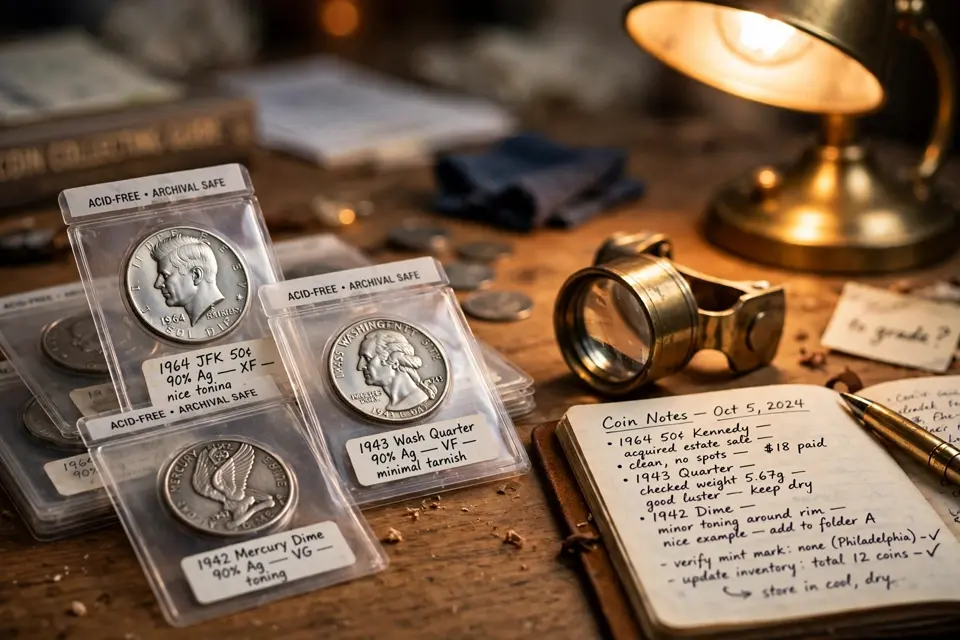
Compare your coin against the value table above, and be honest about the angle. A 20-degree rotation is a real error, but it is not a 180-degree error. For rotations of 90 degrees and above, or for any rotated die on a scarce date or a proof coin, professional grading with error attribution is worth the cost. For smaller rotations on common coins, a clear photo pair and an accurate angle measurement are usually enough.
Frequently Asked Questions
How do I check if my coin has a rotated die error?
Hold the coin by its edges at 3 and 9 o'clock with the obverse upright, then flip it top to bottom. On a normal United States coin the reverse comes up upright; if it comes up tilted, sideways, or upside down, the coin has a rotated die error.
How much rotation does a coin need to be valuable?
Rotations of 15 degrees or less generally carry no premium, because they sit inside normal striking tolerance and the major grading services do not recognize rotations below 15 degrees. Value starts at 16 degrees and climbs with the angle.
Are rotated die coins rare?
Small rotations are relatively common, especially on early copper coins such as the 1864 two-cent piece. Dramatic rotations of 90 degrees and above are much scarcer, and a full 180-degree rotation on a modern or proof coin is genuinely rare.
What is the most valuable rotated die angle?
The 180-degree rotation, where the reverse is fully upside down in medal alignment, is the most valuable angle. On a common modern coin in mint condition it can reach $500+ to $1,000+, and on a scarce date or a popular series it climbs far higher.
Can a rotated die error be faked?
A genuine rotated die coin is struck that way, so its design is sharp and its weight and edge match the issue. A faked or altered coin usually shows tool marks, softened details, or a wrong weight, so have any doubtful coin examined before you pay error prices.
Should I get my rotated die coin graded?
For rotations of 90 degrees and above, and for any rotated die on a scarce date or a proof coin, grading with error attribution is worth it. For smaller rotations on common coins, clear photographs and an accurate angle measurement are usually enough.
A rotated die coin costs nothing to check, and the difference between a face-value coin and a $1,000+ error is one careful flip test. Before you spend or sell any coin you are unsure about, run it through The Diggin Dave's free Error Identifier to confirm the error type, use the Coin Value Checker to confirm its value range, and try Grade-or-Not for a grade verdict on your best examples.
As an Amazon Associate, this site may earn from qualifying purchases.
Related Reading
- How to Identify a Doubled Die Coin: Real Doubling vs Machine Doubling — the raised-vs-flat test that separates true doubling from machine doubling
- How to Identify a Broadstrike Coin: Oversized, Full Design & Real Values — the diameter test for coins struck outside the collar
- How to Identify a Die Crack Coin: Raised Lines, Cuds & Real Values — the raised-line test that separates genuine die cracks from scratches, plus cud values