How to Identify an Off-Center Coin: Blank Crescents, Percentages & Real Values
Coin errors · 9 min read · Published November 4, 2026 · Updated November 4, 2026
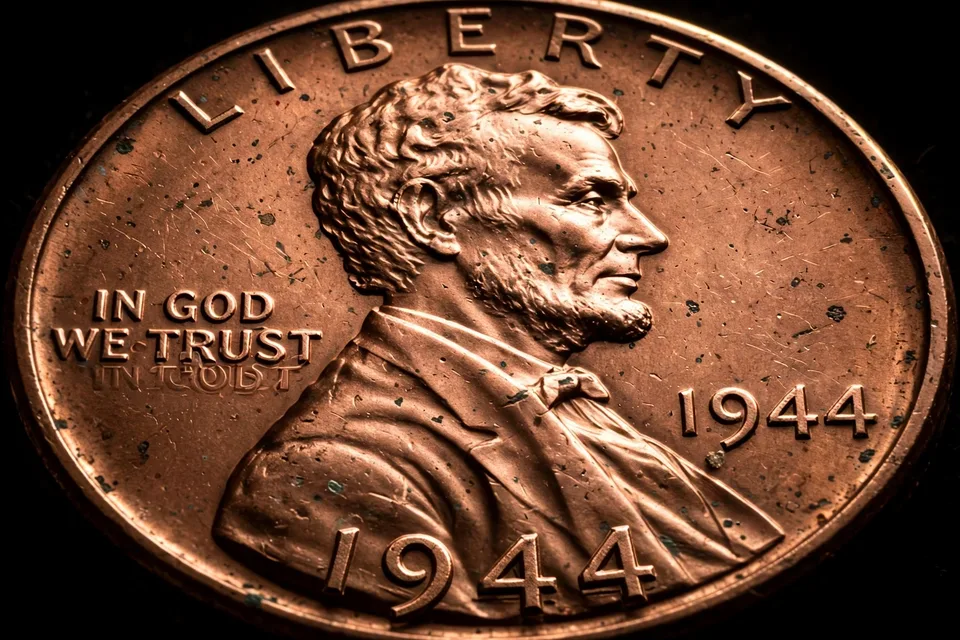
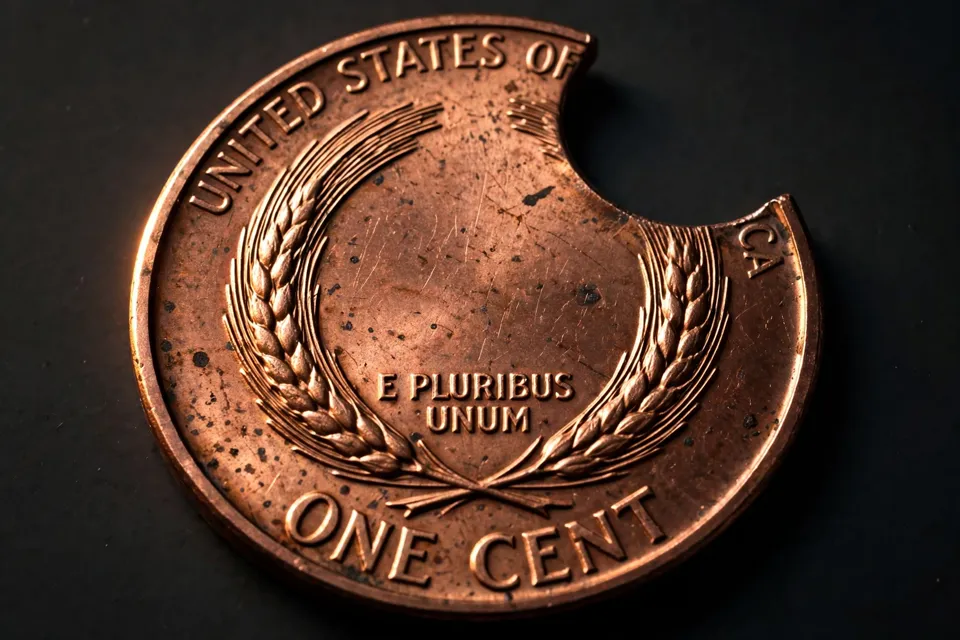
An off-center coin is a coin struck with its planchet sitting off-center between the dies, so part of the design is missing and a smooth blank crescent of unstruck metal shows on one side. The short answer to how to identify an off-center coin is this: look for a design shifted to one side, a flat blank crescent on the opposite side, and a coin that still weighs exactly what its denomination should weigh. If the blank area is smooth with original mint luster, you are almost certainly holding a genuine off-center strike.
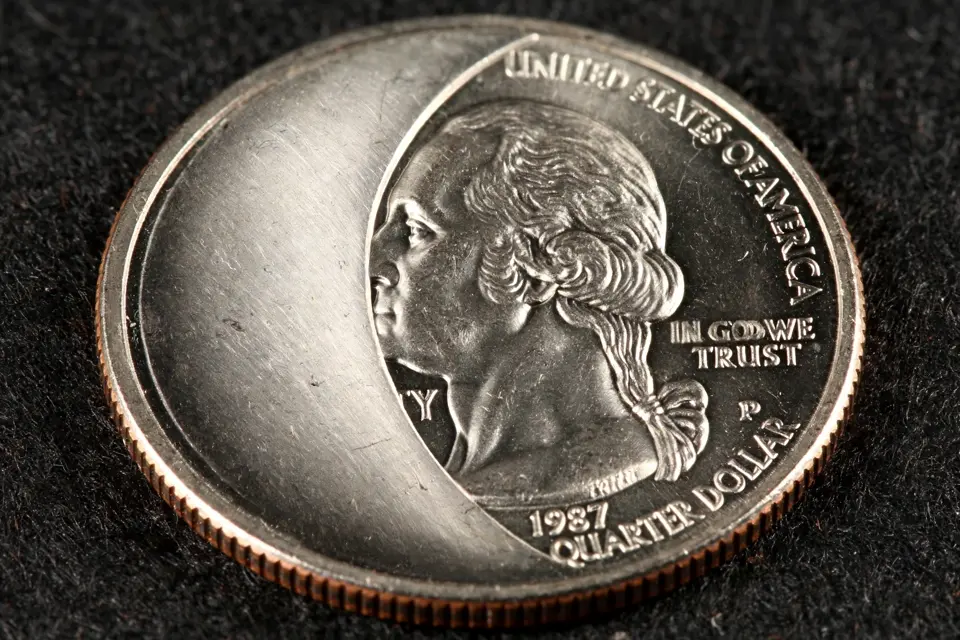
Off-center strikes are the most visual of all mint errors. No loupe is needed to spot a dramatic one, which is why they are the error most often found in pocket change and bank rolls. They are also the most often spent by mistake: a coin with half its design missing looks damaged, and beginners regularly spend a $200+ error as an ordinary quarter.
How an off-center strike happens
Every coin starts as a blank planchet, a round disc of the right metal, weight, and diameter. Before striking, it must sit perfectly centered inside a collar, a steel ring that holds it in place and presses the reeding into the edge on reeded denominations. The hammer and anvil dies then close together, impressing both designs at once.
An off-center strike happens when the planchet is not centered when the dies close. Part of the planchet sticks out beyond the die faces, so that part receives no design at all, while the part between the dies is struck normally. The unstruck part stays flat and blank.
Modern mint quality control catches most off-center strikes, which is why dramatic examples are scarce. Minor shifts still slip through, and older coins reach collectors far more often.
The percentage: the number that drives value
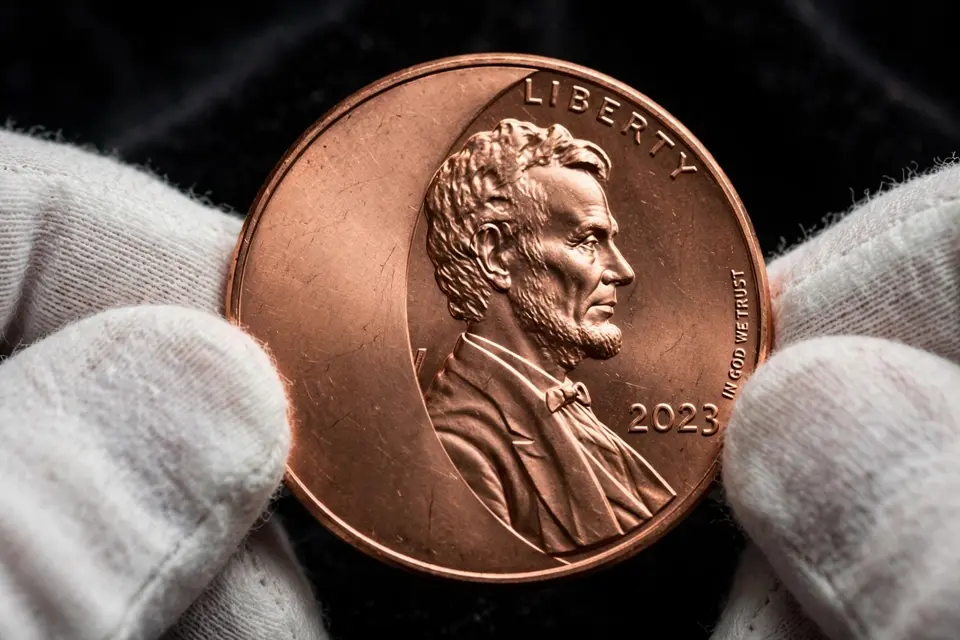
Collectors describe every off-center coin by its percentage, the first thing any buyer asks. It is the share of the planchet left blank: if a fifth of the coin is blank crescent, it is 20% off-center; if half is blank, it is 50% off-center.
The percentage matters for two reasons. First, drama: a 50% off-center coin is unmistakable from across a room, while a 5% shift needs a second look. Second, the date. A highly off-center coin is more likely to have its date struck clean off the planchet, and a coin with no visible date is much harder to identify, authenticate, and sell. The sweet spot collectors pay most for is roughly 40% to 60% off-center with the full date still visible.
Small shifts are common and cheap. A coin 5% to 10% off-center shows only a sliver of blank rim, and on a modern cent it adds little more than $10+. At 10% to 20%, the crescent is obvious and circulated examples start at $25+ to $100+. At 30% to 50% with the date visible, values climb into the $100+ to $250+ range, and higher for quarters and half dollars. Past 60%, the coin becomes mostly blank metal, and value falls back unless the surviving design sliver still shows the date and mint mark.
The 5-step identification checklist
Work through these steps in order. The weight test and the luster test catch nearly every fake.
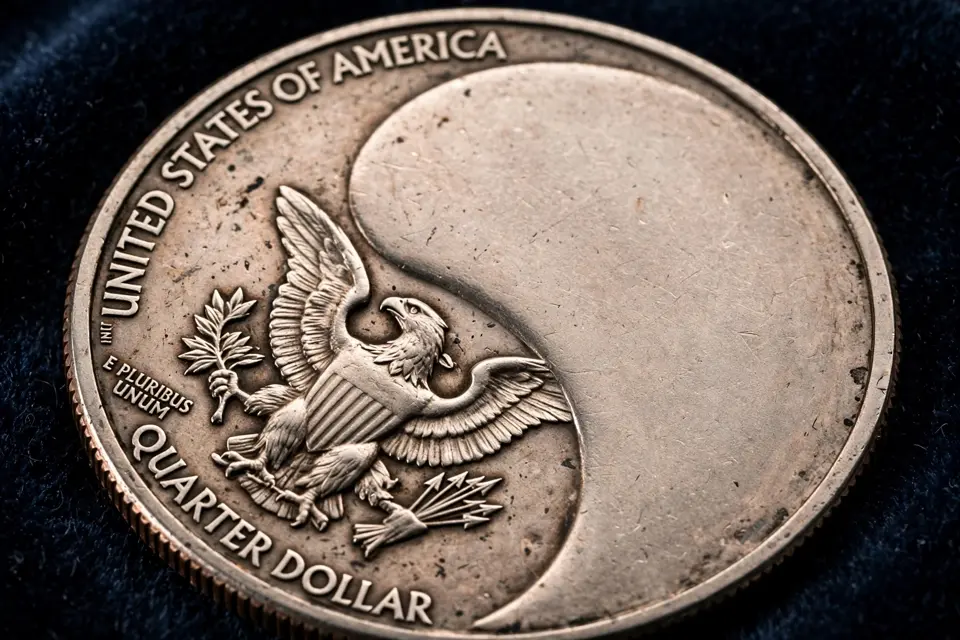
First, find the blank crescent: one smooth, flat, unstruck area shaped like a crescent moon, opposite the direction the design shifted. It should look like untouched planchet metal, smooth and even with original mint luster. If the blank area is rough, scratched, or dull gray while the rest of the coin is lustrous, suspect damage, not a mint error.
Second, check that the design is cut off cleanly. On a genuine strike, the design simply stops where the die stopped: letters, portrait details, and rim elements end abruptly at the boundary of the blank crescent, with no torn or smeared metal. A coin ground, filed, or sanded after leaving the mint shows tool marks and metal pushed up along the cut edge. Mint striking never leaves tool marks.
Third, weigh the coin. This is the test most fakes fail. A genuine off-center coin weighs the normal weight for its type, because the planchet was complete: a clad quarter weighs 5.67 grams, a zinc cent 2.5 grams, a nickel 5.0 grams. A coin ground down to imitate one weighs noticeably less.
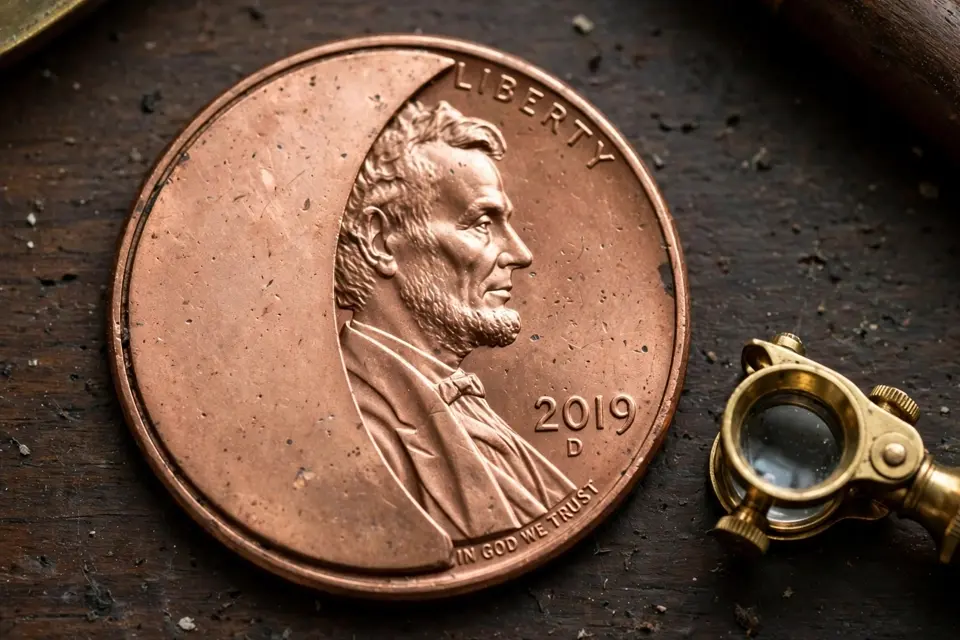
Fourth, examine the edge and the rim. On the struck side, the rim and reeding look normal. On the shifted side, the rim is missing or weak, and reeding fades out, because that part of the planchet was never inside the collar.
Fifth, read the date and mint mark, and check both sides. A genuine off-center strike shifts the design on both faces in the same direction, because the whole planchet was misaligned. If the obverse is shifted but the reverse is centered, you are looking at a misaligned die, worth far less. A full visible date is the single biggest value multiplier in this error type.
Off-center vs the lookalikes
A broadstrike is struck without the collar rising, so the planchet spreads wider and thinner, but the design is complete on both sides. No design is missing, and there is no blank crescent.
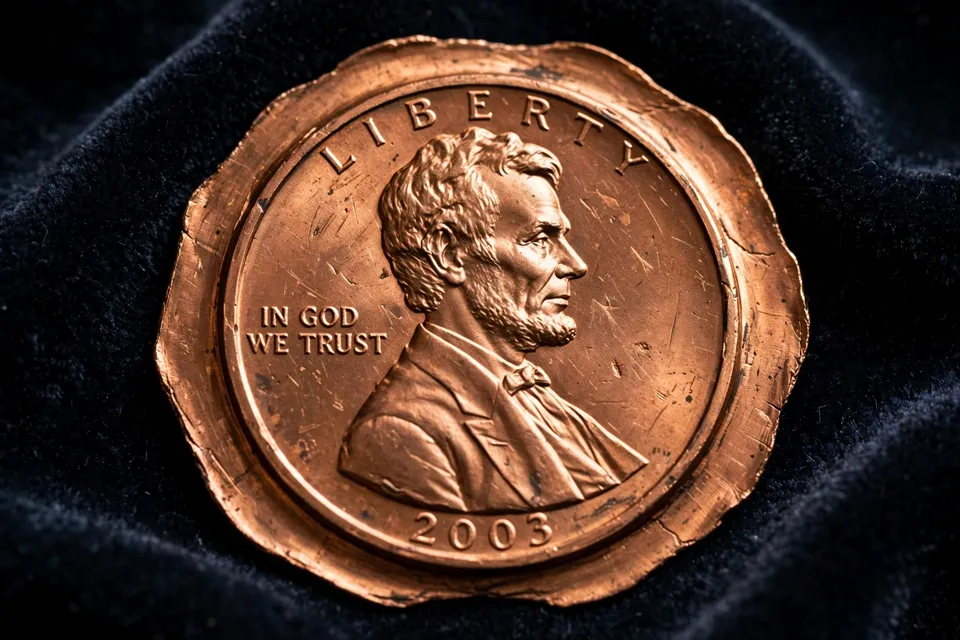
A partial collar strike, nicknamed the railroad rim, happens when the collar rises only partway. One side has a normal rim and reeding, while the other spreads flat, giving the edge a stepped, rail-like profile.
A misaligned die strike looks the most like an off-center coin. Here one die, usually the hammer die, sits slightly off-center while the planchet sits correctly. The result is a design shifted on one face only, with the other face perfectly centered, and no blank crescent. Misaligned dies are common and worth little.
A double strike is a coin struck twice, showing two overlapping impressions of the normal design, both reading the right way round. The coin shows doubled elements, not a blank crescent.
Off-center coin values by percentage
Values depend on percentage, date visibility, denomination, and condition, in that order. The table below gives typical collector-market ranges.
| Percentage off-center | Date visible? | Typical value range | Notes |
|---|---|---|---|
| 5% to 10% | Yes | $10+ to $25+ | Minor shift, common on cents |
| 10% to 20% | Yes | $25+ to $100+ | Obvious crescent; the entry point most collectors start at |
| 20% to 30% | Yes | $50+ to $150+ | Strong drama; date usually survives |
| 30% to 50% | Yes | $100+ to $250+ | Sweet spot begins |
| 40% to 60% | Yes | $200+ to $500+ | Peak demand; full date key |
| 40% to 60% | No | $50+ to $150+ | Missing date cuts value sharply |
| 60% to 90% | Rarely | $75+ to $300+ | Mostly blank planchet |
Denomination matters as well. Larger coins are scarcer as off-center errors, so a 50% off-center half dollar outvalues the same percentage on a cent. Older coins command premiums too: a 10% off-center 1793 Flowing Hair cent is a rare error for its era. Recorded market examples show the pattern clearly. A 50% off-center quarter with a visible date routinely trades in the $200+ range. A 60% off-center strike on a defective planchet in mint-state brown brought $2,413+ at Heritage in 2021, and a double-struck cent with an 80% off-center error sold for $575+ in 2008. Percentage gets attention, but date, denomination, and condition set the price.
Fakes, damage, and coins that only look off-center
Ground-down coins are the commonest fake. Someone grinds or files one side of a normal coin to create a blank crescent, then polishes it. The weight test exposes them immediately, since grinding removes metal, and magnification shows parallel file lines that mint striking never produces.
Vise jobs and spooned coins are post-mint damage, not mint errors. A coin squeezed in a vise or hammered at the edge spreads and distorts, but the design is smeared, not cleanly cut off.
Altered dates are the trap on high-percentage examples. Because a visible date is worth so much, some sellers add or re-engrave a date onto a dateless off-center coin. Check the date under magnification: genuine digits sit at the same depth and sharpness as the surrounding design, while added digits show tool marks and metal displacement. When the date is the whole value of the coin, certification is the safe route.
What to do with a coin you suspect
Hold the coin by its edge, photograph both sides in side lighting, and weigh it before anything else.
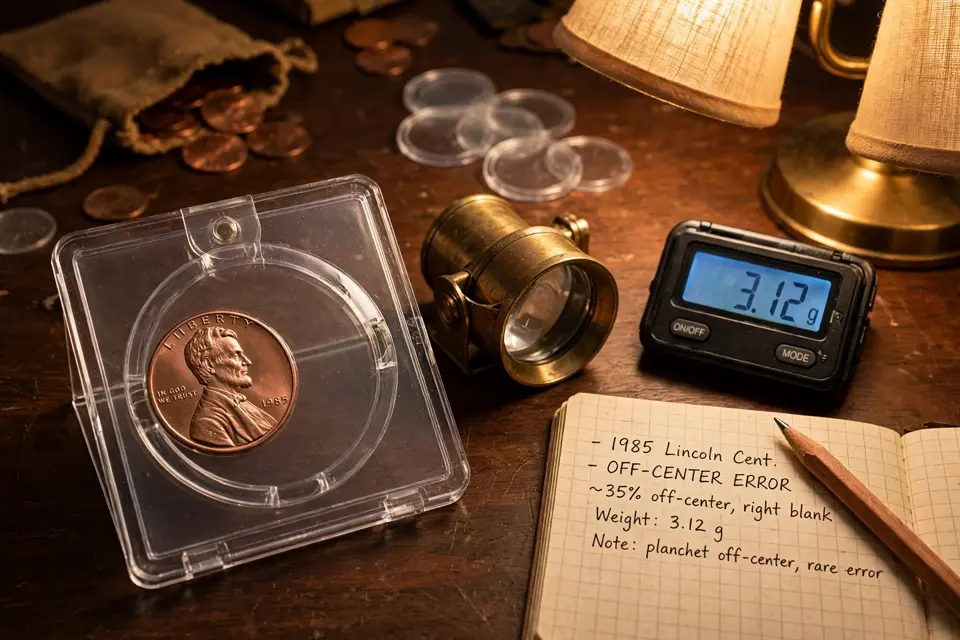
Put the coin in a 2x2 holder or an acid-free flip, never in a pocket or jar with other coins, where the blank crescent picks up scratches that look like damage. Do not clean it: cleaning strips the mint luster from the blank area, one of the proofs that the coin is genuine. Send dramatic, high-denomination, or high-grade examples for professional authentication, because a certified coin removes the fake question for the next buyer. A minor 5% to 10% off-center cent is a collection find, not a grading submission.
Frequently Asked Questions
What is an off-center coin?
An off-center coin is a coin struck while its planchet sat off-center between the dies, so part of the design is missing and a smooth blank crescent shows on one side. The planchet was complete, so the coin weighs normally, and the design is cut off cleanly where the die ended.
How can I tell an off-center coin from a broadstrike?
A broadstrike has a complete design on a wider, thinner planchet, because the collar never rose, while an off-center coin is missing part of its design and shows a blank crescent.
What percentage off-center is most valuable?
The most valuable band is 40% to 60% off-center with the full date still visible, typically $200+ to $500+ for common denominations. Without a visible date, the same percentage falls to $50+ to $150+.
Are minor off-center coins worth anything?
Yes, but modestly. A 5% to 10% off-center cent is typically worth $10+ to $25+, and a 10% to 20% example runs $25+ to $100+.
How do I spot a fake off-center coin?
Weigh it first: a genuine off-center coin weighs the normal weight for its type, while a ground-down fake weighs less. Then check the blank area under magnification for file lines or dull, polished metal.
Should I get an off-center coin graded?
Grade it when the value clearly clears the fee: dramatic 40% to 60% examples with a full date, older coins, and larger denominations all qualify. A minor modern cent is a collection find best kept raw.
An off-center coin costs nothing to check, and the difference between a $10+ minor shift and a $500+ dramatic strike with a full date is one careful look at the blank crescent. Before you spend or sell any coin you are unsure about, run it through The Diggin Dave's free Error Identifier to confirm the error type, use the Coin Value Checker to confirm its value range, and try Grade-or-Not for a grade verdict on your best examples. A 10x loupe, a pocket digital scale, and acid-free flips are the only tools the five-step checklist needs.
As an Amazon Associate, this site may earn from qualifying purchases.
Related Reading
- How to Identify a Doubled Die Coin: Real Doubling vs Machine Doubling — the raised-vs-flat test that separates true doubling from machine doubling
- How to Identify a Clipped Planchet Coin: Real Clips, Fake Cuts & Values — the Blakesley effect, clip shape and metal-flow tests that separate real mint errors worth $10+ to $1,020+ from fakes
- How to Identify a Broadstrike Coin: Oversized, Full Design & Real Values — the oversized-diameter test that separates a broadstrike, with its complete design, from an off-center strike