1871-CC Seated Liberty Dime: Carson City’s Second Year
Coin Encyclopedia · 8 min read · Published November 7, 2026
Carson City struck 20,100 Seated Liberty dimes in 1871, and that number makes the 1871-CC one of the great small-mintage rarities of the American West. The mint had opened only the year before, in 1870, to coin the silver pouring out of Nevada’s Comstock Lode — and in its second year it struck a dime so scarce that most collectors never see one outside a holder. There are no researched grade values for this date in our guide yet, so the grade table below shows “—” rather than invented figures.
The 1871-CC is a coin of the Comstock: Nevada silver, struck in Nevada, for a Nevada economy that ran on it. To hold one is to hold the silver rush itself — and to understand why a mint mark of two letters, CC, carries a premium that no mintage figure alone can explain.
Carson City’s second year
The Carson City Mint opened in 1870, built beside the Comstock Lode to save Nevada miners the long haul to San Francisco. Its first year was a learning year — small output, rough dies, and a frontier operation finding its feet. Its second year, 1871, was not much bigger: 20,100 dimes, struck for a territory whose population was measured in the tens of thousands and whose economy ran on silver straight from the ground.
That small output is the whole story of the 1871-CC. Carson City was never a large mint — it struck coins only when the Comstock produced silver and the territory needed coin, and it closed for good in 1893. Every CC coin carries that frontier history in its mint mark, and the 1871-CC carries it in its mintage as well: twenty thousand coins, struck in a desert town, for a mining economy, in the second year of a mint that would last only twenty-three.
The Comstock connection
The silver in the 1871-CC came from the Comstock Lode, the great Nevada silver strike that had been producing since 1859. Comstock ore was rich — some of the richest silver ore ever mined — and it travelled a short road from the mines of Virginia City to the mint at Carson City, where it was refined, alloyed, and struck into coin. The 1871-CC is therefore not just a coin from Nevada; it is Nevada silver, made into Nevada money, in Nevada.
That direct line from mine to mint is why Carson City coins are collected as a group, and why the CC mint mark carries a premium beyond any single mintage. A collector who owns an 1871-CC owns a piece of the Comstock itself — the lode that built San Francisco’s fortunes, funded the Union’s war effort, and made Nevada a state. The coin is small. The history behind it is not.
What an 1871-CC Seated Liberty dime is worth by grade
Our guide has not researched grade values for the 1871-CC yet, and the table below says so plainly. A dash is not a zero and it is not a guess — it is a gap, and this page would rather show the gap than invent a figure for it.
| Grade | Estimated value |
|---|---|
| Good (G-4) | — |
| Fine (F-12) | — |
| Extremely Fine (XF-40) | — |
| About Uncirculated (AU-50) | — |
| Mint State 60 (MS-60) | — |
| Mint State 65 (MS-65) | — |
Guide values reviewed November 5, 2026 — figures update live from our Worker.
The live module on this page checks our Worker for reported results for this exact date and grade on every load. When a verified result exists for a grade, it appears in the table above; until then, the dash stands.
What can be said without a number is the shape of the market. A Carson City dime with a mintage of 20,100 behaves like the rarity it is: worn examples are scarce, Mint State examples are events, and each appearance is valued on its own merits. The mintage is the anchor, and the CC mint mark is the multiplier — together they make the 1871-CC one of the most sought-after Seated dimes in the series.
Reading the CC
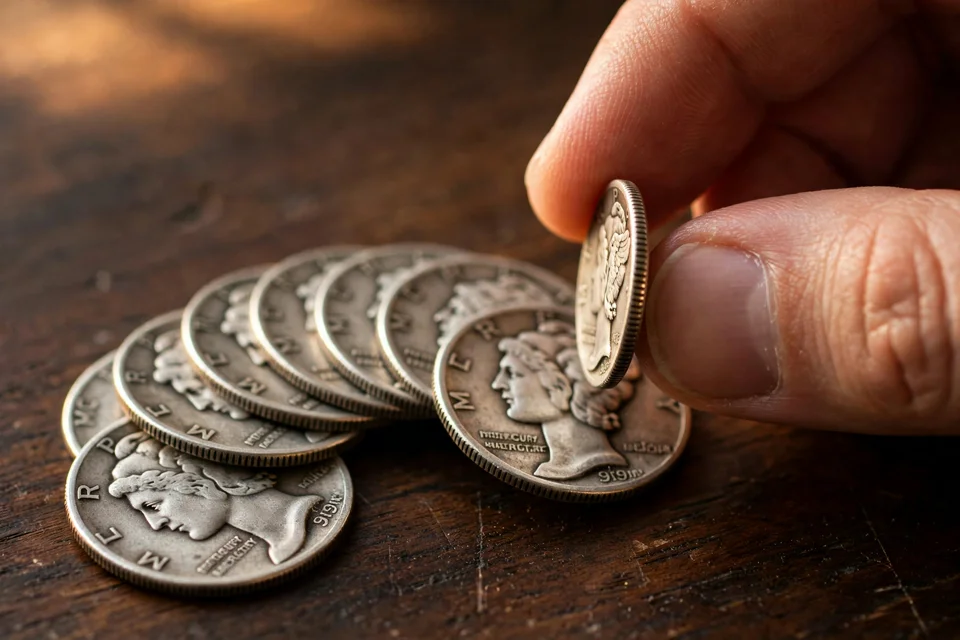
On a Seated Liberty dime the mint mark sits on the reverse, below the wreath — CC for Carson City, O for New Orleans, S for San Francisco, and no letter for Philadelphia. The 1871-CC’s CC is small, and on a worn reverse it can be hard to read, so use a 5x to 10x loupe and good light. A coin with a clear 1871 and a clear CC below the wreath is the coin this page is about; a coin with a clear 1871 and no letter is the common Philadelphia issue.
Check the mark’s position and depth against a known genuine example before trusting it. An added CC is an old trick on Carson City coinage, and it is usually betrayed by tool marks in the metal around the letters or by letters that sit too high, too shallow, or at the wrong angle. A genuine CC is crisp, correctly placed, and struck at the same depth as the rest of the design. Any 1871-CC whose value clears the grading fee belongs in a PCGS or NGC holder — certification is where the premium is paid, and the only defence against an added mint mark.
Specs — silver, the 1853 standard
The 1871-CC is a silver dime of the 1853 standard: 90% silver and 10% copper, 17.9 millimetres across, weighing 2.49 grams. The Mint reduced the dime’s weight from 2.67 grams to 2.49 grams in 1853, and the 1871-CC was struck to that reduced standard — the same standard that would last until the Coinage Act of 1873 raised it slightly to 2.5 grams.
The metal floor for this issue is shown as — on this page: our melt table does not cover Seated Liberty dimes, and this page will not invent a figure for it. What the specs do tell you is how to check the coin — weigh it at 2.49 grams, measure it at 17.9 millimetres, and check the edge for sharp, even reeding. A genuine 1871-CC is exactly that weight and exactly that size, and a cast copy feels light and often shows tiny bubbles or seams under magnification.
Why CC dimes are collected
Carson City coins are collected as a group, and the reason is the mint itself. The CC mint mark means Nevada silver, a frontier mint, and a twenty-three-year history that ended in 1893 when the Comstock played out and the Mint closed its doors. No other American mint mark carries quite the same romance, and no other mint’s coins are collected with quite the same devotion.
The 1871-CC sits near the head of that group. It is the second-year issue of a short-lived mint, with a mintage of 20,100, from the richest silver lode in American history. Collectors who build Carson City sets need it, collectors who build Seated dime sets need it, and collectors who simply love the West want it. That demand, against a mintage of twenty thousand, is why the coin is scarce in every grade — and why it will stay scarce.
Verified auction records
No standalone record for the 1871-CC sits in our verified records file. The Seated Liberty dime series has no single headline record in our data — its market is defined by mintage and grade rather than by one famous result, and the 1871-CC’s mintage of 20,100 is the figure that defines it.
For this date, the honest measure is the live results panel below, which checks for newly reported results every time the page loads. A Carson City dime with a mintage of twenty thousand appears rarely enough that each appearance is news, and the panel is where that news lands first.
Latest reported results for this coin
Checking for newly reported results…
Your 1871-CC Seated Liberty dime questions, answered
How much is an 1871-CC Seated Liberty dime worth?
Our guide has not researched grade values for the 1871-CC yet, so the grade table above shows — rather than invented figures. The live module on this page checks for newly reported results on every load. The mintage of 20,100 and the CC mint mark are the anchors for its scarcity.
What does CC mean on a Seated Liberty dime?
CC means Carson City, Nevada. The Carson City Mint opened in 1870 to coin silver from the Comstock Lode, and it struck coins until 1893. The CC mint mark sits on the reverse, below the wreath.
Why are Carson City dimes so collectable?
The CC mint mark means Nevada silver from the Comstock Lode, struck at a frontier mint with a twenty-three-year history. Collectors build Carson City sets as a group, and the 1871-CC is the second-year issue with a mintage of just 20,100.
Is the 1871-CC Seated Liberty dime silver?
Yes. The 1871-CC is 90% silver and 10% copper, weighing 2.49 grams to the 1853 standard. The metal floor for this issue is shown as — on this page.
How do I tell a genuine 1871-CC from an added CC?
Check the mint mark under a loupe: a genuine CC sits below the wreath, crisp and at the right depth. An added CC often shows tool marks around the letters or sits too high, too shallow, or at the wrong angle. Weigh the coin too — a genuine example is exactly 2.49 grams.
Check your 1871-CC
Run the date and mint mark through the free Coin Value Checker for an instant estimate, or get a Grade-or-Not verdict on whether your coin is worth certifying. The full dime guide is here: How Much Is a Dime Worth?.
Written for the West: the 1871-CC is Nevada silver from the Comstock, and this guide exists so the next one found gets its mint mark checked before it is spent.
This guide is for education — learn the coin first, and get a professional opinion before buying or selling.