1927-D Saint-Gaudens $20: A $4.4 Million Denver Rarity
Coin Encyclopedia · 10 min read · Published November 7, 2026
One hundred and eighty thousand. That is the mintage of the 1927-D Saint-Gaudens double eagle — 180,000 coins struck at Denver in 1927, and the key date of the most collected $20 series in American history. Nearly all of them were melted after the gold recall, and the survivors are few. One of them, graded MS66, realized $4,440,000 at Heritage in August 2022. Another, graded MS65+ CAC, realized $3,840,000 at GreatCollections in January 2025. If you think you have one, read this whole page before you do anything else, because there are very few in the world, and the fakes outnumber them.
This page is about that number. The 1927-D is a Saint-Gaudens double eagle designed by Augustus Saint-Gaudens, struck at Denver in 1927, and the rarest regular date of the series. Our guide has not researched grade-by-grade figures for this date, so the table below is empty. The records are not.
The key date, and why
The Saint-Gaudens double eagle ran from 1907 to 1933, and most dates are available in quantity. The 1927-D is the exception. Denver struck 180,000 double eagles in 1927, and then the gold recall came, and the government melted its stocks. The 1927-D double eagles, being among the newest gold coins in the vaults, were melted in large numbers. The coins that survived were the ones already in private hands — in collections, in safe-deposit boxes, overseas — beyond the reach of the melting pot.
That is why the mintage figure is misleading. On paper, 180,000 is a large number — larger than many ordinary dates in the series. In reality, the number that reached collectors is tiny. The survivors are coins that escaped the melting pot, and the market values them that way. The 1927-D is the date that every Saint-Gaudens set needs, and the date that most sets will never have.
For collectors, the lesson is simple: mintage is not rarity. Rarity is what survives, in what grade, and how many people want it. The 1927-D is the key date of the most collected $20 series in American history, and the demand is permanent. Series collectors need it. Date collectors need it. And every one of them is chasing the survivors of a mintage that was mostly melted.
The grade table, still to be researched
The table below is our researched collector estimates from the live guide, reviewed November 5, 2026. Grades our guide has not researched yet are shown as “—”, not guessed. For this date, that is every grade. No grade-by-grade figures are catalogued yet, so the table below is a statement of what we do not yet know, not a set of numbers to lean on.
| Grade | Estimated value |
|---|---|
| Good (G-4) | — |
| Fine (F-12) | — |
| Extremely Fine (XF-40) | — |
| About Uncirculated (AU-50) | — |
| Mint State 60 (MS-60) | — |
| Mint State 65 (MS-65) | — |
An empty table on the key date of the series can feel wrong, and it is worth saying why it is there. The grade table is built from researched figures, and a coin with so few survivors does not produce grade-by-grade figures in the ordinary way. There are not enough examples to build a table. There are records, and the records are below. Those are the honest figures for this coin, and they are the only figures that matter.
Two records at the top
Two verified auction results anchor this coin's market in our records. In August 2022, Heritage Auctions offered a 1927-D Saint-Gaudens double eagle graded PCGS MS66, from the Bob R. Simpson Collection, and it realized $4,440,000. In January 2025, GreatCollections offered a 1927-D graded PCGS MS65+ CAC, and it realized $3,840,000. Those are the two highest figures in our data for this date, and they are among the highest figures ever realized for a Saint-Gaudens double eagle.
| Coin | Grade | Auction | Amount |
|---|---|---|---|
| 1927-D Saint-Gaudens Double Eagle | MS66 | Heritage Auctions, Aug 2022 | $4,440,000 |
| 1927-D Saint-Gaudens Double Eagle | MS65+ CAC | GreatCollections, Jan 2025 | $3,840,000 |
Read those records carefully. They are MS66 and MS65+ — gem grades, the finest of the survivors — and they realized $4,440,000 and $3,840,000. That tells you everything about this coin: the grade is everything, because there are so few survivors that the finest of them are worth millions, and the rest are worth far less. The gap between MS65 and MS66 is $600,000, and it exists because a single point of grade, a touch of lustre, or a cleaner field can move the figure by hundreds of thousands of dollars. If you hold a 1927-D, the only number that matters is the one a professional grader assigns after examining the coin in hand.
The D on the front
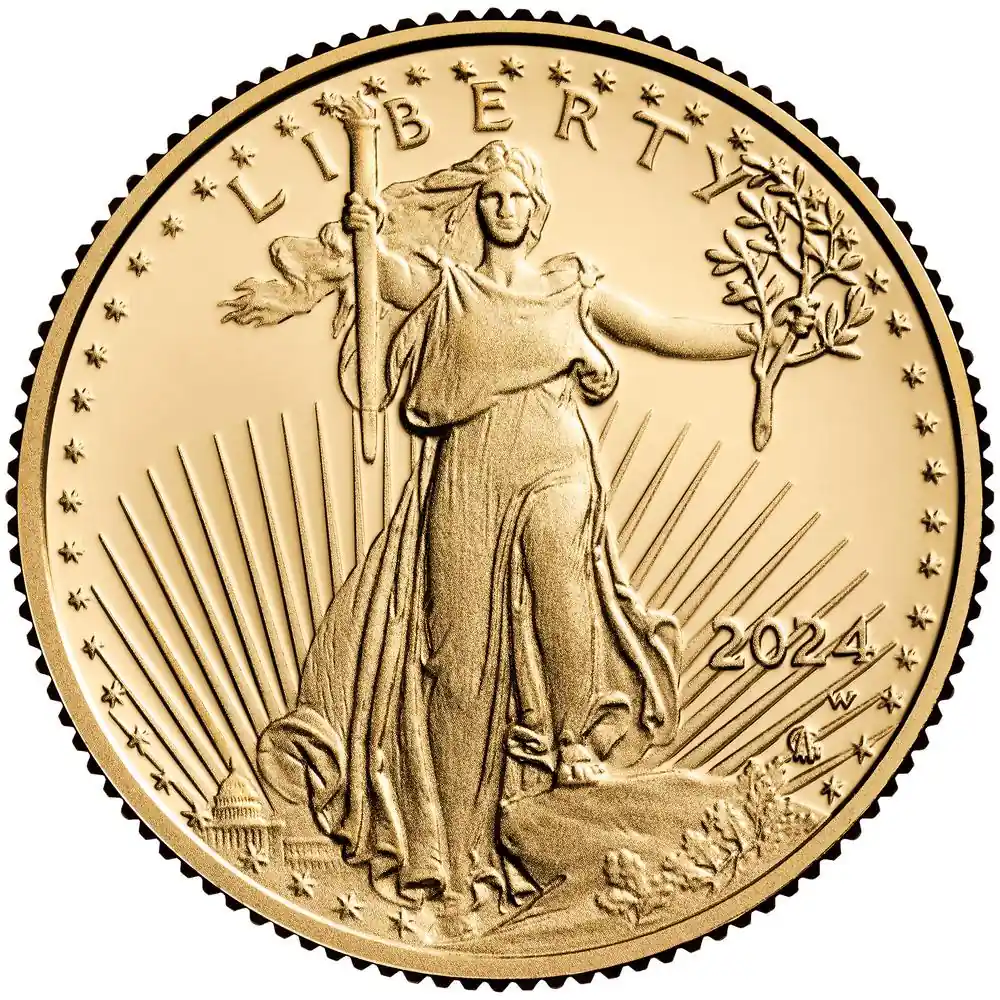
The Saint-Gaudens double eagle carries its mint mark on the obverse, above the date, below Liberty's feet — not on the reverse, where most coins carry it. That is the first thing to find on a 1927-D. Turn the coin over to the obverse, find Liberty striding toward the sun, and look above the date, below her feet. The D is there, small and plain, and it is the difference between a common Philadelphia double eagle and the key date of the series.
A genuine D has the right shape, the right depth, and the right position. It sits in the same place on every genuine 1927-D, because it was punched into the die in the same place. An added D sits slightly off, or too shallow, or at the wrong angle, and the metal around it often shows tool marks. The 1927-D is the most faked date in the series, because the fake is so simple: take a common Philadelphia double eagle, add a D, and an ordinary gold coin becomes a key date. Compare against a known genuine example, and if anything looks wrong, stop. The D is the coin. If the D is wrong, the coin is wrong.
Specs and the metal floor
The 1927-D Saint-Gaudens double eagle weighs 33.436 grams and measures 34 millimetres across, struck in 90% gold and 10% copper. It holds 0.9675 troy ounces of pure gold — nearly a full ounce, the largest gold content of any regular United States coin. The specification is the same for every Saint-Gaudens double eagle from 1907 to 1933. If you have handled any $20 gold coin, the 1927-D feels identical in the hand: heavy, broad, and unmistakably gold.
Metal floor: — The live melt figure on this site is calculated only for the $1 gold dollar, whose specification the Worker carries. Larger gold — $2.50, $5, $10 and $20 — has no live melt specification yet, so this page shows “—” for the metal floor rather than a computed figure. The weight above is the honest check: a genuine coin matches it, and a light coin is not genuine.
Weigh it first. A genuine double eagle is 33.436 grams, and a counterfeit in base metal will be far too light. Then measure it: 34 millimetres, with a lettered edge reading E PLURIBUS UNUM that is sharp and even all the way round. Then look at the design under a loupe — Saint-Gaudens' Liberty has crisp drapery and a clean torch, the eagle's feathers are sharp, and the D is in the correct position above the date. A cast copy looks soft, with mushy details and tiny bubbles in the fields. On a coin this rare, those three checks are the beginning, not the end: certification is where the figure is settled, and certification is the only way the market will accept the coin at all.
Why the key date is the key date
The 1927-D is the key date because it is the date that every set needs and almost no set has. The Saint-Gaudens double eagle is the most collected $20 series in American history, and a set without the 1927-D is unfinished. That single fact drives more demand than any other feature of the coin. First years get the attention, but key dates get the urgency — because there is no other coin that fills the hole, no later date to substitute, no second chance.
The 1927-D is also the last Denver double eagle of its kind, struck in the final years before the Depression and the gold recall changed American money for good. It closes a chapter. Collectors who hold one are holding the end of an era, in a coin that was struck in large numbers and then almost entirely destroyed. That is a powerful combination, and the records above are the market's answer to it.

Latest reported results for this coin
Checking for newly reported results…
Your 1927-D double eagle questions, answered
What is a 1927-D Saint-Gaudens double eagle worth?
Our guide has not researched grade-by-grade figures for this date, so the grade table below shows — for every grade. The verified records are $4,440,000 for an MS66 at Heritage in August 2022 and $3,840,000 for an MS65+ CAC at GreatCollections in January 2025.
Why is the 1927-D the key date of the series?
180,000 were struck at Denver in 1927, and nearly all were melted after the gold recall, when the government melted its stocks. The survivors are few, and high-grade examples are among the rarest coins in American gold.
What are the verified records for the 1927-D?
Our records show $4,440,000 for a PCGS MS66 from the Bob R. Simpson Collection at Heritage in August 2022, and $3,840,000 for a PCGS MS65+ CAC at GreatCollections in January 2025.
How do I know a 1927-D is genuine?
Weigh it at 33.436 grams and measure 34 millimetres, then examine the D mint mark on the obverse, above the date, and the design under a loupe. On a coin this rare, certification from PCGS or NGC is the only way the market will accept it.
Where is the mint mark on a 1927-D double eagle?
The D is on the obverse, above the date, below Liberty's feet — the Saint-Gaudens double eagle carries its mint mark on the front, not the back. It is small, and it must be checked under a loupe.
Check your 1927-D
A 1927-D is 180,000 struck, nearly all melted, and the key date of its series. Weigh it, find the D on the front, and let a grader settle the rest. Run the date and mint mark through the free Coin Value Checker for an instant estimate, or get a Grade-or-Not verdict on whether your coin is worth certifying. The full gold guide is here: Gold Dollar Coin Values by Type and Date.
For learning only: this guide is educational, and the figures here are researched estimates, not a promise of what any single coin will bring. A 1927-D should be authenticated and graded by professionals before any decision is made.
This guide is for education — learn the coin first, and get a professional opinion before buying or selling.