Flying Eagle Cent Value: $30 to $312,000+ Guide
Pennies · 10 min read · Published November 6, 2026 · Updated November 6, 2026
Flying Eagle cent value starts at about $30+ for a worn 1857 or 1858 circulation cent, climbs past $850+ in Mint State, and reaches $312,000+ for the finest known 1856 pattern. The 1856 is the prize: a pattern struck before regular production, with roughly 1,000 made and only about 550 survivors, while the 1858/7 overdate adds a second five-figure chase for collectors who know where to look.
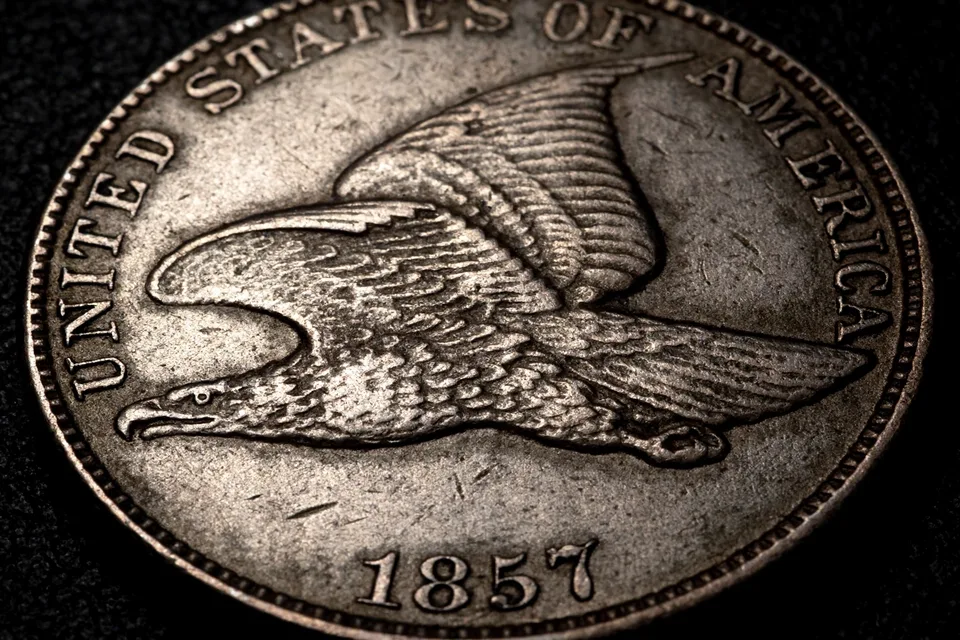
The Flying Eagle cent is the first small cent America ever struck, and it lasted only three dates: 1856, 1857, and 1858. It replaced the big copper large cent, it introduced the 19-millimetre size every cent has kept since, and it was gone within two years because the design simply would not strike properly.
The penny that replaced the large cent
By the early 1850s the large cent was a problem. At 28.57 millimetres across and over 10 grams of copper, it was expensive for the Mint to make and unpopular in shops. Congress acted on February 21, 1857, authorising a new small cent: the Mint would take in worn large cents and old Spanish colonial silver, and hand out the new cents in exchange.
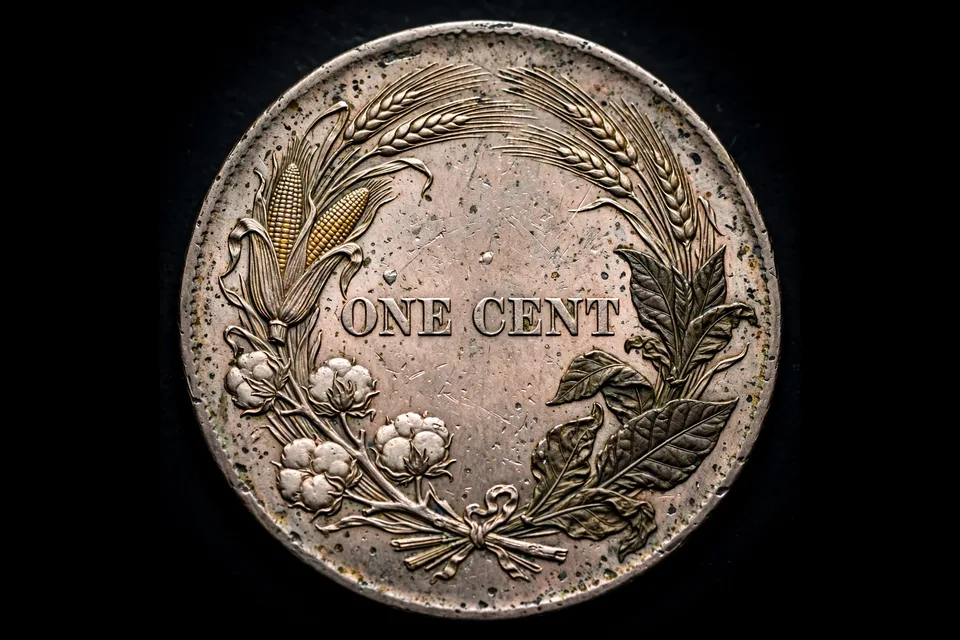
Chief Engraver James B. Longacre designed the new coin. For the obverse he adapted the flying eagle Christian Gobrecht had drawn for the 1836–1839 silver dollars, an eagle in full flight with UNITED STATES OF AMERICA around it and the date below. For the reverse he drew a wreath of corn, wheat, cotton, and tobacco around the words ONE CENT. Regular production began in 1857, with 17,450,000 struck that year and 24,600,000 in 1858.
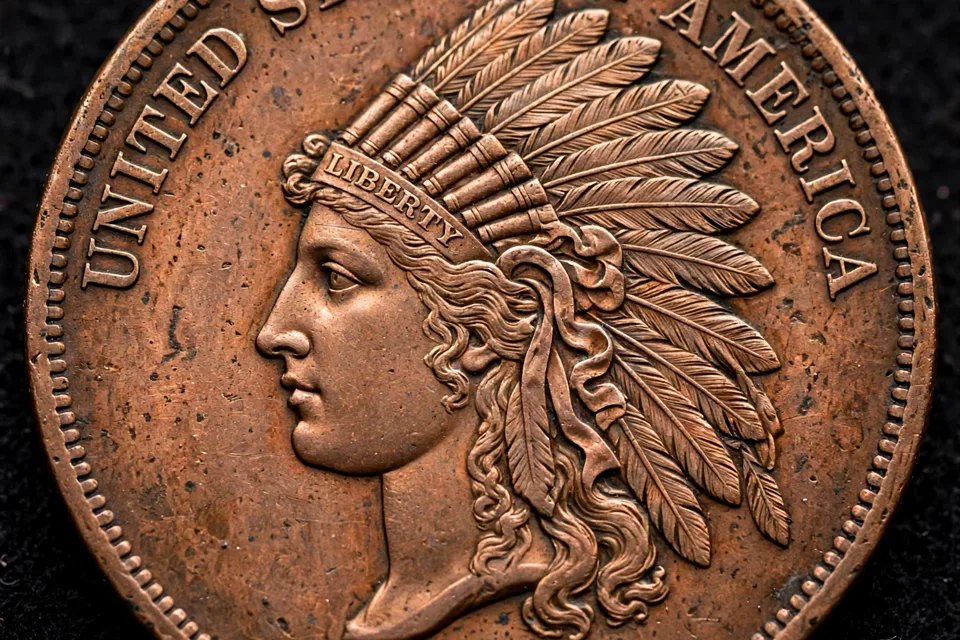
Then the design failed. The eagle's head and tail feathers sat directly opposite the wreath on the reverse, so the metal had to flow into two deep recesses at once during striking, and most coins came out weakly struck. The coins also piled up in commerce — they were not legal tender when issued, so nobody had to accept them — and in 1859 Longacre's own Indian Head cent replaced the eagle.
Flying Eagle cent specifications
A genuine Flying Eagle cent weighs 4.67 grams, measures 19 millimetres across, and has a plain, smooth edge with no reeding. The composition is 88 percent copper and 12 percent nickel, which gives the coin a pale, almost silvery colour quite unlike the red-brown of a later bronze cent. Every example was struck at Philadelphia, so there is no mint mark anywhere on the coin.
The reverse wreath sits exactly opposite the eagle, so the strike is weakest where the design is highest. Weight is your first check: a coin far from 4.67 grams is a fake or a damaged piece, and copper-nickel is not magnetic.
How much is a Flying Eagle cent worth
Most Flying Eagle cents are worth $30+ to $300+ in circulated grades, with Mint State examples starting near $850+ and the 1856 pattern starting near $5,500+.
| Date and variety | Good-4 | Fine-12 | AU-50 | Mint State-63 | Top grade |
|---|---|---|---|---|---|
| 1856 pattern | $5,500+ | $6,900+ | $13,100+ | $24,000+ | $312,000+ |
| 1857 | $25+ | $55+ | $290+ | $850+ | $9,750+ |
| 1858 Large Letters | $30+ | $50+ | $270+ | $850+ | $43,200+ |
| 1858 Small Letters | $30+ | $50+ | $340+ | $950+ | $21,600+ |
| 1858/7 Strong Overdate | $75+ | $200+ | $900+ | $12,000+ | $74,025+ |
A worn 1857 or 1858 in Good condition is a $25+ to $30+ coin, and a Fine example is $50+ to $55+. The jump comes in Mint State: a sharply struck MS-63 1857 or 1858 is an $850+ to $950+ coin, and a gem MS-66 1857 has reached $9,750+ to $12,000+. Proofs are a separate market, starting near $4,100+ and running to $46,000+, with cameo 1858 Small Letters reaching $161,000+.
The 1856 pattern: the $312,000 cent
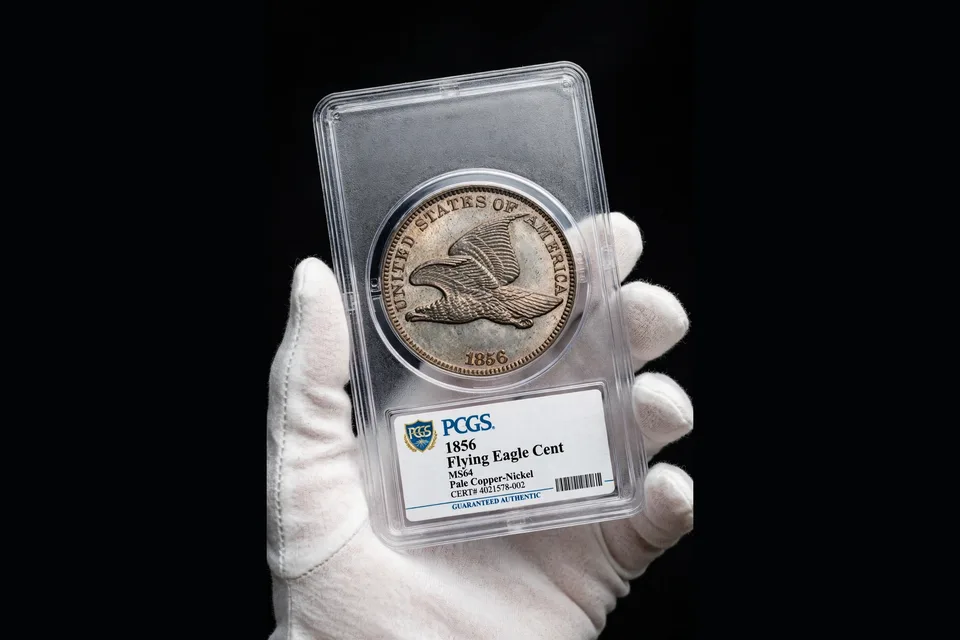
The 1856 was never meant for your pocket. The Mint struck close to 1,000 examples in 1856 as presentation pieces, sent to members of Congress, Treasury officials, and editors so the new small cent would have friends when the bill came up. PCGS lists a 634-piece presentation mintage, and about 550 survivors are estimated in all grades.
The record belongs to a single coin. The 1856 Snow-3 Flying Eagle cent graded PR67+ by PCGS, with CAC approval and ex Bob R. Simpson provenance, sold through Heritage on November 21, 2024, for $312,000. It smashed the previous record of $240,000 set by the same coin at Heritage in September 2020. A second coin from the same sale, a Snow-3 graded MS66, brought $192,000. Snow-3 is the die marriage to know: Rick Snow's reference identifies it by a repunched upright 5 in the date.
1857 vs 1858: Large Letters, Small Letters, and the 1858/7 overdate
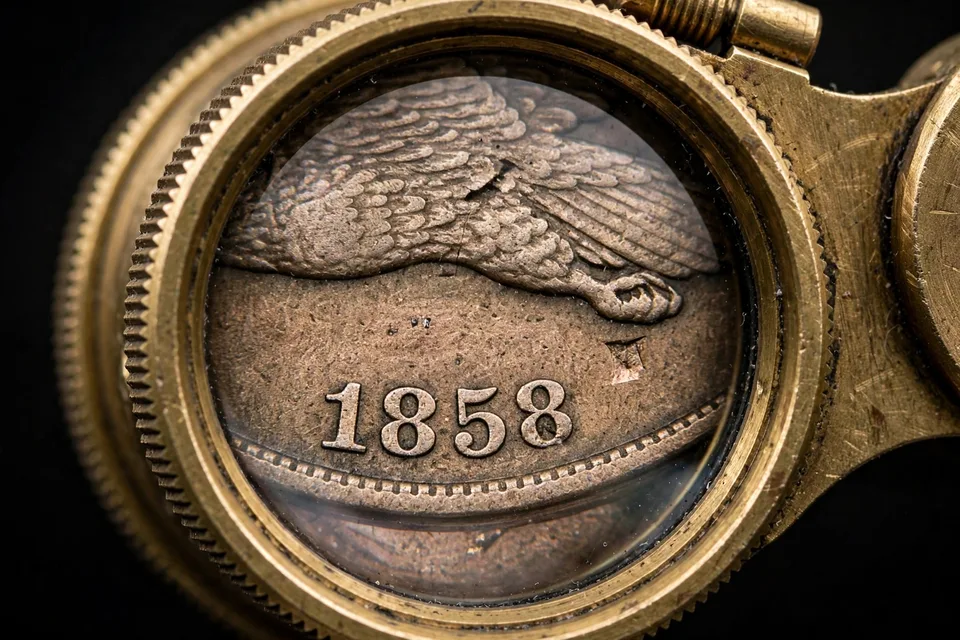
The 1858 overdate is the variety that turns a $30+ coin into a four-figure find. In 1858 the Mint reused a leftover 1857 obverse die and punched an 8 over the 7, leaving the top of the 7 visible under the 8 on strong examples. The Strong Overdate, catalogued as FS-301 and Snow-1, is worth $75+ in Good condition, $900+ in AU, $12,000+ in MS-63, and the auction record stands at $74,025 for an MS-65+ example. Check the 8 under a 10x loupe: on a genuine overdate the curve of the 7 shows through the lower loop of the 8.
Large Letters and Small Letters are the two 1858 types. Look at the word AMERICA on the obverse. On Large Letters, struck from the 1857 hub, the bases of the A and the M touch. On Small Letters, struck from the new 1858 hub, there is a clear gap between the A and the M. Values are close: both start near $30+ in Good and $850+ to $950+ in MS-63, with gem Large Letters reaching $43,200+ and gem Small Letters $21,600+. Do not pay a premium for the letter variety alone in circulated grades; the money is in the overdate and in the grade.
How to grade a Flying Eagle cent
Grading a Flying Eagle cent is harder than grading most coins because the design itself fights the strike. The eagle's head and the tips of its tail feathers are the highest points on the obverse, and they sit directly opposite the wreath, so even a Mint State coin can show flatness there.
Start with the luster. On a Mint State coin the fields show unbroken satiny luster, even where the eagle's breast feathers are soft. On a circulated coin the luster is broken on the high points first: the eagle's head, the wingtip, and the top leaves of the wreath. In Good condition the eagle is a flat silhouette with the date and legend still readable; in Fine the wing feathers begin to separate; in About Uncirculated the coin looks almost new, with only a trace of friction on the highest feathers.
Spotting a fake 1856
If the date reads 1856, slow down: it is one of the most counterfeited early American cents. The commonest fake is an altered 1858, with the 8 re-cut into a 6, and the second is a cast copy.
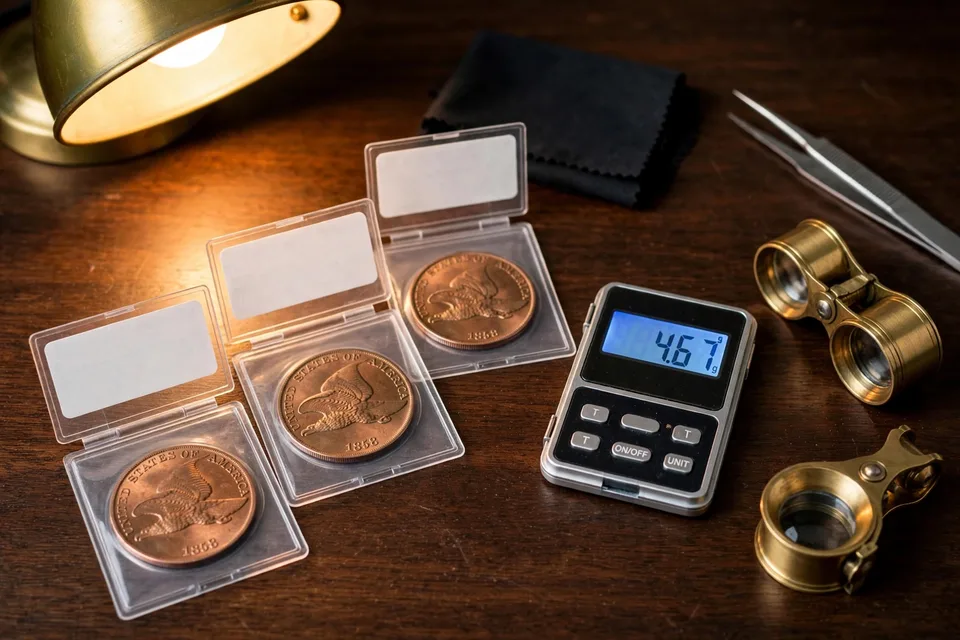
Check the date first under a 10x loupe. On a genuine 1856 the 6 has the correct shape and position for the Snow die marriages, and on a Snow-3 the upright of the 5 is repunched. An altered date shows tool marks, a wrongly shaped 6, or a 6 that sits at a different depth from the other digits. Then weigh the coin: a genuine Flying Eagle cent is 4.67 grams, and a cast copy is usually light or heavy by a few tenths of a gram. A genuine 1856 has no mint mark, a pale copper-nickel colour, and the weak breast feathers of an original striking. If anything feels wrong, buy the slab, not the coin: a certified 1856 from PCGS or NGC removes the entire question.
Frequently Asked Questions
How much is an 1856 Flying Eagle cent worth?
A genuine 1856 Flying Eagle cent is worth $5,500+ in Good condition, $6,900+ in Fine, $24,000+ in Mint State, and the record is $312,000 for the PR67+ PCGS CAC Snow-3 sold at Heritage in November 2024.
How much is an 1857 or 1858 Flying Eagle cent worth?
A circulated 1857 or 1858 Flying Eagle cent is worth $25+ to $30+ in Good condition and $50+ to $55+ in Fine. Mint State examples start near $850+ to $950+, and gem MS-66 examples have reached $9,750+ to $12,000+.
What is the difference between Large Letters and Small Letters on an 1858 Flying Eagle cent?
Look at the word AMERICA on the obverse. On Large Letters, struck from the 1857 hub, the bases of the A and the M touch each other. On Small Letters, struck from the new 1858 hub, there is a clear gap between the A and the M.
Is a Flying Eagle cent silver?
No. A Flying Eagle cent is 88 percent copper and 12 percent nickel, with no silver at all. Its pale colour comes from the nickel in the alloy. The coin's value is entirely collector value, not metal value, which is only a few cents.
Why is the 1856 Flying Eagle cent so valuable?
The 1856 was a pattern, not a circulation issue. The Mint struck only close to 1,000 examples to promote the new small cent, and about 550 survive. It is the first small cent ever struck, and the finest known example sold for $312,000 at Heritage in November 2024.
How can I tell if my 1856 Flying Eagle cent is real?
Check the date under a 10x loupe for tool marks or a wrongly shaped 6, weigh the coin — a genuine example is 4.67 grams — and look for the pale copper-nickel colour, a plain edge, and the weak breast feathers of an original striking. A magnetic coin is a fake.
A Flying Eagle cent costs nothing to check, and the difference between a $30+ circulation cent and a $312,000+ pattern is one careful look at the date, the variety, and the strike. Before you spend or sell any coin you are unsure about, run it through The Diggin Dave's free Coin Value Checker to confirm its value range, and try Grade-or-Not for a grade verdict on your best examples. A 10x loupe, coin capsules, and a coin reference book are the only tools the checks in this guide need.
As an Amazon Associate, this site may earn from qualifying purchases.
Further Reading on Flying Eagle Cents
- Indian Head Penny Values by Date: $2 to $340,875+ — the cent that replaced the Flying Eagle in 1859, with its own key dates and the $340,875 record
- Wheat Pennies Worth Money, 3¢ to $1.7 Million+ — the Lincoln series that followed the Indian Head cent, from 3 cents to the $1.7 million copper error
- Copper vs Zinc: Which 1982 Penny Is Worth More? — the 7-variety copper-to-zinc guide, with the 1982-D Small Date copper transitional error at $18,800+