How Much Is a Two-Cent Piece Worth? 1864–1873 Guide
Two-Cent Piece Values · 10 min read · Published November 7, 2026 · Updated November 7, 2026
A two-cent piece is worth $15+ in worn condition, $50+ in Extremely Fine, and $100+ to $600+ in Mint State for common dates. The exceptions decide the real money: the 1864 Small Motto starts at $120+ and reaches $3,275+ in MS-65, the 1872 — only 65,000 struck — starts at $125+, the 1867 doubled die runs $2,500+ to $20,000+, and the proof-only 1873 issues run $1,000+ to $52,900+. Bronze carries almost no melt value, so every dollar above a few cents is collector value.
What Is a Two-Cent Piece?
The two-cent piece was born in the middle of the Civil War, when citizens hoarded every cent and small coin vanished from circulation. Shopkeepers made change with tokens and postage stamps. Congress answered with the Act of April 22, 1864, which created a bronze two-cent piece, changed the cent to bronze, and put IN GOD WE TRUST on United States coinage for the first time.
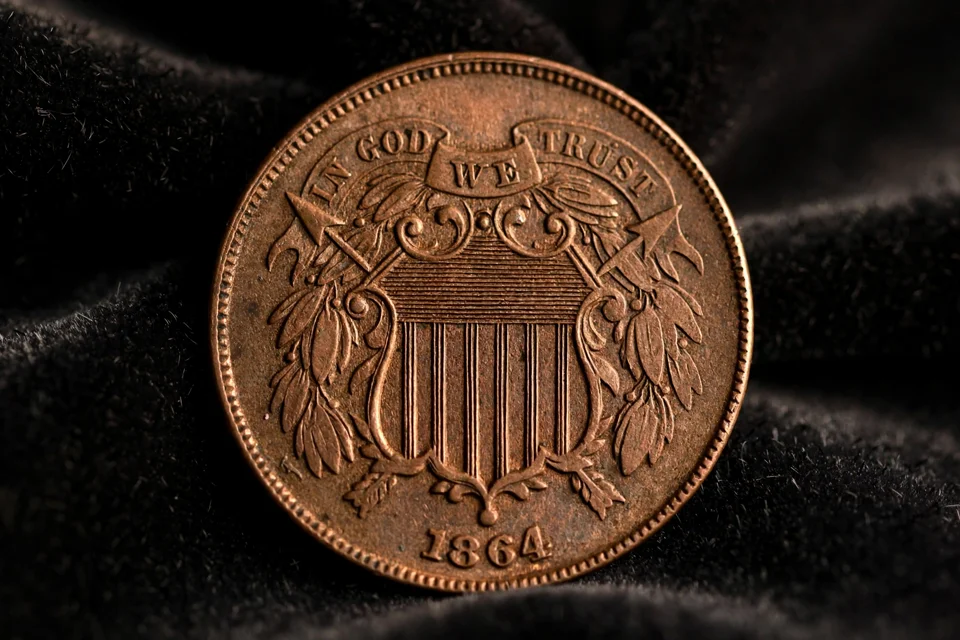
Chief Engraver James B. Longacre designed it. The obverse carries a Union shield with crossed arrows behind it, a ribbon above the shield bearing the motto, and the date below. The reverse shows a large 2 and the word CENTS inside an open wheat wreath. Every two-cent piece was struck at Philadelphia — the denomination carries no mint mark at all, so a missing mint mark is normal, not an error.
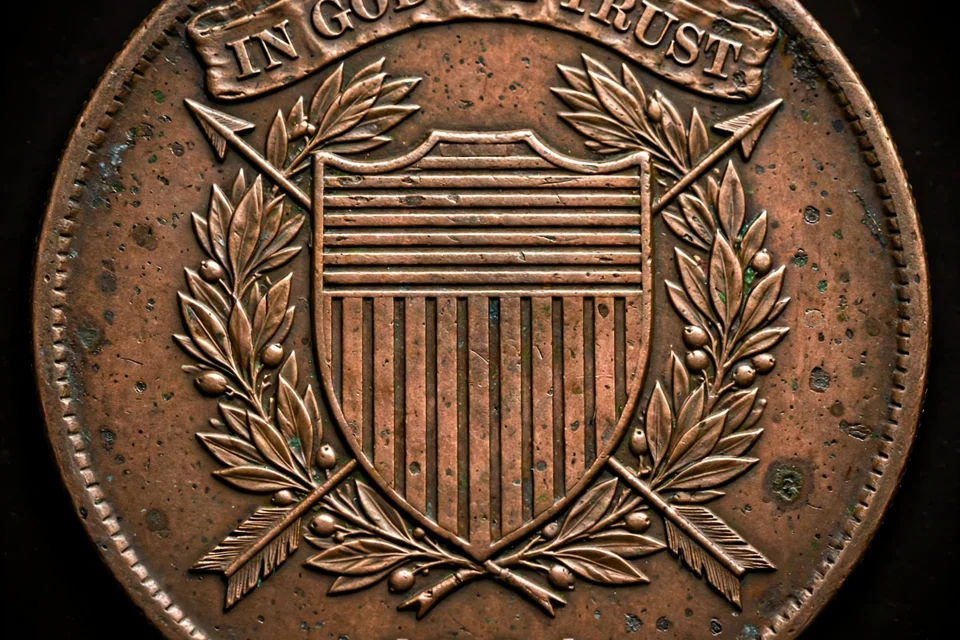
| Specification | Two-Cent Piece |
|---|---|
| Years struck | 1864–1873 (circulation 1864–1872; proofs only 1873) |
| Designer | James B. Longacre |
| Composition | Bronze — 95% copper, 5% tin and zinc |
| Weight | 6.22 grams (96 grains) |
| Diameter | 23 millimetres |
| Edge | Plain |
| Mint | Philadelphia only — no mint mark |
| First | First United States coin to carry IN GOD WE TRUST |
The denomination never really worked. The three-cent nickel arrived in 1865 and the five-cent nickel in 1866, and mintage fell every year after 1865, from 13,640,000 down to 65,000 in 1872. The Coinage Act of 1873 abolished it outright. The series spans just ten dates — which is why collectors love it: a complete set is short and affordable in circulated grades.
How Much Is a Two-Cent Piece Worth?
Most two-cent pieces trade on date and grade, not on metal. A worn common date is a $15+ coin; a red Mint State common date is a $600+ coin. Colour matters as much as grade — an MS-65 Red is worth several times the same coin in MS-65 Brown.
| Date / Variety | Mintage | Good (G-4) | Very Fine (VF-20) | Extremely Fine (EF-40) | Mint State (MS-60) | MS-65 |
|---|---|---|---|---|---|---|
| 1864 Large Motto | 19,822,500 | $20+ | $25+ | $50+ | $110+ | $625+ |
| 1864 Small Motto | Part of 19,847,500 | $140+ | $240+ | $350+ | $875+ | $3,275+ |
| 1865–1871 (common dates) | 721,250–13,640,000 | $15+ | $25+ | $50+ | $110+ | $600+ |
| 1867 Doubled Die Obverse | Unknown | — | $2,500+ | $6,000+ | $10,000+ | $20,000+ |
| 1872 | 65,000 | $125+ | $225+ | $325+ | $475+ | $1,500+ |
| 1873 Closed 3 (proof) | 600 | $1,000+ to $52,900+ (PR-60 to PR-67) | ||||
| 1873 Open 3 (proof) | 500 | $2,000+ to $35,900+ (PR-60 to PR-67) | ||||
The 1864 Large Motto is the cheapest date because the Mint struck nearly 20 million of them; by 1870 it struck only 861,250, and by 1871 only 721,250. The date is the first thing to read, every time.
The 1864 Small Motto vs Large Motto — the $100+ Difference
The first two-cent pieces off the press carried a Small Motto: the words IN GOD WE TRUST are tiny on the ribbon above the shield, squeezed into letters that barely fill the band. Within weeks, Longacre enlarged the lettering — the Large Motto fills the ribbon boldly. The Small Motto dies were used only briefly, and PCGS estimates only about 10,000 examples survive across all grades.
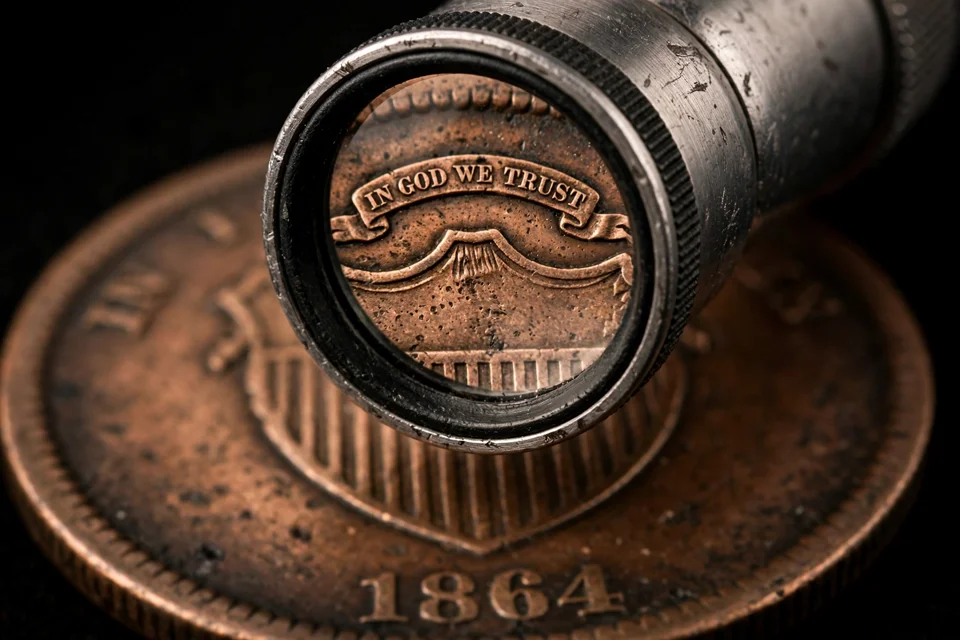
Check it with a 10x loupe and angled light. On a Small Motto the letters are small and widely spaced, with plain ribbon visible above and below them; on a Large Motto they are tall and crowded, touching the ribbon's edges. A worn Small Motto is still worth $120+ to $140+ — roughly seven times a Large Motto in the same grade — and a Mint State Small Motto runs $875+ to $3,275+, with fully red gems reaching $70,000+. Sellers mix the two up constantly. Never pay Small Motto money without checking the ribbon yourself.
The 1867 Doubled Die Obverse — the Series' Major Variety
The 1867 doubled die obverse, catalogued as FS-101, is the one error every two-cent collector hunts. The hub struck the die twice slightly out of alignment, so the obverse lettering — the motto and the date — shows a second, raised image with split serifs. It is a true doubled die, not machine doubling: rounded, raised, and identical on every coin from that die.
Values start where ordinary two-cent pieces stop: Very Fine $2,500+, Extremely Fine $6,000+, Mint State $10,000+, and MS-65 examples reach $20,000+. Read our doubled die identification guide first — flat, shelf-like doubling is machine doubling and adds nothing, and anything worth four figures should be certified before you buy it.
The 1872 — Only 65,000 Struck
The 1872 is the rarest circulation date in the series: the Mint struck just 65,000 pieces, the lowest mintage of any business-strike two-cent piece, because the denomination was already dying. Even a heavily worn 1872 starts at $125+, a Very Fine example runs $225+, and Mint State examples start at $475+ and reach $1,500+ in MS-65, with choice red gems climbing toward $5,000+.
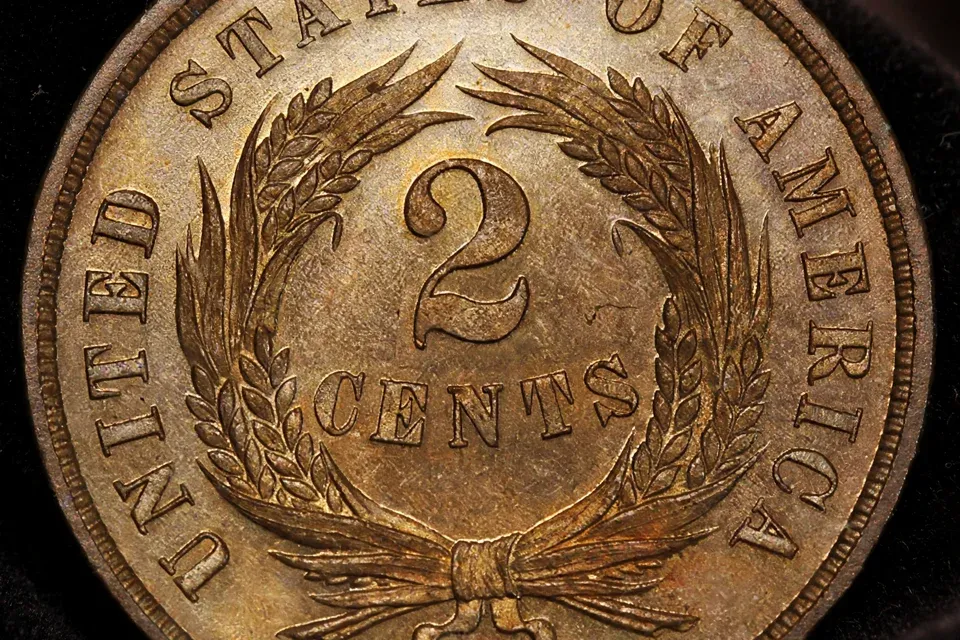
The 1872 is also the most counterfeited date after the 1873 proofs — altering a common 1871 into an 1872 pays. Check the date digits under magnification — altered 2s show tool marks and uneven serifs — and buy certified if the price is over $300.
The 1873 Proof-Only Finale — Closed 3 vs Open 3
No two-cent piece was struck for circulation in 1873. The Mint made proofs only — about 600 of the Closed 3 variety, where the top of the 3 is closed, and about 500 of the Open 3, where the 3 is open at the top. The Open 3 was not widely recognised as a separate variety until 1957.
Proof two-cent pieces are graded PR-60 to PR-67, and colour decides the price as much as grade: Brown, Red-Brown, and Red. A Brown proof starts around $1,000+ to $2,000+; Red-Brown proofs run $3,000+ to $9,000+ in PR-65 and PR-66. The series record is $52,900, paid for an 1873 Closed 3 graded PR-67 Red at Stack's Bowers in August 2010. Recent Open 3 sales show the same ladder: a PR-64 Red brought $3,538 at Heritage in July 2026 and a PR-66 Red-Brown with CAC approval brought $9,000 in December 2022. For any 1873 proof, buy certified — the denomination's final year is also its most faked.
What Decides the Value?
Four things decide a two-cent piece's worth, in this order: variety, date, grade, and colour. Variety comes first because a Small Motto or a doubled die multiplies the value of any grade. Date comes second because mintage falls off a cliff after 1865. Grade comes third — and on copper, grade includes the surface.
Colour designations — BN for Brown, RB for Red-Brown, RD for Red — describe how much original mint red survives. A common 1864 Large Motto in MS-65 Brown is a $300+ coin; the same coin in MS-65 Red is a $625+ coin. On the Small Motto the gap is wider: Brown examples top out near $4,400, while Red examples reach $70,000+. Original red is fragile — one cleaning strips it permanently, so never clean a two-cent piece. If you are unsure about a coin worth $500+, send it to PCGS or NGC.
Mistakes That Cost Collectors Money
- Paying Small Motto money for a Large Motto. Check the ribbon under a loupe first.
- Cleaning a find. A cleaned coin loses its original red and most of its premium.
- Buying a raw 1873 proof. The final year is the most faked date in the series — certified or not at all.
- Calling machine doubling a doubled die. The 1867 doubled die is raised and split-serifed; flat shelf-like doubling is worth nothing extra.
- Assuming age equals value. An 1864 Large Motto is 162 years old and worth $20+ in Good.
- Ignoring colour. Two coins in the same grade can be worth three times apart on colour alone.
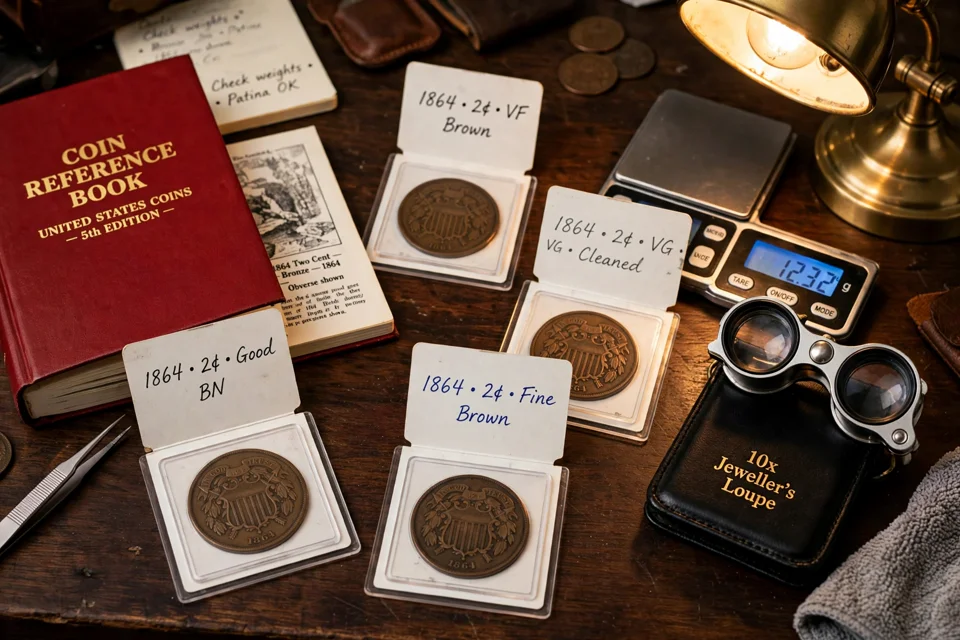
A two-cent piece costs nothing to check, and the difference between a $20+ common date and a $3,275+ Small Motto is one careful look at the ribbon. Before you spend or sell, run your coin through The Diggin Dave's free Coin Value Checker, check the 1867 doubled die with the Error Identifier tool, and try Grade-or-Not. A 10x loupe, 2x2 coin flips, and a Red Book price guide are the only tools the checks in this guide need.
As an Amazon Associate, this site may earn from qualifying purchases.
Further Reading on Two-Cent Pieces
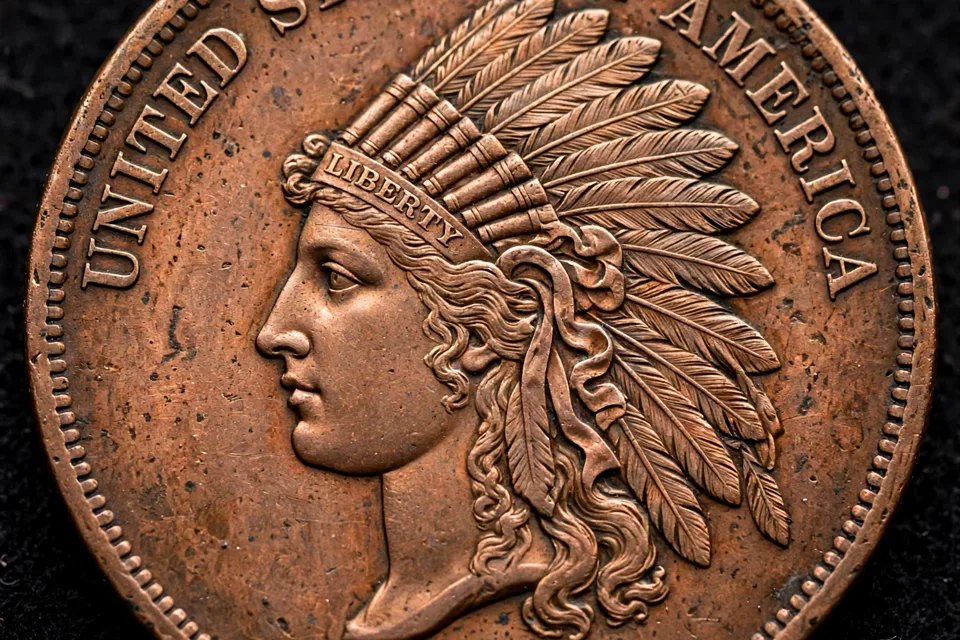
- Indian Head Penny Values by Date: $2 to $340,875+ — Longacre's other Civil War-era design
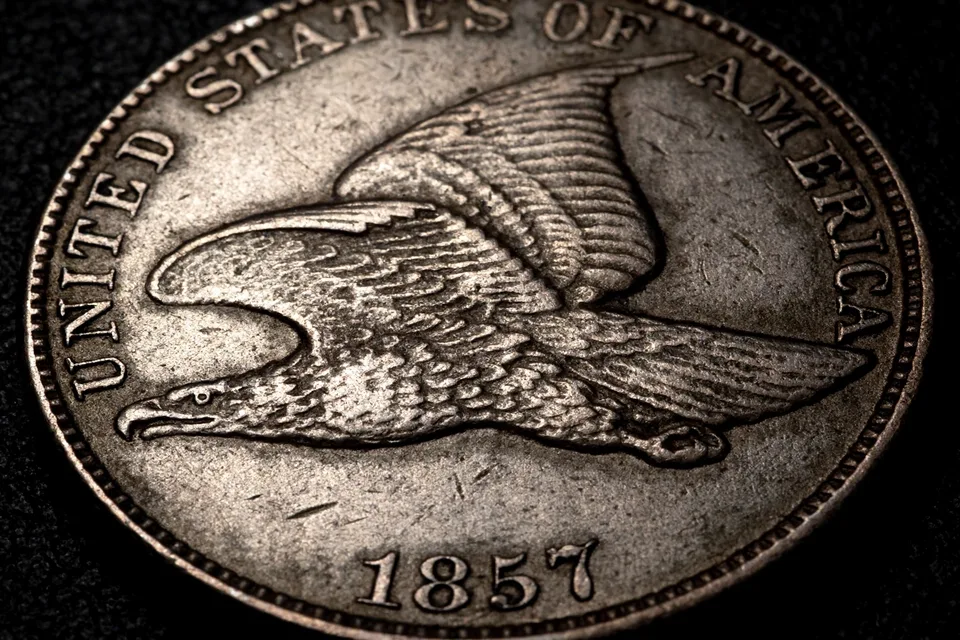
- Flying Eagle Cent Value: $30 to $312,000+ Guide — the small cent that came before, also by Longacre
- Doubled Die vs Machine Doubling: How to Tell Apart — the tests that separate a $2,000+ error from machine doubling
Frequently Asked Questions
How much is a two-cent piece worth?
Most are worth $15+ worn, $50+ in Extremely Fine, and $100+ to $600+ in Mint State. Key dates cost far more: the 1864 Small Motto starts at $120+, the 1872 at $125+, and the 1867 doubled die at $2,500+.
What is the difference between a Small Motto and a Large Motto two-cent piece?
On a Small Motto the words IN GOD WE TRUST are tiny on the ribbon, with plain ribbon showing above and below. On a Large Motto the letters are tall and fill the ribbon. The Small Motto was used only in the first weeks of 1864, so it is worth roughly seven times a Large Motto.
How much is an 1864 two-cent piece worth?
An 1864 Large Motto is worth $20+ in Good, $50+ in Extremely Fine, and $110+ to $625+ in Mint State. An 1864 Small Motto is worth $140+ in Good, $350+ in Extremely Fine, and $875+ to $3,275+ in Mint State.
Is a two-cent piece silver?
No. It is bronze — 95% copper with 5% tin and zinc — and contains no silver. Its melt value is only a few cents.
What is the rarest two-cent piece?
The rarest regular issue is the 1872, with only 65,000 struck. The rarest of all are the proof-only 1873 issues — about 600 Closed 3 and 500 Open 3 — and the 1864 Small Motto proof, of which only 20 to 30 are known.
How much is an 1872 two-cent piece worth?
An 1872 is worth $125+ in Good, $225+ in Very Fine, $325+ in Extremely Fine, and $475+ to $1,500+ in Mint State, with choice red gems reaching $5,000+.