1848 CAL. Quarter Eagle: The Gold Rush $2.50
Coin Encyclopedia · 9 min read · Published November 7, 2026
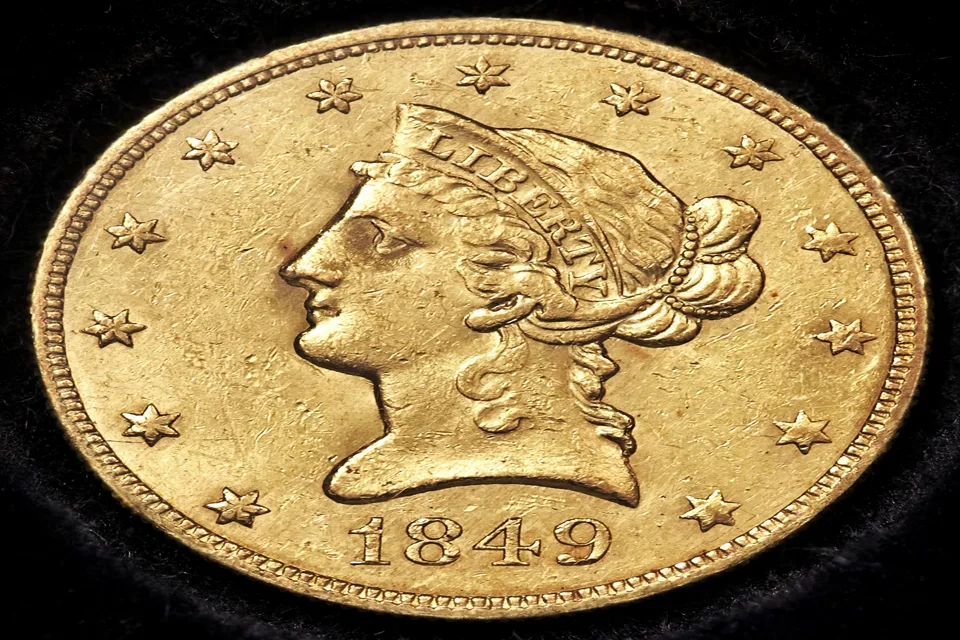
Look at the reverse of an 1848 quarter eagle, above the eagle, and you will see four letters that should not be there: CAL. They are punched into the die, small and plain, and they mark the first federal coin ever struck from California gold. In 1848, Colonel Richard Mason, the military governor of California, sent gold east to Philadelphia — the first California gold to reach the Mint — and asked that the coins struck from it be marked. The Mint obliged. It punched CAL. into the reverse die, struck 1,389 quarter eagles, and created one of the most famous coins in American history.
This page is about those four letters. The 1848 CAL. quarter eagle is a Liberty quarter eagle designed by Christian Gobrecht, struck at Philadelphia, with a counterstamp that is not a counterstamp at all — it was punched into the die, so every one of the 1,389 carries it. Our guide has not yet researched grade-by-grade figures for this date, so the table below is empty. The story is not.
CAL.: four letters, one gold rush
The California gold rush began in January 1848, when gold was found at Sutter's Mill. By the summer, the news had reached the East, and Colonel Mason, the military governor of California, sent a shipment of gold to Washington to prove the discovery was real. The gold reached Philadelphia, and Mason asked that the coins struck from it be marked, so that the first California gold coinage would be known as such. The Mint agreed, and the letters CAL. were punched into the reverse die of the quarter eagle.
The choice of the quarter eagle was practical. It was the smallest gold coin, and the shipment was small — enough gold for 1,389 quarter eagles, and no more. The coins were struck in the autumn of 1848, and they went into circulation as ordinary $2.50 gold pieces, distinguished only by the four letters above the eagle. Most of them circulated, wore down, and were melted in later years. The survivors are the coins that were saved because someone noticed the letters, and understood what they meant.
Find the CAL. first. Turn the coin over, find the eagle, and look above it, in the field between the eagle and the legend. The letters CAL. are there, with a period after the L, punched into the die — which means they are sharp, even, and in the same place on every genuine example. A counterstamp added later to a common 1848 quarter eagle will sit slightly off, or too shallow, or at the wrong angle, and the metal around it will show tool marks. The CAL. is the coin. If the CAL. is wrong, the coin is wrong.
The grade table, still to be researched
The table below is our researched collector estimates from the live guide, reviewed November 5, 2026. Grades our guide has not researched yet are shown as “—”, not guessed. For this date, that is every grade. No grade-by-grade figures are catalogued yet, so the table below is a statement of what we do not yet know, not a set of numbers to lean on.
| Grade | Estimated value |
|---|---|
| Good (G-4) | — |
| Fine (F-12) | — |
| Extremely Fine (XF-40) | — |
| About Uncirculated (AU-50) | — |
| Mint State 60 (MS-60) | — |
| Mint State 65 (MS-65) | — |
An empty table on the most famous quarter eagle in American history can feel wrong, and it is worth saying why it is there. The grade table is built from researched figures, and the research has not reached this date yet. That does not make the coin common, and it does not make it cheap. It makes it unresearched, and the honest figure for it comes from the coin in hand, graded by a professional, and from the live feed on this page when newly reported results land. No one should quote you a figure for an 1848 CAL. from a guide alone.
The first California gold coinage
The 1848 CAL. quarter eagle is the first federal coin struck from California gold, and that position is what makes it famous. Before 1848, the Mint's gold came from the Appalachian gold rush in North Carolina and Georgia, and from foreign coin and bullion. California changed everything: within a few years, the Mint was striking millions of dollars in gold coinage from California metal, and San Francisco opened its own mint in 1854 to coin the gold where it was found.
The CAL. quarter eagle is the beginning of that story. It is a Philadelphia coin, struck from California gold, marked as such, in the first year of the gold rush. It predates the San Francisco Mint by six years, and it predates the double eagle's great years by a decade. It is a small coin — the smallest United States gold coin — carrying the biggest story in American gold: the discovery that remade the nation's money.
That story is why the coin is collected the way it is. Gold rush collectors need it. Quarter eagle collectors need it. Rarity collectors need it. And every one of them is chasing the same 1,389 coins, struck from a single shipment of gold, in a single year, with four letters punched into the die. The result is a coin that trades rarely, through established channels, with certification, at figures that reflect its position in history.
Specs and the metal floor
The 1848 CAL. quarter eagle weighs 4.18 grams and measures 17.9 millimetres across, struck in 90% gold and 10% copper. It holds 0.12094 troy ounces of pure gold — the same specification as every Liberty quarter eagle from 1840 to 1907. If you have handled any $2.50 gold coin, the 1848 CAL. feels identical in the hand: small, solid, and unmistakably gold.
Metal floor: — The live melt figure on this site is calculated only for the $1 gold dollar, whose specification the Worker carries. Larger gold — $2.50, $5, $10 and $20 — has no live melt specification yet, so this page shows “—” for the metal floor rather than a computed figure. The weight above is the honest check: a genuine coin matches it, and a light coin is not genuine.
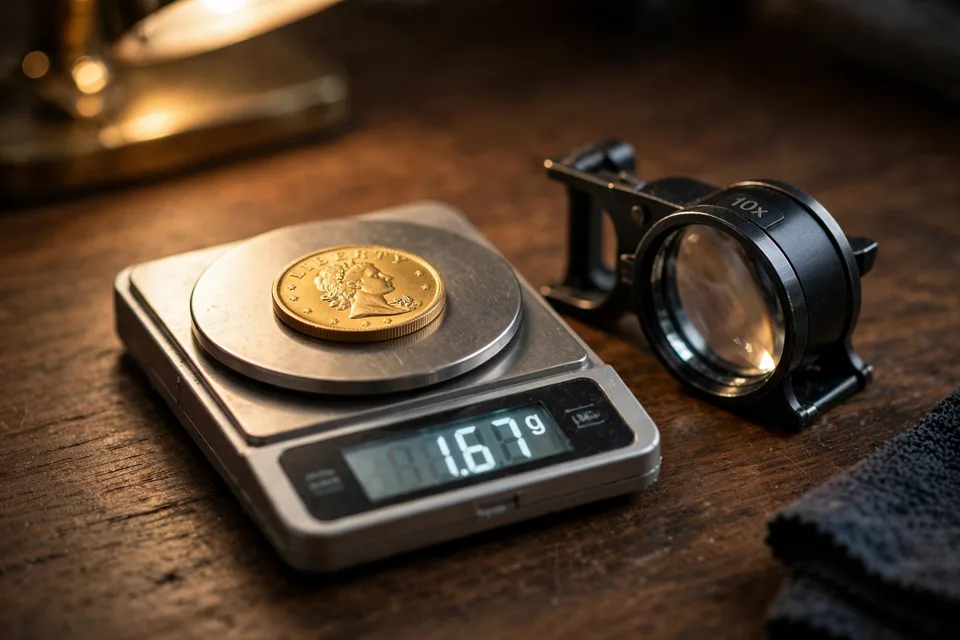
Weigh it first. A genuine quarter eagle is 4.18 grams, and a counterfeit in base metal will be far too light. Then measure it: 17.9 millimetres, with a reeded edge that is sharp and even all the way round. Then look at the design under a loupe — Gobrecht's Liberty has crisp hair and a clean coronet, the eagle's feathers are sharp, and the CAL. is in the correct position above the eagle. A cast copy looks soft, with mushy details and tiny bubbles in the fields. On a coin this famous, those three checks are the beginning, not the end: certification is where the figure is settled.
What to do if you think you have one
Do not clean it. Do not dip it. Do not polish it. Cleaning destroys the original surfaces that graders look for, and on a coin like this, the damage from a single cleaning can cost far more than the coin's gold content. Hold it by the edges, keep it in a proper holder, and handle it as little as possible.
Then get it certified. The 1848 CAL. is exactly the kind of coin where certification pays for itself many times over: it settles the authenticity of the CAL., it establishes the grade, and it makes the coin acceptable to every serious buyer. A raw 1848 CAL. will always be discounted for doubt. A certified one is not. And if the CAL. turns out to be added later — punched into a common 1848 quarter eagle after it left the Mint — the grader will tell you, and you will have spent the fee to learn the truth, which is cheaper than learning it any other way.
Latest reported results for this coin
Checking for newly reported results…
Your 1848 CAL. quarter eagle questions, answered
What is an 1848 CAL. quarter eagle worth?
Our guide has not yet researched grade-by-grade figures for this date, so the grade table below shows — for every grade. As the first federal coin struck from California gold, with only 1,389 made, it is a famous rarity, and a professional grade is the only reliable way to value one.
What does CAL. mean on the coin?
CAL. stands for California. The letters were punched into the reverse die to mark the coin as struck from California gold — the first federal coinage made from gold found in the California gold rush.
Why was the CAL. counterstamp added?
Colonel Richard Mason, the military governor of California, sent California gold east to Philadelphia in 1848 with a request that the coins struck from it be marked. The Mint punched CAL. into the reverse die, so all 1,389 carry the mark.
How many 1848 CAL. quarter eagles were struck?
1,389 were struck at Philadelphia. That is the mintage recorded in our catalog. The coins were struck from the first California gold to reach the Philadelphia Mint.
How do I check an 1848 CAL. quarter eagle?
Weigh it at 4.18 grams and measure 17.9 millimetres, then look for the CAL. above the eagle on the reverse and examine the design under a loupe. On a coin this famous, certification from PCGS or NGC is strongly advised.
Check your 1848 CAL.
An 1848 CAL. is four letters and 1,389 coins, and the first California gold coinage. Weigh it, find the CAL., and let a grader settle the rest. Run the date and mint mark through the free Coin Value Checker for an instant estimate, or get a Grade-or-Not verdict on whether your coin is worth certifying. The full gold guide is here: Gold Dollar Coin Values by Type and Date.
For learning only: this guide is educational, and the figures here are researched estimates, not a promise of what any single coin will bring. An 1848 CAL. should be authenticated and graded by professionals before any decision is made.
This guide is for education — learn the coin first, and get a professional opinion before buying or selling.