1838-C Liberty Half Eagle: Charlotte Mint's Opening $5
Coin Encyclopedia · 10 min read · Published November 7, 2026
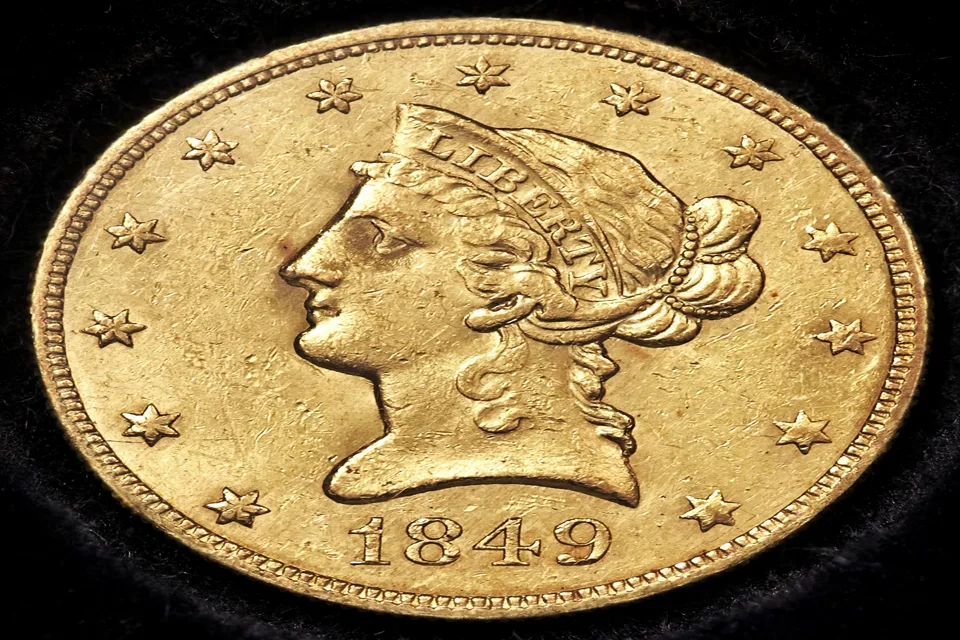
Charlotte opened its mint in 1838, and the first half eagle it struck was the 1838-C. It is a Classic Head half eagle, designed by William Kneass, with the C mint mark in a place no other Charlotte coin carries it: on the obverse, above the date. The mint had no reverse punch ready in its first year, so the C went on the front, above the 1838, where every collector since has looked for it. If you hold one today, you are holding the first coin of any kind struck at Charlotte, and the last year of the Classic Head design, in a single piece of gold.
This page is about that opening year. The 1838-C is the only Charlotte half eagle of the Classic Head design, and the first half eagle ever struck at that mint. Our catalog records no mintage figure for this issue and no grade-by-grade figures, so the table below is empty and no mintage is stated. The history is not empty, and the coin's position is clear: a first-year branch-mint coin, struck in a new mint's opening year, in the final year of its design.
Charlotte's opening year
The Charlotte Mint was opened to coin the gold of the Appalachian gold rush. Gold had been found in North Carolina in the early 1800s, and by the 1830s the region was producing enough gold to justify its own mint, rather than shipping the metal to Philadelphia. Charlotte opened in 1838, alongside Dahlonega in Georgia, and both mints struck their first coins that year — half eagles and quarter eagles, in gold, for a region that used gold every day.
The Charlotte Mint was a small operation, and its first year shows it. The mint had no reverse punch ready for the half eagle, so the C mint mark was placed on the obverse, above the date — a position used in this series only in that first year. Later Charlotte coins carry the mint mark on the reverse, where it belongs. That obverse C is the quickest way to confirm an 1838-C: a Classic Head half eagle dated 1838 with a C above the date is a Charlotte coin, struck in the mint's opening year. A Classic Head half eagle dated 1838 without a C is a Philadelphia coin.

Charlotte struck coins in only three denominations during its brief history: the half eagle, the quarter eagle, and the gold dollar. The half eagle was the largest of them, and the 1838-C was the first of them. The mint operated from 1838 to 1861, closing when the Civil War began, and it never reopened — which means every Charlotte coin is a finite piece of a closed story, and the 1838-C is its first chapter.
The grade table, still to be researched
The table below is our researched collector estimates from the live guide, reviewed November 5, 2026. Grades our guide has not researched yet are shown as “—”, not guessed. For this date, that is every grade. No grade-by-grade figures are catalogued yet, so the table below is a statement of what we do not yet know, not a set of numbers to lean on.
| Grade | Estimated value |
|---|---|
| Good (G-4) | — |
| Fine (F-12) | — |
| Extremely Fine (XF-40) | — |
| About Uncirculated (AU-50) | — |
| Mint State 60 (MS-60) | — |
| Mint State 65 (MS-65) | — |
An empty table on a first-year Charlotte coin can feel wrong, and it is worth saying why it is there. The grade table is built from researched figures, and the research has not reached this date yet. That does not make the coin common, and it does not make it cheap. It makes it unresearched, and the honest figure for it comes from the coin in hand, graded by a professional, and from the live feed on this page when newly reported results land. No one should quote you a figure for an 1838-C from a guide alone.
The Classic Head, in its final year
The Classic Head half eagle ran from 1834 to 1838, and the 1838-C is its last year. The design was William Kneass's reworking of Liberty for the reduced-weight gold coinage of 1834, when the Act of June 28, 1834 cut the gold in the half eagle from 8.748 grams to 8.359 grams and the diameter to 22.5 millimetres. Kneass adapted John Reich's earlier Liberty motif into a head with a banded cap, facing left, with thirteen stars around the rim and the date below. The reverse shows an eagle with a shield, an olive branch and arrows, and the words UNITED STATES OF AMERICA and FIVE D. around it.
That weight cut is the reason the Classic Head exists at all. Before 1834, the gold in a half eagle was worth more than five dollars, so the coins were melted. The 1834 Act reduced the gold, and the Mint needed a new design for the lighter coin. Kneass provided it, and the Classic Head ran for five years — 1834 to 1838 — before Gobrecht's Liberty replaced it in 1839. The 1838-C is the final year of that five-year design, struck at a mint that had just opened, in the only year Charlotte struck the Classic Head.
One detail matters for the 1838-C specifically: the composition. The coins of 1834 to 1836 were struck in 89.92% gold, with the balance silver and copper. The Coinage Act of 1837 raised the gold to 90%, with 10% copper, and the 1838-C was struck in that 90% composition. A genuine 1838-C is 90% gold and 10% copper, weighing 8.359 grams. That composition is part of the authentication, and it is one of the things a professional checks.
Specs and the metal floor
The 1838-C half eagle weighs 8.359 grams and measures 22.5 millimetres across, struck in 90% gold and 10% copper. It holds 0.24187 troy ounces of pure gold. The diameter is larger than the later Liberty half eagle, which was reduced to 21.6 millimetres in 1840 — the Classic Head is a broader, thinner coin, and the difference is visible when the two are held side by side. If you have handled a Liberty half eagle, the 1838-C feels wider in the hand, and lighter in the same way, because the gold is spread across a larger disc.
Metal floor: — The live melt figure on this site is calculated only for the $1 gold dollar, whose specification the Worker carries. Larger gold — $2.50, $5, $10 and $20 — has no live melt specification yet, so this page shows “—” for the metal floor rather than a computed figure. The weight above is the honest check: a genuine coin matches it, and a light coin is not genuine.
Weigh it first. A genuine Classic Head half eagle is 8.359 grams, and a counterfeit in base metal will be far too light. Then measure it: 22.5 millimetres, with a reeded edge that is sharp and even all the way round. Then look at the design under a loupe — Kneass's Liberty has crisp hair and a clean cap, the eagle's feathers are sharp, and the C mint mark sits above the date on the obverse, in the correct position. A cast copy looks soft, with mushy details and tiny bubbles in the fields. On a first-year Charlotte coin, those three checks are the beginning, not the end: certification is where the figure is settled.
A closed mint, a closed story
The Charlotte Mint operated from 1838 to 1861, and it never reopened. It closed when the Civil War began, its machinery was seized, and its coinage ended. That short life is why Charlotte coins are collected the way they are: twenty-three years of coinage, small mintages, and a mint mark that tells you exactly where the coin came from — a place, a time, and a gold rush. The 1838-C is the first coin of that story, struck in the mint's opening year, in the final year of its design, with its mint mark in a place no other Charlotte coin carries.
That is the premium. A Charlotte coin is not just a coin with a mint mark. It is a coin from a place and a time that ended, struck in a small branch mint in North Carolina, for miners who were paid in gold. The 1838-C half eagle is the first $5 from that mint, and it carries all of that history in a single letter above a date. Collectors of Charlotte gold start here, and most of them never finish, because the first year is also the hardest to find.
Latest reported results for this coin
Checking for newly reported results…
Your 1838-C half eagle questions, answered
What is an 1838-C Liberty half eagle worth?
Our guide has not yet researched grade-by-grade figures for this date, so the grade table below shows — for every grade. As the first half eagle struck at Charlotte, it is a key date of the Classic Head series, and a professional grade is the only reliable way to value one.
Why does the catalog record no mintage for the 1838-C?
Our catalog records no mintage figure for this issue, so none is stated here. The absence of a figure is a gap in our data, not a statement about how many were struck.
Where is the mint mark on an 1838-C half eagle?
The C is on the obverse, above the date — the only position used in this series in its first year, because the Charlotte Mint had no reverse punch ready. Later Charlotte coins carry the mint mark on the reverse.
What is the Classic Head design?
The Classic Head is William Kneass's Liberty, struck on the half eagle from 1834 to 1838. It was the design for the reduced-weight gold coinage of 1834, and 1838 was its final year — the same year Charlotte opened.
Who designed the 1838-C half eagle?
William Kneass, the Mint's chief engraver, designed the Classic Head, adapting John Reich's earlier Liberty motif. It is the last Classic Head half eagle, and the first half eagle ever struck at Charlotte.
Check your 1838-C
An 1838-C is Charlotte's first $5, struck in its opening year with the C above the date. Weigh it, find the C, and let a grader settle the rest. Run the date and mint mark through the free Coin Value Checker for an instant estimate, or get a Grade-or-Not verdict on whether your coin is worth certifying. The full gold guide is here: Gold Dollar Coin Values by Type and Date.
For learning only: this guide is educational, and the figures here are researched estimates, not a promise of what any single coin will bring. An 1838-C should be authenticated and graded by professionals before any decision is made.
This guide is for education — learn the coin first, and get a professional opinion before buying or selling.