1849-C Gold Dollar Open Wreath: 4 Known, $690,000 Finest
Coin Encyclopedia · 9 min read · Published November 7, 2026
The 1849-C Open Wreath gold dollar is the king of the gold dollar series, and the reason fits in one sentence: only four or five examples are known. Struck at Charlotte in the series’ very first year, with an open wreath on the reverse, it is the rarest gold dollar variety by survival. The finest, graded MS63 Prooflike, realized $690,000 at auction in 2004. Every other gold dollar is measured against it, and none of them comes close: the next rarest dates in the series are merely scarce, while this one is nearly unique.
That scarcity changes how this page works. Most coin pages on this site help you find a coin in a jar or a roll. This one almost certainly will not: with four or five known, the chance that an unidentified 1849-C Open Wreath is sitting in a drawer is vanishingly small. What this page does instead is teach you the test, so that if you ever do see one — in an inherited collection, in an old album, in a dealer’s case — you recognise it in ten seconds, and you know enough not to handle it like an ordinary coin.
Four or five in the world
Our gold dollar guide records that only four or five examples of the 1849-C Open Wreath are known. That is not a mintage figure. The mintage for the whole 1849-C issue was 11,634, covering both the open-wreath and closed-wreath reverses. The open-wreath coins are a handful of that total, struck at the very start of the run before the reverse was changed. Almost all of them are accounted for: they sit in major collections, they appear in the record books, and they change hands rarely, at figures that make headlines.
The finest known example is the MS63 Prooflike that realized $690,000 at auction in 2004. That is the record for the variety and the highest figure in the whole gold dollar series. It is also, by a wide margin, the most important gold dollar in existence: the first-year issue from a small Southern mint, in the finest grade, with the rarest reverse. The other known examples are scarcely less important, because with four or five in the world, every one of them is a museum piece.
The record: $690,000 for the MS63 Prooflike in 2004
| Coin | Grade | Source | Realized |
|---|---|---|---|
| 1849-C Open Wreath gold dollar | MS63 Prooflike | 2004 | $690,000 |
That result has stood for more than two decades, and it is the ceiling of the variety, not the worth of any other example. The gap between the finest known coin and the next is large, because the population is so small that each coin is its own market. If you ever handle a candidate, the first step is not a number. It is authentication, by a professional, before anything else is said about it.
Open wreath or closed wreath — the ten-second test
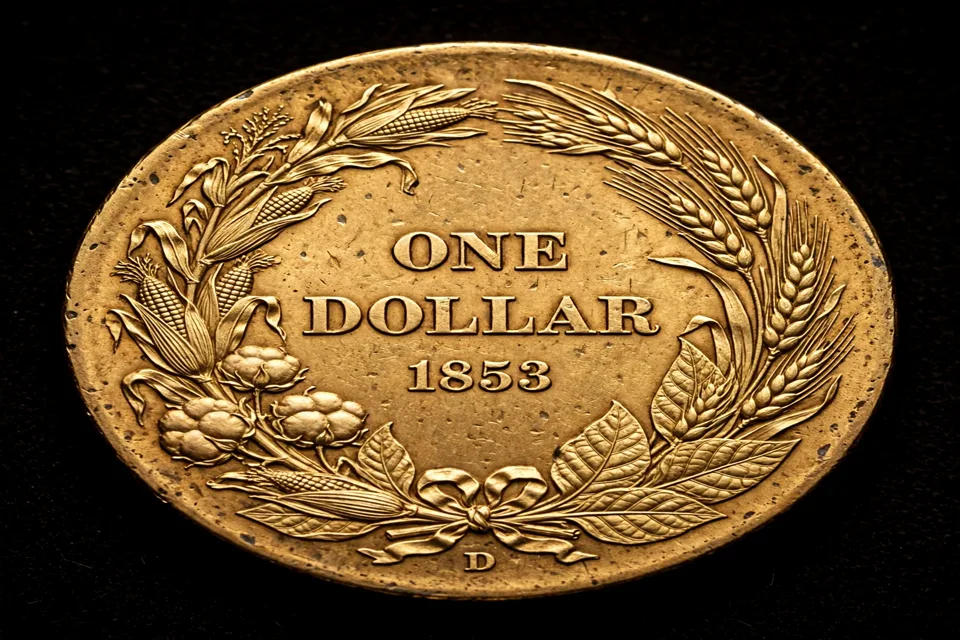
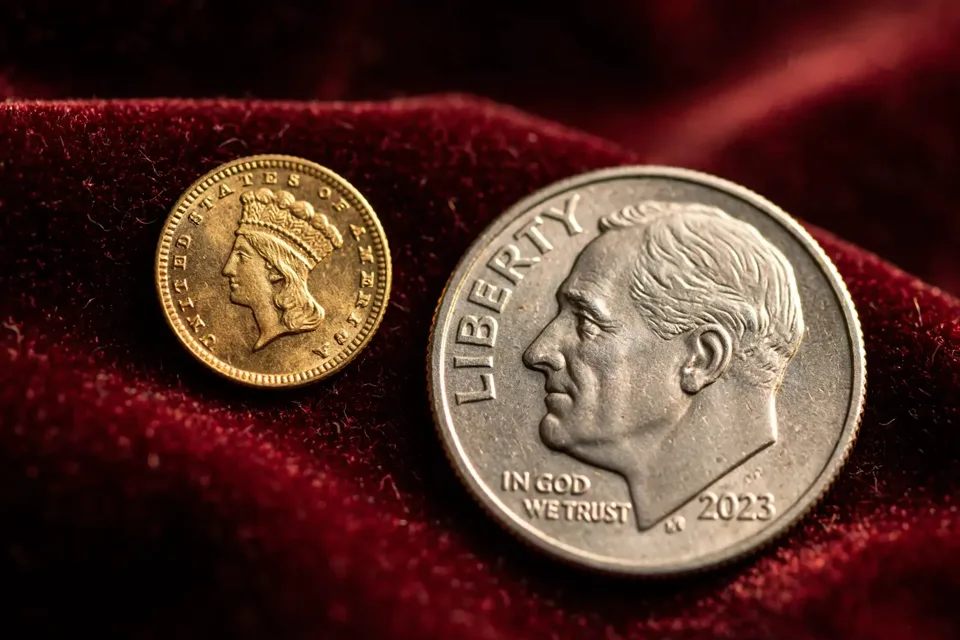
Look at the wreath on the reverse, the two branches that circle the denomination. On the Open Wreath the branches stand apart at the top, with a clear gap between them. On the Closed Wreath they meet at the top, closing the circle. The difference is small and the coins are tiny — at barely 13 millimetres, the Type 1 gold dollar is the smallest regular-issue U.S. coin ever made for circulation — so use a loupe and a good light, and compare against a confirmed example if you can.
The mint mark sits on the reverse too, directly below the wreath’s bow: a C means Charlotte, and no mark means Philadelphia. Charlotte and Dahlonega both operated only from 1838 to 1861 in Southern gold-producing regions and closed during the Civil War, so every C- or D-mint gold dollar is genuinely scarce next to Philadelphia issues. The 1849-C is the scarcest of them all, and the open wreath is the scarcest of the scarcest.
What a 1849-C Open Wreath is worth by grade
The figures below are our researched collector estimates from the live guide, reviewed November 5, 2026. Every researched grade is a six-figure coin, which is why this table looks like no other gold dollar table on the site. Good and Mint State 65 are not researched yet, and they show “—” rather than a guess.
| Grade | Estimated value |
|---|---|
| Good (G-4) | — |
| Fine (F-12) | $135,000 |
| Extremely Fine (XF-40) | $218,500–$339,110 |
| About Uncirculated (AU-50) | $461,834 |
| Mint State 60 (MS-60) | $604,445–$1,250,000 |
| Mint State 65 (MS-65) | — |
Read the table from the bottom up and the story is clear: even a worn 1849-C Open Wreath, graded Fine, carries a researched value of $135,000. That is the floor of the variety, and it is higher than the ceiling of almost every other gold dollar date. The jump to Mint State is enormous, because the finest known example is the MS63 Prooflike that reached $690,000, and the coins below it are priced against it.
Charlotte in 1849 — the first year
The gold dollar was born in 1849, the first year of the California gold rush, when the country suddenly had more gold than it knew what to do with and no small gold coin to spend it in. Chief Engraver James B. Longacre designed all three gold dollar types, and the first coins left the Philadelphia Mint in 1849. The denomination ran through 1889, forty years of America’s tiniest gold coin. Charlotte struck its share from the start, because North Carolina had its own gold fields and its own mint, and the 1849-C was among the first gold dollars the branch mints ever struck.
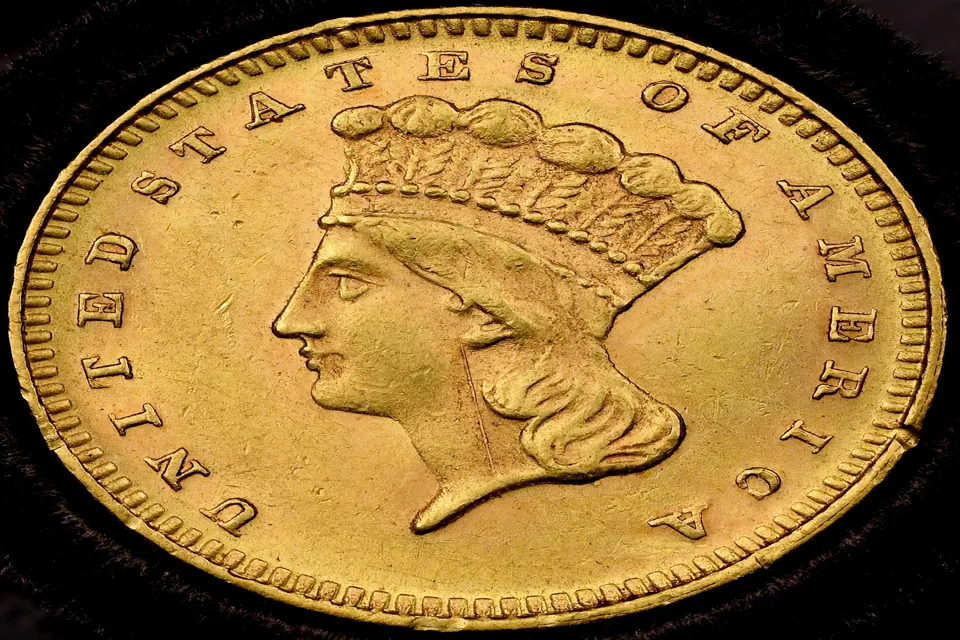
The Type 1 design is the original small portrait of Liberty wearing a beaded coronet, surrounded by thirteen stars. At barely 13 millimetres it is hard to handle and easy to lose, which is part of why so few survive: the coins were small, they were spent, and the ones that were not spent were often melted. The open-wreath reverse lasted only a short time at Charlotte before the closed wreath replaced it, and that short life is the whole reason the variety exists.
Specs and the gold floor
Every gold dollar, of any type, weighs 1.672 grams and carries 0.04837 troy ounces of pure gold, at 90% gold. With gold trading near $4,072 an ounce in November 2026, that metal is worth about $196.97 — the floor under every genuine example, no matter how worn. Gold moves every day, so the floor moves with it; check the live market on the day, and treat anything below the melt figure as a bad offer.
Metal floor updates live from our Worker — last updated November 7, 2026.
The coin is officially the Type 1 Liberty Head gold dollar, designed by James B. Longacre. It measures barely 13 millimetres across, the smallest regular-issue U.S. coin ever made for circulation, with a reeded edge and the mint mark on the reverse below the wreath’s bow. The gold floor above is the least important number on this page: the variety’s worth lives in its rarity, not its metal, and the metal is less than $200 of a six-figure coin.
Handling a coin like this — and the authentication rule
Hold a gold dollar by its edge, never across the faces, and never clean it. The coins are so small that a fingerprint covers a large part of the surface, and cleaning leaves hairlines that a grader will spot at once. Keep the coin in an acid-free holder, away from humidity, and do not store it loose with other coins. If you believe you hold an 1849-C Open Wreath, do not guess and do not show it around: send it to PCGS or NGC for authentication first. With four or five known in the world, a professional opinion is not a precaution. It is the only way the coin exists at all in the market.
Latest reported results for this coin
Checking for newly reported results…
Your 1849-C Open Wreath questions, answered
How many 1849-C Open Wreath gold dollars exist?
Only four or five examples are known, according to our gold dollar guide. The 1849-C Open Wreath is the rarest gold dollar variety by survival, and the finest known example is the MS63 Prooflike that reached $690,000 in 2004.
What is the record for an 1849-C Open Wreath gold dollar?
The finest, graded MS63 Prooflike, realized $690,000 at auction in 2004. That is the record for the variety and the highest figure in the whole gold dollar series.
How do I tell an Open Wreath from a Closed Wreath 1849-C?
Look at the wreath on the reverse, around the denomination. On the Open Wreath the two branches stand apart at the top, with a clear gap. On the Closed Wreath they meet at the top. The difference is small and the coins are tiny, so use a loupe.
Why is the 1849-C Open Wreath so rare?
Because it was struck at Charlotte in the series’ first year, in a tiny run, and the open-wreath reverse was replaced almost at once by the closed wreath. The mintage for the whole 1849-C issue was 11,634, and the open-wreath coins are only a handful of that total.
What is a 1849-C Open Wreath worth in Fine?
Our researched guide value for Fine is $135,000, reviewed November 5, 2026. Extremely Fine runs $218,500–$339,110, About Uncirculated $461,834, and Mint State 60 $604,445–$1,250,000. Even the lowest researched grade is a six-figure coin.
Check your 1849-C
Run the date and mint mark through the free Coin Value Checker for an instant estimate, or get a Grade-or-Not verdict on whether your coin is worth certifying. The full series guide is here: Gold Dollar Coin Values by Type and Date.
This guide is for learning and collecting, not financial advice. The $690,000 figure is a verified auction result for one coin in one grade; the worth of any other example depends on its own condition and attribution.
This guide is for education — learn the coin first, and get a professional opinion before buying or selling.