1873-CC No Arrows Quarter: A 4,000-Coin Goodbye
Coin Encyclopedia · 8 min read · Published November 7, 2026
Four thousand coins. That is the entire mintage of the 1873-CC Seated Liberty quarter without arrows, struck at Carson City before a new law changed the weight of the quarter and added small arrowheads beside the date. When the arrows appeared, the no-arrows coins stopped, and the 4,000 already struck became a closed chapter: the last of the old-weight Carson City quarters.
The arrows are the whole story of this coin. They mark a dividing line in American silver coinage, and the coins struck before the line are the scarce ones. This page explains the weight change, how to read the arrows, and why a 4,000-coin mintage from a frontier mint still matters.
No arrows, then arrows
Look at the date on a Seated Liberty quarter from 1873. On some, the date stands alone. On others, small arrowheads flank the date on either side. The difference is not decoration. The arrows were added in 1873 to mark coins struck at the new, heavier weight required by the Coinage Act of 1873, and the no-arrows coins are the ones struck before the change took effect.
At Carson City the change came fast. The mint struck 4,000 quarters at the old weight, then switched to the new weight with arrows. The no-arrows coins are therefore a distinct, closed issue: struck in one short run, never repeated, and separated from everything that followed by two small arrowheads.
The weight change of 1873
The Coinage Act of 1873 raised the weight of the quarter from 6.22 grams to 6.25 grams, a small increase with a clear purpose: to bring American silver coinage into line with the new standard. The arrows beside the date told anyone handling the coin that it was struck at the new weight. Without the arrows, a merchant could not tell the old coins from the new ones at a glance.
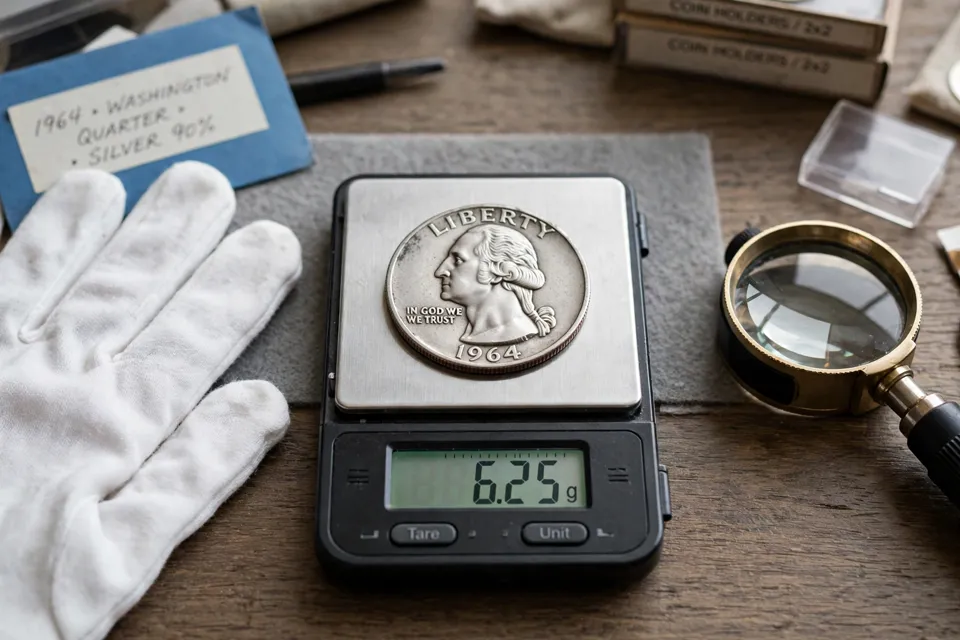
For collectors, the change created two different 1873 quarters at every mint, and the no-arrows versions are the scarce ones everywhere. At Carson City the scarcity is extreme, because the mintage was only 4,000. Weigh a suspect coin: a genuine no-arrows 1873-CC weighs 6.22 grams, while an arrows example weighs 6.25 grams. The scale confirms what the eyes see.
4,000 coins
Four thousand is a small number for a mint, and it is a small number for a series. The coins went into circulation in Nevada, where they wore hard, and the survivors are few. Most show honest, heavy wear, with Liberty’s head and the eagle’s breast softened by decades of handling. A worn example with a readable date, a clear CC, and no arrows beside the date is a coin that has survived a great deal.
There was no collector market waiting to save these coins in 1873. They were spent, and the spending did the damage. Later melting thinned the survivors further, because old silver quarters were melted for their metal without regard to date or variety. The 4,000 that left the mint are now a fraction of that number.
What our guide shows for the 1873-CC
Our value guide has not yet researched grade-by-grade figures for this date, so the table below shows “—” for every grade. The mintage of 4,000 is documented, and it places this coin among the scarcest Seated Liberty quarters ever struck. Grade figures will be added when they are researched.
| Grade | Estimated value |
|---|---|
| Good (G-4) | — |
| Fine (F-12) | — |
| Extremely Fine (XF-40) | — |
| About Uncirculated (AU-50) | — |
| Mint State 60 (MS-60) | — |
| Mint State 65 (MS-65) | — |
Guide values reviewed November 5, 2026 — figures update live from our Worker.
The floor is documented too. The no-arrows 1873-CC is 90% silver, 6.22 grams, and its metal alone sets a floor under every genuine example. Our guide has not yet established the figure for this date, so the specs section shows it as “—” rather than a guess. The collector premium above that floor is where the 4,000-coin mintage lives, and for this date it is large in every grade.
How to confirm yours
Three checks, in order. First, the date: 1873, with no arrowheads beside it. Second, the mint mark: CC on the reverse, below the eagle, crisp and correctly positioned. Third, the weight: 6.22 grams on a pocket scale. A coin that passes all three is a no-arrows 1873-CC, and it deserves a professional opinion.
Watch for altered coins. An arrows example with the arrowheads removed, or a Philadelphia 1873 with an added CC, are the traps to know about. The metal around the date and the mint mark should show no tool marks, and the strike should be consistent across the whole coin. Any doubt is a reason for certification, not a guess.
Handling a 4,000-coin rarity
Do not clean it. Original surfaces are everything on a coin this scarce, and cleaning removes them permanently. Handle it by the edges, store it in an acid-free holder, and keep it dry. Photograph both sides in good light and keep a note of where it came from.
Then get it certified. A professional opinion on authenticity, variety, and grade is the standard for the 1873-CC no-arrows, and it protects the coin and everyone who handles it afterwards.
Latest reported results for this coin
Checking for newly reported results…
Your questions, answered
What does no arrows mean on an 1873-CC quarter?
No arrows means the coin was struck at the old 6.22-gram weight before the Coinage Act of 1873 raised the quarter to 6.25 grams. Arrows were added beside the date to mark the new weight.
How many 1873-CC no-arrows quarters were struck?
Carson City struck 4,000 no-arrows Seated Liberty quarters in 1873 before switching to the heavier arrows design. Survivors are scarce in every grade.
How do I tell a no-arrows 1873-CC from an arrows one?
Look beside the date: arrows examples have small arrowheads flanking the date, no-arrows examples do not. A pocket scale confirms it — no arrows is 6.22 grams, arrows is 6.25 grams.
Is the 1873-CC no-arrows quarter silver?
Yes. It is 90% silver, weighing 6.22 grams with about 0.18 troy ounces of pure silver. The metal floor for this date is shown as a dash in the specs section above until our guide establishes a figure.
Should an 1873-CC no-arrows quarter be certified?
Yes. Certification settles authenticity and the variety, guards against removed arrowheads and added mint marks, and is the accepted standard for a coin with this small a mintage.
Check your 1873-CC
Run the date and mint mark through the free Coin Value Checker for an instant estimate, or get a Grade-or-Not verdict on certification. The wider quarter guide is here: Rare Quarters in Your Change Worth $207,400+. The other first-years Carson City quarter is the 1870-CC Seated Liberty Quarter.
Two arrowheads, or none at all — the 1873-CC no-arrows quarter proves that a tiny change in the law can make a tiny mintage into a landmark, and that a scale and a loupe are worth more than a guess.
This guide is for education — learn the coin first, and get a professional opinion before buying or selling.