1914-D Buffalo Nickel: Denver’s Scarce Second Year
Coin Encyclopedia · 8 min read · Published November 7, 2026
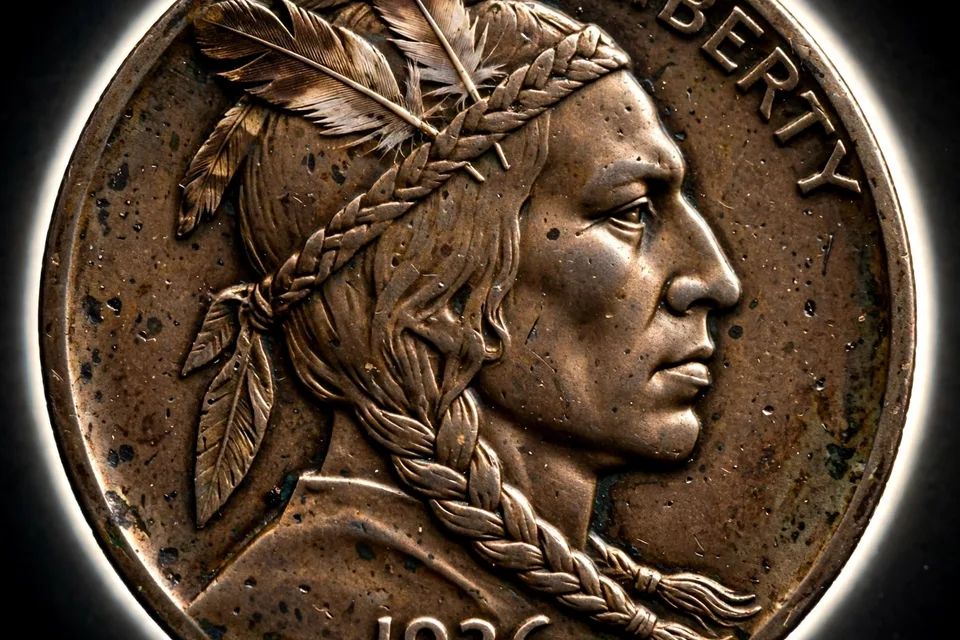
Denver did not get a proper first year with the Buffalo nickel. In 1913 the new design reached the branch mints late, dies arrived in drips, and the year was nearly over before Denver had struck many coins at all. 1914 was different. It was Denver’s first full year of Buffalo nickel production, a whole calendar of striking, and the mint turned out 3,912,000 of them. That number sounds large until you set it beside what Philadelphia was striking in the same years, and until you remember what happened to those coins next: they went to work. A 1914-D Buffalo nickel was not a souvenir. It was a five-cent piece in a mining town, a ranch town, a railroad town, and it stayed in circulation until there was almost nothing left of the design.
That working life is the reason this date matters. The 1914-D is not the rarest Buffalo nickel and it is not the most famous, but it is the first Denver date a collector can actually hunt for, and it teaches everything the series is about: mintage, mint mark, strike, and wear. Find one with a clear date and a readable D and you hold a coin that has survived more than a century of pockets, purses, and cash drawers. Find one with a sharp strike and full detail in the bison’s horn and you hold something genuinely scarce, because Denver’s early Buffalo strikes were often soft.
Denver’s first full year
The Buffalo nickel was James Earle Fraser’s design, and the Mint had struggled to get it into production at all. The high-relief portrait and the bison were hard on the dies, the coins struck poorly, and the first months of 1913 were a scramble. Philadelphia sorted its problems first, as usual, and the branch mints waited their turn. Denver’s 1913 output was small and split between the two reverse types. In 1914 the mint finally had a full year, a settled Type 2 reverse with the flat ground line, and a steady supply of planchets. The 3,912,000 coins it struck that year were the first real Denver run of the series.
Denver’s output went mostly to the Mountain West, where five-cent pieces circulated hard. There were no roll hoards in 1914, no collectors setting aside mint bags, and no reason for anyone to think a common nickel would one day be a classic. The coins that survive today in collectible condition are the ones that left circulation early by accident: a coin dropped in a drawer, a coin saved in a jar, a coin carried as a pocket piece and then forgotten. Everything else wore down, and the date wore first.
The strike problem on early Denver nickels
Look at the bison’s horn first. On a sharply struck Buffalo nickel the horn is a clean, pointed shape with a clear outline. On a weakly struck one it is a soft bump, and the hair detail above it blurs into the field. Denver’s 1914 strikes are often soft in exactly that spot, and the portrait’s hair and the braid can be mushy too. That softness is not wear. Wear flattens the highest points evenly. A weak strike leaves the coin’s details unfinished from the day it was made, and it is most obvious on the horn, the tail, and the top of the bison’s back.
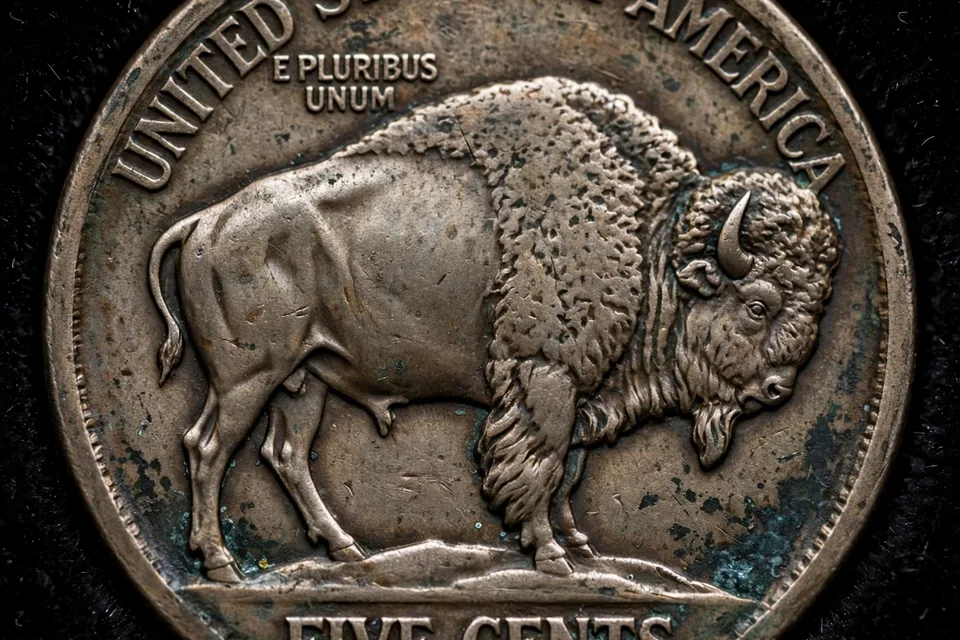
Strike matters because it separates the ordinary from the exceptional on this date. A 1914-D with a full, sharp horn and clear hair detail is a far better coin than a softly struck example in the same grade, and collectors pay for that difference. When you examine a candidate, check the horn, then the bison’s shoulder, then the portrait’s braid. If all three are crisp, you are looking at one of the better-struck survivors of the year. If the horn is a smudge and the braid is flat, the coin was born that way, and no amount of careful handling will change it.
Finding the D
The mint mark is the whole attribution on this coin, and it lives in the worst possible place for survival: on the reverse, below FIVE CENTS, near the bottom rim, where the coin takes the most wear. On a Fine example the D is usually clear. On a Good example it can be a ghost. Hold the coin under a single light source and tilt it slowly, so the light rakes across the surface. A genuine D will show its shape: a straight back and a curved belly, in the right position and the right size. Compare it with a known Denver Buffalo nickel if you can, because a scratched or damaged Philadelphia coin can fool the eye at a glance.
Do not confuse this date with its famous neighbour. The 1914/3 overdate is a Philadelphia variety in which a 1913 die was reused and the 4 was punched over a 3. It shows a ghost of the 3 under the 4 in the date, and it carries no mint mark. The 1914-D is a different coin entirely: a regular Denver issue with a clean 1914 date and a D on the reverse. If your coin has a D, it is not the overdate. If it has no D and the date shows doubling, look again with a loupe, because you may be holding the variety instead.
What our value guide records for this date
Our value guide has not yet researched the 1914-D grade by grade, so the table below is all dashes for now. That is the honest position, and it is the same position as the 1913-S Type 2: the catalog reviewed November 5, 2026, records the mintage and nothing else for this date, and we will not fill the grades with figures borrowed from elsewhere. The mintage is the fact that carries this page, and it is a solid one.
| Grade | Estimated value |
|---|---|
| Good (G-4) | — |
| Fine (F-12) | — |
| Extremely Fine (XF-40) | — |
| About Uncirculated (AU-50) | — |
| Mint State 60 (MS-60) | — |
| Mint State 65 (MS-65) | — |
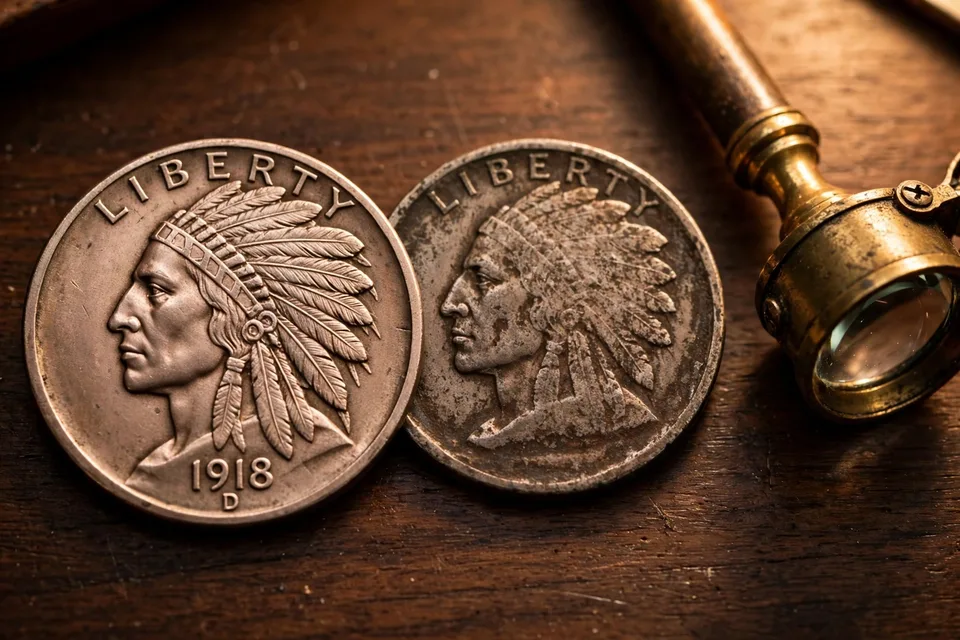
Three million nine hundred twelve thousand coins is not a tiny mintage, and worn 1914-D nickels do turn up. But the survivors worth collecting are far fewer than the number suggests, because the date itself is the first thing to go. A Buffalo nickel’s date sits high on the shoulder of the portrait, unprotected by the rim, and a century of circulation rubs it away. A 1914-D with a full, readable date and a clear D is already a survivor. One with a sharp strike as well is a coin to keep.
How to judge a 1914-D in hand
Start with the date. If all four digits are clear and the 4 is not mushy, the coin has a chance. Then the mint mark, then the horn, then the braid. Then weigh it: a genuine Buffalo nickel weighs 5 grams and measures 21.2 millimetres across, and a coin that is light or the wrong size is a warning. Then look at the edge, which should be plain and even. Finally, look at the overall surface. A coin that has been cleaned will show fine hairlines under a loupe and a dull, washed-out lustre. An original coin, even a worn one, keeps a natural skin that cleaning destroys.
Storage is simple and it matters. Hold the coin by the edge, keep it in an acid-free flip or a holder, and keep it dry. Do not clean it, do not rub it, and do not store it loose with other coins. If the coin looks uncirculated, or if you are unsure about the mint mark, a professional opinion from PCGS or NGC settles both questions at once, and on a second-year Denver date that certainty is worth having.
Latest reported results for this coin
Checking for newly reported results…
Your 1914-D questions, answered
How many 1914-D Buffalo nickels were struck?
Denver struck 3,912,000 Buffalo nickels in 1914. That was the mint’s first full year of the new design, after the short first-year runs of 1913, and it is a modest figure beside the tens of millions Philadelphia struck in the same era.
Where is the mint mark on a 1914-D Buffalo nickel?
The D sits on the reverse, below the words FIVE CENTS near the bottom rim. Denver’s mark is small and wears early, so a side-lit loupe is the best way to confirm it on a circulated coin.
Is the 1914-D related to the 1914/3 overdate?
They are neighbours, not the same coin. The 1914/3 overdate is a separate variety struck at Philadelphia, where a 1913 die was repunched with 1914. The 1914-D is a regular Denver issue, and the two should never be confused when attributing a coin.
Why is the 1914-D scarcer than its mintage suggests?
Because almost the whole run went into circulation and stayed there. Buffalo nickels were working money in the Mountain West, and a 1914-D that spent decades in pockets and tills wears down fast. Uncirculated survivors are far rarer than the 3,912,000 mintage implies.
Does our value guide list estimates for the 1914-D yet?
Not yet. All six grades currently show “—” in our catalog, reviewed November 5, 2026. We show the gap rather than guessing, and the table will be completed as the grade-by-grade research is done.
Check your 1914-D
Run the date and mint mark through the free Coin Value Checker for an instant estimate, or get a Grade-or-Not verdict on whether your coin is worth certifying. The full series guide is here: Buffalo Nickels to Look For: 50¢ to $511,875+.
Written to help you identify and enjoy this coin, not as financial advice. Figures come only from our own researched catalog; a single coin’s real worth always depends on its condition, its strike, and the market on the day.
This guide is for education — learn the coin first, and get a professional opinion before buying or selling.