Depression-Era Scarcity: The 1934-S Peace Dollar
Coin Encyclopedia · 9 min read · Published November 7, 2026
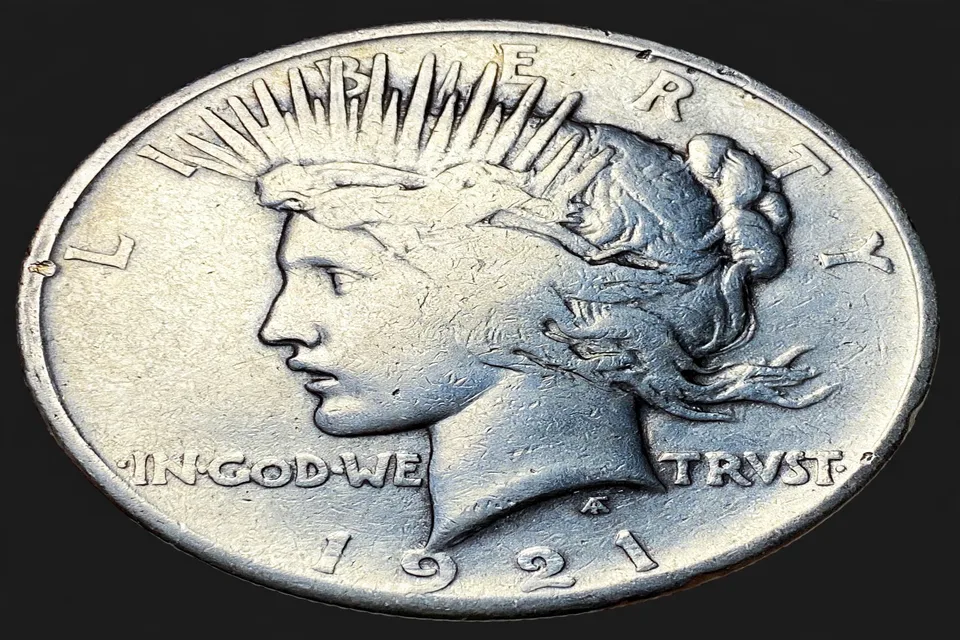
One million eleven thousand. The 1934-S Peace dollar was struck at San Francisco in the depths of the Great Depression, in a year when silver dollars were working money in hard times — and it is scarce in high grade in a way its mintage alone does not explain. Our guide carries researched figures at all six grades: G-4 runs $48 to $75, F-12 runs $65 to $85, XF-40 runs $149 to $203, AU-50 runs $443 to $2,202, MS-60 runs $2,640 to $2,750, and MS-65 runs $7,200 to $19,520. The worn grades are affordable; the top is a different world.
The reason is the Depression itself. Silver dollars struck in 1934 went straight into circulation in an economy where a dollar was working money, and few were set aside. The uncirculated survivors are the coins that sat in Treasury bags or were tucked away early — and the market has valued that survival accordingly, with the AU-50 range alone spanning $443 to $2,202.
What a 1934-S is worth by grade
The curve climbs at every step: G-4 at $48 to $75, F-12 at $65 to $85, XF-40 at $149 to $203, AU-50 at $443 to $2,202, MS-60 at $2,640 to $2,750, and MS-65 at $7,200 to $19,520. The wide AU-50 range — nearly fivefold from bottom to top — is the most honest number on this page: it reflects how much lustre, strike, and eye appeal vary within a single grade for a Depression-era coin.
| Grade | Estimated collector value |
|---|---|
| G-4 | $48–$75 |
| F-12 | $65–$85 |
| XF-40 | $149–$203 |
| AU-50 | $443–$2,202 |
| MS-60 | $2,640–$2,750 |
| MS-65 | $7,200–$19,520 |
A dash (—) means our November 2026 review holds no researched figure for that grade yet — it is a gap in our data, not a zero. Figures are collector estimates, reviewed November 5, 2026.
Two numbers matter most in that table: the lowest figure, which is roughly what any worn example is worth, and the highest, which shows what condition can do. Between them sit 6 researched grades for this date. At G-4 the range runs $48 to $75, and at the top end, MS-65 runs $7,200 to $19,520.
1934: silver dollars in hard times
The Peace dollar returned in 1934 after a five-year gap — no Peace dollars were struck from 1929 through 1933 — and it returned into the Great Depression. The 1934-S was struck at San Francisco in 1,011,000 pieces, and its coins went straight into an economy where a silver dollar was serious money. That is why the worn grades are common and the high grades are scarce: the coins of 1934 were spent, not saved, and the survivors with full lustre are the exception.
For the collector, the practical consequence is simple: a 1934-S with full lustre and a sharp strike is worth a closer look even before you think about the grade number, because the series is famous for weak strikes and a sharp Depression-era example is genuinely scarce.
How to grade your 1934-S
Peace dollars wear first on Liberty's cheek and on the high rays of the crown, and on the reverse the eagle's shoulder and wing tips go flat early. The strike matters more here than on a Morgan: many Peace dollars left the mint softly struck, with weak hair detail and a flat eagle, so a fully struck example with crisp rays and a bold eagle stands out at once. Lustre should roll across the fields in a cartwheel when you tilt the coin; dull, lifeless surfaces mean wear or cleaning, and either one holds the grade down.
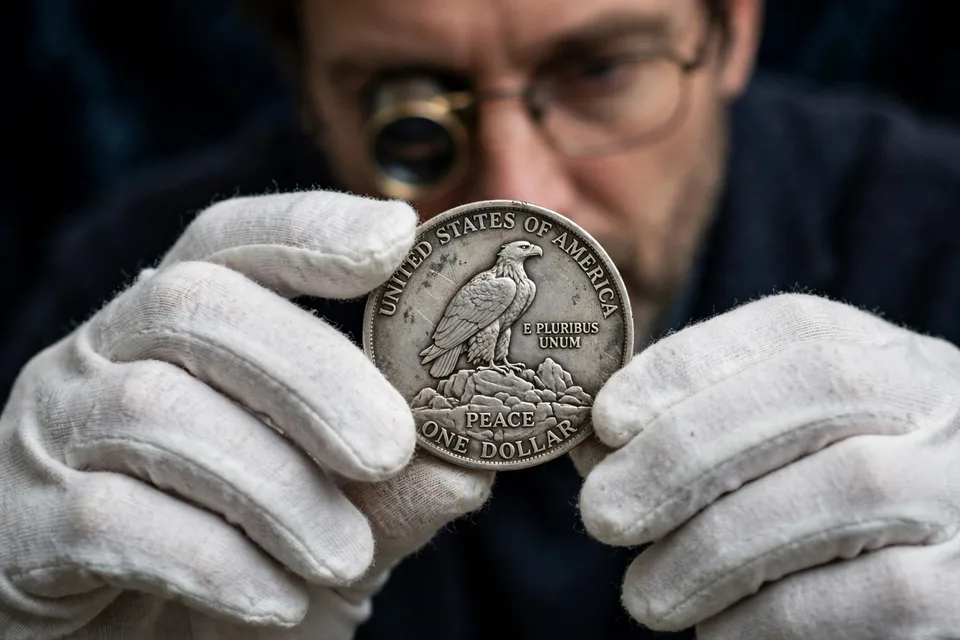
Peace dollars wear first on Liberty's cheek and on the high rays of the crown, and on the reverse the eagle's shoulder and wing tips go flat early. The strike matters more here than on a Morgan: many Peace dollars left the mint softly struck, with weak hair detail and a flat eagle, so a fully struck example with crisp rays and a bold eagle stands out at once. Lustre should roll across the fields in a cartwheel when you tilt the coin; dull, lifeless surfaces mean wear or cleaning, and either one holds the grade down.
Specs and the silver floor
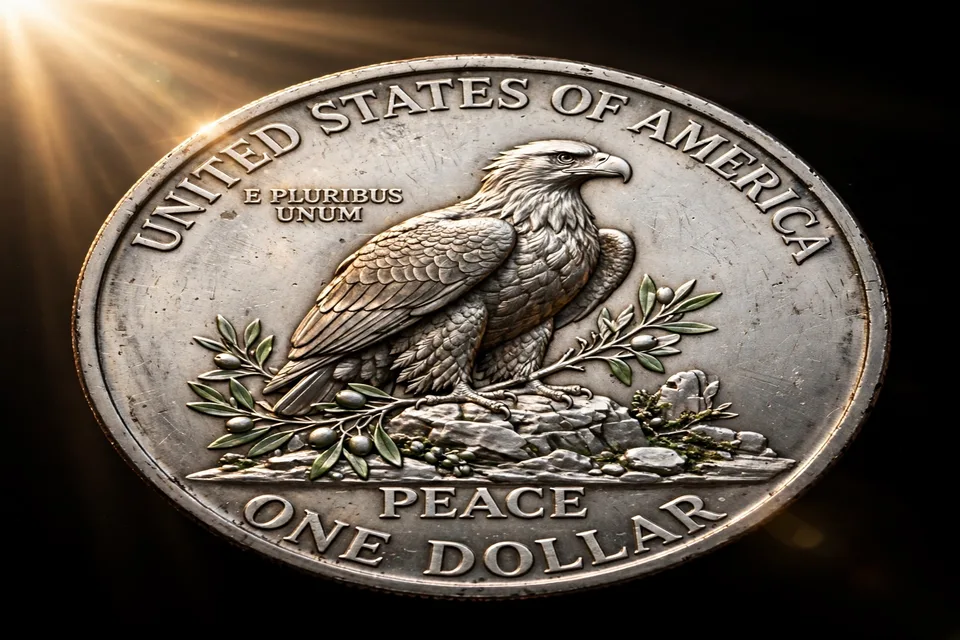
A Peace dollar weighs the same as a Morgan — 26.73 grams, 38.1 millimetres, 90% silver, 0.7734 troy ounces of pure silver — so the metal floor under every genuine example is $40.27. Anthony de Francisci designed it: Liberty in a radiate crown on the obverse, an eagle standing on a rock above the word PEACE on the reverse. The mint mark, when there is one, sits below the eagle, above the word ONE.
Metal floor updates live from our Worker — last updated November 7, 2026.
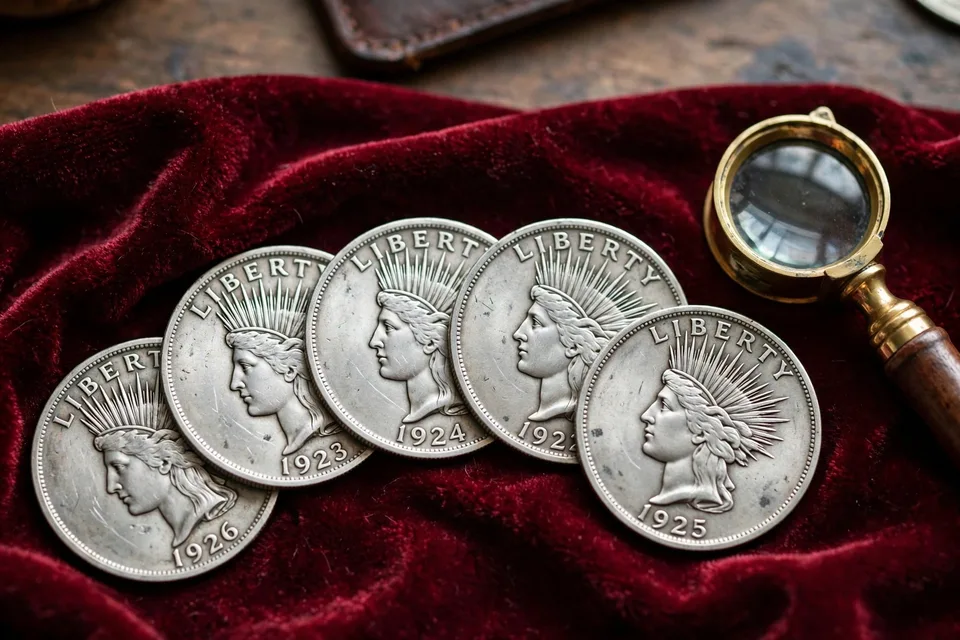
The silver floor is the least interesting number on this page. At 1,011,000 struck, in the depths of the Depression, the 1934-S is worth its mint mark, its year, and its grade — not its metal.
Is your 1934-S genuine?
Counterfeits are a real hazard with every coin in this guide, and the checks are the same ones collectors have used for decades. Weigh it first — 26.73 grams, no excuses — and measure the diameter at 38.1 millimetres. Hold a magnet to it: silver does not stick, and a coin that does is not what it claims to be. Under a loupe, genuine striking leaves crisp, even lettering and clean fields; a cast copy betrays itself with soft details, tiny pits, and a slightly greasy surface. When the stakes are high, certification settles it.
The high-grade figures make this date a target, so a coin claimed as uncirculated deserves the full check — weight, diameter, magnet, and loupe — and certification before any serious money changes hands. Under a loupe, genuine striking leaves crisp, even lettering and clean fields; a cast copy betrays itself with soft details, tiny pits, and a slightly greasy surface.
Latest reported results for this coin
Checking for newly reported results…
Your 1934-S Peace dollar questions, answered
How much is a 1934-S Peace dollar worth?
Researched figures run $48 to $75 at G-4, $65 to $85 at F-12, $149 to $203 at XF-40, $443 to $2,202 at AU-50, $2,640 to $2,750 at MS-60, and $7,200 to $19,520 at MS-65. Every grade carries a researched figure — the fullest coverage of any Depression-era Peace dollar in this guide.
What is the mintage of the 1934-S Peace dollar?
San Francisco struck 1,011,000 Peace dollars in 1934 — the first Peace dollars after a five-year gap, struck in the depths of the Great Depression. The mintage is modest, and the high-grade survival is far scarcer still.
Why were no Peace dollars struck from 1929 to 1933?
Production paused during the Depression years, and the Peace dollar returned in 1934 after a five-year gap. The 1934-S is therefore one of the first Peace dollars of the Depression era, struck into an economy where a silver dollar was serious money.
Why is the AU-50 range so wide on the 1934-S?
Because lustre, strike, and eye appeal vary enormously within a single grade for a Depression-era coin. An AU-50 example with strong lustre and a sharp strike sits at the top of the range, while a dull, softly struck one sits at the bottom — and the range reflects that honestly rather than hiding it.
How do I know my 1934 Peace dollar is from San Francisco?
Turn the coin over and look below the eagle, above the word ONE. A small S there means San Francisco. No mint mark means Philadelphia, and a D means Denver. The S is struck cleanly into the coin, at the same depth as the surrounding design.
Should I get my 1934-S Peace dollar graded?
Consider it when the coin looks uncirculated with full lustre and a sharp strike, because the figures climb steeply with condition. Certification also settles whether the S mint mark is genuine, which matters for every Depression-era San Francisco date.
Check your 1934-S Peace
Run the date and mint mark through the free Coin Value Checker for an instant estimate, or get a Grade-or-Not verdict on whether your coin is worth certifying. The full guide is here: Peace Dollar Values: Silver Prices and Key Dates. The final Peace dollar is the 1935-S Peace dollar, struck the year after this one at San Francisco.
A Depression-era coin that survived hard times in every sense — learn the mint mark, learn the grade, and keep the history close. Shared for education only.