1961 Franklin Half Doubled Die: Spotting the Reverse Error
Coin Encyclopedia · 8 min read · Published November 7, 2026
The 1961 Franklin half doubled-die reverse is an error you can see without squinting. The doubling shows on the reverse — on the Liberty Bell, on the lettering around it, on the eagle — a second image shifted just enough to be obvious under a loupe and visible to the naked eye on a strong example. Doubled dies are the most collected mint errors in American coinage, and the 1961 Franklin reverse is one of the clearest of them.
This guide is a spotting guide first and a value guide second. It covers where the doubling shows, how to separate a real doubled die from machine doubling, the grade table as it stands, and the silver floor. Our catalog does not list a separate mintage for the variety, and it has not yet researched grade-by-grade estimates for it, so those cells show dashes. The doubling itself is the fact that matters.
Where the doubling shows on the reverse
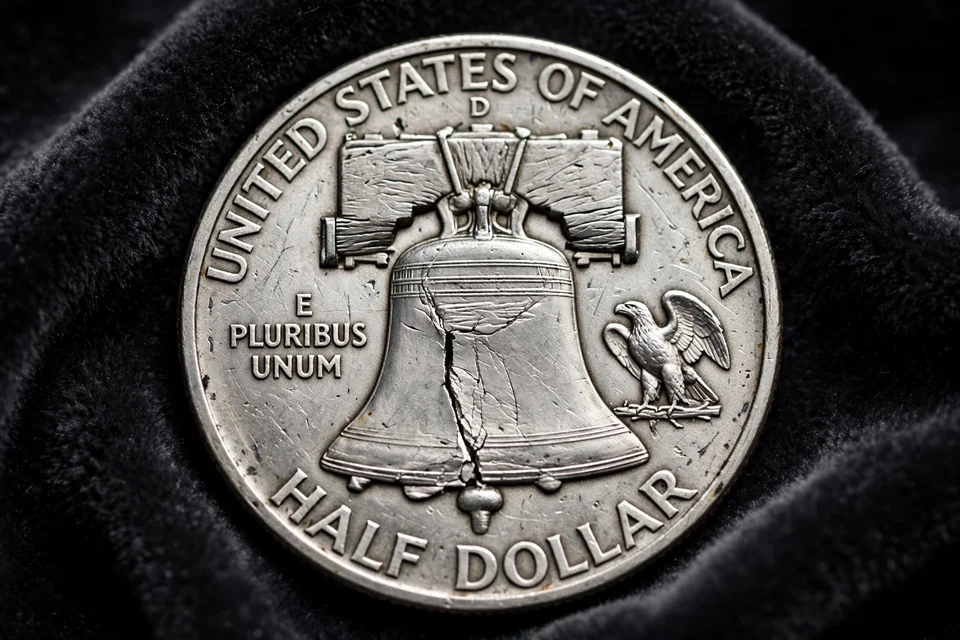
Turn the coin over and start with the words. On the doubled-die reverse, UNITED STATES OF AMERICA and E PLURIBUS UNUM show a clear second outline, shifted slightly from the first, and the effect is strongest on the letters nearest the rim. Then look at the Liberty Bell itself: the bell's outline and the crack carry the same doubled image, and the small eagle beside the bell shows doubling on its wing and tail feathers.
The doubling is classed as a doubled die, which means the doubling was cut into the die itself and appears on every coin that die struck. That is what separates it from machine doubling, where a loose die bounces during the strike and leaves a flat, shelf-like doubling that varies from coin to coin. A doubled die is consistent, raised, and rounded; machine doubling is flat and shelf-like. Learn the difference once and it serves you on every series.
Doubled die or machine doubling — the one-minute test
Hold the coin under a loupe and look at the shape of the doubling, not just its presence. On a true doubled die the doubled letters are raised and rounded, with the same profile as the main letters, because they were hubbed into the die twice. On machine doubling the extra image is flat, like a step cut into the side of the letter, and it often appears on only part of the design.
The second test is consistency: a doubled die shows the same doubling in the same places on every example, while machine doubling is random and varies from coin to coin. The third test is value — machine doubling adds little or nothing to a coin's worth, while a genuine doubled die carries a real premium. If your 1961 reverse shows strong, rounded doubling on the bell and the lettering, you have the variety; if it shows a flat shelf on a few letters, you have a strike artifact.
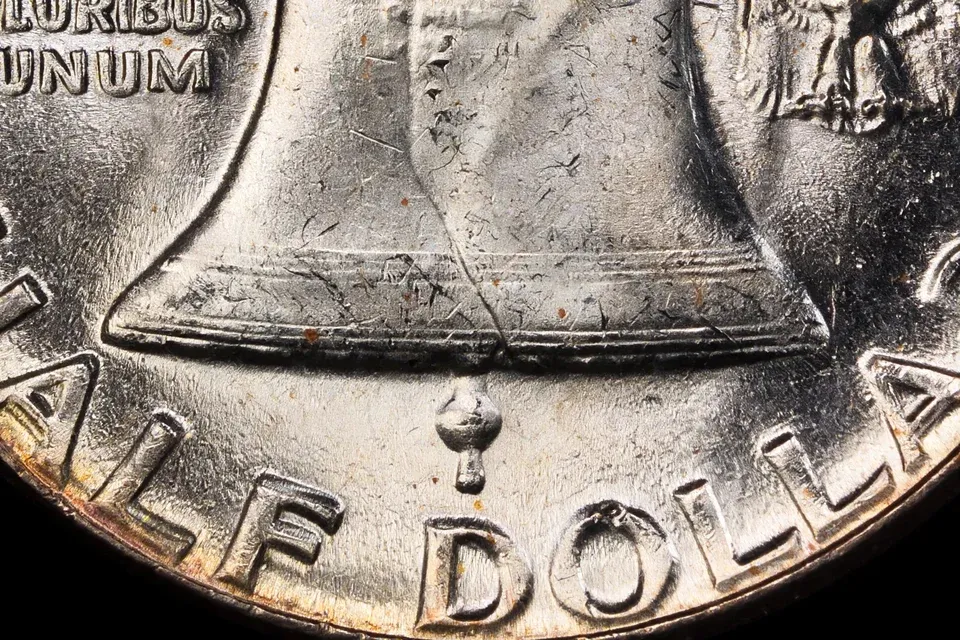
Doubled dies — how a mistake becomes a variety
A doubled die happens when the hub that stamps the design into a working die shifts slightly between impressions, leaving the design doubled on the die itself. Every coin that die strikes carries the same doubling, which is why a doubled die is a variety — a repeatable, identifiable kind of coin — rather than a one-off error. The 1961 doubled-die reverse is one of the Franklin series' best-known varieties, and the doubling is on the reverse, in the lettering around the bell.
The doubling is clearest in the words on the reverse: look at the lettering with a loupe and you will see a ghosted second image, slightly offset from the first. It is not damage, and it is not wear — it is in the die, so it is identical on every example. That repeatability is what makes it collectible: once you have seen one, you can spot another, and once collectors can spot a variety, a market forms around it.
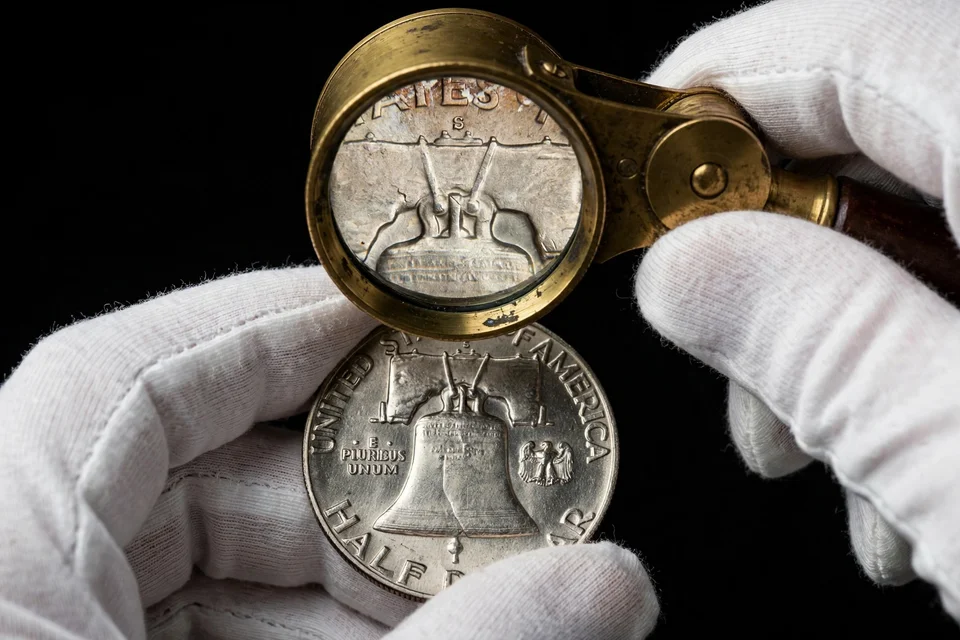
Telling doubling from damage — the check that matters
Not every doubled-looking coin is a doubled die. Machine doubling — a bounce of the die during striking — looks similar at a glance but is flat, shelf-like, and different on every coin. A true doubled die shows rounded, raised doubling that is identical on every example from that die. The distinction matters because only the true variety carries a premium.
The check is straightforward: compare your coin against a known example, or against the published description of the variety. The doubling on the 1961 reverse is in the same place on every genuine example, with the same offset and the same shape. If the doubling moves, changes, or looks flat and shelf-like, it is machine doubling, and the coin is an ordinary 1961. If it matches, you have the variety — and the variety is worth a premium over a normal 1961 at the same grade.
What a 1961 Franklin Half Doubled-die reverse is worth by grade
Our guide has not yet researched grade-by-grade estimates for this date, so every cell below shows “—” rather than a guessed figure. The live system fills these cells the moment research or a newly reported result lands. Figures on this page are reviewed November 5, 2026.
| Grade | Estimated value |
|---|---|
| Good (G-4) | — |
| Fine (F-12) | — |
| Extremely Fine (XF-40) | — |
| About Uncirculated (AU-50) | — |
| Mint State 60 (MS-60) | — |
| Mint State 65 (MS-65) | — |
No researched grade figures exist for the doubled-die reverse yet, because the variety is judged on its doubling, not on the ordinary grade ladder. A doubled-die example is worth a premium over a normal 1961 at the same grade, and the doubling is what a buyer checks first.
Silver, specs, and the floor under the doubled-die Franklin
Every Franklin half from 1948 through 1963 is 90% silver. The coin weighs 12.5 grams and carries 0.36169 troy ounces of pure silver. The live metal floor for this coin is $18.83 — it moves with the live silver market, so the figure updates on every load rather than standing still.
Metal floor updates live from our Worker — last updated November 7, 2026.
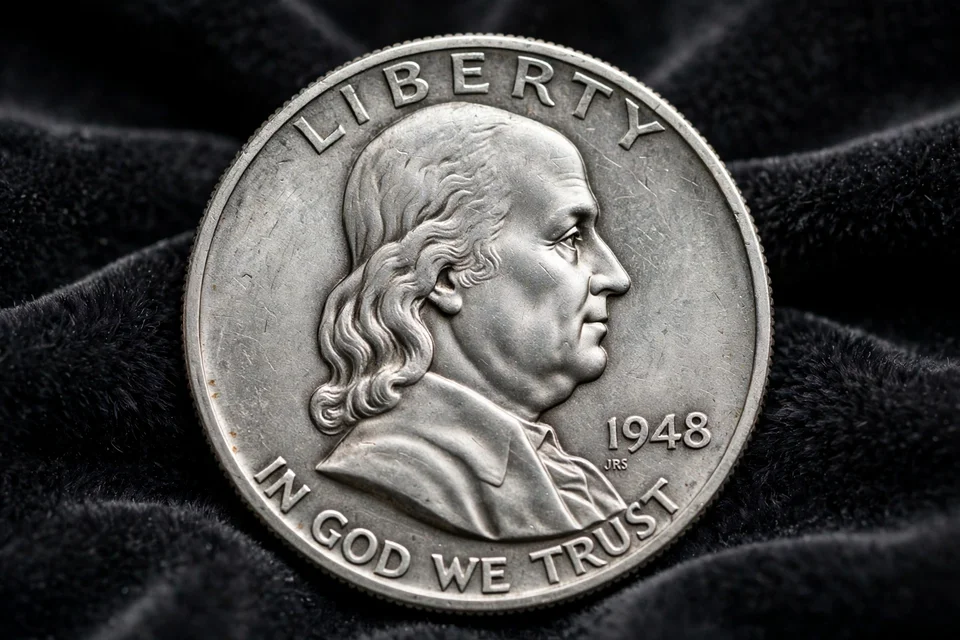
John R. Sinnock's portrait of Benjamin Franklin fills the obverse, with the Liberty Bell and a small eagle on the reverse. Diameter 30.6 millimetres, reeded edge, and the mint mark on the reverse, just above the bell's yoke. The bell's horizontal lines are the detail collectors study for the Full Bell Lines designation.
Verified auction records
Our auction data holds no verified historic record for this date yet — no figure here is guessed. The box below checks for newly reported results on every load, so the first verified result for this coin will appear there.
Latest reported results for this coin
Checking for newly reported results…
Your 1961 Franklin Half Doubled-die reverse questions, answered
How do I spot the 1961 Franklin half doubled-die reverse?
Look at the reverse under a loupe: the lettering of UNITED STATES OF AMERICA and E PLURIBUS UNUM shows a clear second outline, and the Liberty Bell and small eagle carry the same doubling. The doubling is raised and rounded on a true doubled die.
Doubled die or machine doubling — how do I tell?
A true doubled die shows raised, rounded doubling in the same places on every example, because the doubling was cut into the die. Machine doubling is flat and shelf-like, varies from coin to coin, and adds little to a coin's worth.
How much is a 1961 doubled-die Franklin half worth?
Our guide has not yet researched grade-by-grade estimates for this variety, so the table shows dashes. A doubled die trades above the common 1961 in every grade, with the premium growing with grade and with Full Bell Lines on Mint State examples.
How many 1961 doubled-die Franklin halves exist?
Our catalog does not list a separate mintage for the variety. It came from dies that struck thousands of coins, and examples still turn up in rolls and collections — the doubling, not a mintage figure, is how the variety is identified.
Is the 1961 Franklin half silver?
Yes. Every Franklin half from 1948 through 1963 is 90% silver, weighing 12.5 grams with 0.36169 troy ounces of pure silver — worth the live metal floor shown in the specs section below, which moves with the live silver market.
Check your 1961
Run the date and mint mark through the free Coin Value Checker for an instant estimate, or get a Grade-or-Not verdict on whether your coin is worth certifying. The full series guide is here: Franklin Half Dollar Values and Key Dates.
Written for the loupe-and-five-minutes crowd — the 1961 doubled die is out there, and the bell gives it away. This guide is for education — learn the coin first, and get a professional opinion before buying or selling.