How Much Is a Trade Dollar Worth? 1873–1885 Guide
Dollars · 10 min read · Published November 7, 2026 · Updated November 7, 2026
A Trade dollar is worth $200+ to $500+ in circulated condition, $1,000+ to $2,000+ uncirculated, and up to $5,300,000+ for the finest 1885 proof. The coin to look for is the 1878-CC, worth $980+ even worn and up to $322,000+ in top grade, while the proof-only 1884 and 1885 are six- and seven-figure coins. Most are worth several times their $40+ silver melt — the money sits in the date, the mint mark, the grade, and the chopmarks.
On November 17, 2026, one of only five known 1885 Trade dollars — PCGS Proof-63+ with CAC approval, from the Alabama Family Collection — headlines Stack's Bowers' Rarities Night. It is why collectors still hunt this series.
Congress created it in 1873 to win the silver trade with China, struck it heavier than the standard silver dollar, and watched it flood back home when silver prices fell. The series lasted twelve years, and almost every survivor carries a story.
Trade dollar value at a glance
Most are worth $200+ to $500+; the value sits in a handful of dates, the mint mark, and the grade.
| Date | Circulated | MS-63 | Top grade |
|---|---|---|---|
| 1873-P | $200+ | $1,300+ | $138,000+ |
| 1873-CC | $640+ | $9,000+ | $170,200+ |
| 1873-S | $250+ | $2,500+ | $59,800+ |
| 1875-P | $460+ | $3,000+ | $299,000+ |
| 1875-S/CC | $330+ | $5,500+ | $52,900+ |
| 1876-CC Type I/I | $420+ | $15,100+ | $55,200+ |
| 1878-CC | $980+ | $19,300+ | $322,000+ |
| 1878-S | $220+ | $1,300+ | $322,000+ |
| 1879–1883 proofs | $2,600+ | $6,500+ | $92,000+ |
| 1884 proof (10 known) | $350,000+ | $900,000+ | $1,500,000+ |
| 1885 proof (5 known) | $1,100,000+ | $3,450,000+ | $5,300,000+ |
Two things drive every number: the date and the grade. A common 1878-S is $220+ worn; the same design as an 1878-CC is $980+ worn and $19,300+ in mint state.
A coin built for China, not for America
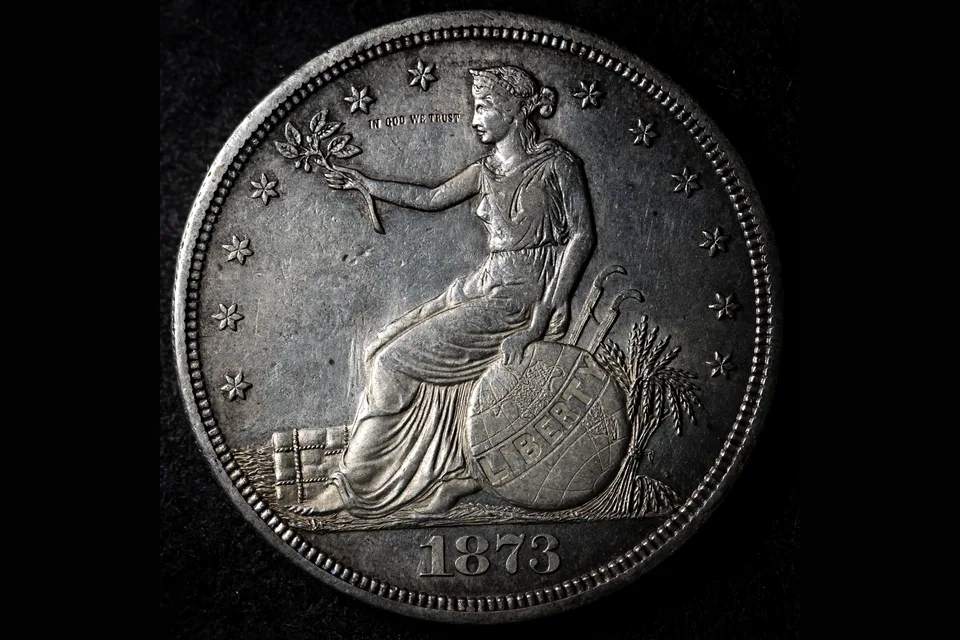
Congress passed the Coinage Act of February 12, 1873, with one market in mind: China. Mexican 8 reales pieces dominated Asian trade, and American merchants needed a silver dollar Chinese traders would accept on sight. The answer was a coin struck heavier than the standard silver dollar — 420 grains total weight (27.22 grams), 90 percent silver and 10 percent copper, holding 378 grains of pure silver (0.7874 troy ounces). Barber's Seated Liberty obverse shows Liberty on a globe, olive branch in hand, shield inscribed LIBERTY at her side, IN GOD WE TRUST above.
The reverse carries the eagle with outstretched wings, UNITED STATES OF AMERICA above and TRADE DOLLAR below, with 420 GRAINS. 900 FINE. stamped right on the coin — the weight and fineness printed where a Chinese merchant could read them.
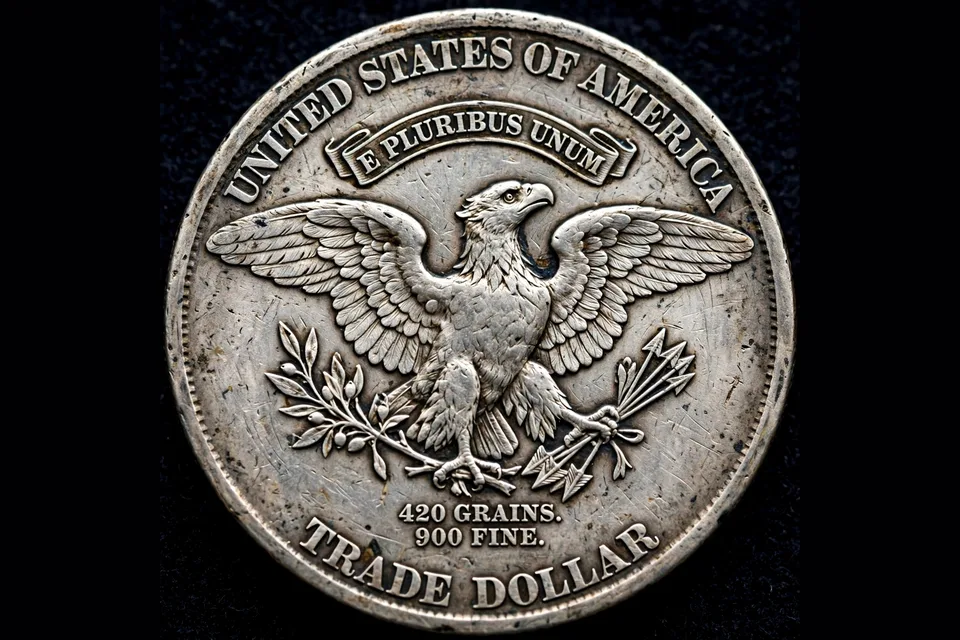
The plan worked too well. The coin was legal tender up to five dollars, and when silver prices fell, Trade dollars flooded back home at a profit. Congress revoked the legal-tender status on July 22, 1876, business strikes ended in 1878, and proofs continued alone through 1885. In 1887 Congress authorised redemption at face value, and about 7.7 million were turned in and melted — of about 35.9 million business strikes, only a fraction survives in collectible condition.
Type I or Type II: the two details that split the series
In 1876 Barber redesigned the Trade dollar's hubs, splitting the series into two types collectors still check with a loupe. On the obverse, Type I shows three fingers on Liberty's outstretched right hand and LIBERTY ribbon ends pointing left; Type II shows four fingers and ribbon ends pointing down. On the reverse, a Type I eagle carries a small berry under the claw holding the olive branch; on Type II the berry is gone.
Every 1873 and 1874 Trade dollar is Type I on both sides; 1875 and 1876 mix the types, and all coins from 1877 onward are Type II on both sides. The 1876-CC is the variety hunter's date — Type I/I and Type I/II, plus a scarce Doubled Die Reverse. In high grade the pairing can be worth thousands, so the check takes ten seconds and a 10x loupe: count the fingers, find the berry.
Chopmarks: the stamps that tell the coin's story
A chopmark is a small Chinese character punched into a Trade dollar by a merchant in China, a stamp that said the coin's silver had been tested and trusted. A single coin could collect a dozen marks as it crossed Asia. No other United States series wears its working history on its face.
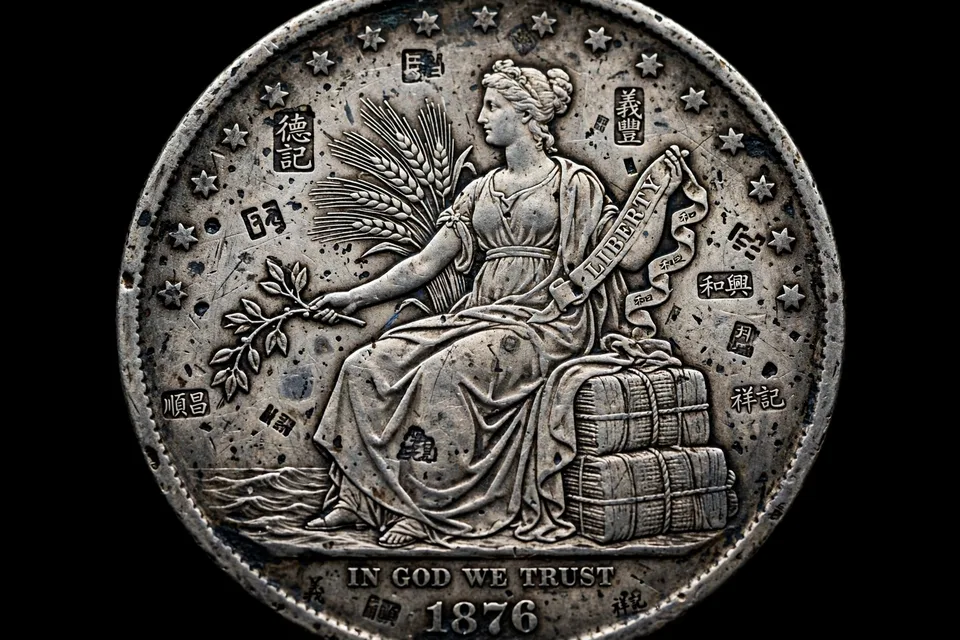
Chopmarks usually cost value: a chopmarked coin trades roughly 10 to 30 percent below an unmarked coin in the same grade, and a heavily chopped common date loses more. The rule bends on the rare dates — an 1878-CC or 1873-CC with chopmarks still commands most of its value, because the date carries the price.
Chopmarks also help against fakes: a convincing chopmark is hard to forge, and most counterfeits arrive unmarked and underweight. Check the weight first — 27.22 grams — and treat a chopmark as supporting evidence, never proof on its own.
The key dates: 1878-CC, 1873-CC, and the proof-only years
The 1878-CC is the key date of the business strikes: only 97,000 were struck at Carson City, the lowest mintage of the series. It is worth $980+ worn, $1,930+ in Fine, $7,360+ in Extremely Fine, and $19,300+ in mint state, the finest reaching $322,000+.
The 1873-CC runs second: 124,500 struck in the first year at Carson City, worth $640+ worn and up to $170,200+ in top grade. The 1875 Philadelphia issue (218,900 struck) and the 1875-S/CC overmintmark — an S punched over a CC — complete the list. The 1875-S/CC is worth $330+ worn and $5,500+ in mint state.
The proof-only years are where the series turns legendary. From 1879 through 1883 the Mint struck only proofs, 960 to 1,987 a year, worth $2,600+ to $92,000+ by grade. Then come the two coins every collector knows by heart: the 1884, with ten known, and the 1885, with five. Both were struck quietly at Philadelphia, never recorded in Mint reports, and not publicly known until years later. The 1884 runs $350,000+ to $1,500,000+; the 1885 holds the series record at $5,300,000+.
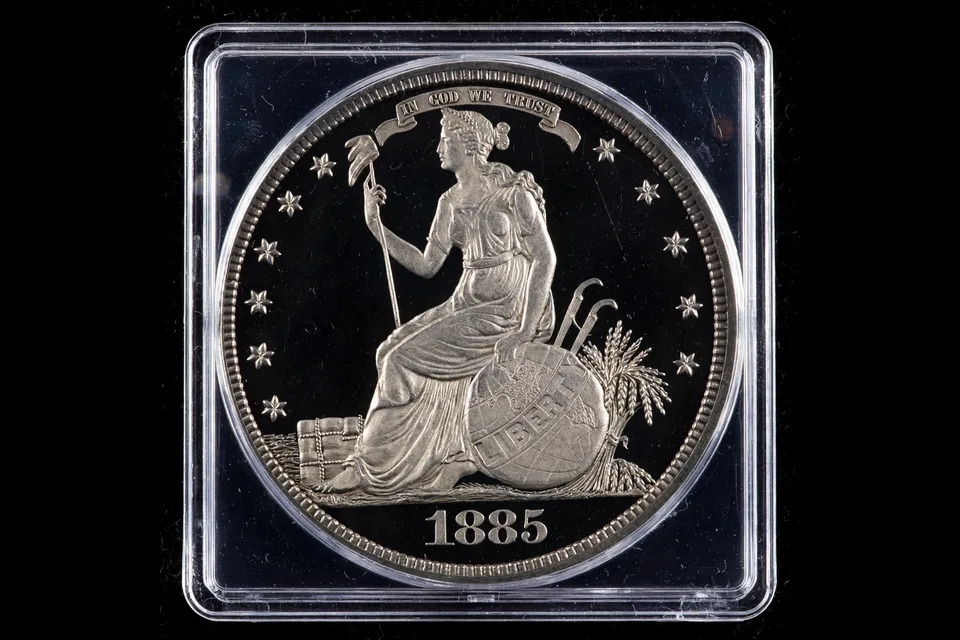
That record is why November 17 matters. The Alabama Family 1885, PCGS Proof-63+ with CAC approval, leads Stack's Bowers' Rarities Night alongside a 1794 Flowing Hair dollar (NGC MS-62+) and a 1792 half disme (NGC MS-65). The house expects mid-six-figure and seven-figure prices, and whatever the 1885 brings resets the ceiling for the whole series.
How to check your Trade dollar in five minutes
Start with the numbers that catch most fakes. A genuine Trade dollar weighs 27.22 grams, measures 38.1 millimetres across, with a reeded edge. A coin that is a gram light or heavy is wrong, whatever the date says. Silver is not magnetic, so a magnet that sticks is an instant fail, and a genuine silver dollar rings with a clear high ping when tapped — a dull thud means a base-metal core.
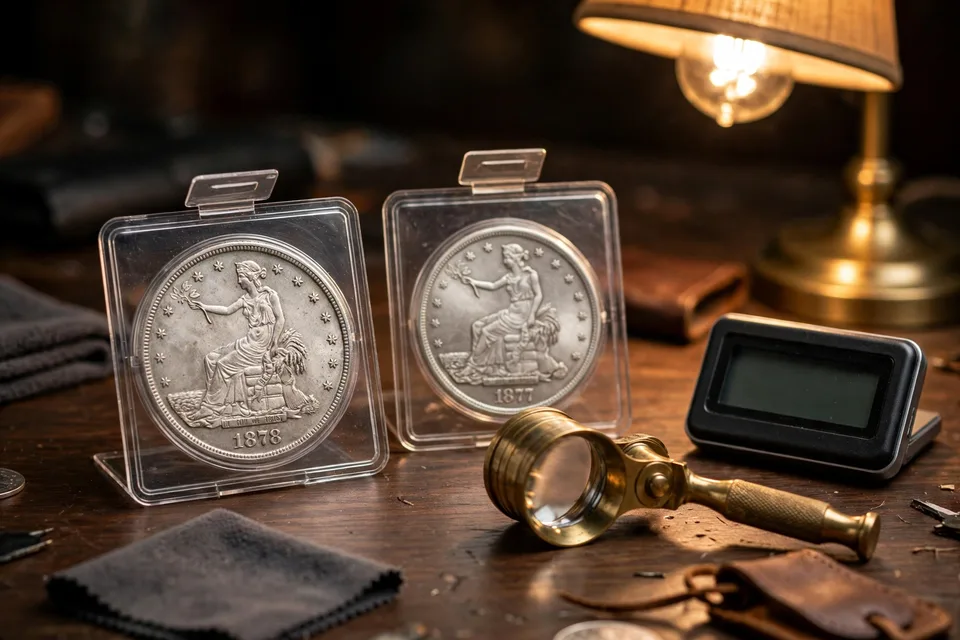
Then read the coin with a 10x loupe. Check the date and mint mark against the key-date list, count Liberty's fingers and look for the berry to fix the Type I or Type II pairing, and read chopmarks for what they are — merchant stamps, not damage. Genuine wear is smooth and even; cast fakes show a grainy texture and soft, mushy lettering.
Trade dollars are among the most counterfeited United States coins, and the fakes concentrate where the money is: the 1878-CC, the 1873-CC, and the proof-only dates. Never buy a raw key date without certification, and get any coin worth four figures or more authenticated before you spend or sell. A $30+ authentication fee is cheap insurance against a $980+ mistake.
Frequently Asked Questions
How much is a Trade dollar worth?
Most are $200+ to $500+ circulated and $1,000+ to $2,000+ uncirculated. The 1878-CC is $980+ worn and up to $322,000+ in top grade; the proof-only 1884 runs $350,000+ to $1,500,000+ and the 1885 holds the series record at $5,300,000+.
Are Trade dollars made of real silver?
Yes. A Trade dollar is 90 percent silver and 10 percent copper, weighs 27.22 grams, and holds 0.7874 troy ounces of pure silver. With silver near $52 an ounce, the melt alone is about $40+.
What is a chopmark on a Trade dollar?
A chopmark is a small Chinese character punched into the coin by a merchant in China to show the silver was tested and trusted. Chopmarked coins usually trade 10 to 30 percent below unmarked coins in the same grade, though the discount shrinks on rare dates like the 1878-CC.
How much is an 1878-CC Trade dollar worth?
An 1878-CC is worth $980+ in Good, $1,930+ in Fine, $7,360+ in Extremely Fine, and $19,300+ in mint state, with the finest reaching $322,000+. Only 97,000 were struck, the lowest business-strike mintage of the series.
How much is an 1885 Trade dollar worth?
An 1885 Trade dollar is worth $1,100,000+ and up, with the series record at $5,300,000+. Only five are known, all proofs struck quietly at Philadelphia, never recorded in Mint reports. One of the five — PCGS Proof-63+ with CAC approval — headlines Stack's Bowers' Rarities Night on November 17, 2026.
How do I know if my Trade dollar is real?
Check the weight first: a genuine Trade dollar weighs 27.22 grams, measures 38.1 millimetres, and silver is not magnetic. Then examine the date, mint mark, and surfaces under a 10x loupe — genuine wear is smooth, while cast fakes look grainy with soft lettering. Get any key date authenticated.
A Trade dollar costs nothing to check, and the difference between a $200+ common date and a $5,300,000+ 1885 is one careful look at the date and the mint mark. Before you spend or sell any coin you are unsure about, run it through The Diggin Dave's free Coin Value Checker to confirm its value range, and try Grade-or-Not for a grade verdict on your best examples. A 10x loupe, 38mm coin capsules, and a Trade dollar reference book are the only tools the checks in this guide need.
As an Amazon Associate, this site may earn from qualifying purchases.
Further Reading on Trade Dollars
- 1921 Morgan Dollar Value: $40 to $240,000+ — the most collected silver dollar, with most 1921 Morgans worth $40+ in silver and rare proofs at $240,000+
- Peace Dollar Values: Silver Prices and Key Dates — common Peace dollars start at $38+ in silver value, while the 1928 key date tops $129,250+
- How Much Is a Susan B. Anthony Dollar Worth? — most are worth $1+ to $2+, but the 1979-P Wide Rim reaches $7,000+ and top examples $12,250+