How Much Is a Susan B. Anthony Dollar Worth?
Dollars · 10 min read · Published November 6, 2026 · Updated November 6, 2026
A Susan B. Anthony dollar is worth $1+ to $2+ in circulated condition, $2+ to $5+ uncirculated, and up to $12,250+ for the finest certified examples. The coin to look for is the 1979-P Wide Rim, worth $25+ uncirculated and up to $7,000+ in top grades, while the scarce 1981-S and the Type 2 proofs add two more four-figure chases. Most of the 888 million struck are worth face value — the money sits in the varieties, the proofs, and the grade.
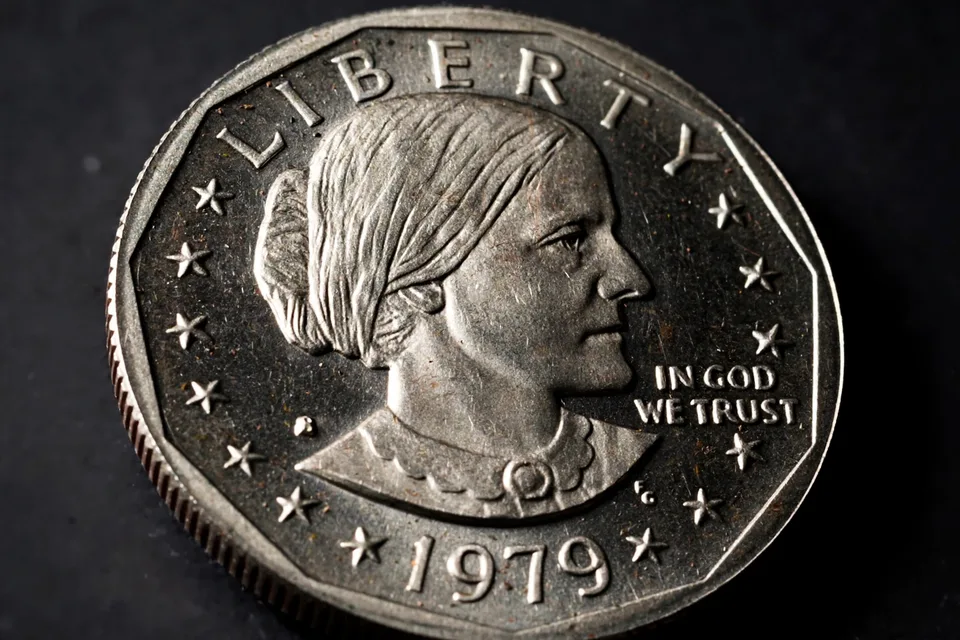
The Anthony dollar was the first circulating United States coin to honour a real woman, and one of the Mint's biggest public failures. Struck from 1979 to 1981 and once more in 1999, it was too close in size to the quarter. Hundreds of millions were struck, most were saved rather than spent, and the rare ones hide among the common ones.
Susan B. Anthony dollar value at a glance
Most are worth $1+ to $5+; the value sits in a handful of dates and varieties.
| Date and variety | Circulated | MS-63 | Top grade |
|---|---|---|---|
| 1979-P Narrow Rim | $1+ | $2+ | $9,200+ |
| 1979-P Wide Rim | $5+ | $25+ | $7,000+ |
| 1979-D | $1+ | $2+ | $12,250+ |
| 1979-S | $1+ | $3+ | $4,460+ |
| 1980-P, 1980-D, 1980-S | $1+ | $2+ | $1,500+ |
| 1981-P, 1981-D | $2+ | $5+ | $1,100+ |
| 1981-S | $5+ | $40+ | $5,520+ |
| 1999-P, 1999-D | $1+ | $4+ | $1,790+ |
Two things drive every number in that table: the variety and the grade. A common 1979-P is a $1+ coin; the same date with the Wide Rim variety is $25+ uncirculated. At the top end, certified MS-68 examples set the records: $12,250+ for a 1979-D and $9,200+ for a 1979-P.
The dollar that looked too much like a quarter
Congress authorised the dollar in 1978, and the Mint released it in 1979. Susan B. Anthony (1820–1906) was the natural choice: the suffrage leader arrested in 1872 for voting, whose campaign helped lead to the Nineteenth Amendment in 1920. No real woman had ever appeared on a circulating United States coin before.
Chief Engraver Frank Gasparro designed both sides. The obverse carries Anthony's portrait inside an eleven-sided inner border, with LIBERTY above and the date below; the 1979-P was the first circulating United States coin to carry the P mint mark. The reverse shows an eagle landing on the Moon, adapted from the Apollo 11 mission insignia, with ONE DOLLAR beneath it.
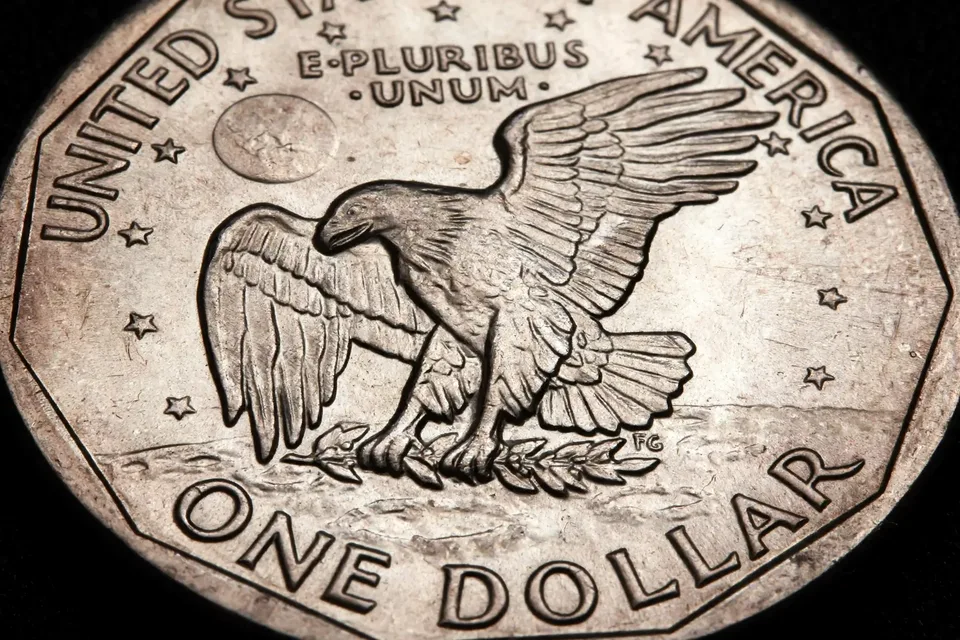
The coin failed for a simple reason: at 26.5 millimetres across it was barely larger than a 24.26-millimetre quarter, and in a pocket or a till the two were easy to confuse. Vending machines rejected it and the public never adopted it. The Mint struck 360,222,000 at Philadelphia in 1979 alone, yet almost none circulated. Production stopped after 1981 — the 1981 coins were sold only in mint sets — and the dollar returned only in 1999, while the Sacagawea dollar was being prepared.
A genuine Anthony dollar weighs 8.1 grams and has a reeded edge. The composition is copper-nickel clad — outer layers of 75 percent copper and 25 percent nickel bonded to a pure copper core — so it contains no silver or gold and carries no melt premium above face value.
The 1979-P Wide Rim: the variety worth real money
The Wide Rim — also called the Near Date — turns a $1+ coin into a $25+ coin, and in top grades into a $7,000+ coin. On a normal 1979-P the date sits well clear of the rim; on the Wide Rim the rim is thicker and the date sits almost touching it. It comes from a different obverse die, and appears only on 1979-P coins.
Spotting one takes ten seconds. Hold the coin flat and look at the gap between the 9 in 1979 and the rim: on the Narrow Rim there is a clear band of field between the date and the rim, while on the Wide Rim the date crowds the rim and the rim itself looks noticeably thicker. A 10x loupe makes the call certain. Wear does not change the call — a worn Narrow Rim still shows the wide gap.
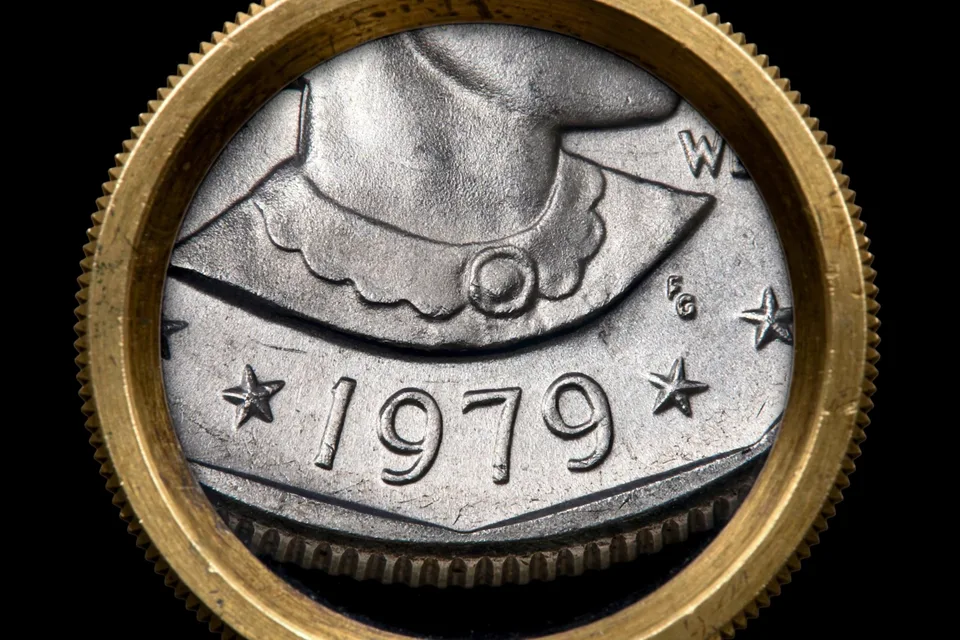
Values follow the grade closely. A circulated Wide Rim is $5+ to $25+, an uncirculated example is $25+ to $200+, and the auction record stands at $6,995 for an MS67+ example. A Narrow Rim in the same grades is $1+ to $5+.
Type 1 vs Type 2 proofs: the Clear S
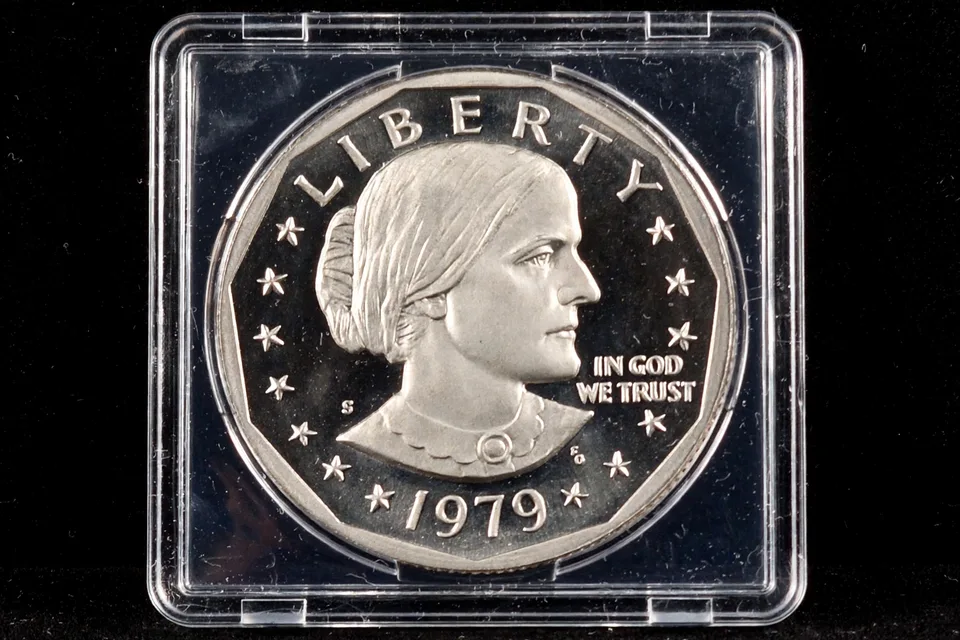
The proof story comes down to one letter. Proofs were struck at San Francisco in 1979, 1980, 1981, and 1999. On the 1979-S and 1981-S proofs, the S mint mark comes in two forms: Type 1, a filled, blobby S, and Type 2, a sharp, clear S. The Clear S is scarce, and collectors pay roughly six times more for it.
A 1979-S Type 1 proof is $2+ to $50+, while a 1979-S Type 2 proof is $15+ to $120+, with a PR70 record of $1,955. The 1981-S Type 2 is scarcer still, at $50+ to $200+. About 3.7 million 1979-S proofs were struck; only a small fraction carry the clear S, so check every proof set you own under a 10x loupe.
The scarce 1981 coins and the 1999 revival
The 1981 coins are the sleepers of the series. Only 3,000,000 were struck at Philadelphia, 3,250,000 at Denver, and 3,492,000 at San Francisco, and none was released for circulation. That makes a 1981-S $40+ in MS64 and $600+ in MS66, with a top price of $5,520+. The 1981-P and 1981-D are cheaper, at $2+ to $5+ circulated and up to $1,100+ at the top, but they remain the scarcest circulation strikes by mintage.
The 1999 revival is the opposite story: a big mintage with a small premium. The Treasury struck 29,592,000 at Philadelphia and 11,776,000 at Denver in 1999, to keep dollar coins available while the Sacagawea dollar was prepared for 2000. A circulated 1999 is $1+ to $2+, an uncirculated example is $4+ to $5+, and the top certified examples reach $1,790+ for the 1999-P. The 1999 coins are common, but they are the last Anthony dollars ever struck.
Susan B. Anthony dollar errors worth money
Errors are the third way an Anthony dollar gains value, and the most spectacular is the 1999 struck on a Sacagawea planchet. A small number of 1999 dollars were struck on the golden-coloured manganese-brass planchets prepared for the Sacagawea dollar, and one sold for $7,700+. If your 1999 dollar is golden instead of silvery-white, get it authenticated — it may be one of the rarest modern errors.
Other errors include off-centre strikes, double-struck coins, and the 1979 "blob" error, where a die break left a raised blob — one sold for $2,299. Wrong-planchet errors and dramatic off-centres command the strongest premiums, while minor strike-throughs and small die cracks add little.
How to check your Susan B. Anthony dollar in five minutes
Start with the date and the mint mark. Read the date, then find the small P, D, or S on the obverse to the left of the portrait. A 1979-P goes straight to the Wide Rim check: is the date close to the rim? A 1981 is a mint-set coin — look closely at the grade. A 1999 goes to the colour check: golden is an error.
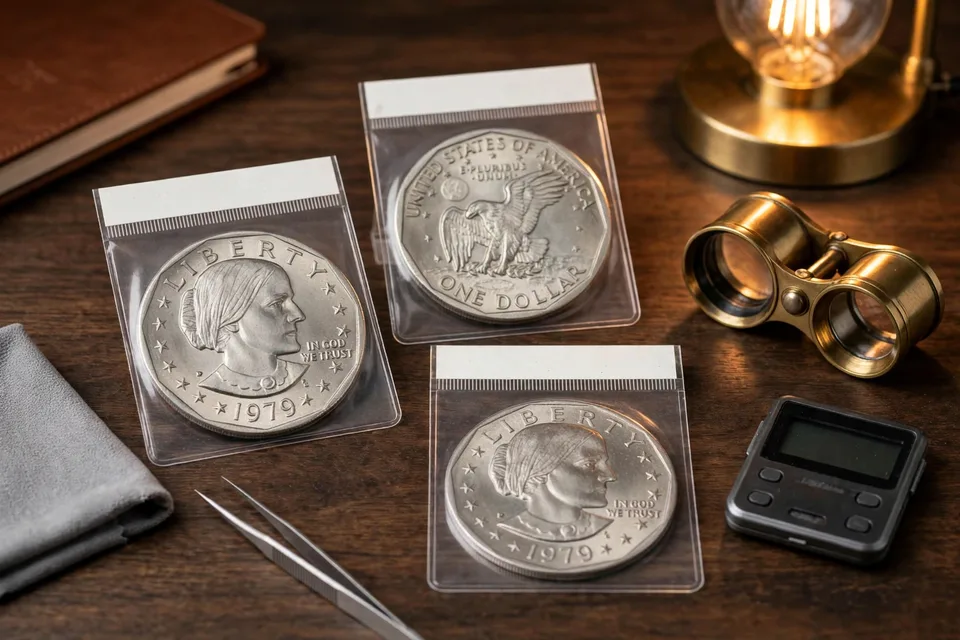
Then check the grade. Look for unbroken mint lustre, sharp detail in Anthony's hair, and a clean cheek. A circulated coin shows flatness first on the highest points — the hair above the ear and the eagle's breast. Weigh the coin if anything feels wrong: a genuine Anthony dollar is 8.1 grams. Keep any coin you suspect is valuable in a holder, handle it by the edges, and never clean it.
Frequently Asked Questions
How much is a Susan B. Anthony dollar worth?
Most are worth $1+ to $2+ circulated and $2+ to $5+ uncirculated. The exceptions: the 1979-P Wide Rim at $25+ uncirculated, the 1981-S at $40+ in MS64, the Type 2 proofs at $50+ to $200+, and the finest certified examples at $12,250+.
What is a 1979-P Wide Rim Susan B. Anthony dollar worth?
A 1979-P Wide Rim is worth $5+ to $25+ circulated, $25+ to $200+ uncirculated, and up to $7,000+ in top grades (record $6,995 for an MS67+ example). Look for the date close to the thick rim; the Narrow Rim has a clear gap.
Are Susan B. Anthony dollars silver?
No. They are copper-nickel clad, with outer layers of 75 percent copper and 25 percent nickel bonded to a pure copper core. They contain no silver or gold, so there is no melt premium.
How do I tell a Wide Rim from a Narrow Rim?
Look at the gap between the date and the rim on a 1979-P dollar. On the Wide Rim, also called the Near Date, the date sits almost touching a noticeably thicker rim. On the Narrow Rim, or Far Date, there is a clear band of field between the date and the rim. A 10x loupe makes the call certain.
What is a Type 2 Susan B. Anthony proof?
A Type 2 proof carries a sharp, clear S mint mark, as opposed to the filled, blobby S of the Type 1. Type 2 proofs exist for the 1979-S and 1981-S and are worth roughly six times the Type 1: $15+ to $120+ for the 1979-S and $50+ to $200+ for the 1981-S.
Are 1999 Susan B. Anthony dollars worth anything?
A normal 1999 dollar is worth $1+ to $2+ circulated and $4+ to $5+ uncirculated, with top examples reaching $1,790+. The exception is the rare 1999 struck on a golden Sacagawea planchet, which sold for $7,700+ — check the colour before spending one.
A Susan B. Anthony dollar costs nothing to check, and the difference between a $1+ coin and a $7,000+ Wide Rim is one careful look at the date. Before you spend or sell any coin you are unsure about, run it through The Diggin Dave's free Coin Value Checker to confirm its value range, and try Grade-or-Not for a grade verdict on your best examples. A 10x loupe, dollar coin capsules, and a coin album are the only tools the checks in this guide need.
As an Amazon Associate, this site may earn from qualifying purchases.
Further Reading on Susan B. Anthony Dollars
- Which Eisenhower Dollars Are Worth $21,600+? — the big dollar that came before the Anthony dollar, with silver issues at $12+ and the 1972 Type 2 topping $10,500
- Peace Dollar Values: Silver Prices and Key Dates — the classic silver dollar, from $38+ in silver value to the 1928 key date at $129,250+
- Gold Dollar Coin Values by Type and Date — the small gold dollar, from $450+ for common dates to key dates at $180,000–$690,000+