Blank Planchet Coins: Type 1 vs Type 2 & Values
Coin errors · 10 min read · Published November 5, 2026 · Updated November 5, 2026
A blank planchet coin is a metal disc that never received a design: both faces are smooth, with no portrait, no eagle, no date, and no lettering on either face. To identify one, check four things in order: the rim, the edge, the weight, and the diameter. A genuine blank has either no raised rim at all (a Type 1 blank) or a smooth raised rim on both faces (a Type 2 planchet), a plain edge with no reeding, and the exact weight and diameter of the coin it was meant to become.
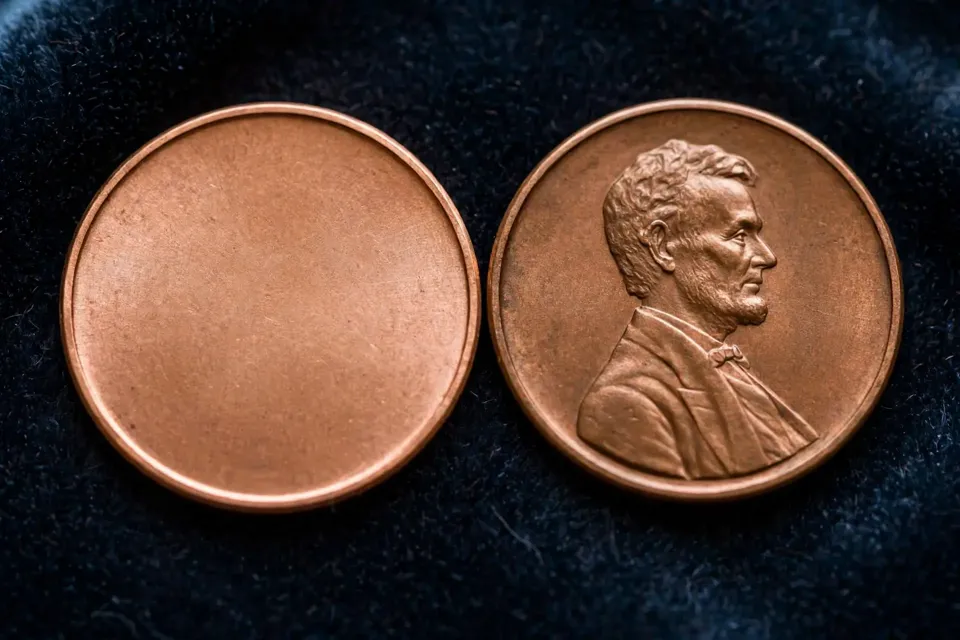
A coin ground flat in a workshop, an arcade token, a washer, and a genuinely unstruck Mint planchet can all look identical in a blurry photograph. The difference is worth real money: a penny blank trades for $1+ to $2+, while a lettered-edge dollar blank can reach $40+ to $500+.
How a blank becomes a coin
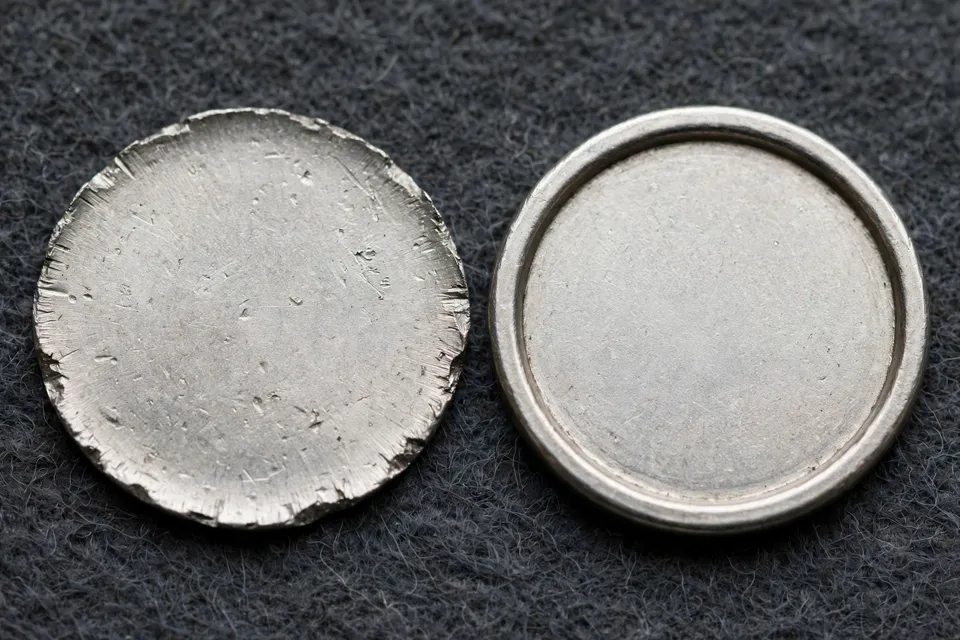
Every United States coin starts as a flat metal disc. A blanking press punches discs out of a long coil of coin metal. The freshly punched disc is called a blank, and its edge carries a cut-and-tear texture: smooth where the punch sheared through, rougher where the metal tore away. The blank is then softened, washed, and dried, and passed through the upset mill, which squeezes its edge and raises a low rim around both faces. That rimmed disc is properly called a planchet, ready for the press.
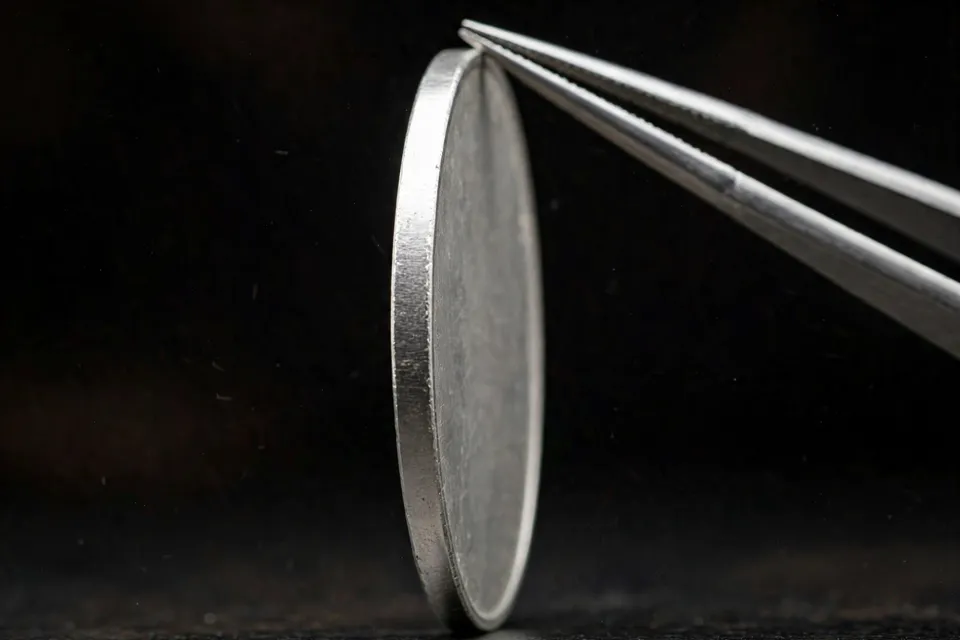
Finally, the planchet goes into the press, where the dies strike the design and, on reeded coins, the collar forms the reeded edge at the same instant. That is the most useful fact in this guide. Reeding is created during the strike, by the collar surrounding the planchet. A disc that was never struck therefore cannot carry reeding. If your blank-looking disc has a reeded edge, it was struck and then altered afterward.
Type 1 blank vs Type 2 planchet
Collectors use two labels for unstruck discs, depending on how far the disc got before it escaped. A Type 1 blank is the freshly punched disc: no upset rim, faces running flat all the way to the edge, and an edge still showing the cut-and-tear texture. A Type 2 planchet has passed through the upset mill: a smooth, raised rim around both faces, a smoother edge, and a diameter matching the finished coin. Both are genuine unstruck pieces, and the Type 2 planchet is the more recognizable form.
| Disc stage | Rim | Edge | Diameter |
|---|---|---|---|
| Type 1 blank | None — faces run flat to the edge | Cut-and-tear texture from the punch | Slightly larger than the finished coin |
| Type 2 planchet | Smooth raised rim on both faces | Smoother and more even after upsetting | Matches the finished coin |
How to identify a blank planchet coin in 5 steps
First, examine both faces under a good light and a 10x loupe, tilting the disc so light rakes across each surface. A genuine blank shows no design at all: no ghost of a portrait, no faint lettering, no trace of a date. Surface marks are normal, but any surviving design detail, however faint, means the piece was struck and then worn, damaged, or obscured.
Second, run your eyes around the full rim and the whole edge, turning the disc slowly so you see its entire circumference. Note whether a raised rim appears on both faces, on one face only, or on neither. A rim on one face only, or a rim that stops and starts, is a warning sign of alteration or of a different error entirely.
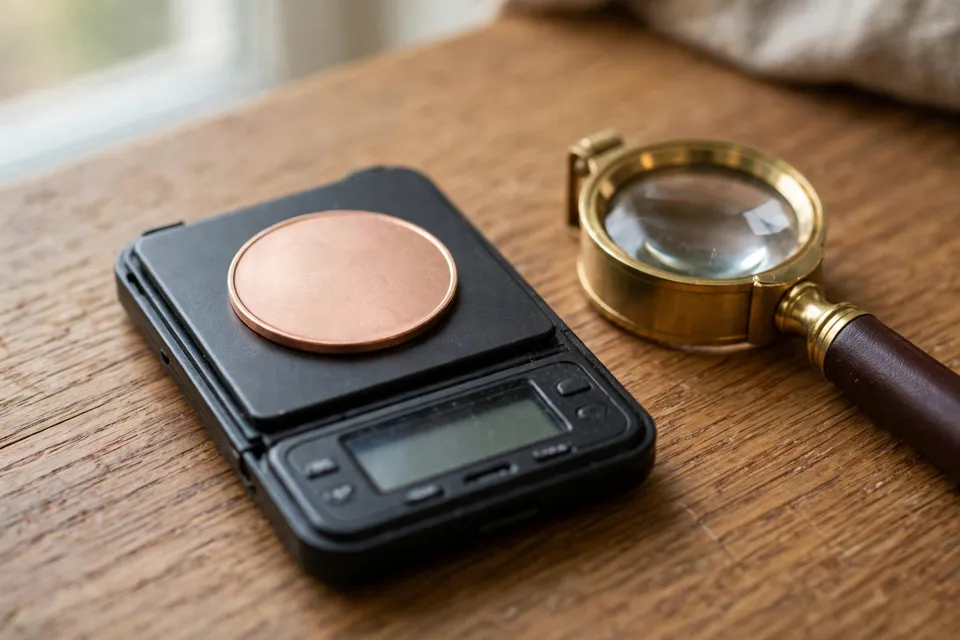
Third, weigh the disc on a pocket scale that reads to 0.01 grams, and measure its diameter with calipers. A disc weighing 5.67 grams and measuring 24.26 millimeters was meant to be a quarter. A disc weighing 2.50 grams and measuring 19.05 millimeters was meant to be a zinc cent. A disc matching no denomination in the table below is a foreign blank, a token, or a fake.
Fourth, check the edge for reeding and for lettering. A genuine blank planchet for a reeded denomination has a plain edge: no grooves, no ridges, no hint of reeding anywhere around the circumference. If you find reeding, the piece was struck and then ground flat, and the identification stops there. The one exception is a dollar blank with edge lettering, genuine because dollar edge lettering is applied in a separate step after striking.
Fifth, check the color and metal against the denomination the weight points to. A copper-colored blank at 3.11 grams fits a pre-1982 copper cent planchet. A copper-colored blank at 2.50 grams fits a post-1982 zinc cent planchet with its copper plating. A gray, layered edge showing a copper core between silvery outer layers points to a clad planchet. A solid gray disc at quarter weight showing no clad layering may be a silver planchet from an older composition, or a foreign blank, and that is when a specialist's opinion becomes worth paying for.
Blank planchet weight and diameter table
Use this table as the matching key for the third step. Weights are the standard specifications for the finished coins; a genuine Type 2 planchet matches them, while a Type 1 blank may measure a fraction wider because the upset mill has not yet squeezed it to size.
| Intended coin | Weight | Diameter |
|---|---|---|
| Cent, zinc (1982 to present) | 2.50 grams | 19.05 millimeters |
| Cent, copper (before 1982) | 3.11 grams | 19.05 millimeters |
| Nickel | 5.00 grams | 21.21 millimeters |
| Dime, clad | 2.27 grams | 17.91 millimeters |
| Quarter, clad | 5.67 grams | 24.26 millimeters |
| Half dollar, clad | 11.34 grams | 30.61 millimeters |
| Small dollar | 8.10 grams | 26.50 millimeters |
| Eisenhower dollar, clad | 22.68 grams | 38.10 millimeters |
Two weights cause the most confusion. A zinc cent planchet and a copper cent planchet share the same diameter but differ by 0.61 grams, so the scale, not the eye, tells them apart.
What is a blank planchet worth
Blank planchet values are driven by size, metal, and how far the disc got through production. Penny blanks are the most common blank planchets in the hobby because the Mint has long distributed blank cent planchets at no charge to young collectors earning the Coin Collecting Merit Badge, so thousands of genuine penny blanks entered the hobby legitimately.
| Blank planchet | Typical value |
|---|---|
| Penny (cent) blank | $1+ to $2+ |
| Clad or nickel blank | $2+ to $8+ |
| Small dollar planchet (Sacagawea, Presidential, Native American) | $12+ to $15+ |
| Eisenhower dollar blank | $20+ to $30+ |
| Authenticated blank with no raised rim | $50+ |
| Lettered-edge dollar blank (the faceless dollar) | $40+ to $500+ |
The lettered-edge dollar blank, nicknamed the faceless dollar, breaks the plain-edge rule in a legitimate way. In 2007 and 2008, some Presidential and Native American dollar blanks bypassed the main coining press and went directly to the edge-lettering machine, which stamped the edge inscriptions onto a disc that had never received an obverse or reverse design.
Blank planchet vs lookalikes
Most blank-looking discs collectors bring to dealers are not blank planchets, and each lookalike has a tell. A ground or polished coin is the most common fake: someone files or polishes the design off a struck coin, leaving smooth faces. The tell is the edge — the ground coin keeps the reeding the strike gave it — plus tool marks, an unnaturally shiny surface, and a weight that runs light because metal was removed. A genuine blank has a plain edge, a natural Mint surface, and full weight.
A die adjustment strike is a genuine Mint product rather than a fake. When press operators test whether the dies are set too far apart, the strike lands so weakly that only a faint, blurry ghost of the design appears. These trade for $20+ to $40+ depending on denomination and how much design shows.
What to Do With a Suspect Blank Planchet
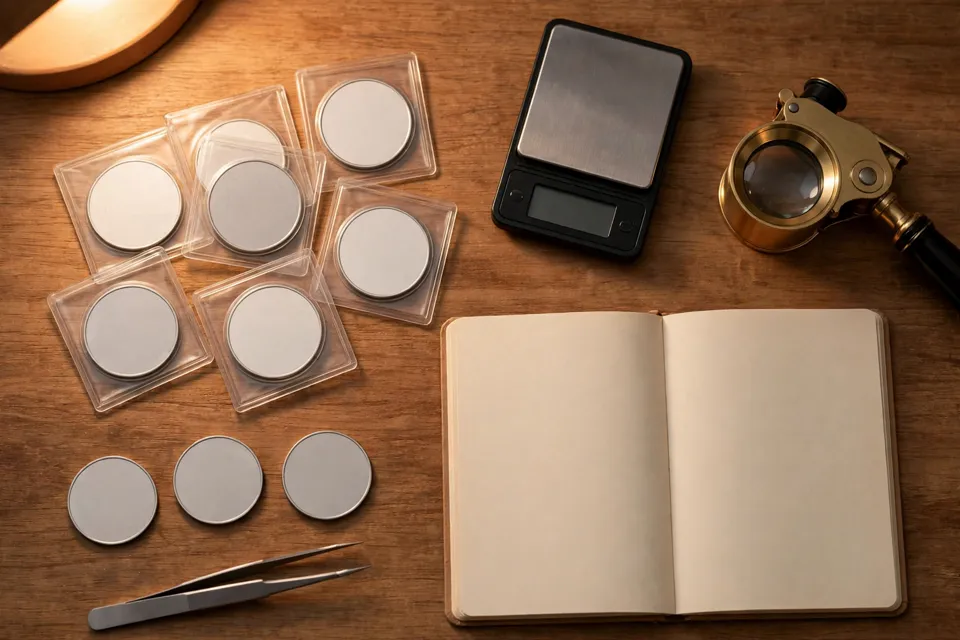
If your disc passes all five checks, handle it by the edges, slip it into an acid-free flip, and write down its weight, diameter, and what the edge looks like while the details are fresh. That note costs nothing and it is the first thing any dealer will ask about. Do not clean it, polish it, or try to improve its surface: cleaning destroys the natural Mint surface authenticators look for, and a cleaned blank is worth less than a dull genuine one.
Questions About Your Blank Planchet
Is a blank planchet coin a real mint error?
Collectors file blank planchets under mint errors, but strictly they are unfinished coins rather than mis-struck ones. A doubled die or an off-center strike was struck wrong, while a blank planchet escaped the Mint before the dies ever touched it.
How much is a blank penny worth?
A genuine penny blank typically trades for $1+ to $2+. Penny blanks are the most common blank planchets because the Mint has long distributed blank cent planchets to young collectors earning the Coin Collecting Merit Badge.
Can a blank planchet have a reeded edge?
No, with one famous exception. Reeding is formed by the collar during the strike, so a disc that was never struck cannot carry reeding. A blank-looking disc with a reeded edge is a struck coin ground or polished flat afterward.
How do I tell a blank planchet from a coin someone ground flat?
Check the edge, the surface, and the weight. A ground coin keeps the reeding from its strike, shows file or polishing marks under a loupe, and usually weighs light because grinding removed metal. A genuine blank has a plain edge, a natural Mint surface, and the full standard weight for its denomination.
Why are dollar blanks worth more than penny blanks?
Dollar blanks are larger, scarcer in unstruck form, and harder to find outside the Mint's controls, while penny blanks were widely distributed to young collectors. Small dollar planchets typically trade for $12+ to $15+, Eisenhower dollar blanks for $20+ to $30+, and lettered-edge dollar blanks for $40+ to $500+.
Should I get a blank planchet graded?
Get silver blanks, large dollar blanks, lettered-edge dollar blanks, and any suspected gold blank graded, because certification is where much of their value lives. For a common penny or clad blank, grading usually costs more than the piece is worth, so an acid-free flip and a label with its weight and diameter are the right home.
A blank planchet coin costs nothing to check, and the difference between a $1+ penny blank and a $500+ lettered-edge dollar blank is one careful look at the rim, the edge, and the scale. Before you spend or sell any coin you are unsure about, run it through The Diggin Dave's free Error Identifier to confirm the error type, use the Coin Value Checker to confirm its value range, and try Grade-or-Not for a grade verdict on your best examples. A 10x loupe, a pocket digital scale, and a digital caliper are the only tools the five-step checklist needs.
As an Amazon Associate, this site may earn from qualifying purchases.
Further Reading on the Blank Planchet
- How to Identify a Wrong Planchet Coin: Weight, Size & Value Tests — the weight and diameter tests that separate a blank planchet from a coin struck on the wrong denomination's planchet
- How to Identify a Clipped Planchet Coin: Real Clips, Fake Cuts & Values — the clip test for a planchet that was punched wrong before it ever reached the press
- How to Identify a Missing Clad Layer Coin: Copper Faces, Weight Tests & Real Values — the copper-face test for a planchet whose clad layer failed before striking