Missing Clad Layer Coins: Copper Faces & Weight Tests
Coin errors · 10 min read · Published November 4, 2026 · Updated November 4, 2026
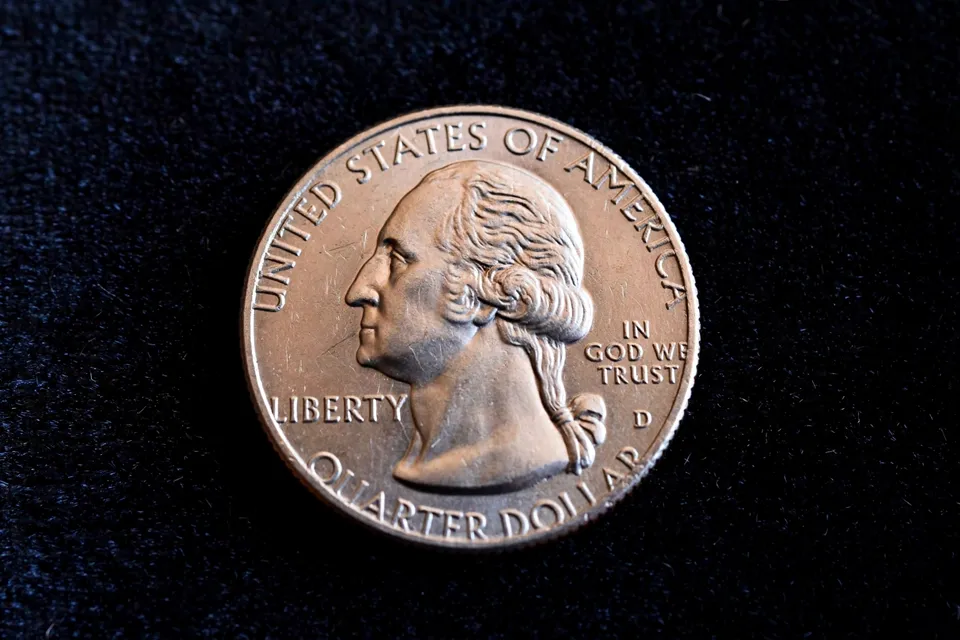
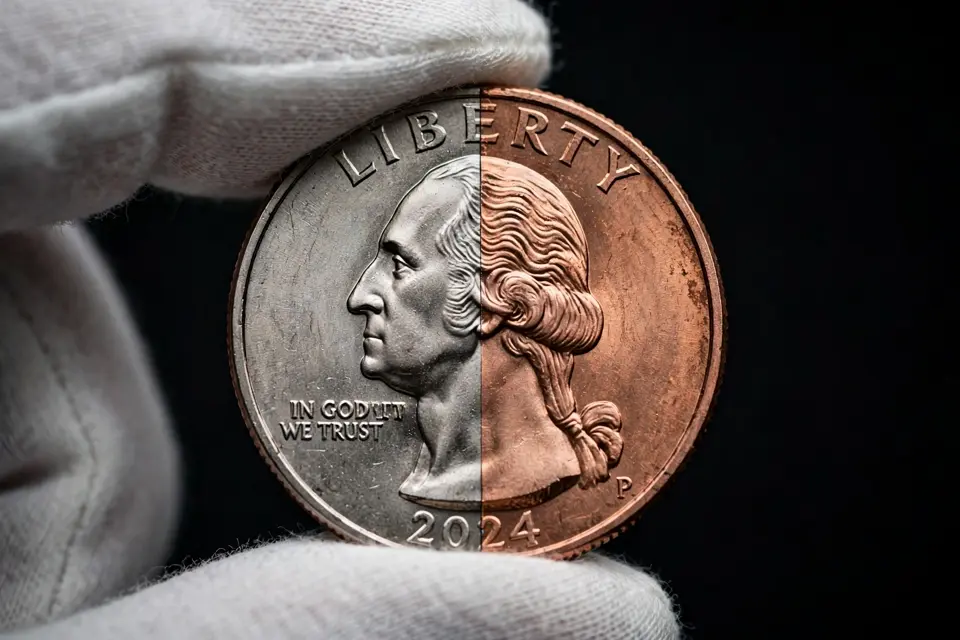
A coin with a missing clad layer is easy to spot once you know the test: one face looks copper-colored instead of silver, the coin weighs about 15% less than normal, and the design on the copper face is still sharp and fully struck. If all three signs are present, you are almost certainly holding a genuine mint error worth $75+ to $5,000+, depending on the denomination and how much of the layer is gone. A brown-looking coin that weighs normally, or one with soft, eaten-away detail, is far more likely toning, environmental damage, or an acid-stripped fake.
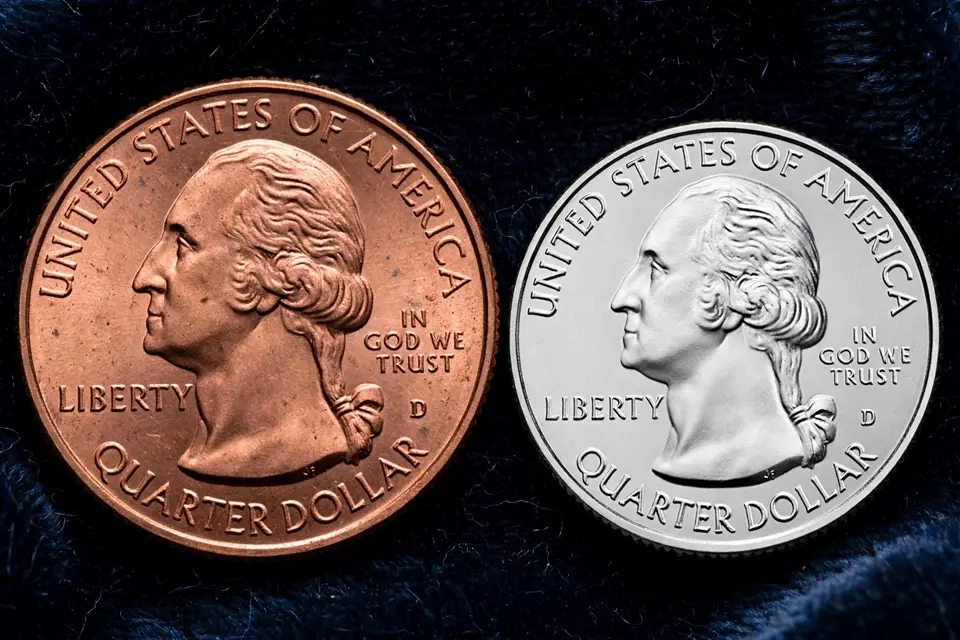
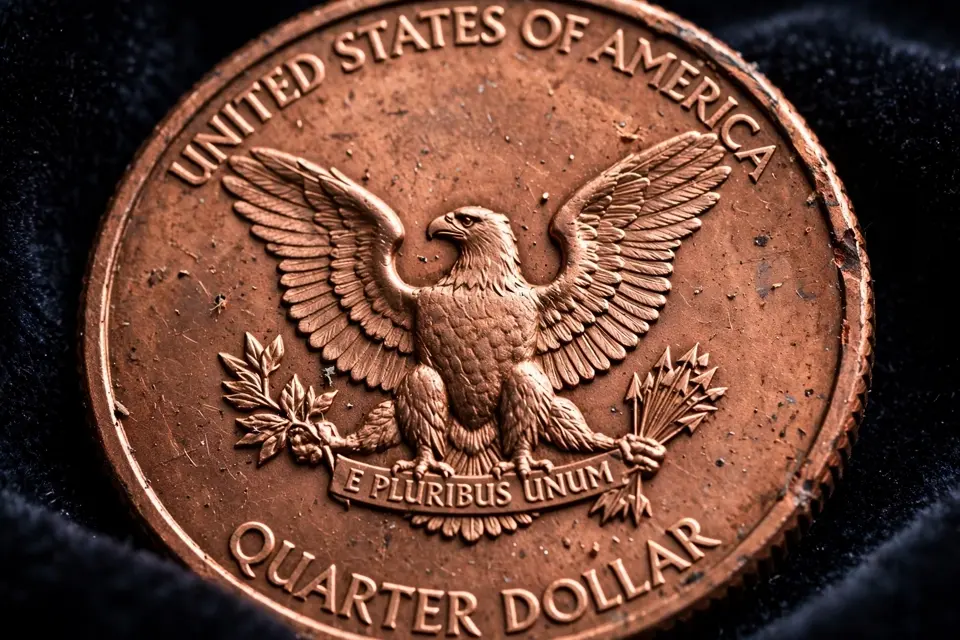
A missing clad layer happens when one of the thin outer skins of a modern clad coin fails to bond to its copper core before striking. The strike itself is completely normal, which is why a genuine example looks like an ordinary coin that simply changed color on one face. That sharp, normal strike is the key clue: every common fake attacks a finished coin after it left the Mint, and post-mint damage always softens the design.
What a clad coin actually is
Clad coinage began with the Coinage Act of 1965, which removed silver from circulating dimes and quarters; half dollars and dollar coins followed in 1971. Every one of these coins is the same sandwich: a pure copper core, visible as the reddish band on a normal quarter's reeded edge, between two outer layers of copper-nickel alloy, 75% copper and 25% nickel. That construction sets a hard limit on which coins can carry the error. Jefferson nickels are struck from a single solid alloy of 75% copper and 25% nickel, with no layers to lose, so a nickel can never have a missing clad layer. A so-called "missing clad nickel" is plated, stained, or damaged, not a mint error.
How a missing clad layer happens
Almost every missing clad layer is a bonding failure: the Mint bonds long strips of metal under immense pressure and heat, then punches planchets from the strip, and if the surfaces were not clean or the pressure was insufficient, the outer layer never fuses to the core. The loose layer usually falls away after blanking but before striking, so the planchet enters the press already missing one skin. A second route produces partial examples: if one outer strip runs short during bonding, the end of the strip exposes raw copper, and blanks punched from that section carry only part of a clad layer. Those coins show a copper patch with a visible step where the remaining silver layer ends.
A rare third route breaks the weight rule entirely: in a rolling-mill error, a section of strip is manufactured with only two layers from the start, then rolled to normal thickness, so a blank punched from it weighs almost normally. A 1976 Bicentennial quarter struck this way weighs 5.39 grams, only 0.28 grams below normal, and a 2005-P West Virginia quarter weighs 5.57 grams. Normal weight therefore does not rule out a missing clad layer, but such a coin needs expert authentication before anyone pays an error premium for it.
Identify It in 5 Steps
First, check the color on both faces: a genuine example shows a copper-colored face, bright coppery orange when fresh or dark reddish brown when circulated, while the other face stays silver-gray. Second, look for the step: where a partial layer ends, the exposed copper core sits slightly lower than the surviving silver layer, a tiny ledge visible with a loupe and raking light. Toning never produces a step. Third, weigh the coin three times on a scale accurate to 0.01 grams. A quarter missing one clad layer drops from the normal 5.67 grams to about 4.67 grams, because one quarter clad layer weighs roughly one gram; a documented 1977 Washington quarter with its obverse layer missing weighed 4.70 grams. A dime falls from 2.27 grams to about 1.90 grams.
Fourth, check the edge and reeding: a genuine example keeps full, sharp reeding, with the copper core exposed across the whole affected face. Fifth, judge the design: on a real missing clad layer, every letter and date digit on the copper face is struck with full sharpness. Acid stripping eats the surface unevenly and leaves soft, mushy detail and pitting.
Full, partial, and dual missing clad layers
Collectors describe missing clad layers by how much of the outer layer is gone and which face is affected. A full missing clad layer means the entire face is copper, described as obverse missing clad or reverse missing clad. A partial keeps some silver on the affected face, described by percentage: a coin with half its reverse layer gone is a 50% missing reverse clad. Partials are actually scarcer than full examples, because a layer usually either bonds or it does not, yet they generally sell for less, because collectors prefer the dramatic look of a full copper face. The rarest form is the dual missing clad layer, where both outer layers separate and the coin shows copper on both faces: fewer than 10 dual examples are known for Roosevelt dimes, only five to 10 for Washington quarters, a single example for Kennedy half dollars, and none at all for dollar coins.
| Type | What you see | Weight change |
|---|---|---|
| Full missing clad layer | One entire face copper, other face silver | About 15% light |
| Partial missing clad layer | Copper patch with a step at the silver boundary | Less than 15% light |
| Dual missing clad layer | Copper on both faces | About 30% light |
Missing clad layer vs the lookalikes
Most brown quarters in circulation are not errors at all. Toning is the commonest mimic: copper-nickel alloy can discolor to brown, gold, or near-black from heat, soil, or long storage, but toning sits on the surface, keeps the weight normal, and never creates a step. The dangerous mimic is the acid-stripped coin, deliberately dipped to dissolve one clad layer. Acid leaves soft detail, pitting, an unnaturally even copper color with no luster, and often a weight that is too low or irregular rather than cleanly about one gram light on a quarter. Plated coins fail the opposite way: a copper-plated quarter looks copper on both faces, weighs normal or slightly heavy, and shows plating bubbles or peeling at the rim. A wrong-planchet coin can also look copper, but its weight and diameter match a different denomination. Lamination errors leave an irregular, rough patch with jagged edges, never the smooth, full-face copper of a missing clad layer. When in doubt, the weight test plus the sharpness test settle almost every case: a genuine error is lighter by the right amount and sharp, while a fake is normal weight or mushy, or both.
Real values by type and denomination
Missing clad layer values start higher than most modern errors, because the error is scarce and obvious. Most full examples sell for $75+ to $100+ circulated, and partial examples generally bring $35+ to $50+. Series changes the picture sharply. State Quarters and America the Beautiful Quarters reverse the usual preference: collectors building those series want the state design side, so a reverse missing clad layer on a State Quarter often sells for $200+, five to 10 times more than an obverse example of the same coin. A 2005-D California quarter missing its reverse clad layer has been listed near $595, and a 2000 Maryland quarter missing its clad layer has reached $1,000+. A 1986-P quarter missing its clad layer sold through Heritage Auctions in 2022 for $68, showing how much condition and timing matter on common-date examples.
| Example | Typical value range |
|---|---|
| Partial missing clad layer, any common denomination | $35+ to $50+ |
| Full missing clad layer, common quarter or dime | $75+ to $100+ |
| Full missing clad layer, State Quarter reverse | $200+ |
| 2005-D California quarter, reverse missing clad | $595 |
| 2000 Maryland quarter, missing clad layer | Up to $1,000+ |
| Dual missing clad layer, any denomination | $1,000+ to $5,000+ |
What to Do Next
Do not clean it, ever. Cleaning destroys the original surfaces collectors pay for and can turn a $200+ error into a damaged coin worth a fraction of that. Weigh it three times on a 0.01-gram scale, photograph both faces and the edge in good light, and store it in an acid-free flip. If the coin passes the checklist, certification is worth the cost on full and dual examples. For a partial example, weigh the certification cost against the $35+ to $50+ value range before submitting.
Questions About the Missing Clad Layer
How can you tell if a coin is missing a clad layer?
Check three things together: one face copper-colored while the other stays silver, about 15% below normal weight, and a sharp, fully struck design on the copper face. A coin that passes all three is a strong candidate; one that fails any of them is usually toning, damage, or a fake.
How much lighter is a missing clad layer quarter?
A normal clad quarter weighs 5.67 grams, and one clad layer weighs roughly one gram, so a full missing clad layer quarter weighs about 4.67 grams; a documented 1977 example weighed 4.70 grams. A dime drops from 2.27 grams to about 1.90 grams.
Can a nickel have a missing clad layer?
No. Jefferson nickels are struck from a single solid alloy of 75% copper and 25% nickel, with no layers to lose. A copper-colored nickel is plated, stained, or damaged, never a missing clad layer error.
Is every brown quarter a missing clad layer error?
No, and most are not. Toning, soil staining, and heat exposure can all turn a quarter brown while keeping its weight normal. A genuine missing clad layer is lighter by about a gram on a quarter and shows a clean copper face with sharp detail.
Is a partial missing clad layer worth more than a full one?
Usually not, even though partials are scarcer. Collectors prefer the dramatic look of a full copper face, so full examples generally sell for more. Partials typically bring $35+ to $50+, while full common examples start around $75+ to $100+.
Does normal weight rule out a missing clad layer?
Not always. In a rare rolling-mill error, a section of strip is made with only two layers and rolled to normal thickness, so the coin weighs almost normally. A 1976 Bicentennial quarter made this way weighs 5.39 grams, and a 2005-P West Virginia quarter weighs 5.57 grams. A normal-weight suspect needs expert authentication first.
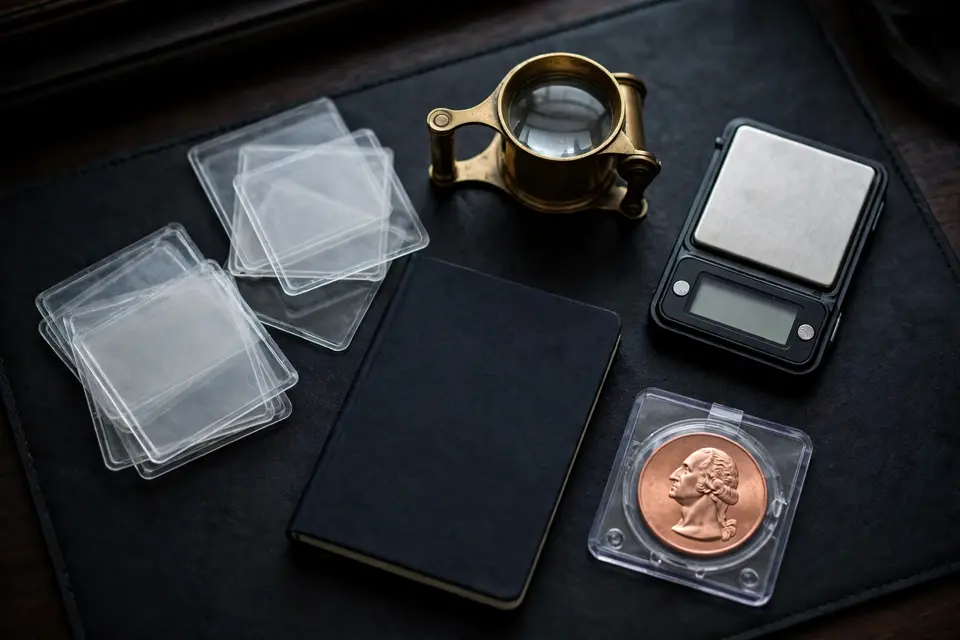
A missing clad layer coin costs nothing to check, and the difference between a $35+ partial and a $5,000+ dual example is one careful look at the copper face and the scale. Before you spend or sell any coin you are unsure about, run it through The Diggin Dave's free Error Identifier to confirm the error type, use the Coin Value Checker to confirm its value range, and try Grade-or-Not for a grade verdict on your best examples. A 10x loupe, a pocket digital scale, and cotton gloves are the only tools the five-step checklist needs.
As an Amazon Associate, this site may earn from qualifying purchases.
More Missing Clad Layer Reading
- How to Identify a Doubled Die Coin: Real Doubling vs Machine Doubling — the raised-vs-flat test that separates true doubling from machine doubling
- How to Identify a Clipped Planchet Coin: Real Clips, Fake Cuts & Values — the Blakesley effect, clip shape and metal-flow tests that separate real mint errors worth $10+ to $1,020+ from fakes
- How to Identify a Wrong Planchet Coin: Weight, Size & Metal Tests — the weight and diameter tests that separate a wrong-planchet strike from a missing clad layer
- How to Identify a Blank Planchet Coin: Type 1 vs Type 2, Weight Tests & Real Values — the rim, edge, weight, and diameter tests that separate a true unstruck planchet from a ground coin or a struck-through lookalike