How the 1955 Doubled Die Penny Reached $320,625
Coin Encyclopedia · 9 min read · Published November 7, 2026
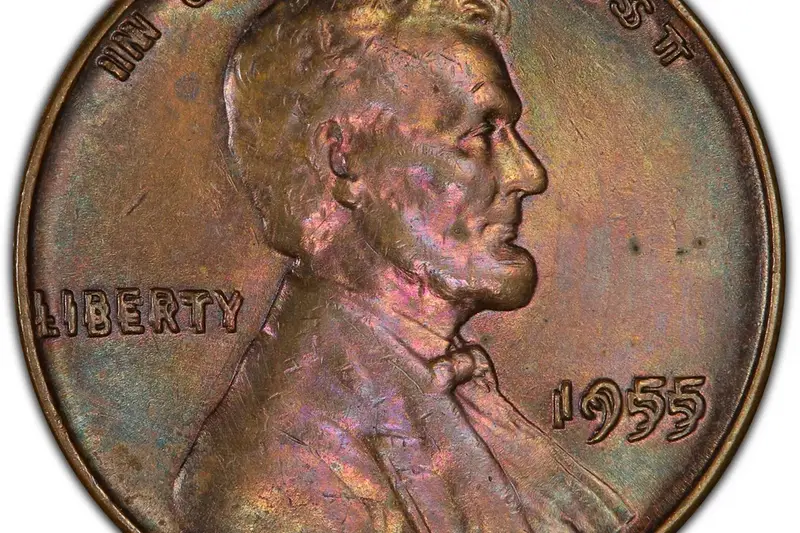
The 1955 Doubled Die penny is the most famous doubled die in American coinage. The doubling is so bold you can see it without a magnifier: the date 1955, the word LIBERTY, and the motto IN GOD WE TRUST each show a second, shifted image, nearly as strong as the first. It is the coin that turned ordinary collectors into error hunters, and it is still the doubled die every other doubled die is measured against.
Our 1955 guide puts even worn examples at $1,000+, and the table below carries our researched estimates across the grades — from $1,244–$1,523 in Fine to $40,000+ in MS-65. Above the table sit two verified records: $320,625 at GreatCollections in February 2025 and $124,875 at GreatCollections in March 2020. This page covers how the error happened, how to read the doubling, and how to separate a true doubled die from the machine doubling that fools so many collectors.
How a misaligned hub created a legend
The error happened when the die was made, not when the coin was struck. A working die is cut by a hub — the master image pressed into the die steel — and the hub must impress the die twice to bring the design up fully. On the 1955 doubled die, the hub was misaligned on the second impression: it came down rotated slightly from the first, and the die carried both impressions. Every coin that die struck shows the same doubled date, the same doubled LIBERTY, and the same doubled motto, because the doubling is in the die itself.
The Mint caught the error late. Our 1955 guide puts the number released into circulation at about 20,000 to 24,000 coins, with perhaps 10,000 to 15,000 surviving today across all grades — struck during a single evening shift, mixed into a batch of normal cents, and shipped out before anyone noticed the doubling. The coins went into circulation in the northeast, and collectors started finding them in change within weeks. The hunt has never stopped: the 1955 doubled die is still found in old collections, estate lots, and rolls, seventy years later.
That survival is the coin's other story. Ten to fifteen thousand survivors across all grades is a small number for a coin that famous, and only a couple hundred are believed to exist in Mint State. Most survivors are worn — the coin circulated, like every cent of its decade — which is why even a worn example starts above $1,000 and the finest run past $300,000.
Reading the doubling
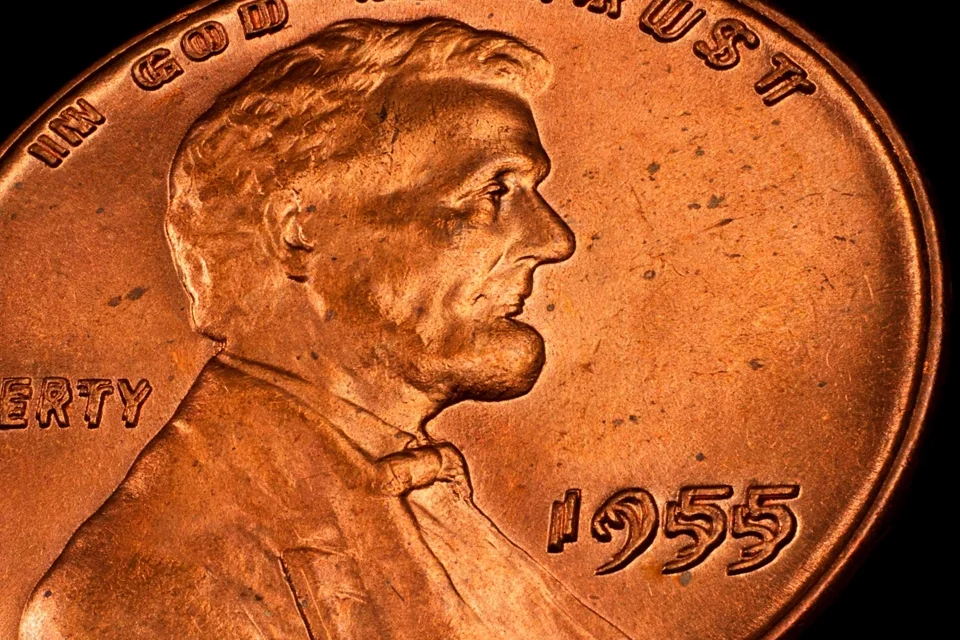
Look at the date first. On a genuine 1955 doubled die, the 1955 shows bold, rounded doubling — the second image of each digit sits shifted to the side, nearly as strong as the first, with the doubling boldest on the 5s. Then look at LIBERTY: the doubled letters are thick and rounded, with split serifs, and the effect is strongest on the B, E, R, and T. The motto IN GOD WE TRUST shows the same doubling, clearest on the words GOD and TRUST.
The key word is rounded. True hub doubling shows letters that match the originals in height and thickness, with rounded, split serifs — the doubled image is as strong as the first, because it was cut into the die by the same hub. Use a 10x loupe and a single light source, tilted slowly, and the doubling will stop you at once: on the 1955 it is not subtle, and it does not need a magnifier to see. That boldness is the coin's signature, and it is why the 1955 is the doubled die every collector learns first.
Weigh the coin while you have it in hand. A genuine 1955 doubled die is bronze at 3.11 grams and 19 millimetres across, with a plain edge — the same as any 1955 cent, because the error is in the die, not the metal. A coin far off that weight is not a doubled die; it is a problem.
Hub doubling versus machine doubling
The distinction is between true doubled dies and common machine doubling, and it is the most important lesson on this page. Machine doubling — often marketed misleadingly as the “poor man's doubled die” — happens during striking, not during die-making: the die shifts or bounces a fraction of a millimetre as the coin is struck, and the design smears. It shows flat, shelf-like doubling with a reduced, stepped appearance, and it is worth little, because it happens to ordinary coins all the time.
Hub doubling is different. It happens when the die is made, so the doubled letters match the originals in height and contour, with rounded, split serifs — the doubled image is as strong as the first. The 1955 doubled die, catalogued as FS-101, shows exactly that: strong, rounded doubling that matches the original lettering in height and contour. Learn the difference on the 1955 first, and you will not be fooled by machine doubling on any other date — especially the 1972 and 1995 doubled dies, where the same confusion catches collectors every year.
At serious value, certification is the standard. The grading services attribute the doubled die — FS-101, PCGS #2826 — and the attribution is what makes the coin tradable at its real figure. A raw 1955 doubled die offered at a discount is not a deal; it is the most famous error in American coinage, and it is faked, altered, and misattributed more than any other.
What the grade table says
The table below is the most complete in this batch: all six grades carry researched estimates, reviewed November 5, 2026. Good runs $1,500+, Fine $1,244–$1,523, Extremely Fine $1,500+, About Uncirculated $2,000+, Mint State 60 $3,500+, and Mint State 65 $40,000+. Even worn examples start above $1,000, and the climb from MS-60 to MS-65 — $3,500+ to $40,000+ — shows how scarce original Mint State examples are, and how much the market pays for them.
Above the table sit the records. A PCGS MS65+ Red example with CAC approval, from the Stewart Blay “Red Copper” Collection, reached $320,625 at GreatCollections in February 2025. A second PCGS MS65+ Red with CAC approval reached $124,875 at GreatCollections in March 2020. Two coins, one house, five years apart — and a gap of nearly $200,000 between them, which is how a market for a finest-known coin moves when the finest example changes hands.
The coin at a glance
Designer Victor David Brenner. Struck 1955 at Philadelphia only. Composition bronze, 95 percent copper with 5 percent tin and zinc. Weight 3.11 grams, diameter 19 millimetres, plain edge. Obverse: Lincoln facing right, date below, bold hub doubling on the date, LIBERTY, and IN GOD WE TRUST. Reverse: two wheat stalks flanking ONE CENT, UNITED STATES OF AMERICA above. Mintage 330,958,200 for the 1955 Philadelphia cent as a whole; about 20,000 to 24,000 doubled dies released into circulation, with perhaps 10,000 to 15,000 surviving. Variety FS-101, PCGS #2826. Metal floor: —. A copper cent carries no precious-metal floor, so the live system shows no melt figure for this coin — its worth is collector value alone.
The 1955 Doubled Die is the most famous error in American coinage, and the doubled die every other doubled die is measured against. Learn the rounded doubling here, and the 1972 and 1995 will make sense when you meet them — same lesson, smaller figures, same loupe.
What a 1955 Doubled Die is worth by grade
The figures below are our researched collector estimates from the live guide, reviewed November 5, 2026. All six grades carry estimates, from $1,244–$1,523 in Fine to $40,000+ in MS-65 — and even worn examples start above $1,000.
| Grade | Estimated value |
|---|---|
| Good (G-4) | $1,500+ |
| Fine (F-12) | $1,244–$1,523 |
| Extremely Fine (XF-40) | $1,500+ |
| About Uncirculated (AU-50) | $2,000+ |
| Mint State 60 (MS-60) | $3,500+ |
| Mint State 65 (MS-65) | $40,000+ |
Verified auction records
Two verified results — both for MS65+ Red examples with CAC approval, five years apart — anchor the top of the 1955 market.
| Coin | Grade | Sale | Price |
|---|---|---|---|
| 1955 Doubled Die Lincoln cent | MS65+ Red CAC, Stewart Blay “Red Copper” Collection | GreatCollections, February 2025 | $320,625 |
| 1955 Doubled Die Lincoln cent | MS65+ Red CAC | GreatCollections, March 2020 | $124,875 |
Latest reported results for this coin
Checking for newly reported results…
Your 1955 Doubled Die questions, answered
How much is a 1955 Doubled Die penny worth?
The table above carries our researched estimates, reviewed November 5, 2026: $1,500+ in Good, $1,244–$1,523 in Fine, $1,500+ in Extremely Fine, $2,000+ in About Uncirculated, $3,500+ in MS-60, and $40,000+ in MS-65. Even worn examples bring $1,000+, and the finest recorded example reached $320,625 at GreatCollections in February 2025.
How can I tell a real 1955 Doubled Die from machine doubling?
Look for rounded doubling that matches the originals in height and thickness, with split serifs — the doubled date, LIBERTY, and motto are nearly as strong as the first images. Machine doubling shows flat, shelf-like doubling with a stepped, reduced appearance, because it happens during striking when the die bounces. Only hub doubling is a variety worth a premium.
How many 1955 Doubled Die pennies were made?
Our 1955 guide puts the number released into circulation at about 20,000 to 24,000 coins, struck during a single evening shift and mixed into a batch of normal cents. Perhaps 10,000 to 15,000 survive today across all grades, and only a couple hundred are believed to exist in Mint State.
What is the highest figure a 1955 Doubled Die has reached?
The record is $320,625 for a PCGS MS65+ Red example with CAC approval, from the Stewart Blay “Red Copper” Collection, at GreatCollections in February 2025. A second MS65+ Red with CAC approval reached $124,875 at GreatCollections in March 2020.
Can I still find a 1955 Doubled Die in circulation?
It is still found in old collections, estate lots, and rolls, seventy years later — but not in ordinary pocket change. The coins went into circulation in the northeast in 1955, and collectors have been hunting them ever since. Check the date and LIBERTY on every 1955 you handle; the doubling is bold enough to see without a magnifier.
Check your 1955 Doubled Die
Run the date through the free Coin Value Checker for an instant estimate, or work the doubling through the Error Coin Identifier step by step. The full doubled-die guide is here: 1955 Doubled Die Penny: How to Spot a $2,000+ Error. Compare the other famous doubled dies — the 1969-S Doubled Die and the 1972 Doubled Die.
This guide is written so collectors can recognise the most famous doubled die for themselves — its rounded doubling, its history, and its fakes — and use that knowledge before any individual coin is judged.