How the 1857 Flying Eagle Cent Replaced the Large Cent
Coin Encyclopedia · 7 min read · Published November 7, 2026
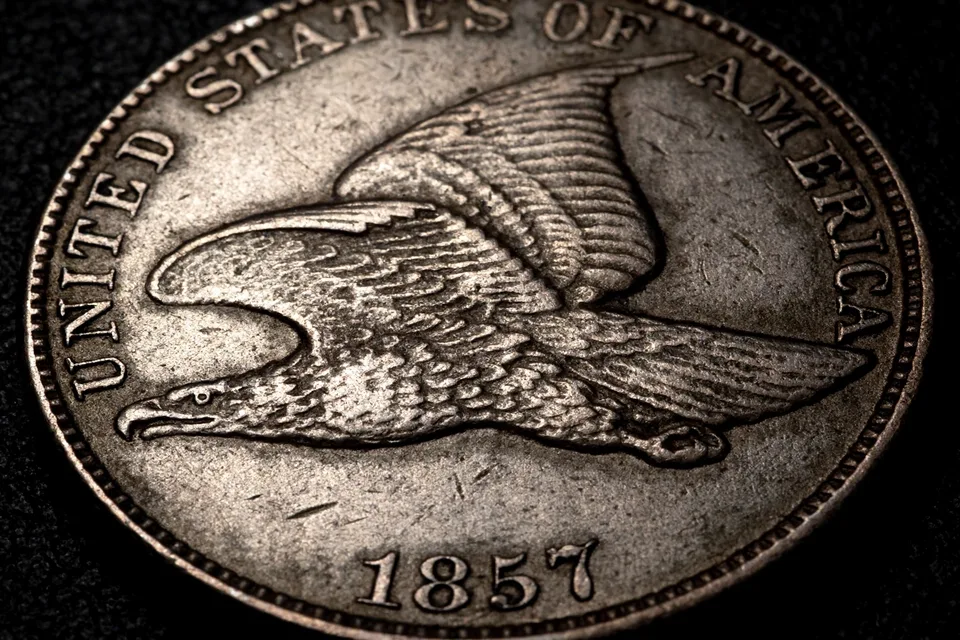
In 1857, the United States stopped making the big copper cent it had struck since 1793 and replaced it with something smaller, lighter, and stranger: a coin with a flying eagle on one side and a wreath on the other, struck in copper-nickel and less than half the weight of the coin it replaced. The Mint struck 17,450,000 of them in the first year, and they went straight into pockets, tills, and jars across the country.
The 1857 is the Flying Eagle cent most collectors meet first. It is common enough to find in modest grades, old enough to feel like real history, and short-lived enough — the whole series lasted only three years — to hold in one small set. This page covers why the coin exists, how to read the strike and the metal, and where the first year fits beside the pattern that came before it and the varieties that came after.
Why 1857 replaced the large cent
The large cent was dying of its own weight. By the 1850s it cost the Mint almost a cent to make a cent, it was heavy and awkward, and merchants were tired of it. Congress had been pressed for years to do something, and the Flying Eagle design — Chief Engraver James B. Longacre's small cent, carrying Christian Gobrecht's eagle in flight — was the answer that finally passed. The act of February 1857 ended the large cent and the half cent together, and the new small cent took their place.
The public did not take to it at once. The copper-nickel coin was pale next to the old copper cents, and the eagle — copied from a silver dollar design of the 1830s — looked odd to people used to Liberty's portrait. But the coin worked: it was cheap to strike, easy to carry, and the Mint could make them fast. The 17,450,000 struck in 1857 were only the start; 1858 would bring more than 24 million, and by 1859 the Indian Head cent would take over the same small planchet.
That three-year window is what makes the series collectible. A complete Flying Eagle set is three dates — 1856, 1857, 1858 — and only the first of those is genuinely rare. The 1857 is the set's affordable entry point, and it is also the coin that teaches you the series: the strike, the metal, and the wreath are all the same here as on the other two dates.
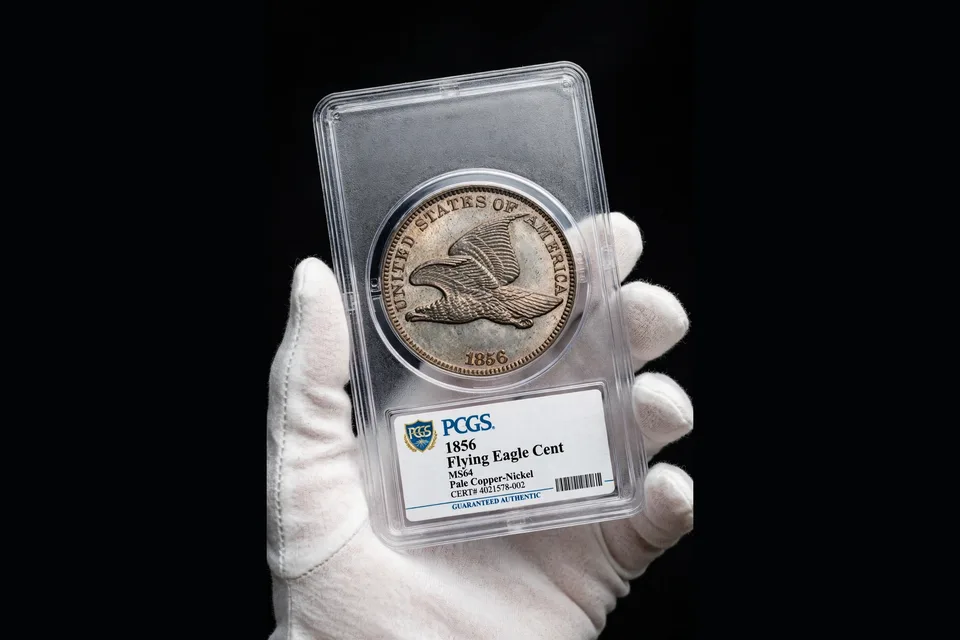
Reading the strike on an 1857
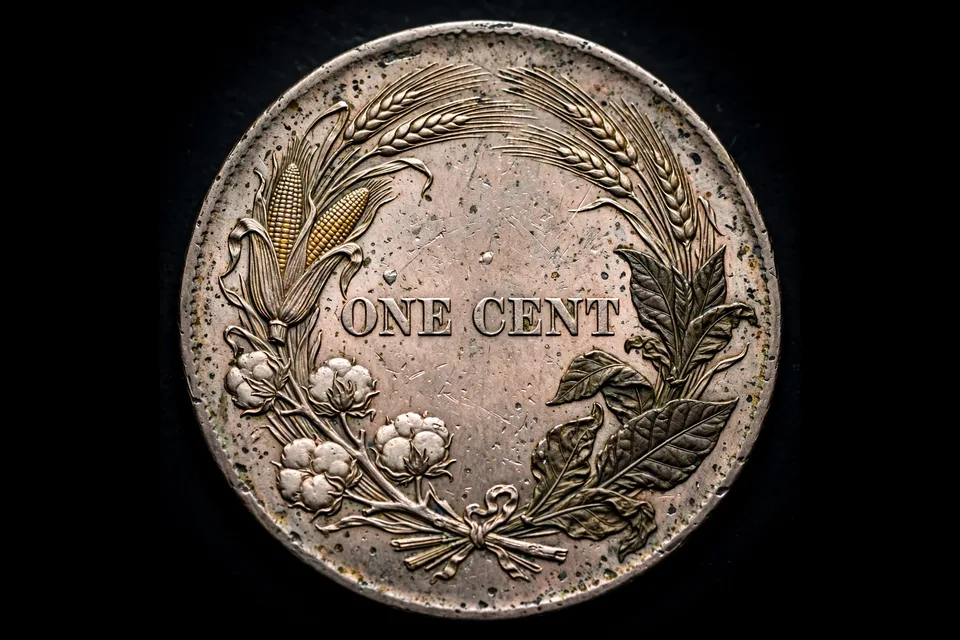
Flying Eagle cents are notorious for weak strikes, and the 1857 is where most collectors learn what that means. The eagle's breast feathers and the wreath's leaves are the high points of the design, and on many 1857 cents they never fully formed — the metal simply did not flow into the deepest parts of the die. A coin with a sharp breast and full wreath leaves is a better-struck example, and it stands out at once beside a typical one.
Look at the coin in a single light source, tilted slowly. On a well-struck 1857 the eagle's wing feathers separate into clean lines; on a weak one they melt into a smooth, flat patch. The same goes for the wreath: individual leaves should read as leaves, not as a blur. None of this is damage — it is how the coin left the Mint — but it is the first thing an experienced collector checks, and it is worth learning before you judge any Flying Eagle by its wear alone.
Colour matters too. The copper-nickel alloy tones differently from bronze: old 1857 cents often show a soft grey-tan surface, sometimes with a faint golden cast where the nickel shows through. A coin that looks bright pink or orange has likely been cleaned, and cleaning is the fastest way to cut a Flying Eagle's appeal in half. Original surfaces, even dark ones, are what collectors want.
The metal, the weight, and the colour
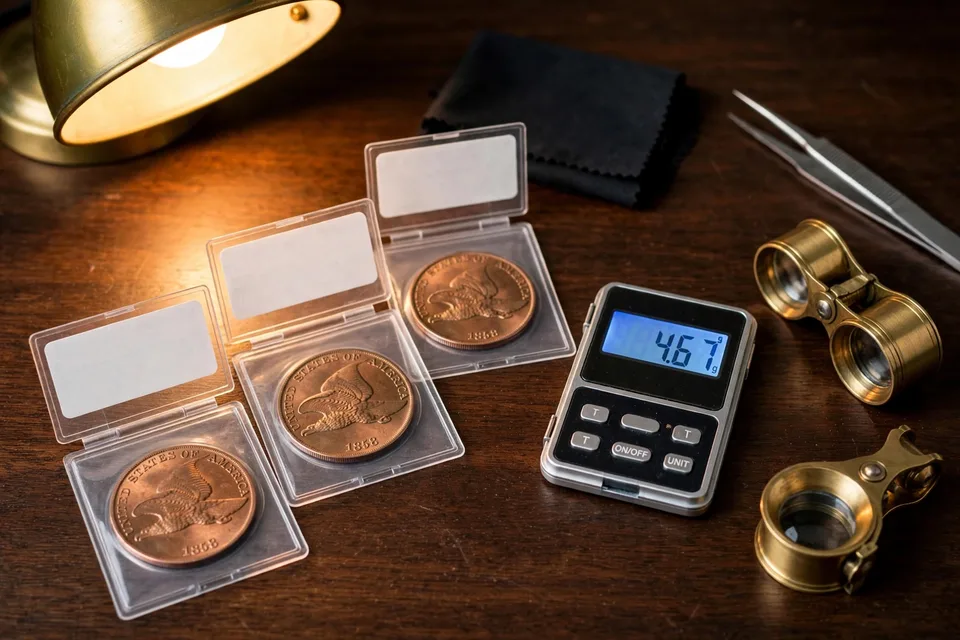
An 1857 Flying Eagle cent is 88 percent copper and 12 percent nickel, weighs about 4.67 grams, and measures 19 millimetres across — the small-cent size every later cent would keep. The nickel in the alloy gives the coin its pale, almost silvery colour, which is why collectors of the day called these pieces “white cents.” The same alloy carried into the copper-nickel Indian Head cents of 1859 to 1864, so the pale look is a family trait, not a flaw.
Weigh your coin if you can. A genuine 1857 should sit close to 4.67 grams; a coin far off that mark — heavy, light, or wrong in diameter — deserves a closer look. The test is not conclusive on its own, but it is cheap, fast, and it catches the crudest copies before you spend anything on opinions. Pair the weight with the colour: a Flying Eagle cent that looks like an ordinary copper penny, bright orange-pink instead of pale grey-tan, has almost certainly been cleaned or is not what it claims to be.
Where 1857 cents turn up today
With 17,450,000 struck, the 1857 is not a coin you hunt for in rolls — it is a coin you find in old collections, dealer stock, and estate lots, usually in worn to mid-grade condition. Mint State examples exist but are a small fraction of the mintage, and the best-struck ones are scarcer still. Most collectors start with a decent Fine or Very Fine example, learn the strike tells on it, and upgrade only when a sharper coin appears at a figure they are comfortable with.
The 1857 also makes a good first key to the whole small-cent story. Hold it beside a large cent and the change of 1857 is suddenly physical: the old coin is a heavy disc of copper, the new one is light and pale and modern. That contrast is why the year matters, and why the 1857 stays in collections even though it is the common date of a three-year series.
What an 1857 is worth by grade
Our guide has not yet researched grade-by-grade estimates for the 1857 — the table below shows “—” for every grade rather than a guess. The series guide carries the current overview of Flying Eagle values across all three dates.
| Grade | Estimated value |
|---|---|
| Good (G-4) | — |
| Fine (F-12) | — |
| Extremely Fine (XF-40) | — |
| About Uncirculated (AU-50) | — |
| Mint State 60 (MS-60) | — |
| Mint State 65 (MS-65) | — |
Guide values reviewed November 5, 2026 — figures update live from our Worker.
Latest reported results for this coin
Checking for newly reported results…
Your 1857 Flying Eagle questions, answered
How much is an 1857 Flying Eagle cent worth?
Our guide has not yet researched grade-by-grade estimates for the 1857, so this page carries no estimated value by grade. As the first circulation year with 17,450,000 struck, it is the affordable entry point of the three-year series; the series guide carries the current overview of Flying Eagle values.
Is the 1857 Flying Eagle cent rare?
No. With 17,450,000 struck, the 1857 is the common circulation date of the series. It is scarce only in sharply struck Mint State condition, where weak strikes kept most examples from grading high. The rare date is the 1856 pattern, with close to 1,000 struck.
Why is the 1857 Flying Eagle cent weakly struck so often?
The eagle's breast feathers and the wreath leaves are high points of the design, and the metal often did not flow fully into the dies. Many 1857 cents left the Mint with soft detail that looks like wear but is actually a weak strike. A sharply struck 1857 stands out clearly beside a typical one.
Why is the 1857 Flying Eagle cent pale, not copper-coloured?
The pale colour comes from the nickel: the coin is 88 percent copper and 12 percent nickel, and the nickel lightens the copper to a silvery grey-tan. Collectors of the day called these pieces white cents. The same alloy carried into the copper-nickel Indian Head cents of 1859 to 1864.
What replaced the 1857 Flying Eagle cent?
The same small planchet carried on: the Indian Head cent replaced the Flying Eagle design in 1859, keeping the 19-millimetre size. The Flying Eagle series itself lasted only 1856 to 1858, with 1857 as its first circulation year.
Check your 1857 Flying Eagle cent
Run the date through the free Coin Value Checker for an instant estimate, or test it against the Key Date Checker to see where it sits in the series. The full series guide is here: Flying Eagle Cent Value: $30 to $312,000+ Guide. Compare it with the pattern year — the 1856 Flying Eagle cent — and the final year, the 1858 Flying Eagle cent.
This guide is written so collectors can learn the history and identification of the 1857 Flying Eagle cent for themselves; use it as education, and confirm any individual coin with a professional before acting on it.