1858 Flying Eagle Cent Varieties: Letters and Overdate
Coin Encyclopedia · 7 min read · Published November 7, 2026
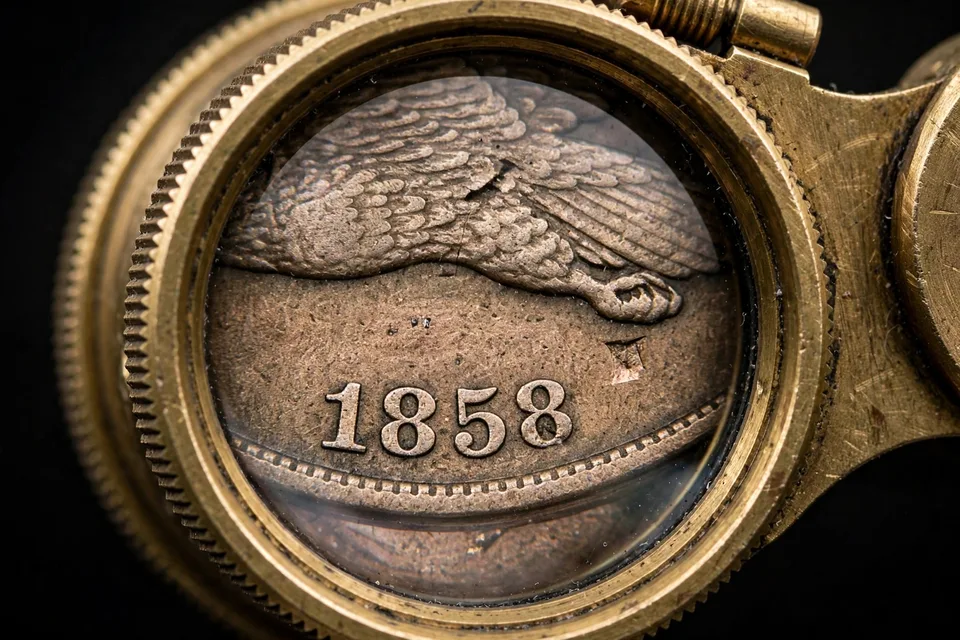
The 1858 Flying Eagle cent is the last year of the shortest series in American cents — and the busiest. The Mint struck 24,600,000 of them, more than the 1857, and in doing so produced two distinct lettering varieties, a famous overdate, and the weakest strikes of the whole run. It is the year where a collector stops asking “which date?” and starts asking “which kind?”
That question is the whole page. Large letters or small letters, overdate or plain date, sharp or mushy — the 1858 rewards the collector who looks closely, and it punishes the one who does not. The varieties below are all visible with a loupe and a little patience, and they are the reason the final Flying Eagle year is still worth a careful look more than a century and a half later.
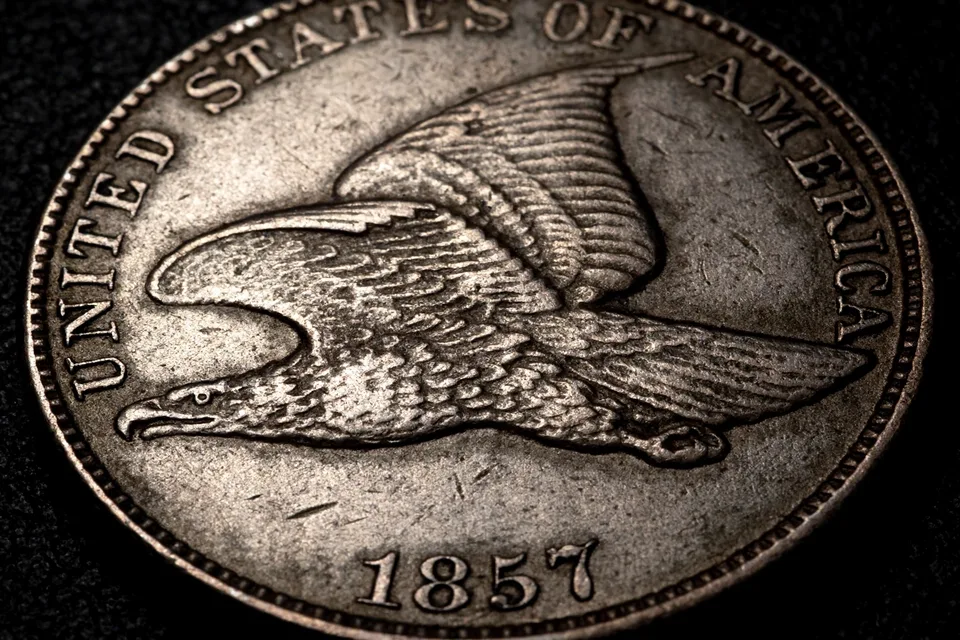
Large letters, small letters — the split to learn first
The 1858 comes in two varieties, and the difference is on the reverse: the size of the letters in UNITED STATES OF AMERICA. On the large-letters variety the lettering is tall and bold — look at the word AMERICA, where the bases of the A and the M touch each other. On the small-letters variety the letters are noticeably smaller and finer, and there is a clear gap between the A and the M. Hold the two side by side and the difference is obvious. Hold one on its own and it is easy to miss — which is why most collectors learn the split by comparing against a known example first, then trusting their eye.
The small-letters variety is the scarcer of the two, and it is the one collectors usually chase. But scarcity here is relative: both varieties were struck in large numbers, and the premium for small letters is modest beside the gap between an 1858 and an 1856. What the split really does is give the 1858 a second dimension — a variety hunt inside a common date, and a reason to look at every 1858 twice.
A practical tip: photograph the reverse of any 1858 you own, then compare it against a reference image of each variety at the same size. The eye adjusts to whatever it sees most, and a side-by-side comparison beats memory every time. Once you have seen both, you will not confuse them again.
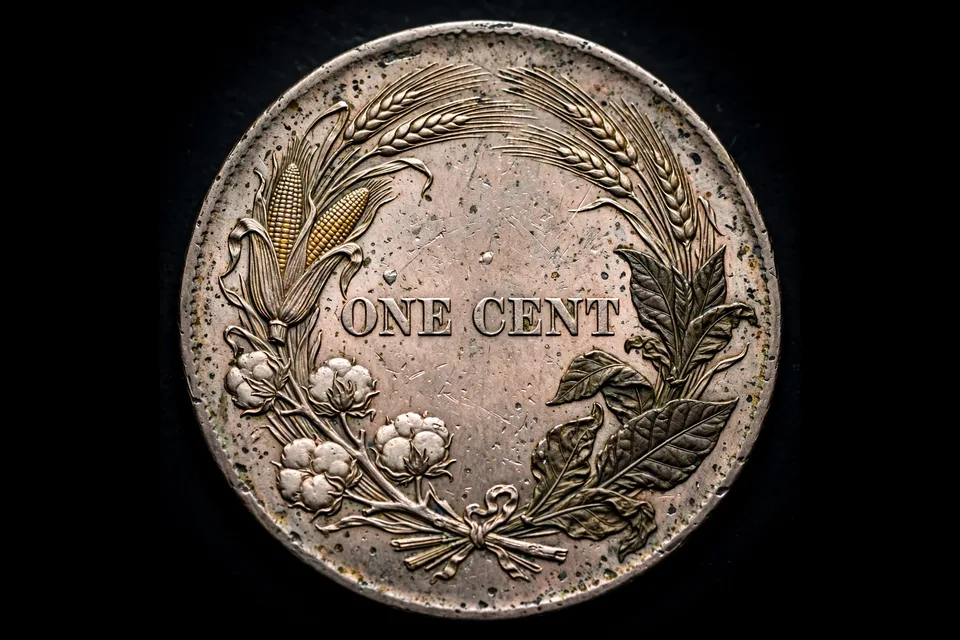
The 1858/7 overdate — a 7 hiding under the 8
The most famous 1858 variety is the overdate: a die first cut with a 7, then re-cut with an 8 over it. On a strong example you can see the curve of the 7 showing through the lower loop of the 8, like a shadow under the final digit. It is catalogued as FS-301 and Snow-1, and it is the variety that turns an ordinary 1858 into a coin worth a second and third look.
Check the 8 under a 10x loupe in raking light. On a genuine overdate the curve of the 7 shows through the lower loop of the 8, and the digit often looks slightly thick or doubled at the base. On a normal 1858 the 8 is clean. Weak examples exist — the overdate is not always bold — so a faint trace still counts if the shape is right, but a coin with no trace at all is simply a regular 1858.
Our series guide records the overdate reaching $74,025 at auction for a Mint State 65+ example, which tells you how far the variety can run in top condition. In worn grades it is a far more modest coin — the point is not that every overdate is a treasure, but that the variety is real, findable, and worth the loupe time.
Why 1858 strikes are the weakest of the three years
If the 1857 taught collectors about weak strikes, the 1858 is the advanced course. The dies were pushed hard across a mintage of 24,600,000, and late strikes are often soft across the eagle's breast and the wreath. A sharply struck 1858 is genuinely scarce, and it commands attention for that reason alone — the strike, not the date, is what separates a good 1858 from a great one.
This is also why grading an 1858 by wear alone misleads. A coin with a soft breast may have seen almost no circulation at all; it simply never had the detail to lose. Learn to separate strike from wear before you judge any Flying Eagle, and the 1858 is the coin to learn it on — it shows the difference more clearly than any other date in the series.
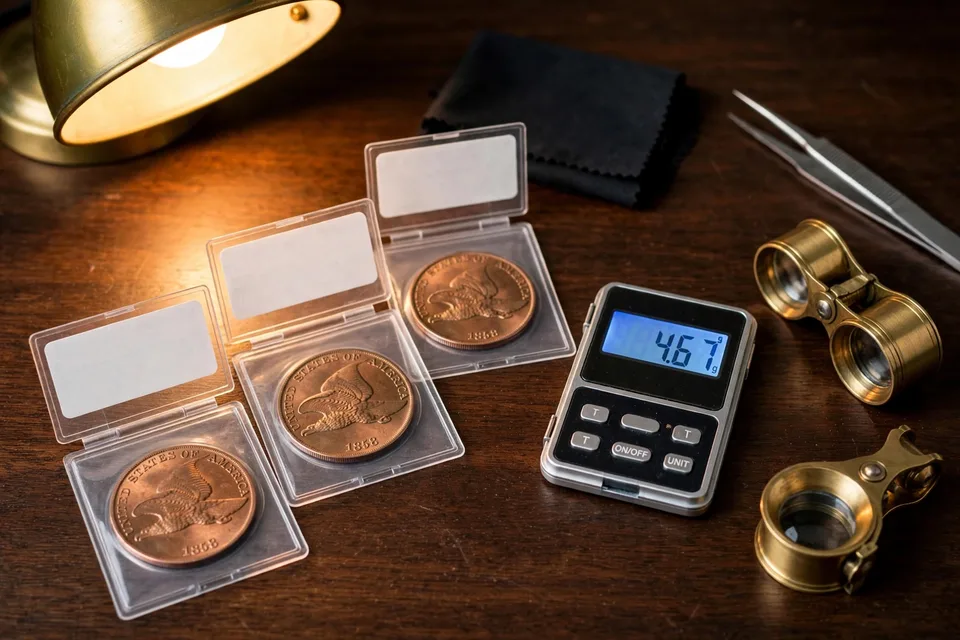
The end of the eagle
The 1858 was the last Flying Eagle cent because the design had run its course. The eagle was borrowed, the strikes were weak, and the Mint wanted a portrait design for the new small cent. In 1859 the Indian Head cent took over the same 19-millimetre planchet, and the eagle flew away after three years. The 1858, with its varieties and its huge mintage, is the closing chapter — common enough to own, varied enough to study, and the last chance to hold the design as a circulation coin.
For the set builder, the 1858 is the finishing date: 1856 for the story, 1857 for the start, 1858 for the varieties. A set of three, one of them a pattern and two of them circulation coins, tells the whole small-cent revolution in a single row. That is a small set with a large story, and the 1858 carries the ending.
What an 1858 is worth by grade
Our guide has not yet researched grade-by-grade estimates for the 1858 — the table below shows “—” for every grade rather than a guess. The series guide carries the current overview of Flying Eagle values across all three dates, including the overdate.
| Grade | Estimated value |
|---|---|
| Good (G-4) | — |
| Fine (F-12) | — |
| Extremely Fine (XF-40) | — |
| About Uncirculated (AU-50) | — |
| Mint State 60 (MS-60) | — |
| Mint State 65 (MS-65) | — |
Guide values reviewed November 5, 2026 — figures update live from our Worker.
Latest reported results for this coin
Checking for newly reported results…
Your 1858 Flying Eagle questions, answered
How do I tell large letters from small letters on an 1858 Flying Eagle cent?
Look at the word AMERICA on the reverse. On Large Letters, struck from the 1857 hub, the bases of the A and the M touch each other. On Small Letters, struck from the new 1858 hub, there is a clear gap between the A and the M. Compare your coin side by side with a reference image of each variety at the same size — the difference is clear once seen together.
What is the 1858/7 overdate?
The 1858/7 overdate is a variety where the die was first cut with a 7 and then re-cut with an 8 over it. On strong examples the curve of the 7 shows through the lower loop of the 8. It is catalogued as FS-301 and Snow-1, and our series guide records it reaching $74,025 at auction in Mint State 65+.
How many 1858 Flying Eagle cents were made?
24,600,000 were struck in 1858, the largest mintage of the three-year series. The date is common, and its interest lies in the varieties — large and small letters, and the 1858/7 overdate — rather than in the mintage itself.
Why are 1858 Flying Eagle cents so weakly struck?
The dies were pushed hard across a mintage of 24,600,000, and late strikes are often soft across the eagle's breast and the wreath. A soft breast on an 1858 is often a weak strike, not wear — learn to separate the two before judging any Flying Eagle by its detail.
Is the small-letters 1858 worth more than the large-letters?
Yes, the small-letters variety is scarcer and carries a premium, though a modest one beside the gap between an 1858 and the 1856 pattern. Both varieties were struck in large numbers; the split matters most to variety collectors completing the series in all its forms.
Check your 1858 Flying Eagle cent
Run the date through the free Coin Value Checker for an instant estimate, or use the Error Coin Identifier to work through the overdate tells step by step. The full series guide is here: Flying Eagle Cent Value: $30 to $312,000+ Guide. And set your 1858 beside the other two years — the 1856 Flying Eagle cent and the 1857 Flying Eagle cent — to see the whole three-year run at once.
This page exists to teach collectors how to identify the 1858 Flying Eagle cent's varieties for themselves; it is educational reference, and any individual coin should be confirmed by a professional before a decision rests on it.