The 1866 Indian Head Cent and the Bronze Switch
Coin Encyclopedia · 7 min read · Published November 7, 2026
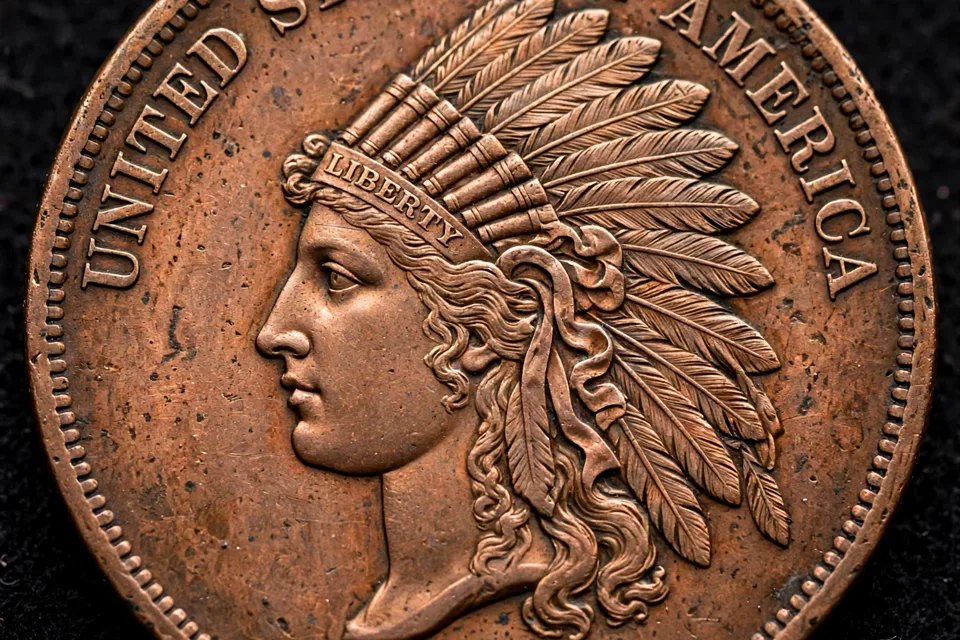
The 1866 Indian Head cent is not a key date, and that is exactly why it is worth a page of its own. It is the bronze cent after the change had settled: the Mint had left copper-nickel behind in 1864, sharpened Liberty's portrait for the softer bronze, and struck 9,826,500 cents in 1866 for a country coming out of civil war. It is the ordinary cent of its year — and the ordinary cent is how you learn the series.
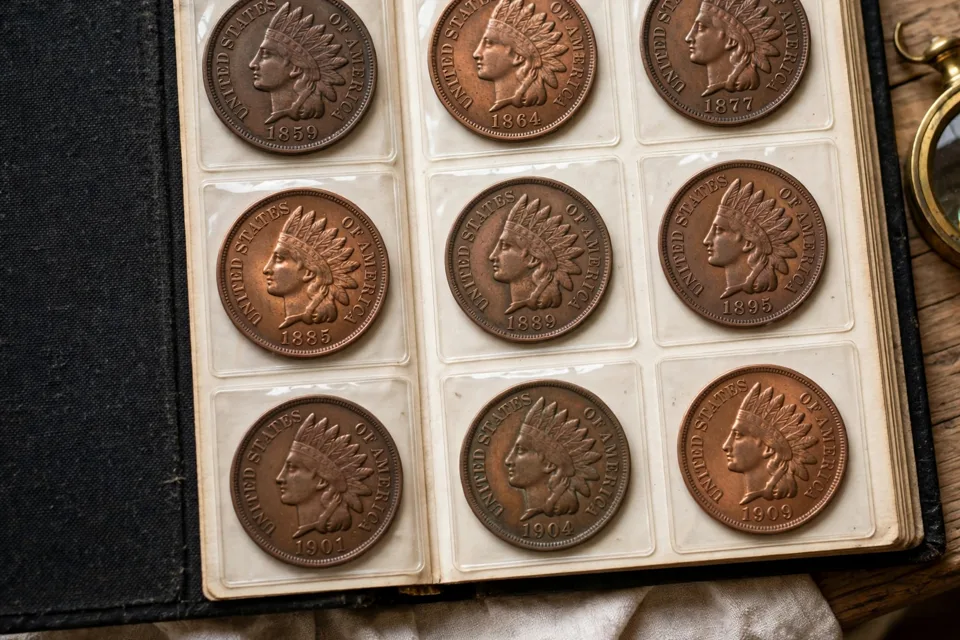
Hold an 1866 beside an 1859 and the whole story of the 1860s is in your hands: the pale “white cent” against the warm bronze one, the softer portrait against the sharpened one, the heavy 4.67-gram planchet against the light 3.11-gram one. This page walks through that comparison, how to read an 1866, and where the first settled bronze year fits in a set that runs from 1859 to 1909.
The bronze cent finds its footing
The switch came in the spring of 1864. Copper-nickel cents cost too much to make and the nickel was needed for the war effort, so the Mint moved to bronze — 95 percent copper with 5 percent tin and zinc — and cut the weight from 4.67 grams to 3.11 grams. The year 1864 was struck in both metals, which makes it the confusing one. By 1866 there was no confusion left: every cent was bronze, every cent weighed 3.11 grams, and the alloy the Lincoln cent would inherit was fixed for the next forty years.
Chief Engraver James B. Longacre sharpened the portrait for the change. Bronze is softer than copper-nickel, so the design needed crisper lines to strike well, and Longacre reworked Liberty's face and headdress — and added his initial L to the ribbon behind her neck, the mark collectors call the 1864-L variety. The 1866 carries that sharpened portrait and that L as a matter of course. It is not a variety on an 1866; it is simply how the coin was made.
The mintage tells you the coin's place in the series. At 9,826,500, the 1866 is a middle-of-the-road year — neither the tens of millions of the 1880s and 1900s nor the tiny mintages of 1877 and the San Francisco pair. It circulated hard in the post-war years, which is why most survivors are worn, and why a sharp, original 1866 stands out at once in a tray of brown cents.
Telling bronze from copper-nickel
The scale settles it. A copper-nickel Indian cent weighs 4.67 grams; a bronze one weighs 3.11 grams. The two metals overlap only in 1864, so weight plus date answers nearly every question in the series: an 1866 at 3.11 grams is bronze, full stop, and an 1866 at 4.67 grams is a coin that deserves a second look, because it should not exist in that metal.
Colour backs the scale up. Copper-nickel cents are pale, almost silvery — the “white cents” of the day — while bronze cents are warm brown, darkening with age toward chocolate and near-black on the oldest survivors. A bright pink or orange 1866 has likely been cleaned, and cleaning is the fastest way to cut an Indian cent's appeal: original surfaces, even dark ones, are what collectors want, and a cleaned coin never gets them back.
Reading an 1866
Start on the obverse. Liberty faces left in a Native American headdress, the feathers sweeping back across the field, with UNITED STATES OF AMERICA around the rim and the date 1866 below. On a sharp example the feather tips separate into clean lines; on a worn one they melt into the field, and the headdress band is the first detail to go. The L on the ribbon behind Liberty's neck is small — a loupe helps — but it is there on every genuine 1866.
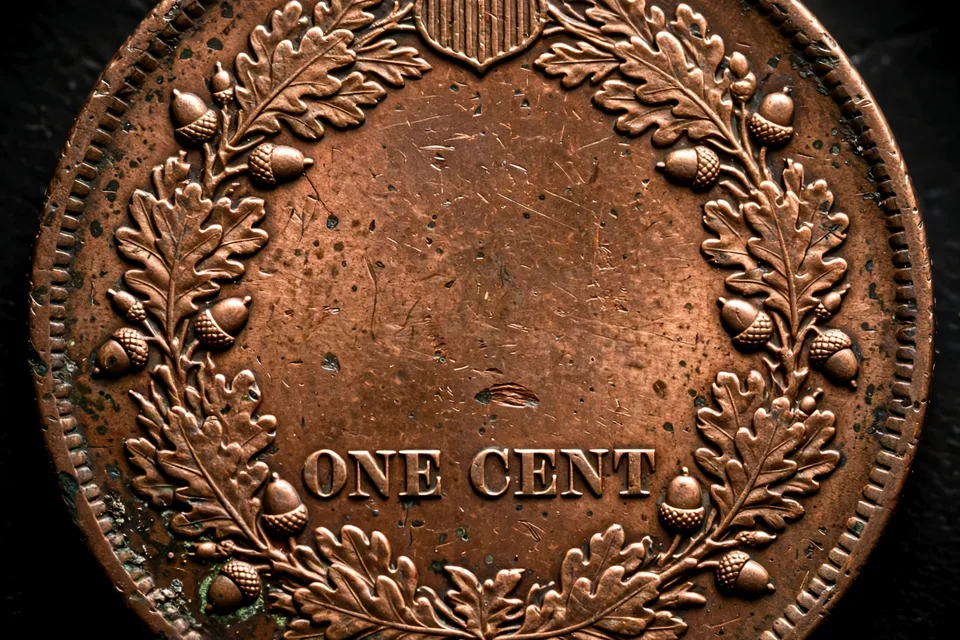
Turn the coin over. The reverse shows an oak wreath with a shield at the top, ONE CENT at the centre, and no mint mark anywhere — Philadelphia struck every Indian cent until San Francisco joined the series in 1908, so an 1866 with an S below the wreath would be a coin to walk away from. The wreath leaves are the wear tell on this side: full leaves mean a lightly circulated coin, while a smooth wreath with the shield worn flat means a cent that worked for a living.
Check the edge while you have it in hand. Indian cents have a plain edge, and the coin should measure 19 millimetres across. A coin that is thick, light, or wrong in diameter has a problem that no amount of toning can hide, and it is worth a professional opinion before it is treated as genuine.
The coin at a glance
Designer James B. Longacre. Struck 1866 at Philadelphia only. Composition bronze, 95 percent copper with 5 percent tin and zinc. Weight 3.11 grams, diameter 19 millimetres, plain edge. Obverse: Liberty in a Native American headdress, date below. Reverse: oak wreath with a shield at the top, ONE CENT at the centre, no mint mark. Mintage 9,826,500. Metal floor: —. A copper cent carries no precious-metal floor, so the live system shows no melt figure for this coin — its worth is collector value alone.
The 1866 sits in the middle of the bronze run that stretches from 1864 to 1909, and it is the year to learn the alloy on. Once you can tell bronze from copper-nickel by weight and colour, and once you can read the sharpened portrait and the L, every other bronze date in the series reads the same way — and the key dates, when you meet them, will stand out for the right reasons.
What it is worth by grade
Our guide has not yet researched grade-by-grade estimates for the 1866 — the table below shows “—” for every grade rather than a guess. As a common date, the series guide puts ordinary Indian cents at $2+ worn, $15+ in Very Fine, and $75+ in Mint State.
| Grade | Estimated value |
|---|---|
| Good (G-4) | — |
| Fine (F-12) | — |
| Extremely Fine (XF-40) | — |
| About Uncirculated (AU-50) | — |
| Mint State 60 (MS-60) | — |
| Mint State 65 (MS-65) | — |
Guide values reviewed November 5, 2026 — figures update live from our Worker.
Latest reported results for this coin
Checking for newly reported results…
Your 1866 Indian Head questions, answered
How much is an 1866 Indian Head cent worth?
Our guide has not yet researched grade-by-grade estimates for the 1866, so this page carries no estimated value by grade. As a common date, the series guide puts ordinary Indian cents at $2+ worn, $15+ in Very Fine, and $75+ in Mint State. Sharp, original examples run above those figures; cleaned or damaged ones run below them.
How do I know if my Indian cent is bronze or copper-nickel?
Weigh it. A copper-nickel Indian cent (1859 to 1864) weighs 4.67 grams; a bronze one (1864 to 1909) weighs 3.11 grams. The two metals overlap only in 1864, so weight plus date settles nearly every question. Colour backs the scale up: copper-nickel is pale and silvery, bronze is warm brown.
Did the 1866 Indian Head cent have a mint mark?
No. Philadelphia struck every Indian cent until San Francisco joined the series in 1908, so an 1866 carries no mint mark. Only the 1908-S and 1909-S carry an S, on the reverse below the wreath. An 1866 with an S is not a genuine variety.
What is the L on the ribbon behind Liberty's neck?
The L is the initial of James B. Longacre, the coin's designer. He added it in 1864 when he sharpened the portrait for the softer bronze planchets. On the 1866 it is a normal part of the design, not a variety — the 1864-L is the variety because that year was struck both with and without it.
Where do 1866 Indian Head cents turn up today?
In old collections, dealer stock, and estate lots, usually worn — the 1866 circulated hard in the post-war years. Mint State examples exist but are a small share of the 9,826,500 struck, and a sharp, original one stands out at once beside a typical brown survivor.
Check your 1866 Indian Head cent
Run the date through the free Coin Value Checker for an instant estimate, or test it against the Key Date Checker to see where it sits in the series. The full series guide is here: Indian Head Penny Values by Date: $2 to $340,875+. Compare it with the sleeper key — the 1872 Indian Head cent — and the king of the series, the 1877 Indian Head cent.
This guide is written so collectors can learn the bronze Indian Head cent for themselves — its metal, its portrait, and its place in the series — and use that knowledge before any individual coin is judged.