1877 Indian Head Cent: The $340,875 Key Date
Coin Encyclopedia · 9 min read · Published November 7, 2026
The 1877 Indian Head cent is the king of the series, and it has been since almost the day it was struck. Philadelphia made only 852,500 of them — the lowest mintage of any Philadelphia Indian cent — in a year when the country was in the middle of a depression and the Mint was barely striking cents at all. Collectors recognised it as the rarity of the set at once, and they have chased it ever since.
The numbers explain why. Our series guide puts worn examples at $900+ and records the finest at $340,875 — a PCGS MS66+ Red with CAC approval that reached that figure at GreatCollections in November 2023. Between those two figures sits the most counterfeited Indian cent ever made, a coin that demands certification and rewards patience. This page covers the mintage, the record, the counterfeits, and how to read a real 1877.
The year the Mint barely struck cents
The 1877 mintage of 852,500 was not an accident. The Panic of 1873 had left the country in a long depression, commerce was slow, and the demand for new cents was low — the Mint struck what was needed and little more. The 1870s are mostly affordable dates for that reason: low demand kept mintages modest across the decade. But 1877 was the low point of the low years, and the only Philadelphia date in the whole series to fall below a million.
That is the whole key in one fact. A series collected by date needs one of every year, and there were fewer than a million 1877 cents to go around — against tens of millions for the 1880s and 1900s. The 1877 was recognised as the rarity of the set almost from the day it was struck, which means it was saved, hoarded, and hunted from the start. It did not become a key date later. It was born one.
Condition makes the gap wider. The 1877 circulated like every cent of its decade, and most survivors are worn — feather tips gone, wreath leaves flat, the date soft. Sharp, original Mint State examples are a small share of the 852,500, and the finest of them is the coin that reached $340,875. The distance between a worn 1877 and that coin is the distance between two different markets, and it is why the grade table below climbs as steeply as it does.
The $340,875 record
One coin owns the top of this market. A PCGS MS66+ Red example with CAC approval reached $340,875 at GreatCollections in November 2023 — the highest verified figure for any Indian Head cent in our series guide, ahead of the finest 1864-L proof at $161,000 and the finest 1909-S at $97,750. The grade matters as much as the figure: MS66+ Red means a coin that is nearly perfect and still carries its original mint red, a combination that almost never survives 150 years on a bronze cent.
The record also shows what the market pays for. It is not the date alone — a worn 1877 is a $900+ coin, not a $340,875 one. It is the date plus the grade plus the colour plus the originality, all at once. Collectors who chase the 1877 in high grade are chasing a coin that barely exists, and the record is the market admitting how rarely it appears.
The counterfeit problem
The 1877 is the most counterfeited Indian cent, and the fake is as simple as the Lincoln cent's: take a common date, change the date. An 1878 with its 8 reworked into a 7, a common 1870s cent with an added 7 — the tricks are old and the tools are better now than they were. Our series guide puts it plainly: any 1877 that is not certified should be treated as guilty until proven genuine.
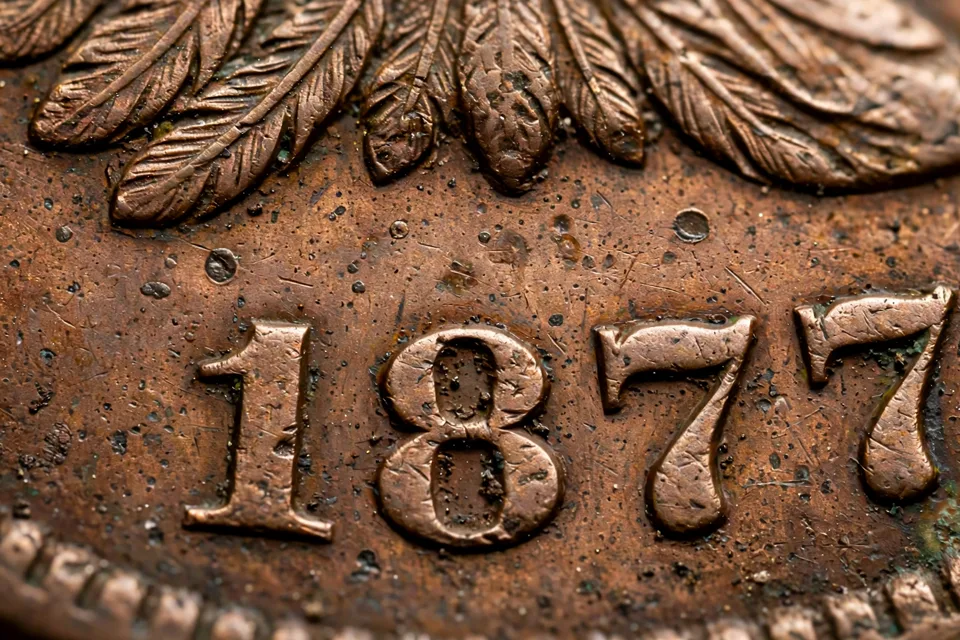
Check the date under a loupe first. On a genuine 1877 the digits are level, evenly struck, and the same depth as each other, with the 7 shaped exactly like the 7 on a genuine example. A reworked date shows tool marks, a digit that sits at a different depth, or a 7 whose shape is wrong. Then weigh the coin: a genuine 1877 is bronze at 3.11 grams and 19 millimetres across, with a plain edge and no mint mark. A coin that fails the weight test is not a bargain — it is a lesson.
At serious value, certification is not optional. The grading services authenticate the date and the metal, and the holder is what makes an 1877 tradable at its real figure. An uncertified 1877 offered at a discount is not a deal; it is the oldest trap in the series, and it has caught better collectors than any of us.
Reading a real 1877
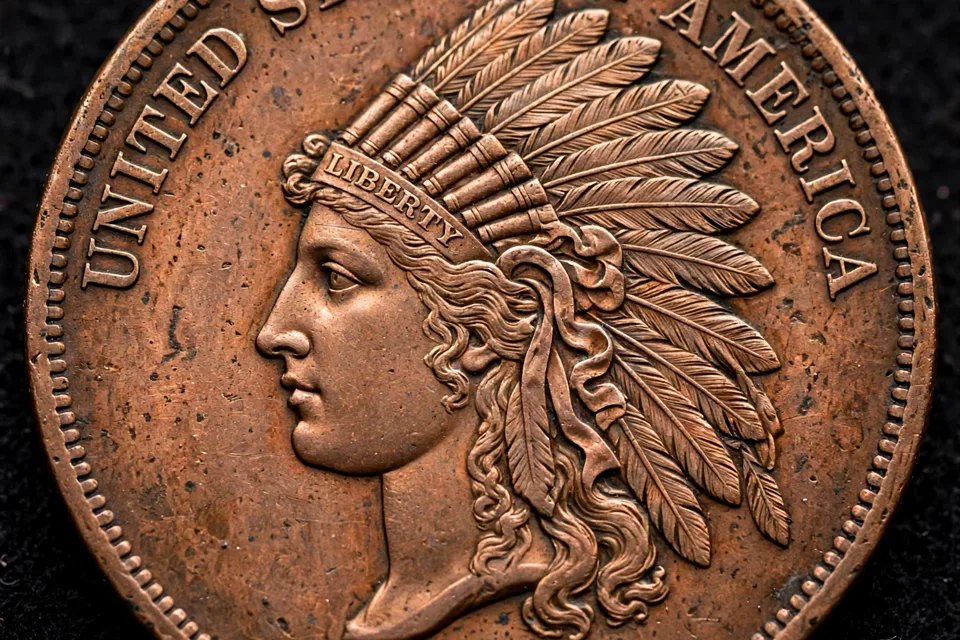
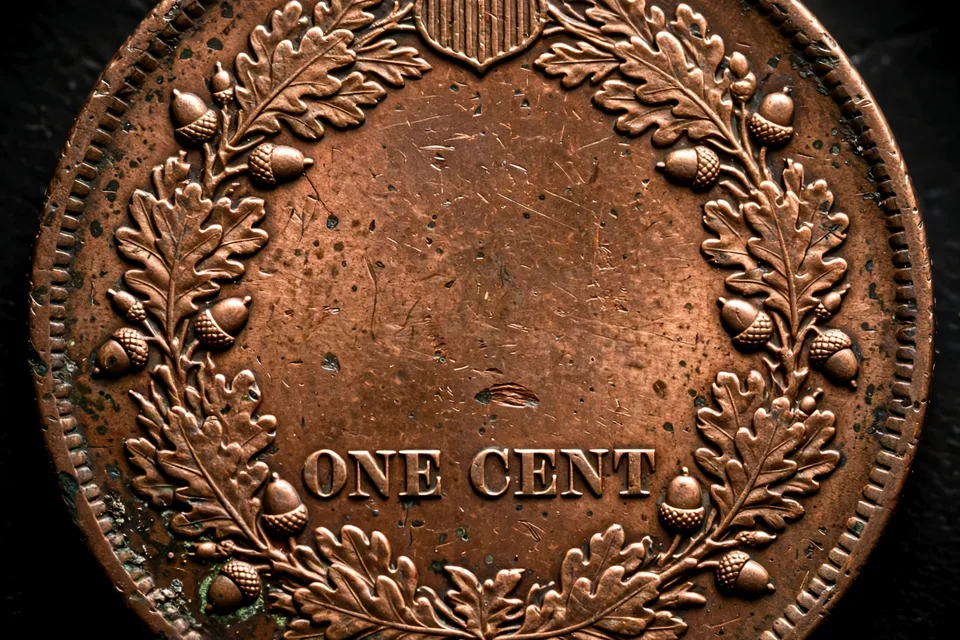
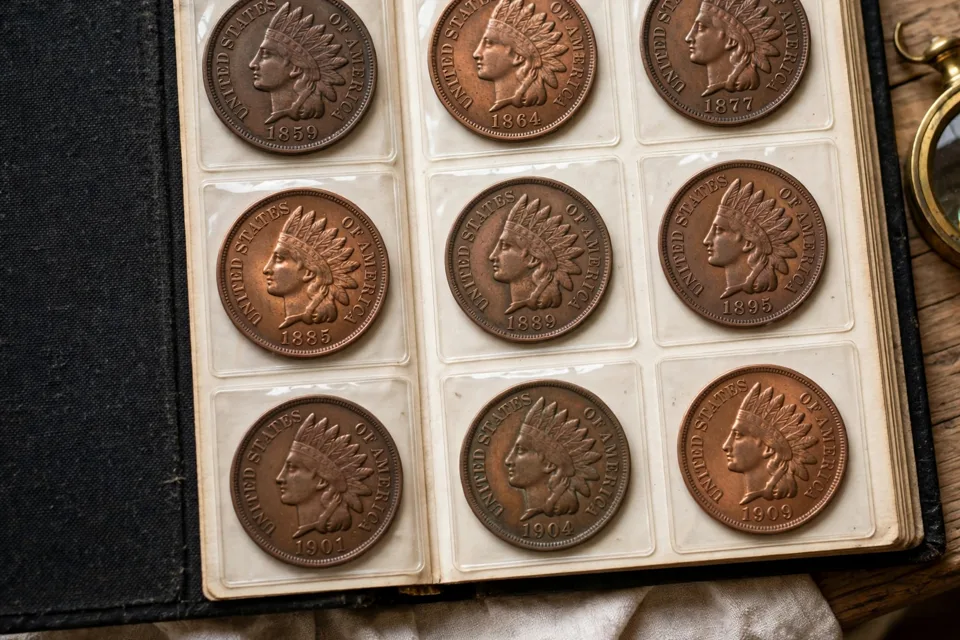
Start with the portrait. Liberty faces left in a Native American headdress, and on a genuine 1877 the feather tips, the headdress band, and the L on the ribbon behind her neck should read the way they do on any sharp bronze Indian cent. The reverse shows the oak wreath with a shield at the top and ONE CENT at the centre, with no mint mark — Philadelphia struck every Indian cent until 1908.
Then read the colour. Bronze Indian cents grade as Red, Red-Brown, or Brown, and colour is the biggest value driver after grade itself on this coin — the record coin is Red, and a Brown coin in the same technical grade is worth a fraction of it. Original surfaces matter more than brightness: a coin that looks bright pink or orange has likely been cleaned, and cleaning strips the very originality that makes a high-grade 1877 valuable. Handle it by the edges, keep it in an acid-free holder, and let the colour do the talking.
The coin at a glance
Designer James B. Longacre. Struck 1877 at Philadelphia only. Composition bronze, 95 percent copper with 5 percent tin and zinc. Weight 3.11 grams, diameter 19 millimetres, plain edge. Obverse: Liberty in a Native American headdress, date below, Longacre's L on the ribbon behind her neck. Reverse: oak wreath with a shield at the top, ONE CENT at the centre, no mint mark. Mintage 852,500 — the lowest of any Philadelphia Indian cent. Metal floor: —. A copper cent carries no precious-metal floor, so the live system shows no melt figure for this coin — its worth is collector value alone.
The 1877 is the date the whole Indian Head series is measured against. It is the lowest mintage, the highest record, and the most counterfeited — three facts that belong together, because a coin only gets faked this much when it is worth faking. Learn the date, learn the weight, and never accept one without certification.
What an 1877 is worth by grade
The figures below are our researched collector estimates from the live guide, reviewed November 5, 2026. One grade — About Uncirculated — has not been researched yet and shows “—”, not a guess. The table runs from $575–$1,028 in Good to $19,200–$26,400 in MS-65.
| Grade | Estimated value |
|---|---|
| Good (G-4) | $575–$1,028 |
| Fine (F-12) | $1,175–$1,500 |
| Extremely Fine (XF-40) | $2,600–$2,810 |
| About Uncirculated (AU-50) | — |
| Mint State 60 (MS-60) | $4,850–$5,220 |
| Mint State 65 (MS-65) | $19,200–$26,400 |
Verified auction records
One verified result sits at the top of the 1877 market — the highest figure for any Indian Head cent in our series guide.
| Coin | Grade | Sale | Price |
|---|---|---|---|
| 1877 Indian Head cent | MS66+ Red CAC | GreatCollections, November 2023 | $340,875 |
Latest reported results for this coin
Checking for newly reported results…
Your 1877 Indian Head questions, answered
How much is an 1877 Indian Head cent worth?
The table above carries our researched estimates, reviewed November 5, 2026: $575–$1,028 in Good, $1,175–$1,500 in Fine, $2,600–$2,810 in Extremely Fine, $4,850–$5,220 in MS-60, and $19,200–$26,400 in MS-65. Worn examples start around $900+, and the finest recorded example reached $340,875 at GreatCollections in November 2023.
Why is the 1877 Indian Head cent so valuable?
Mintage. Only 852,500 were struck — the lowest of any Philadelphia Indian cent — in a depression year when the Mint barely struck cents. A series collected by date needs one of every year, and there were fewer than a million 1877 cents to go around. It was recognised as the rarity of the set almost from the day it was struck.
How can I tell a real 1877 from a fake?
Check the date under a loupe: genuine digits are level, evenly struck, and the same depth, with a correctly shaped 7. Reworked dates show tool marks or a digit at the wrong depth. Then weigh the coin — a genuine 1877 is bronze at 3.11 grams. Any 1877 that is not certified should be treated as guilty until proven genuine.
What is the highest figure an 1877 Indian Head cent has reached?
The record is $340,875 for a PCGS MS66+ Red example with CAC approval, at GreatCollections in November 2023. It is the highest verified figure for any Indian Head cent in our series guide, ahead of the finest 1864-L proof at $161,000 and the finest 1909-S at $97,750.
Is the 1877 the rarest Indian Head cent?
It is the lowest-mintage Philadelphia date and the most famous key of the series, but the San Francisco pair — 1908-S at 1,115,000 and 1909-S at 309,000 — are scarcer by mintage in the case of the 1909-S. The 1877 is the king because of its mintage, its record, and its place as the set's recognised rarity since the day it was struck.
Check your 1877 Indian Head cent
Run the date through the free Coin Value Checker for an instant estimate, or get a Grade-or-Not verdict on whether your coin is worth certifying. The full series guide is here: Indian Head Penny Values by Date: $2 to $340,875+. Compare the other scarce bronze dates — the 1872 Indian Head cent and the 1873 Doubled LIBERTY cent.
This guide is written to help collectors recognise the 1877 Indian Head cent — its mintage, its record, and its counterfeits — for themselves; it is educational reference, and any individual coin should be confirmed by a professional before a decision rests on it.