Coin Encyclopedia: 152 U.S. Coin Profiles
Coin Encyclopedia · 152 profiles · Published November 7, 2026
Every coin in this encyclopedia has its own profile — the date and mint mark, the mintage, the grade-by-grade figures from our own guide, the live silver or gold floor, and the verified auction records behind the famous examples. There are 152 profiles here, from the 1856 Flying Eagle cent to the 1933 Saint-Gaudens double eagle, grouped by denomination and series below. Start with the coin in your hand: find its series, open its profile, and run it through the Coin Value Checker for an instant estimate.
Two things to know before you browse. First, the numbers on every profile update live — grade values come from our Worker and the silver and gold floors move with the live spot, so a profile never goes stale while you read it. Second, a dash (—) is an honest gap, not a zero: it means our November 2026 review holds no researched figure for that grade yet, and none was invented to fill the space. Figures are collector estimates, never financial advice — the full method is on the Methodology page.
Cents
Flying Eagle Cent (1856–1858)
The Flying Eagle cent ran only three years, and the 1856 was a pattern barely released — which is why it leads every want list. The eagle in flight, borrowed from the Gobrecht dollar, lasted until the Indian Head took over in 1859.
- 1856 Flying Eagle Cent — Transition issue
- 1857 Flying Eagle Cent — First circulation year
- 1858 Flying Eagle Cent — Large and small letters
Indian Head Cent (1866–1909)
The Indian Head cent carried the same portrait for half a century, from the Civil War years to the first Lincoln cents. Key dates hide in plain sight — the 1877, the 1908-S, and the 1909-S that closed the series.
- 1866 Indian Head Cent — Bronze
- 1872 Indian Head Cent — Bronze
- 1873 Indian Head Cent — Doubled LIBERTY variety
- 1877 Indian Head Cent — Philadelphia key
- 1908-S Indian Head Cent — First S-mint cent
- 1909-S Indian Head Cent — Final year
Lincoln Cent (1909–1995)
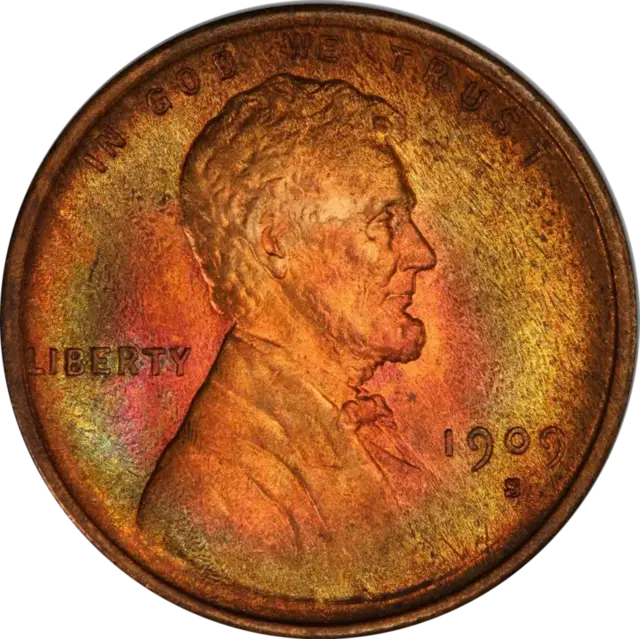
The Lincoln cent is the coin most Americans have actually held, and its key dates are the most hunted in the hobby — doubled dies, low mintages, and the 1909-S VDB that started it all. Ninety years of wheat and memorial cents, one profile at a time.
- 1909 Lincoln Cent — VDB reverse
- 1909-S Lincoln Cent — No VDB
- 1909-S Lincoln Cent — VDB reverse
- 1911-S Lincoln Cent — Wheat reverse
- 1914-D Lincoln Cent — Wheat reverse
- 1922-D Lincoln Cent — Weak D / No D varieties
- 1924-D Lincoln Cent — Wheat reverse
- 1931-S Lincoln Cent — Wheat reverse
- 1955 Lincoln Cent — Doubled-die obverse
- 1969-S Lincoln Cent — Doubled-die obverse
- 1972 Lincoln Cent — Doubled-die obverse
- 1982-D Lincoln Cent — Copper small date
- 1992 Lincoln Cent — Close AM reverse
- 1995 Lincoln Cent — Doubled-die obverse
Nickels
Buffalo Nickel (1913–1937)
James Earle Fraser's Buffalo nickel put a Native American portrait and an American bison on a five-cent piece — and the 1913 Type 1 to Type 2 change, the three-legged 1937-D, and the 1918/7-D overdate keep collectors checking every date.
- 1913-S Buffalo Nickel — Type 2
- 1914-D Buffalo Nickel — Denver
- 1918-D Buffalo Nickel — 1918/7-D overdate
- 1921-S Buffalo Nickel — San Francisco
- 1924-S Buffalo Nickel — San Francisco
- 1926-S Buffalo Nickel — San Francisco key
- 1937-D Buffalo Nickel — Three-legged variety
Jefferson Nickel (1938–1950)
The Jefferson nickel replaced the Buffalo in 1938 and has run ever since. The early years hold the keys — the 1939-D, the 1950-D, and the wartime silver 1943 that collectors still pull from circulation.
- 1938-D Jefferson Nickel — First year
- 1938-S Jefferson Nickel — First year
- 1939-D Jefferson Nickel — Denver
- 1943 Jefferson Nickel — Wartime silver
- 1950-D Jefferson Nickel — Denver key
Half Dimes
Seated Liberty Half Dime (1853–1867)
The smallest silver coin of the Seated Liberty series — fifteen and a half millimetres of 90% silver. Arrows beside the date mark the 1853 weight cut; the legend obverse of 1860 finished the design.
Dimes
Barber Dime (1894–1901)
Charles Barber's Liberty Head dime is a short, sharp series: the 1894-S, struck just 24 times, is the most valuable dime in American numismatics. The other keys are quieter — low-mintage New Orleans and San Francisco dates.
- 1894-S Barber Dime — San Francisco rarity
- 1895-O Barber Dime — New Orleans key
- 1901-S Barber Dime — San Francisco
Mercury Dime (1916–1945)
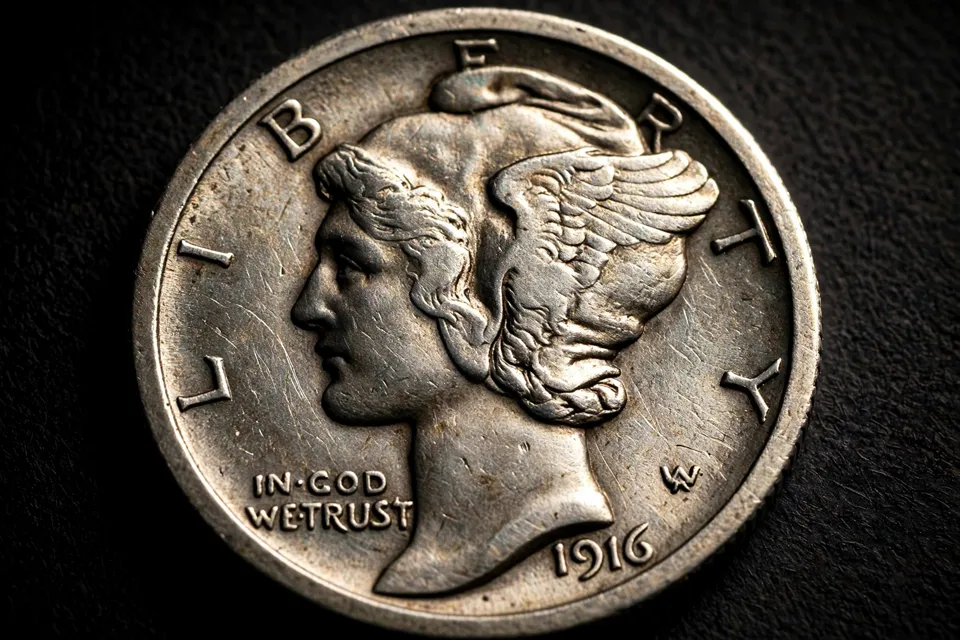
Adolph Weinman's Winged Liberty is the dime most collectors picture first — and the 1916-D is the key date that defines the whole series. Full Bands, overdates, and the 1942/1 are the details that separate a common dime from a great one.
- 1916-D Mercury Dime — Denver key
- 1921 Mercury Dime — Philadelphia
- 1921-D Mercury Dime — Denver
- 1926-S Mercury Dime — San Francisco
- 1931-D Mercury Dime — Denver
- 1942 Mercury Dime — 1942/1 overdate
- 1945 Mercury Dime — Final year
Roosevelt Dime (1949–1996)
The Roosevelt dime has been pocket change since 1946, but its silver years hold real keys — the 1949-S, the 1955 with the lowest mintage of the series, and the 1996-W struck only for mint sets.
- 1949 Roosevelt Dime — Silver
- 1949-S Roosevelt Dime — Silver
- 1950-S Roosevelt Dime — Silver
- 1955 Roosevelt Dime — Silver
- 1982 Roosevelt Dime — No-P variety
- 1996-W Roosevelt Dime — West Point
Seated Liberty Dime (1844–1873)
Seated Liberty dimes ran for nearly forty years, and the branch-mint keys — above all the Carson City dates — are the ones that make the series. Three profiles here, each a different corner of the same long run.
- 1844 Seated Liberty Dime — Little Orphan Annie
- 1871-CC Seated Liberty Dime — Carson City
- 1873-CC Seated Liberty Dime — Arrows
Quarters
Barber Quarter (1896–1913)
The Barber quarter is the toughest of the three Barber denominations to complete in high grade. The 1896-S, 1901-S, and 1913-S are the keys, and even common dates are scarce with full detail.
- 1896-S Barber Quarter — San Francisco key
- 1901-S Barber Quarter — San Francisco key
- 1913-S Barber Quarter — San Francisco key
Seated Liberty Quarter (1842–1873)
Seated Liberty quarters are the workhorses of the series — long-running, widely collected, and quietly scarce in high grade. The Carson City dates are the ones that stop collectors in their tracks.
- 1842-O Seated Liberty Quarter — Small date
- 1870-CC Seated Liberty Quarter — Carson City
- 1873-CC Seated Liberty Quarter — No arrows
Standing Liberty Quarter (1916–1927)
Hermon MacNeil's Standing Liberty is the most beautiful quarter America ever struck — and the 1916, with its bare-breasted first design, is the series key. Full Head examples are the standard every collector chases.
- 1916 Standing Liberty Quarter — Type 1
- 1917-S Standing Liberty Quarter — Type 1
- 1918-S Standing Liberty Quarter — 1918/7-S overdate
- 1921 Standing Liberty Quarter — Philadelphia
- 1923-S Standing Liberty Quarter — San Francisco
- 1927-S Standing Liberty Quarter — San Francisco
Washington Quarter (1932–1950)
The Washington quarter began as a one-year bicentennial issue in 1932 and never left. The 1932-D and 1932-S are the keys; the 1937-D doubled die is the variety that rewards a careful eye.
- 1932-D Washington Quarter — Denver key
- 1932-S Washington Quarter — San Francisco key
- 1936-D Washington Quarter — Denver
- 1937-D Washington Quarter — Doubled-die obverse
- 1940-D Washington Quarter — Denver
- 1950-D Washington Quarter — D/S overmintmark
- 1950-S Washington Quarter — S/D overmintmark
Half Dollars
Barber Half (1892–1915)
The Barber half is the Liberty Head half dollar, struck for nearly a quarter century. The 1892-O Micro O — a quarter-dollar punch used on a half-dollar die — is the series crown jewel.
- 1892-O Barber Half — Micro O variety
- 1893-S Barber Half — San Francisco
- 1914 Barber Half — Philadelphia key
- 1915 Barber Half — Final year
Franklin Half (1949–1963)
The Franklin half is the last silver half dollar struck for circulation in quantity, and the shortest complete series to collect. Full Bell Lines separate the common from the choice, and the 1955 Bugs Bunny is the variety everyone looks for.
- 1949-S Franklin Half — San Francisco
- 1953-S Franklin Half — San Francisco
- 1955 Franklin Half — Philadelphia
- 1961 Franklin Half — Doubled-die reverse
- 1963 Franklin Half — Final year
Kennedy Half (1964–1998)
The Kennedy half began in 1964, months after the assassination, in 90% silver — and it is still struck today. The 1964 Accented Hair, the 1970-D, and the 1998-S matte proof are the dates that matter.
- 1964 Kennedy Half — 90% silver
- 1964-D Kennedy Half — 90% silver
- 1970-D Kennedy Half — 40% silver
- 1987 Kennedy Half — Mint Set issue
- 1998-S Kennedy Half — Matte finish
Seated Liberty Half (1855–1878)
Seated Liberty halves are big silver coins with a long, quiet run — and the Carson City dates are the ones with stories attached. The 1870-CC and 1878-CC are the keys of this small group.
- 1855-S Seated Liberty Half — Arrows
- 1870-CC Seated Liberty Half — Carson City
- 1878-CC Seated Liberty Half — Final CC half
Walking Liberty Half (1916–1938)
Adolph Weinman's Walking Liberty is the half dollar that became the Silver Eagle's obverse. The 1921 issues are the keys, and the 1916-S and 1938-D are the dates that complete a set.
- 1916 Walking Liberty Half — First year
- 1916-S Walking Liberty Half — First year
- 1917-S Walking Liberty Half — Obverse mint mark
- 1919-D Walking Liberty Half — Denver
- 1921 Walking Liberty Half — Philadelphia key
- 1921-D Walking Liberty Half — Denver key
- 1921-S Walking Liberty Half — San Francisco key
- 1938-D Walking Liberty Half — Denver semi-key
Silver Dollars
Morgan Dollar (1878–1921)
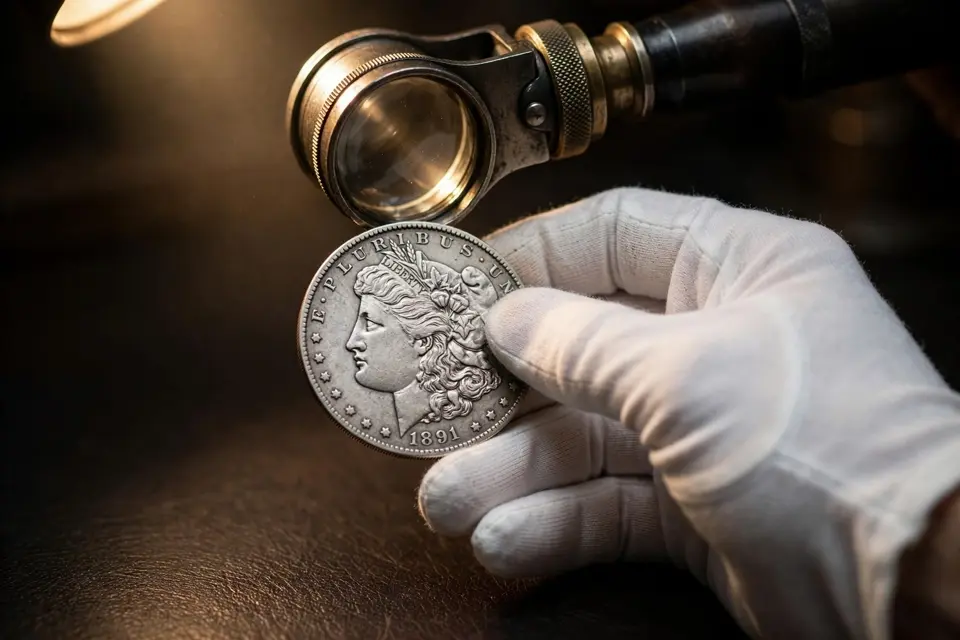
The Morgan dollar is the most collected coin in American numismatics — dozens of dates and mints, Carson City keys, and the 1921 that closed the series. Eighteen profiles here, from the first Carson City strikes to the final year.
- 1878-S Morgan Dollar — First-year San Francisco
- 1878-CC Morgan Dollar — First-year Carson City
- 1879-CC Morgan Dollar — Clear CC / capped die
- 1880-CC Morgan Dollar — Carson City
- 1881-CC Morgan Dollar — Carson City
- 1883-S Morgan Dollar — San Francisco
- 1884-S Morgan Dollar — San Francisco
- 1885-CC Morgan Dollar — Carson City
- 1889-CC Morgan Dollar — Carson City
- 1892-S Morgan Dollar — San Francisco
- 1893-S Morgan Dollar — San Francisco key
- 1893-CC Morgan Dollar — Final CC Morgan
- 1894 Morgan Dollar — Philadelphia key
- 1895-S Morgan Dollar — San Francisco
- 1895-O Morgan Dollar — New Orleans
- 1903-O Morgan Dollar — New Orleans
- 1904-S Morgan Dollar — San Francisco
- 1921-D Morgan Dollar — Final-year Denver
Peace Dollar (1921–1935)
The Peace dollar was struck to mark the end of the First World War, and its high-relief first year is one of the great designs of the century. The 1928 is the key date — the lowest mintage of any Peace dollar ever struck.
- 1921 Peace Dollar — High relief
- 1924-S Peace Dollar — San Francisco
- 1927-D Peace Dollar — Denver
- 1927-S Peace Dollar — San Francisco
- 1928 Peace Dollar — Philadelphia key
- 1928-S Peace Dollar — San Francisco
- 1934-S Peace Dollar — San Francisco
- 1935-S Peace Dollar — Final-year San Francisco
Seated Liberty Dollar (1851–1852)
The Seated Liberty dollar of 1851 and 1852 is a two-year whisper — just 1,300 and 1,100 struck, the rarest regular-issue silver dollars of the 1850s. Both profiles here are among the scarcest coins in this encyclopedia.
Gold Dollars
Gold Dollar (1849–1856)
The gold dollar is the smallest gold coin America ever struck — thirteen millimetres of 90% gold. The 1849-C is the first Charlotte gold dollar, and the branch-mint dates are the ones that carry the premiums.
- 1849-C Gold Dollar — Open wreath
- 1854-D Gold Dollar — Type 2
- 1855-O Gold Dollar — Type 2
- 1856-S Gold Dollar — Type 2
Quarter Eagles ($2.50 Gold)
Indian Quarter Eagle (1911–1926)
Bela Lyon Pratt's Indian quarter eagle is the only U.S. coin with an incuse design — the devices sunk into the field instead of raised. The 1911-D is the key; the 1926-D is the scarce late date.
Liberty Quarter Eagle (1848–1854)
The Liberty quarter eagle is the $2.50 gold piece that carried the Coronet design through the Gold Rush years. Two profiles here: the 1848 and the 1854-S, the first San Francisco quarter eagle.
- 1848 Liberty Quarter Eagle — CAL. counterstamp
- 1854-S Liberty Quarter Eagle — First-year San Francisco
Half Eagles ($5 Gold)
Indian Half Eagle (1909–1929)
The Indian half eagle is Pratt's incuse design at five dollars — and the 1909-O is the key, the only New Orleans Indian half eagle ever struck. The 1929 is the final year, struck just before the Depression ended the series.
Liberty Half Eagle (1838–1854)
The Liberty half eagle carried the Coronet design for seventy years. The 1838-C is the first Charlotte half eagle, and the 1854-S is the first San Francisco half eagle — two firsts in two profiles.
Eagles ($10 Gold)
Indian Eagle (1907–1933)
Augustus Saint-Gaudens' Indian eagle is the ten-dollar counterpart to the double eagle — and the 1933 is the final year, struck as the gold standard ended. The 1907 is the first year of the design.
Liberty Eagle (1870–1883)
The Liberty eagle is the ten-dollar gold piece that financed the Gilded Age. The 1870-CC and 1883-O are the Carson City and New Orleans keys of this pair.
Double Eagles ($20 Gold)
Liberty Double Eagle (1854–1879)
The Liberty double eagle is the twenty-dollar gold piece of the Gold Rush and the Civil War — the largest regular gold coin of its day. The 1854-O, 1870-CC, and 1879-O are three very different corners of the same series.
- 1854-O Liberty Double Eagle — New Orleans
- 1870-CC Liberty Double Eagle — Carson City
- 1879-O Liberty Double Eagle — New Orleans
Saint-Gaudens Double Eagle (1907–1933)
The Saint-Gaudens double eagle is the most beautiful coin America ever struck — and the 1933 is the most famous coin in the world. The 1927-D is the rarest regular issue of the series.
- 1907 Saint-Gaudens Double Eagle — High relief
- 1921 Saint-Gaudens Double Eagle — Philadelphia
- 1927-D Saint-Gaudens Double Eagle — Denver rarity
- 1930-S Saint-Gaudens Double Eagle — San Francisco
- 1933 Saint-Gaudens Double Eagle — Restricted issue
Values are estimates, not financial advice. This encyclopedia is for education — learn the coin first, and get a professional opinion before buying or selling.